



Prenup for Business Owners: Protect Your Company

Every business owner getting married should have a prenuptial agreement. Not because the marriage is likely to fail, but because without one, your company’s fate in a divorce is decided by default state law — and those defaults were not written with your investors, your employees, or your cap table in mind. A well-drafted prenup for business owners defines separate property, sets valuation rules, and handles appreciation before a court ever has to guess, as Forbes confirms in its business owner prenup guide.
Here is where to start right now:
- Gather your formation documents. Pull your articles of incorporation or LLC operating agreement, cap table, shareholder agreements, and the last two years of business tax returns.
- Schedule a baseline valuation. Even a preliminary figure from a CPA or certified business appraiser gives your attorney something concrete to work with.
- Consult a family law attorney early. Both you and your future spouse need independent counsel. One lawyer cannot represent both of you.
- Exchange full financial disclosures. Courts look hard at whether both parties knew what they were signing away. Incomplete disclosure is the fastest way to get a prenup thrown out.
- Sign well before the wedding. Aim for at least 30–60 days before the ceremony. Presenting an agreement the week before the wedding invites a later claim of coercion, as Disso’s prenup timing guidance makes clear.
Key Takeaways
A prenup for business owners is enforceable only when it combines full financial disclosure, independent counsel for both parties, and specific clause language covering valuation, appreciation, and debt — not just a general separate-property declaration.
| Point | Details |
|---|---|
| Get a prenup early | Sign at least 30–60 days before the wedding to avoid any claim of coercion or duress. |
| Address appreciation and valuation | Fix the valuation method, baseline date, and appreciation treatment in writing — vague language invites disputes. |
| Full disclosure is mandatory | Both parties must disclose all assets and liabilities; incomplete disclosure is the most common reason courts invalidate prenups. |
| Coordinate with corporate documents | Align prenup language with shareholder agreements, buy-sell provisions, and investor side letters before signing. |
| Highdesertfamilylawgroup | The firm drafts business-owner prenups in Scottsdale, coordinating with CPAs and corporate counsel for agreements that hold up. |
Table of Contents
- Why business owners have unique prenup needs
- Checklist of vital prenup clauses business owners need
- How to classify and document business ownership and contributions
- Addressing business appreciation and valuation: methods and clause patterns
- How salary, owner draws, and distributions should be handled
- Debt allocation and business liabilities
- What a prenup cannot do and legal limits to watch for
- How to make sure your prenup is enforceable
- Practical next steps, timeline, and estimated costs
- What most business owners get wrong about prenups
- How Highdesertfamilylawgroup supports business owners before marriage
- Sources
Why business owners have unique prenup needs
A standard prenup protects personal assets. A prenup for business owners has to protect something far more complicated: an entity with employees, debt, investors, contracts, and a value that changes every quarter.
When a marriage ends without a prenup, courts in most states treat business appreciation that occurred during the marriage as marital property, even if you founded the company before the wedding. That means your spouse may be entitled to a share of growth you built through years of 70-hour weeks. In community property states like Arizona, the default rules are especially aggressive about treating income and assets acquired during marriage as jointly owned. You can read how those rules play out locally in High Desert’s guide to Arizona community property.
The stakes go beyond the two of you. If a divorce forces a sale or a court-ordered buyout, investors may have approval rights that get triggered. Co-founders may suddenly find their partner’s ownership stake encumbered by a divorce proceeding. Employees watch ownership battles unfold and wonder whether the company survives. Drafting a prenup as part of business-continuity planning — not just personal asset protection — reframes it as a responsible governance step, one that protects the people who depend on the company as much as it protects you.
Checklist of vital prenup clauses business owners need
Neptune’s prenup planning guide makes the point plainly: naming a business as separate property is only the starting point. The real protection comes from the clauses that follow. Here is what a business-owner prenup should include, and why each clause earns its place:
- Separate property identification. Name the business explicitly, including its legal entity name, EIN, and formation date. Attach the cap table as an exhibit.
- Appreciation treatment. Specify whether passive appreciation (market-driven growth) stays separate, and whether active appreciation (growth tied to your labor during the marriage) triggers any reimbursement or formula share.
- Valuation method and date. Fix the method (book value, agreed formula, or neutral appraiser) and the baseline date. Without this, every dispute becomes a battle of competing experts.
- Buyout formula. If a divorce occurs, the agreement should define how the business interest is priced and paid out — installments, a lump sum, or a right of first refusal.
- Income and distributions. Decide whether your salary is marital income, whether owner draws are separate, and how retained earnings are treated.
- Management and control. Confirm that the non-owner spouse has no operational role or voting rights, and that divorce proceedings cannot trigger a forced management change.
- Confidentiality. Protect trade secrets, client lists, and financial data from disclosure in any divorce proceeding.
- Debt allocation. Assign responsibility for pre-marriage business debt and any loans or personal guarantees taken during the marriage.
- Dispute resolution. Specify mediation or arbitration before litigation. This keeps valuation disputes out of open court and away from competitors’ eyes. Mediation vs. arbitration in divorce explains the tradeoffs between these paths.
- Spousal support waiver or cap. Where permitted by local law, set a limit or waiver on spousal support tied to the business’s performance.
Pro Tip: Prefer objective, formulaic language over vague phrases like “fair market value as agreed by the parties.” A fixed formula, a named appraiser panel, or a cap tied to a multiple of EBITDA gives both sides a clear answer without requiring a new negotiation at the worst possible moment.
Roupas Law’s breakdown of business-owner prenup clauses confirms that these clause categories are the ones most frequently contested in business-related divorce proceedings.
How to classify and document business ownership and contributions
The prenup is only as strong as the paper trail behind it. Courts evaluating a separate-property claim want to see that the business was clearly yours before the marriage and that marital funds did not quietly become entangled with it. The following documents build that story:
| Document | Why It Matters |
|---|---|
| Articles of incorporation / LLC operating agreement | Establishes entity formation date and original ownership structure |
| Cap table (current and historical) | Shows your ownership percentage and any dilution events |
| Shareholder or member agreements | Defines transfer restrictions and buy-sell triggers already in place |
| Business tax returns (2–3 years) | Provides baseline revenue, income, and asset figures for valuation |
| Balance sheets and P&L statements | Supports the valuation baseline and tracks retained earnings |
| IP assignment agreements | Confirms that patents, trademarks, and trade secrets belong to the entity, not you personally |
| Loan and personal guarantee documents | Identifies pre-marriage debt obligations and any personal exposure |
| Payroll records | Distinguishes your salary from business distributions |
| Bank statements (business accounts) | Demonstrates separation of business and personal funds |
Once you have these documents, coordinate with your corporate counsel to confirm the prenup language does not conflict with existing shareholder agreements or investor side letters. Some investor agreements include change-of-control or encumbrance provisions that could be triggered by a divorce. Notifying key stakeholders early, where your agreements require it, prevents a surprise later.
Addressing business appreciation and valuation: methods and clause patterns
Valuation is where most business-owner prenups either hold up or fall apart. The Gruv prenup guide for entrepreneurs recommends fixing both the method and the date in writing, because leaving either open invites competing expert testimony years later.
| Method | Best Fit | Key Tradeoff |
|---|---|---|
| Book value | Asset-heavy businesses (real estate, equipment) | Often understates true value; easy to calculate |
| Agreed formula (e.g., 3× EBITDA) | Stable, cash-flow businesses | Simple and fast; may not reflect market conditions at divorce |
| Fixed-date fair market value | Most businesses at signing | Requires a real appraisal upfront; clear baseline |
| Neutral appraiser panel | Complex or high-growth companies | Most accurate; most expensive and time-consuming |
For appreciation specifically, you have three main paths. First, passive appreciation stays entirely separate — growth driven by market forces, not your labor. Second, active appreciation triggers a reimbursement formula: the non-owner spouse receives a defined percentage of growth attributable to marital effort, often capped. Third, a buyout option lets you purchase the marital interest at a formula price within a set window after divorce.
Neutral valuation triggers — a named appraiser, a tied formula with a cap — reduce disputes compared with open-ended language, as Neptune’s planning guide notes. The worst outcome is an agreement that says “fair market value” with no method, no appraiser, and no date. That language hands the dispute to dueling experts and a judge.
How salary, owner draws, and distributions should be handled
How you pay yourself through the business has direct consequences for what counts as marital property. The prenup needs to address each payment type separately:
- Salary treated as marital income. The most common approach: your W-2 salary flows into the marital estate, and savings built from it are shared. Clean and simple, but it means the marital estate grows with your compensation.
- Owner draws classified as separate. If draws come from pre-marriage retained earnings, the prenup can classify them as separate. This requires clean bookkeeping to hold up.
- Distributions split by formula. A hybrid rule: distributions above a defined threshold stay separate; amounts below go into the marital pool.
- Retained earnings stay with the entity. Profits left inside the business and not distributed can be designated as separate property of the entity, not personal marital income.
Pro Tip: Before finalizing any compensation clause, have your CPA review the language. A clause that reclassifies distributions as separate property could affect your S-corp election or create phantom income issues. Tax consequences and prenup language need to be aligned, not drafted in isolation.
The spousal support implications matter too. If your salary is marital income and the marriage ends, a court calculating support will look at that salary figure. A prenup can cap support or set a formula, but it cannot waive it entirely in ways that leave your spouse destitute — more on that in the limits section below.
Debt allocation and business liabilities
Business debt is often personal debt in disguise. Many small-business owners have personally guaranteed loans, lines of credit, or equipment leases. A prenup that ignores this leaves your spouse potentially exposed to obligations they never agreed to take on.
Cover these points explicitly:
- Pre-marriage business debt. State that all debt existing at the time of the agreement is the owner-spouse’s sole responsibility, with an indemnity and hold-harmless clause protecting the non-owner spouse from creditor claims.
- Loans taken during marriage. Decide in advance whether business loans taken during the marriage are marital debt (both parties responsible) or separate (owner-spouse only). The answer often depends on whether marital funds were used as collateral.
- Personal guarantees. If you sign a personal guarantee during the marriage, the prenup should specify whether the non-owner spouse shares that exposure. Lenders are not bound by your prenup, but the agreement can require indemnification between spouses.
- Future liabilities. Include a general indemnity clause covering business liabilities arising after the wedding, so a judgment against the business does not automatically become a claim against marital assets.
When refinancing or signing new guarantees during the marriage, revisit whether the prenup language still covers the new obligation. Some lenders require both spouses to sign guarantees regardless of a prenup — in those cases, the indemnity clause between spouses becomes the only protection.
What a prenup cannot do and legal limits to watch for
A prenup is powerful, but courts will not enforce everything. Knowing the limits keeps you from drafting clauses that give false confidence:
- Child custody and child support. No prenup can predetermine custody arrangements or waive child support. Courts decide both at the time of divorce based on the child’s best interests, period.
- Waivers that leave one spouse destitute. A complete waiver of spousal support may be unenforceable if it would leave the non-owner spouse on public assistance. Courts in many states will modify or void such provisions.
- Unconscionable terms. An agreement so one-sided that no reasonable person would have signed it voluntarily is vulnerable to challenge. Fairness in process matters as much as fairness in outcome.
- Provisions encouraging divorce. A clause that financially rewards either party for filing for divorce is void in most jurisdictions.
- Illegal waivers. You cannot waive rights that public policy prohibits waiving, regardless of what the agreement says.
Jurisdictional variance is real. What holds in one state may not hold in another, and if you move after signing, the enforceability analysis may shift. What a prenup protects explains the scope of protection in plain terms, and consulting local counsel before finalizing any clause is non-negotiable.
How to make sure your prenup is enforceable
A prenup that gets thrown out is worse than no prenup at all — it signals to a court that something went wrong in the process. The enforceability checklist is short, but every item on it is mandatory:
- Full financial disclosure. Both parties must disclose all assets, liabilities, income, and business interests before signing. Hiding a business interest or understating its value is grounds for invalidation.
- Independent legal counsel for each party. One attorney cannot represent both sides. Each party needs their own lawyer to review the agreement.
- Reasonable timing. Sign at least 30–60 days before the wedding. Last-minute agreements face a presumption of duress.
- Voluntary execution. No pressure, no ultimatums, no signing at the rehearsal dinner. Courts look at the circumstances of signing, not just the document itself.
- Proper execution formalities. Signatures, witnesses, and notarization requirements vary by state. Premarital agreement enforcement standards covers what courts look for when an agreement is challenged.
- Recordkeeping. Keep copies of all disclosure documents, valuation work, and attorney correspondence. If the agreement is ever challenged, this paper trail documents voluntariness and fairness.
The most common procedural failure is timing: an agreement handed to a future spouse days before the wedding, without counsel, without time to review. Courts see this pattern regularly and treat it as coercion. Give the process the same lead time you would give any significant business transaction.
Practical next steps, timeline, and estimated costs
Here is the roadmap from decision to signed agreement:
- Gather documents (Week 1–2): Pull entity formation docs, cap table, shareholder agreements, three years of tax returns, balance sheets, and any personal guarantee documents.
- Get a baseline valuation (Week 2–4): Engage a CPA or certified business appraiser for a preliminary valuation. Complex businesses may need a full formal appraisal.
- Retain a family law attorney (Week 2–3): Both parties hire independent counsel. Retaining a prenup lawyer explains what to look for and what to expect at the first meeting.
- Draft and negotiate (Week 4–8): Your attorney drafts; your future spouse’s attorney reviews and negotiates. Expect at least one round of revisions on business-specific clauses.
- Exchange formal disclosures (Week 6–8): Both parties provide signed financial disclosure statements. This step is not optional.
- Sign with proper formalities (at least 30 days before the wedding): Execute with witnesses or notarization as required by your state.
What to bring to the first consult:
- Cap table and operating or shareholder agreement
- Last two to three years of business and personal tax returns
- Most recent balance sheet and P&L
- Any existing buy-sell agreements or investor side letters
- A list of personal guarantees currently in effect
- A rough estimate of the business’s current value
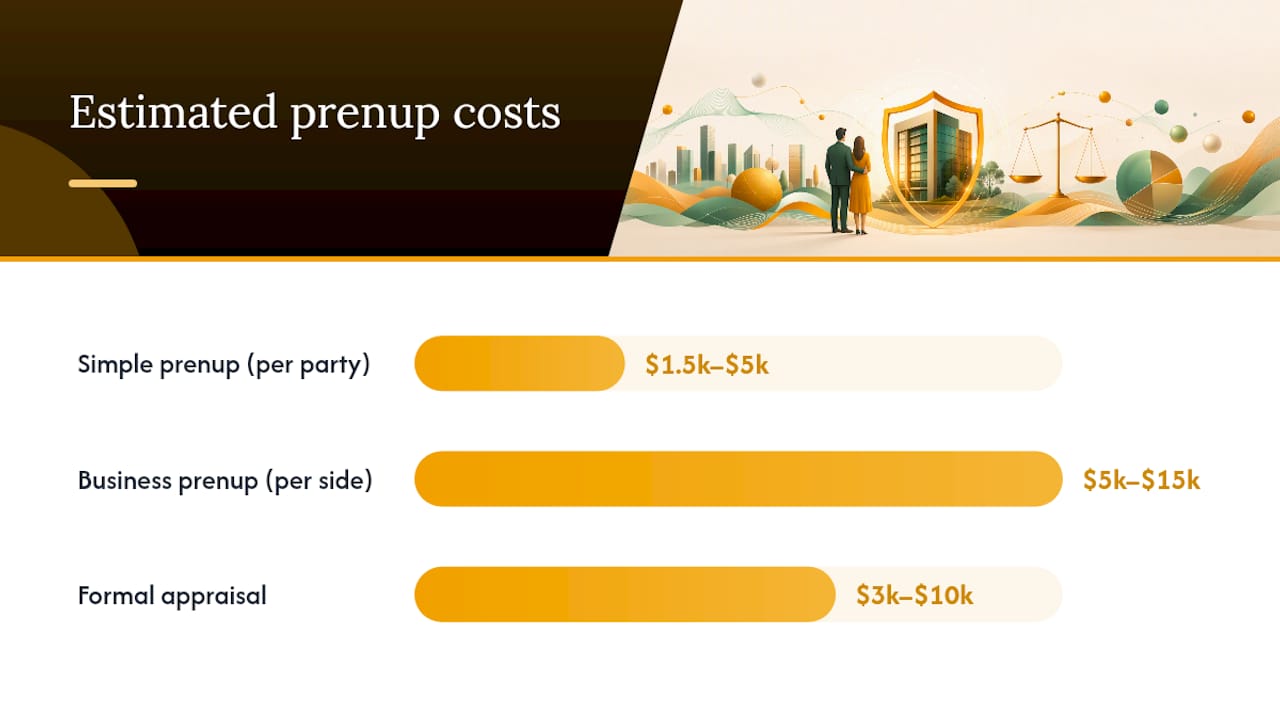
Cost ranges vary widely. Attorney fees for a straightforward prenup typically run $1,500–$5,000 per party. A business-owner prenup with valuation work and complex clause negotiation can run $5,000–$15,000 or more per side. A formal business appraisal adds $3,000–$10,000 depending on complexity. These are estimates; your attorney can give you a more precise range after reviewing your situation. For estate planning coordination alongside the prenup, budget additional time with an estate attorney.
What most business owners get wrong about prenups
The conventional wisdom says: “Name the business as separate property and you’re protected.” That advice is incomplete, and in practice it creates a false sense of security that can cost far more to fix than the prenup cost to draft.
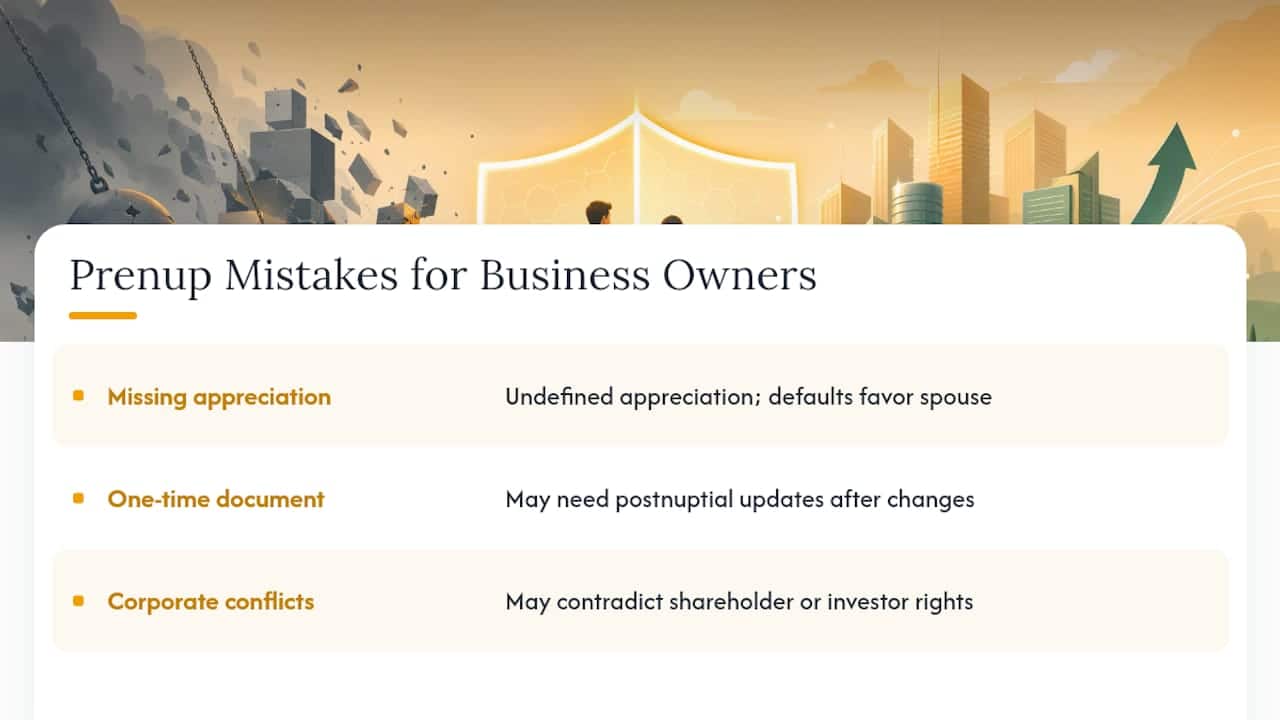
The gap is almost always in the appreciation language. A founder who names the business as separate property but says nothing about how growth is treated has left the most valuable part of the agreement blank. Courts in most states will then apply their default rules to that appreciation — and those defaults often favor the non-owner spouse, especially when the owner worked in the business throughout the marriage.
The second pitfall is treating the prenup as a one-time document. Businesses change. A company worth $500,000 at the wedding may be worth $8 million five years later. If the valuation method in the prenup no longer reflects how the business actually operates — or if you’ve added co-founders, taken on investors, or restructured the entity — the original language may not cover the new reality. Prenups can be amended by postnuptial agreement, and that option is worth revisiting whenever the business undergoes a significant structural change. Postnuptial vs. prenuptial agreement covers when an update makes sense.
The third mistake is drafting the prenup without coordinating with the business’s corporate documents. A prenup that conflicts with a shareholder agreement’s transfer restrictions, or that ignores an investor’s right of first refusal, creates a legal contradiction that neither document fully resolves.
How Highdesertfamilylawgroup supports business owners before marriage
Business owners in Scottsdale and across Arizona who need a prenup drafted with real attention to business-continuity concerns have a direct path forward with Highdesertfamilylawgroup. The firm brings over 20 years of family law experience to prenuptial and postnuptial agreements, working alongside your CPA and corporate counsel to make sure the agreement holds up — in court and in the boardroom.

Services relevant to business owners include prenuptial and postnuptial agreement drafting, valuation coordination, divorce mediation, and representation in contested proceedings where business interests are at stake. The firm also handles buy-sell agreement review and can coordinate with your existing corporate counsel to align the prenup with shareholder agreements and investor documents.
Schedule a consultation to bring your documents, your questions, and your timeline. The first conversation is the fastest way to understand exactly what your business needs and how long the process will take.
Sources
- The Business Owner’s Guide To Prenuptial Agreements
- How to Plan for Your Business in a Prenup as a Couple | Neptune Blog
- Prenuptial Agreement for Entrepreneurs: Asset Protection
This article provides general legal information, not legal advice. Laws vary by jurisdiction, and you should confirm current rules with a qualified family law attorney before signing any agreement.
This article is general information, not a substitute for advice from a qualified lawyer. Consult a qualified legal professional about your own circumstances before acting on anything here.