



Avoid $304–$349 Fees: Use A.R.S. §25-325 to Restore Name in Arizona

If you want your former name back, the fastest and least expensive way in Arizona is to request restoration in your divorce decree under A.R.S. § 25-325. If the decree already left it out, you fix that with a post-decree motion or, in rarer cases, a standalone name-change petition. Either way, update Social Security first, then the MVD, your passport, banks, and any professional licenses, and order several certified copies of the decree before you start.
TL;DR:
- Restoring your former name during divorce under A.R.S. § 25-325 costs nothing extra and is included in the final decree if requested upfront.
- An omitted name restoration can be fixed quickly with a post-decree motion in most cases, avoiding a new court case and extra publication costs.
- To ensure passport approval, the decree must specifically state the return to a former name using precise wording before signing the final order.
- Updating government IDs should start with Social Security, followed by the MVD, passport, banks, and employers, in that order, to prevent rejections.
- Filing a standalone petition to change to a new name involves higher costs, a hearing, and often publication, usually extending the process to three to five months.
Table of Contents
- Your legal options in Arizona: decree restoration, post-decree motion, or standalone petition
- Step-by-step checklist: getting your name changed and your documents updated
- If the decree didn’t restore your name: post-decree motion vs standalone petition
- How to update your IDs and records without getting bounced back
- Timeline and costs: what to expect (decree route vs standalone petition)
- When to hire an attorney and how High Desert Family Law Group can help
- What actually matters here, and what most guides skip
- How High Desert Family Law Group helps you fix a name-change problem the right way
- Where to check the official rules yourself
- Sources
Your legal options in Arizona: decree restoration, post-decree motion, or standalone petition
Arizona gives you three distinct paths depending on timing and what name you actually want, and the paperwork burden is not the same for any of them.
The cleanest path is A.R.S. § 25-325. The statute says the court “shall” restore a party’s former legal name if that party asks for it as part of the dissolution. There’s no separate filing fee, no publication, no extra hearing. It only restores a name you legally held before, like a maiden name. It cannot give you a brand new name you invented for the occasion.
If your decree already finalized without that language, a post-decree motion is usually the efficient fix, filed under your existing case number rather than a fresh lawsuit.
If you want a name that isn’t tied to any name you’ve legally held before, you need a standalone petition under A.R.S. § 12-601, which comes with a hearing and, in many counties, a publication requirement.
- Decree restoration: former legal name only, no added fee, built into your divorce.
- Post-decree motion: fixes an omission, uses your original case number.
- Standalone petition: any new name, requires a hearing and often publication.
Step-by-step checklist: getting your name changed and your documents updated
Follow this order and you’ll avoid the two most common headaches: agencies that reject a decree because the wording isn’t specific enough, and repeat trips to the courthouse for copies you should have ordered the first time.
- Ask for restoration during the divorce, not after. Tell your attorney or write it into your petition or response that you want your former name restored under A.R.S. § 25-325.
- Check the exact wording before the decree is signed. Federal passport regulations require the decree to specifically state that you’re returning to a former name. Vague language (“name changes are hereby granted”) can get rejected at the passport office months later.
- Order 3 to 4 certified copies of the signed decree the same week it’s finalized. Agencies frequently keep the copy you hand over, so one copy will not get you through every stop.
- Update Social Security first. Bring your certified decree and a completed application to your local SSA office.
- Move to Arizona MVD next, then your passport, then banks and lenders, then employer HR, licensing boards, and voter registration.
Pro Tip: Call ahead to any agency with an odd requirement, like a licensing board or a mortgage lender, before you show up. Some accept a photocopy; others want the certified original back in your hands the same day.
If the decree didn’t restore your name: post-decree motion vs standalone petition
An omitted restoration is fixable, but the two remedies differ enough in cost and speed that it’s worth knowing which one applies to you before you file anything.
- Post-decree motion: filed under your original case number, often by stipulation if your ex-spouse agrees, and typically cheaper than starting a new case from scratch.
- Standalone petition: required if you never held the name you want, or if the court won’t grant a motion to amend. Expect a hearing and, in many Arizona counties, a publication requirement.
- Where to start either one: your county Superior Court clerk’s office has the forms and can confirm local filing procedures, since requirements shift slightly county to county.
Ask the clerk specifically whether your county requires a hearing for an uncontested post-decree motion. Some don’t.
How to update your IDs and records without getting bounced back
Sequence isn’t a courtesy suggestion here. It’s the difference between one smooth pass through five agencies and five separate trips to the same office.
- Social Security Administration: first stop, always. Bring the certified decree and your completed application. Most other agencies check your identity against SSA records, so updating out of order causes rejected DMV and bank applications.
- Arizona MVD: bring your updated Social Security card, the certified decree, and your current license. If you’re getting a Real ID, budget extra time for the additional document verification.
- U.S. Passport: the decree must meet the 22 CFR 51.25 wording standard. Depending on how recently your current passport was issued, you’ll file Form DS-5504, DS-82, or a full DS-11 application.
- Banks, lenders, and employer HR: most want your updated Social Security card plus the certified decree.
- Professional licensing boards: check each board’s deadline for reporting a name change. Missing a short notice window can complicate a renewal.
- Voter registration and property deeds: update these once your identification is settled, since both typically ask for matching ID.
Skipping the SSA step first is the single most common reason people get turned away at the MVD counter.
Timeline and costs: what to expect (decree route vs standalone petition)
Money and time both favor doing this inside the divorce.
An uncontested divorce with restoration built in typically reaches a final decree in about two to three months, plus a few additional weeks while you work through agency updates one by one. A standalone petition runs longer and costs more everywhere along the way.
| Route | Filing fees | Extra costs | Typical total timeline |
|---|---|---|---|
| Decree restoration (A.R.S. § 25-325) | None beyond divorce filing fees | None | 60 to 90 days for decree, plus agency updates |
| Standalone petition (A.R.S. § 12-601) | $304 to $349 | Publication: $50 to $150 | About 3 to 5 months |
The publication requirement is usually what stretches a standalone petition out. Court dockets and newspaper publication schedules rarely line up as fast as you’d like, and bundling restoration into your decree sidesteps that entirely.
When to hire an attorney and how High Desert Family Law Group can help
Some name-change scenarios are simple enough to handle with a court self-help packet. Others aren’t, and the cost of getting it wrong is a second round of paperwork.
Talk to a family law attorney if your divorce is contested, if you’re also untangling jointly titled property or deeds that need to match your new name, if your decree already missed the restoration language, or if you have safety concerns about a public name-change publication notice.
High Desert Family Law Group has handled thousands of Arizona family law cases over more than 20 years, including collaborative and uncontested divorces where a clean restoration request in the original decree saved clients a second filing entirely. The firm also handles post-decree motions for clients whose decree left the restoration language out.
- Bring your current decree (or draft), a government ID, and any correspondence from agencies that rejected your paperwork.
- Ask directly whether your case needs a motion or a full petition. The answer changes your cost and timeline.
What actually matters here, and what most guides skip
Most articles on this topic treat name restoration as a footnote buried at the end of divorce advice, something you’ll “handle later.” That’s backwards. The cheapest and fastest version of this entire process depends entirely on one decision made before the decree gets signed, not after.
The conventional advice, “just change your name after,” ignores the real cost difference between a line in your decree and a standalone petition with a hearing and publication. That gap is measured in months and hundreds of dollars, not convenience.
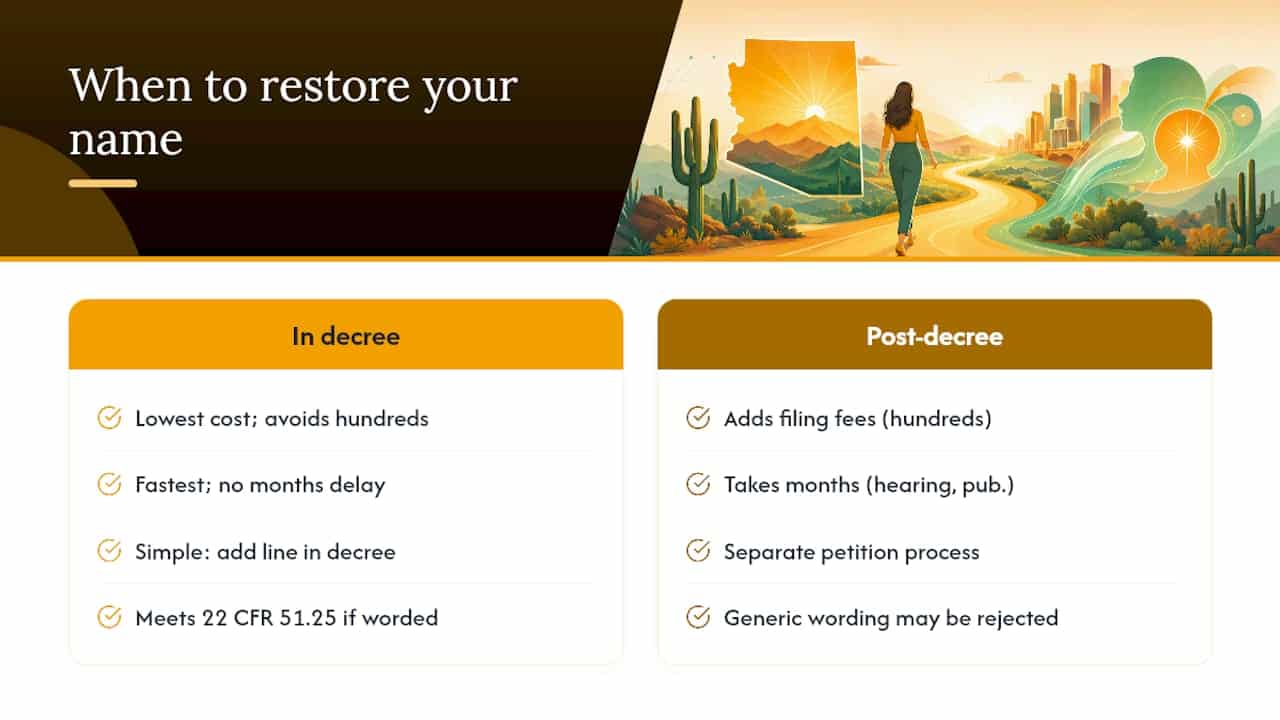
What most people get wrong is treating the passport office as an afterthought. The federal rule under 22 CFR 51.25 is specific about decree wording, and generic “name change granted” language can bounce your passport application even when your MVD and Social Security updates went through fine. Get the wording checked before the judge signs, not after you’re standing in a passport office six months later.
If you’re still finalizing your divorce, ask about restoration now. If you’re past that point, a post-decree motion is almost always faster than people assume.
— Brett
How High Desert Family Law Group helps you fix a name-change problem the right way
High Desert Family Law Group is the direct alternative to guessing your way through court self-help forms when your decree either needs restoration language added or never included it in the first place. Rather than filing a standalone petition and waiting through a publication period, most Arizona clients get faster results with a properly worded post-decree motion, filed under the case number you already have.

The firm has handled these motions for thousands of Scottsdale-area clients across more than 20 years of family law practice, including cases where a rejected passport application traced back to vague decree wording. If your divorce is still open, ask about restoration before the decree is signed. If it’s already final and missing that language, schedule a consultation to find out whether a motion or a full petition fits your situation, and get the wording right the first time.
Where to check the official rules yourself
- A.R.S. § 25-325 — the statute governing name restoration during divorce.
- Arizona Judicial Branch name-change forms — self-service center forms and instructions.
- Social Security Administration — federal guidance on updating your name with SSA.
- 22 CFR § 51.25 — passport acceptance rules for divorce decrees.
Check your county Superior Court clerk’s page for local forms, filing fees, and certified copy costs before you file.
This article is general information, not a substitute for advice from a qualified lawyer. Consult a qualified legal professional about your own circumstances before acting on anything here.
Sources
- Arizona Revised Statutes § 25-325
- 22 CFR § 51.25 (U.S. Code of Federal Regulations)
- Arizona Judicial Branch — Name Change Forms