



Keep the House: Arizona Home Buyout with a 90–180 Day Refinance Plan

Most Arizona couples facing the marital home end up choosing between three paths: sell and split the proceeds, have one spouse buy out the other’s equity, or defer the sale until the kids are older. The buyout route succeeds or fails on three things: an accurate value for the home, whether the keeping spouse can actually qualify for financing, and whether the settlement agreement spells out deadlines in writing. Before you negotiate anything, get a real appraisal and a lender prequalification. That single step prevents the most common and expensive mistake in Arizona home buyouts.
TL;DR:
- An appraisal from a licensed appraiser is essential for a fair buyout value, as opposed to an informal estimate or neighbor’s opinion.
- The lender’s prequalification must be obtained before negotiations to ensure the buying spouse can finance the required amount.
- The settlement agreement should include specific appraisal methods, clear buyout calculations, and enforceable deadlines with consequences for delays.
- The home can remain jointly owned until a triggering event, but the agreement must detail mortgage, tax, and repair responsibilities to avoid disputes.
- If financing falls through, courts can order the property sold, with a court-appointed agent handling the sale and ensuring timely payments and documentation.
Table of Contents
- What Are Your Options for the Marital Home in an Arizona Divorce?
- How Do You Calculate a Fair Home Buyout in Arizona?
- How Do You Finance a Home Buyout in a Divorce?
- What Do Lenders Require to Qualify for a Divorce Buyout Refinance?
- What Arizona-Specific Laws Govern a Home Buyout?
- What Should the Settlement Agreement Say About the Buyout?
- What Happens If Neither Spouse Can Afford to Keep the House?
- How Highdesertfamilylawgroup Handles Home Buyout Cases
- Brett’s Take: The Mistakes That Sink a Home Buyout
- Get Help Structuring Your Arizona Home Buyout
- Sources
What Are Your Options for the Marital Home in an Arizona Divorce?
Every Arizona divorce involving a house comes down to one of three roads, and picking the wrong one usually costs someone money or peace of mind for years.
Selling and splitting the proceeds is the cleanest option when neither spouse wants to stay, or when neither can qualify for a mortgage alone. Proceeds get calculated after paying off the existing mortgage, any home equity line of credit, real estate commissions (typically a moderate percentage), and closing costs. What’s left gets divided according to the community property agreement, which in most cases means an even split unless the couple negotiated otherwise. Selling also has a tax angle worth knowing: IRS Publication 523 allows a capital gains exclusion on a primary residence, and that exclusion can shrink or shift depending on timing and who holds title when the sale closes.
An equity buyout lets one spouse keep the house by paying the other spouse for their share of the equity. This is the emotionally popular choice, especially when kids are attached to a school district or a spouse has strong ties to the neighborhood. But it only works if the keeping spouse can refinance the mortgage into their name alone or qualify to assume the existing loan. A buyout without financing lined up is just a plan on paper.
Deferred sale, sometimes called co-ownership, postpones the decision. Both spouses keep their names on the title and the mortgage, usually until a triggering event like a child graduating from high school. This route can protect kids from a mid-school-year move, but it requires airtight terms:
- Who pays the mortgage, property taxes, and insurance each month
- Who covers repairs and how those costs get divided or reimbursed
- What triggers the eventual sale (a date, a child’s graduation, a remarriage)
- How proceeds get split once the home finally sells
- What happens if one spouse stops paying their share
Deferred sales sound tidy until one ex-spouse remarries, loses a job, or stops paying. Courts can enforce a well-drafted agreement, but a vague one leaves both parties in expensive limbo.
How Do You Calculate a Fair Home Buyout in Arizona?
Getting the buyout number right starts with an honest value for the house, not a guess from a real estate app or a neighbor’s opinion.
1. Get a defensible fair market value. A licensed appraiser’s report holds up far better in negotiation and in court than a broker’s comparative market analysis (CMA). Appraisals can cost several hundred dollars in the Phoenix metro area, but they carry weight if the other spouse disputes the number later. Some couples split the cost and agree in advance to accept the appraised figure as binding, which avoids a second argument over whose real estate agent pulled better comps.
2. Subtract everything owed against the property. Net equity is the fair market value minus the remaining mortgage balance, any HELOC or second lien, and, if the couple is planning to sell rather than buy out, the expected costs of sale. What’s left is the number that actually gets divided.
3. Apply the split and adjust for other assets. Arizona is a community property state, and courts divide community property equitably under A.R.S. § 25-318, which usually but not always means close to a 50/50 split. Read more about how that plays out across other asset categories in this breakdown of Arizona community property laws.
Here’s a worked example. Say the home appraises at a fair market value, subtract the mortgage balance and any liens to calculate net equity. Split evenly, the buyout spouse owes half of that equity to the other. If the couple also has $40,000 in shared retirement savings that they’ve agreed the leaving spouse will take entirely, the cash buyout figure could drop to $100,000 to balance the total settlement. That trade only works cleanly when both assets get valued at the same point in time, since a stock account and a house don’t move in price the same way.
Pro Tip: Ask your appraiser for an “as of” date that matches your other asset valuations. A home appraised in January against a brokerage statement from June creates a mismatch that opposing counsel will flag.
How Do You Finance a Home Buyout in a Divorce?
The buyout number is only half the equation. The other half is whether a lender will actually let the keeping spouse borrow that much money.
Most Arizona buyouts get funded one of four ways:
- Cash-out refinance — the keeping spouse refinances the full mortgage and pulls out enough cash to pay the other spouse their equity share, subject to standard cash-out loan limits.
- Limited cash-out (rate-and-term) refinance — when the settlement agreement is drafted correctly, a divorce buyout on a home the couple has jointly owned for 12 months or more can sometimes qualify under this category, which typically comes with better pricing and higher loan-to-value allowances than a standard cash-out refinance.
- Home equity line of credit (HELOC) — a smaller, faster option when the buyout amount is modest and the keeping spouse already has strong equity and credit.
- Loan assumption — available on some FHA and VA loans, letting the keeping spouse take over the existing loan terms rather than originating a brand new mortgage, though qualification rules are strict and not every loan is assumable.
Loan-to-value caps matter here more than most people expect. Conventional cash-out refinances typically cap borrowing at 80% of the home’s value, which means a spouse with less equity cushion may not be able to pull out enough cash to cover the full buyout, even with decent income. FHA and VA loans carry their own LTV rules, and VA loans in particular can allow more flexibility for eligible veterans, though the details vary by lender and by the borrower’s remaining entitlement.
This is where drafting quality actually changes what a family can afford. The way the marital settlement agreement (MSA) describes the buyout, whether it references a specific dollar figure, an equalization payment, or a percentage of equity, can determine whether the lender’s underwriter classifies the transaction as a limited cash-out refinance or a full cash-out refinance. That distinction alone can mean tens of thousands of dollars in additional available loan proceeds, according to guidance from LegalClarity on divorce buyout and refinance structuring.
Pro Tip: Loop in a mortgage professional, ideally someone with Certified Divorce Lending Professional (CDLP®) training, before the settlement language is finalized, not after. Rewriting an MSA because a lender rejected the wording costs time neither spouse has once a decree is entered.
What Do Lenders Require to Qualify for a Divorce Buyout Refinance?
A judge’s order that one spouse can keep the house means nothing to a mortgage underwriter. The lender still has to approve the loan on its own terms, and that gap catches more Arizona families off guard than any other part of this process.
Here’s what to check before signing off on buyout terms, not after:
- Documented income history. Conventional lenders generally want to see six months of consistent, documented spousal support or child support payments before counting that money as qualifying income. FHA and VA loans sometimes accept three months of history in certain circumstances, but that flexibility isn’t universal and depends on the lender’s own overlays.
- How support counts on both sides of the ledger. If the keeping spouse receives support, it can boost qualifying income once properly documented. If the keeping spouse pays support to the other party, that payment counts as a debt obligation and gets factored into the debt-to-income ratio, which can shrink borrowing power exactly when it’s needed most.
- Credit and debt-to-income review. The refinance application runs on the keeping spouse’s income and credit alone once the other spouse is released from the loan, so a joint household income that looked comfortable during the marriage can suddenly look thin on a single application.
- Timing around the decree. Get prequalified before the settlement is finalized, not after. A prequalification during negotiation reveals whether the buyout figure the couple is discussing is actually financeable, and it avoids the scenario where a decree orders a refinance the keeping spouse’s income simply can’t support, according to Divorce.law’s Arizona refinance guide.
A written decree cannot force a bank to approve a loan. Courts can order a refinance attempt, and they can build in consequences for noncompliance, but they cannot compel a private lender’s underwriting decision. That single fact is why prequalification belongs at the start of buyout negotiations, not the end.
What Arizona-Specific Laws Govern a Home Buyout?
Three legal concepts show up in nearly every Arizona home buyout, and skipping any of them tends to surface as a costly surprise later.
A.R.S. § 25-318 is the backbone statute. It directs Arizona courts to divide community property equitably in a divorce and gives judges authority to order a sale of the home when a buyout isn’t workable, or to award the home to one spouse while offsetting the value with other marital assets. The statute doesn’t require an exact 50/50 split; it requires “equitable,” which gives courts and negotiating spouses more room than many people assume, as outlined in the Arizona Revised Statutes.
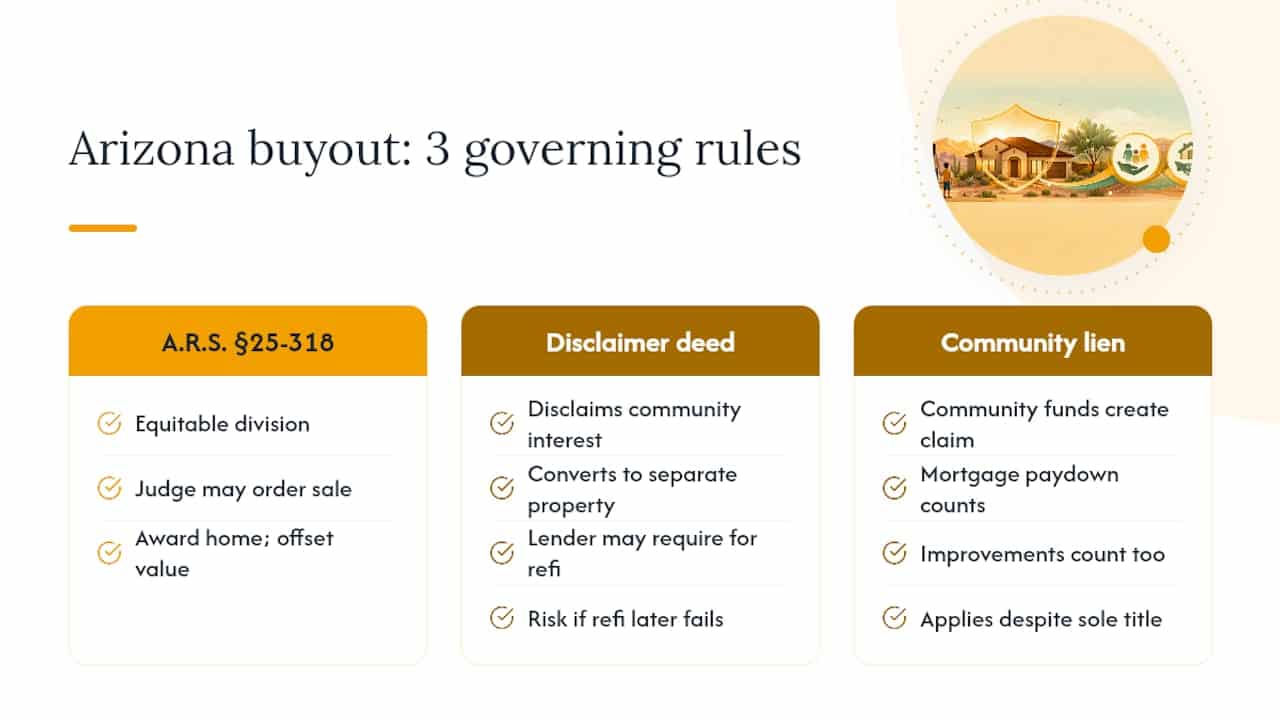
Disclaimer deeds come up constantly in Arizona because the state allows one spouse to sign a document disclaiming their community interest in a property, effectively converting it to the other spouse’s sole and separate property. Lenders sometimes require a disclaimer deed as a condition of a refinance, since it clarifies exactly who holds ownership interest going into the new loan. But signing one before a refinance closes is risky. If the refinance later falls through, the disclaiming spouse may have given up a legal claim to the home without receiving anything in exchange.
The community lien doctrine is the piece people overlook most often. Even when a home is titled as one spouse’s sole and separate property, community funds used to pay down the mortgage principal or fund improvements during the marriage can create a lien-like claim in favor of the community estate. That means a spouse who never appeared on the deed may still have a financial interest tied to the years of mortgage payments made from joint income, as explained in analysis from DivorceHousing on Arizona buyout mechanics.
A property titled in one spouse’s name alone is not automatically free of the other spouse’s financial claim. If community income paid down the mortgage or funded a remodel, that spending can create a recoverable interest regardless of whose name sits on the deed.
Before agreeing to any buyout figure, pull the full title history and mortgage payment record. Attorneys handling property division in divorce routinely run a community contribution analysis, checking down payment source, who paid principal reduction over the years, and who funded major improvements, to build a defensible number rather than an arbitrary one.
What Should the Settlement Agreement Say About the Buyout?
The marital settlement agreement is the document that turns a verbal understanding into something a court, and a lender, will actually enforce. Vague language here is the single biggest reason buyouts collapse months after the ink dries.
A well-drafted MSA covering a home buyout should spell out:
- The exact appraisal method (licensed appraiser versus broker CMA) and who pays for it
- The precise buyout formula, stated as a dollar figure or a clear calculation, not a rough percentage
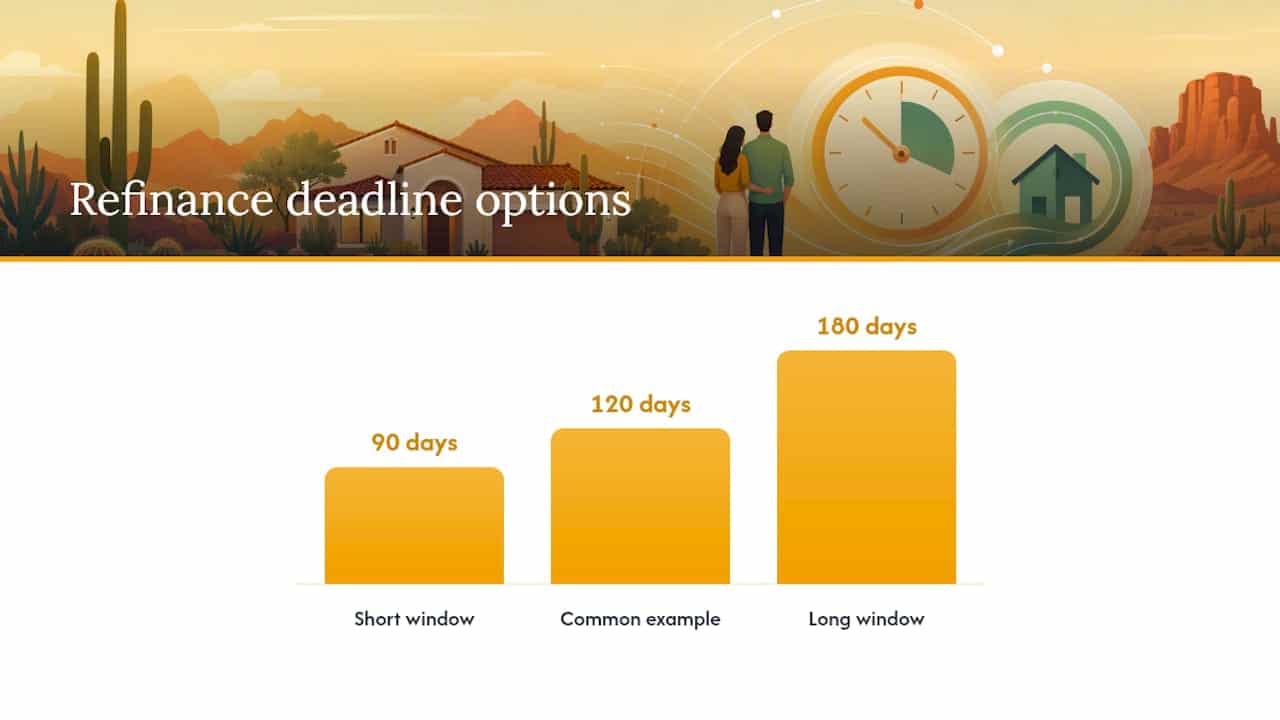
- The refinance deadline, commonly a window of 90 to 180 days from the decree
- What happens if the refinance deadline is missed, including whether the home goes to market automatically
- Indemnity language protecting the non-titled spouse if the keeping spouse defaults on the new loan
- Who holds the funds in escrow during the transition, and how those funds get released
Refinance deadlines matter more than they sound like they should. A keeping spouse who misses a 120 day window because of a slow lender, a paperwork gap, or a sudden credit issue can trigger a default clause that forces the home onto the market anyway, undoing the entire point of the buyout. Some settlement agreements build in a short grace period or a fallback appraisal date to avoid this exact trap.
Once the buyout closes, recording the quitclaim deed or disclaimer deed with the county is the final legal step. In Maricopa County, the recording fee runs a modest flat fee as of 2026, a small cost relative to what’s at stake but an easy detail to forget in the rush to close. Homeowners insurance also needs to be updated immediately to reflect the new sole owner, since a lapsed or mismatched policy can delay closing or leave a gap in coverage.
Pro Tip: Build a specific dollar penalty or automatic listing clause into the MSA for missed refinance deadlines. A settlement that just says “spouse shall refinance” with no consequence attached is nearly impossible to enforce quickly if the other side drags their feet.
What Happens If Neither Spouse Can Afford to Keep the House?
Sometimes the numbers simply don’t work. Neither spouse qualifies for a refinance, or one spouse refuses to cooperate with a sale or buyout agreed to in mediation. Arizona courts have tools for exactly this situation.
Under the equitable division powers in A.R.S. § 25-318, a judge can order the home listed and sold on the open market when a buyout proves unworkable. If one spouse doesn’t sign listing paperwork or otherwise obstructs the sale, the court can appoint a Special Real Estate Commissioner, a neutral third party with legal authority to sign documents, list the property, and complete the sale on behalf of the uncooperative spouse. This remedy exists specifically to prevent one party from holding the process hostage.
While a court-ordered sale or refinance is pending, a few practical steps limit financial damage:
- Keep making mortgage payments on time even if ownership is disputed; missed payments hurt both spouses’ credit regardless of who technically owes what.
- Get a written temporary agreement on who pays which bills during the gap, even informally, to avoid a credit dispute later.
- Avoid taking out new joint debt or making major changes to the property without written consent from the other spouse.
- Keep copies of every payment made toward the mortgage, taxes, or insurance during the pending period, since these can factor into the final equitable distribution.
A forced sale usually takes longer and nets less than a negotiated buyout, since a Special Real Estate Commissioner sale still has to go through standard listing and closing steps, only with a court-appointed signer standing in for the resistant spouse.
How Highdesertfamilylawgroup Handles Home Buyout Cases
Structuring a buyout that survives lender scrutiny takes more than a settlement template. Some firms draft buyout language designed to hold up during refinance underwriting, negotiate the equity figure using appraisal and community contribution data, and coordinate directly with mortgage professionals, including CDLP®-trained lenders, so the MSA and the loan application don’t work against each other.
In a buyout case, the legal team typically coordinates the appraisal timeline, builds enforceable refinance deadlines into the agreement, tracks community lien exposure on disclaimer-deed properties, and negotiates asset trades when a straight cash buyout doesn’t fit the family’s liquidity.
Clients preparing for a first consultation should bring a recent appraisal or comparable sales estimate, current mortgage statements, title history for the property, and recent pay stubs or income documentation for both spouses. Having those documents ready turns the first meeting into real strategy instead of a fact-finding exercise.
Brett’s Take: The Mistakes That Sink a Home Buyout
The same three mistakes show up in almost every failed buyout I’ve reviewed. First, someone agrees to a buyout number before checking if a refinance is actually possible, then discovers three months later that the debt-to-income ratio doesn’t work. Second, a spouse signs a quitclaim or disclaimer deed before the refinance closes, trading away their legal claim on a promise instead of a completed loan. Third, the settlement agreement sets a refinance deadline with no consequence attached, so it gets ignored.
Fix all three with the same three moves: get the appraisal first, get a lender prequalification before you negotiate a number, and schedule a consult before you sign anything. Coordinating the attorney, the appraiser, and the lender at the same time, rather than in sequence, is what actually keeps a buyout on track.
— Brett
Get Help Structuring Your Arizona Home Buyout
A buyout that falls apart at the lender’s desk costs more than one that’s negotiated correctly the first time. Some legal professionals build settlement language that lenders can work with, coordinating appraisal timing, refinance deadlines, and community lien questions so the agreement you sign is one you can close on.

The firm’s team handles buyout drafting, negotiation, and lender coordination as part of broader family law representation, whether your case is heading through litigation, mediation, or a collaborative divorce process. Bring your appraisal or valuation estimate, mortgage statements, title history, and income documentation to your first meeting, and the firm can assess whether your buyout numbers are realistic before you commit to them in writing. If mediation fits your situation better than litigation, ask about how divorce mediation can speed up buyout negotiations without a courtroom fight. Reach out to schedule a consultation and get a clear read on where your buyout stands before you sign anything.
This article is general information, not a substitute for advice from a qualified lawyer. Consult a qualified legal professional about your own circumstances before acting on anything here.
Sources
- Maricopa County Recorder — Recording Fees
- Arizona Revised Statutes § 25-318 — Division of community property
- IRS Publication 523 — Selling Your Home
- Divorce
- How to Divorce and Keep the House: Buyout and Taxes – LegalClarity