



Arizona Domestic Violence Custody: HB2995 and 6 Evidence Items

Arizona treats domestic violence as a decisive factor in custody cases, not just one item on a checklist. Under A.R.S. § 25-403.03, a finding of domestic violence triggers a rebuttable presumption against awarding sole or joint legal decision-making to the abusive parent, and recent changes under HB2995 push courts toward stricter written findings and broader evidence review. Courts can order supervised visitation, protected exchanges, or no overnight parenting time at all. If you’re facing this situation, start collecting documentation now, consider an emergency order if there’s an immediate threat, and talk to a family law attorney before your first hearing.
TL;DR:
- Domestic violence findings create a rebuttable presumption against awarding decision-making authority to the abusive parent, requiring them to prove it is safe for the child.
- Evidence such as police reports, medical records, witness testimony, and prior court orders can be used to establish domestic violence with a preponderance of the evidence standard.
- Courts differentiate between situational incidents and patterns of coercive control, often resulting in harsher restrictions for ongoing abuse or intimidation.
- Protective court orders can include supervised visits, monitored exchanges, or no overnight parenting time, but joint counseling is now explicitly barred under HB2995.
- Emergency custody orders can be issued rapidly if there is an immediate safety threat, provided relevant documentation like police or medical reports is available.
Table of Contents
- How Arizona Law Treats Domestic Violence in Custody Cases
- How Judges Weigh Domestic Violence Against Custody Outcomes
- What Counts as Domestic Violence and What Evidence Courts Accept
- Protective Conditions Courts Can Order
- What Not to Do (and What to Do Instead) in Family Court
- Getting Emergency Orders or Modifying Existing Custody
- How High Desert Family Law Group Helps in These Cases
- A Lawyer’s Perspective: Safety First, Parental Rights Second
- Ready to Talk to an Arizona Family Law Attorney?
- Sources
- FAQ
How Arizona Law Treats Domestic Violence in Custody Cases
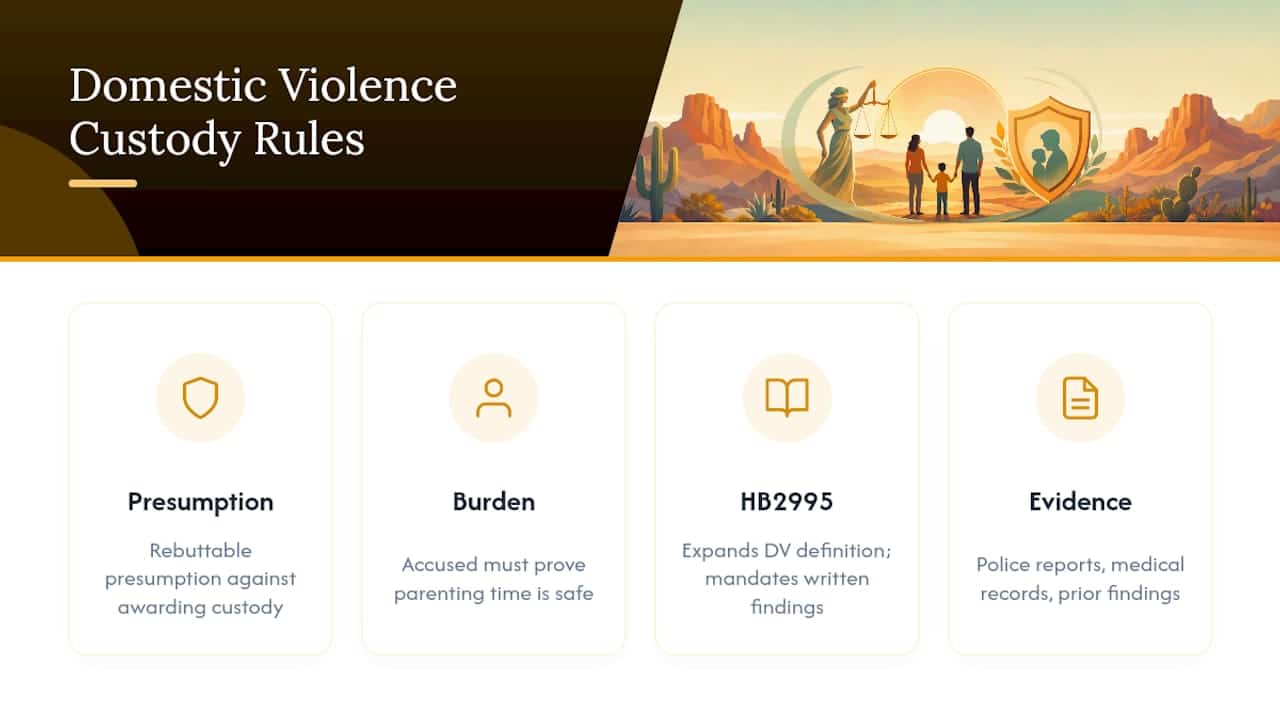
A.R.S. § 25-403.03 requires Arizona judges to weigh a child’s safety above almost every other factor once domestic violence enters the picture. If a court finds that a parent committed an act of domestic violence, a rebuttable presumption arises that giving that parent sole or joint legal decision-making authority would hurt the child’s best interests. The accused parent then carries the burden of proving that parenting time will not endanger the child.
HB2995 sharpened this framework considerably. The legislation expands what legally counts as domestic violence, requires judges to issue detailed written findings when domestic violence is alleged, and lists specific evidence categories courts must weigh, including police reports, medical records, and prior court findings. It also bars joint counseling between a victim and the parent who abused them, replacing that option with referrals to community resources.
Courts apply a preponderance of the evidence standard to domestic violence claims in custody matters. That’s a lower bar than criminal court requires, and under HB2995’s guidance, corroborating evidence isn’t always mandatory for a judge to find abuse occurred.
How Judges Weigh Domestic Violence Against Custody Outcomes
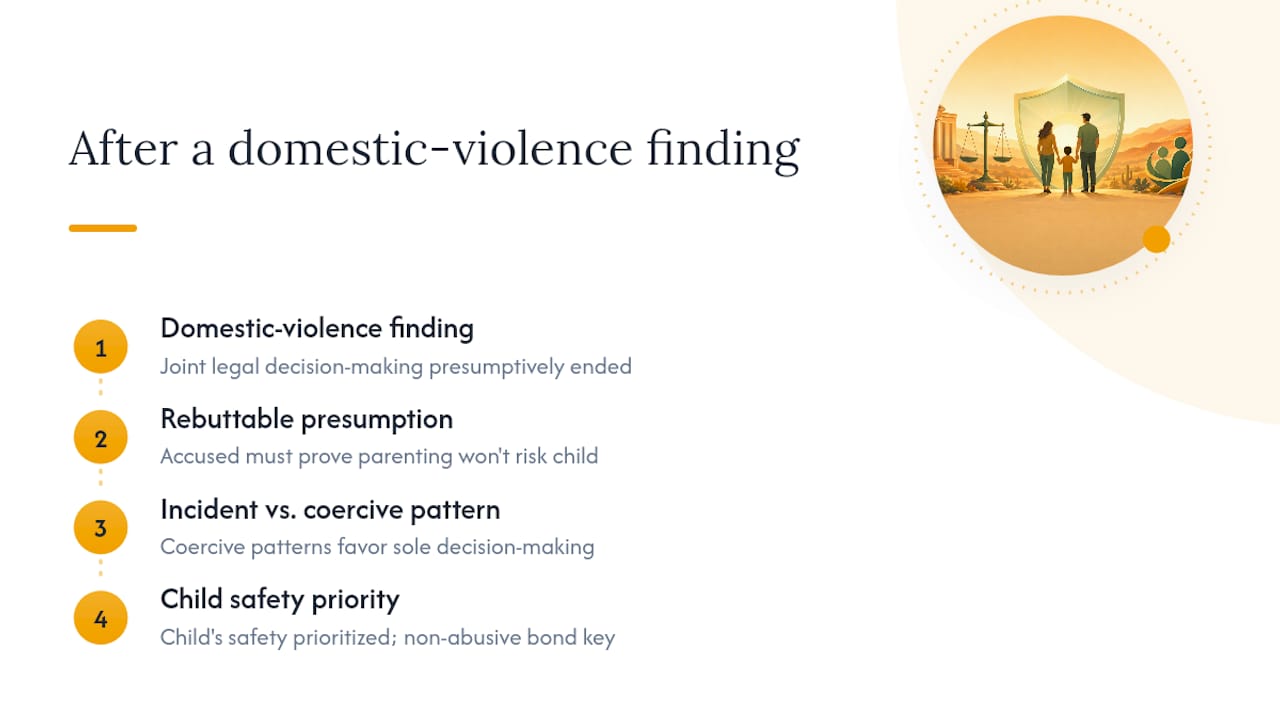
Domestic violence doesn’t sit quietly among the other best-interest factors Arizona judges weigh. It can override them. Once a court makes a domestic violence finding, joint legal decision-making becomes presumptively off the table, and the parent who committed the violence has to overcome that presumption before getting any decision-making authority back.
Judges also distinguish between a single situational incident and an established pattern. A one-time argument that escalated is treated differently than ongoing coercive control, threats, or a pattern of intimidation designed to dominate a partner. Research on custody litigation backs this distinction: courts that separate situational couple violence from coercive control tend to reach safer, more accurate custody outcomes, because coercive patterns usually call for sole decision-making and primary parenting time with the non-abusive parent.
The rebuttable presumption means the accused parent must affirmatively show the court, with evidence, that parenting time won’t put the child at risk. That’s a real burden. Judges prioritize a child’s physical and psychological safety above almost every competing consideration, and a strong, nurturing bond with the non-abusive parent is treated as the single most protective resource a child exposed to domestic violence can have.
What Counts as Domestic Violence and What Evidence Courts Accept
Arizona’s definition reaches further than most people expect. It covers physical harm, sexual assault, and threats that create a reasonable apprehension of harm, along with patterns of coercive control, like isolating a partner financially or monitoring their movements. Behavior tied to a prior order of protection also counts.
Courts consider a wide range of evidence when deciding whether domestic violence occurred:
- Police reports and body-cam or CAD call records
- Medical records documenting injuries or ER visits
- Shelter intake records and advocate documentation
- DCS reports and school records showing behavioral changes
- Witness testimony from neighbors, family, or coworkers
- Prior court findings, including protection orders from other cases
Pro Tip: Start a dated, written timeline the moment you suspect a custody dispute is coming. Judges respond well to specific dates and details, and a timeline built after the fact is far less convincing than one built as events happen.
Because claims can be proven by a preponderance of the evidence, you don’t necessarily need corroborating witnesses for every incident, but more documentation always strengthens your position.
Protective Conditions Courts Can Order
When a judge finds domestic violence occurred, the remedies go beyond just denying joint custody. The court can order a range of protective conditions depending on severity:
- Supervised parenting time through a professional supervisor or agency
- Exchanges limited to protected, monitored locations
- No overnight parenting time until conditions change
- Completion of a batterer’s intervention or treatment program
- Substance abstinence requirements around parenting time
- Bonds or fees to cover supervision costs
- Confidentiality orders protecting a victim’s address or workplace
Joint counseling between the victim and the abusive parent is explicitly off the table under HB2995. Instead, courts direct victims toward independent resources, including trauma-focused counseling like the recovery-oriented therapy many survivors use to process the experience separately from custody proceedings. Full restriction of legal decision-making applies when the presumption isn’t rebutted; lighter conditions, like supervised exchanges alone, apply when the risk is narrower.
What Not to Do (and What to Do Instead) in Family Court
- Don’t contact the other parent in ways that could look like harassment, even if you’re trying to “clear the air.”
- Don’t withhold evidence you think might complicate your story. Judges punish concealment harder than they punish messy facts.
- Don’t skip a court-ordered evaluation or make exaggerated claims. False allegations damage credibility fast and can backfire in a decision-making dispute.
- Do build a factual affidavit with dates, a witness list, and copies of every police or medical record you can gather.
Pro Tip: Write your affidavit like you’re explaining events to a stranger who knows nothing about your relationship. Judges read hundreds of these; specificity and restraint read as credible.
Getting Emergency Orders or Modifying Existing Custody
When there’s an immediate safety threat, Arizona’s superior courts can exercise emergency jurisdiction to issue temporary orders fast, sometimes before the other parent is even notified. The same domestic violence factors and written-findings requirements apply to temporary orders and later modification petitions, not just final custody rulings.
To move quickly, have these ready:
- A police report or incident number, if one exists
- Medical documentation of any injuries
- A written, dated account of the incident triggering the emergency request
- Contact information for any witnesses
Filing for temporary orders or pursuing emergency custody usually moves faster than a standard custody modification, but the underlying legal standard doesn’t change.
How High Desert Family Law Group Helps in These Cases
Domestic violence custody cases require more than knowing the statute. Our team helps Arizona parents build the evidentiary record judges expect, from affidavits to coordinating with domestic violence advocates and DCS caseworkers when relevant. We represent clients in legal decision-making disputes, emergency custody filings, and contested hearings where the rebuttable presumption is the central issue.
Having counsel matters most when arguing whether a presumption has been rebutted. That’s a nuanced legal argument, not a paperwork exercise.
A Lawyer’s Perspective: Safety First, Parental Rights Second
The hardest cases aren’t the obvious ones. They’re the ones where a parent genuinely loves their child but the pattern of coercive control makes unsupervised time unsafe. Courts get this wrong less often than people assume, but only when the record is built carefully. Document early, use victim advocates, and let the evidence, not emotion, carry the argument.
— Brett
Ready to Talk to an Arizona Family Law Attorney?
If domestic violence has entered your custody case, waiting rarely helps your position. Legal representation is available to Arizona parents through emergency custody filings, temporary order hearings, and contested custody trials where domestic violence findings are central to the outcome. We help clients organize police and medical records, draft affidavits that hold up under cross-examination, and argue the rebuttable presumption on both sides of the courtroom.

If you’re preparing for a hearing, bring whatever documentation you already have, incident dates, prior orders, medical records, and any communication that shows a pattern. Our intake process starts with a consultation where we review your situation and outline realistic next steps. Visit our types of family lawyers page to see which practice area fits your case, or head to our homepage to schedule a consultation directly.
This article is general information, not a substitute for advice from a qualified lawyer. Consult a qualified legal professional about your own circumstances before acting on anything here.
Sources
- 25-403.03 – Domestic violence and child abuse
- A Judicial Guide to Child Safety in Custody Cases – NCJFCJ
FAQ
How does domestic abuse affect custody in Arizona?
A finding of domestic violence creates a rebuttable presumption against joint or sole legal decision-making for the abusive parent, and courts can order supervised visitation or restrict overnight parenting time.
What counts as domestic violence in Arizona custody cases?
Arizona’s definition covers physical harm, sexual assault, threats causing reasonable fear, and patterns of coercive control, along with conduct tied to a prior order of protection.
What should I avoid doing in family court during a custody dispute?
Avoid contacting the other parent in ways that could be seen as harassment, withholding evidence, or exaggerating claims. Courts punish concealment and dishonesty harder than they punish messy, honest facts.
How do you prove domestic violence in an Arizona custody case?
Claims are established by a preponderance of the evidence using police reports, medical records, shelter documentation, and witness testimony, and corroboration isn’t always required under HB2995’s evidentiary guidance.
Can a parent get emergency custody if domestic violence just occurred?
Yes. Arizona superior courts can exercise emergency jurisdiction to issue temporary orders quickly when a child or parent faces an immediate safety threat, though the same domestic violence standards apply to those temporary orders.