



Stop Escalation: Court Tools for High Conflict Parenting in Arizona

Arizona courts treat high-conflict parenting as a specific problem with specific remedies, not just a bad divorce. Under A.R.S. §25-403, judges lean on tools like the Parental Conflict Resolution Class, conciliation services, and parenting coordinators to force structure onto cases that can’t self-regulate. If you’re in one of these situations right now, the first move is simple: start documenting every missed exchange, every threatening text, every broken agreement, and call an attorney or your county’s conciliation office before your next hearing.
TL;DR:
- Arizona courts categorize high conflict parenting cases based on patterns like repeated schedule violations, hostile communication, or threats, without requiring a formal diagnosis.
- Court-ordered interventions include a four-hour conflict resolution class, conciliation reports, parenting coordinators, and structured exchanges to manage behavior and reduce escalation.
- Successfully documenting all violations and hostile messages with timestamps and brief notes is crucial for court enforcement or modification efforts.
- Modification typically requires a substantial change in circumstances and cannot usually be revisited within a year unless safety concerns exist.
- An experienced family law attorney can help gather evidence, negotiate parenting plans, and navigate county-specific programs to improve case outcomes.
Table of Contents
- What Counts as a High Conflict Parenting Case in Arizona
- Court-Ordered Interventions Parents Should Expect in Arizona
- Arizona Legal Standards and Enforcement: Parenting Plans, Modifications, and Remedies
- Practical Steps Parents Should Take Now to Protect Their Children and Their Case
- How an Experienced Arizona Family Law Firm Can Help in High Conflict Parenting Cases
- A Realistic Take on Timelines and Priorities in High Conflict Cases
- How High Desert Family Law Group Helps With Custody and Enforcement
- Where to Verify Arizona’s Rules Directly
- Sources
- FAQ
What Counts as a High Conflict Parenting Case in Arizona
Arizona courts don’t require a diagnosis or a label to intervene. They look at patterns of behavior that make normal co-parenting impossible and put a child’s stability at risk. A judge or family court services staffer typically flags a case as high conflict when they see:
- Repeated violations of an existing parenting time schedule or decision-making order
- A pattern of excessive motions, filings, or emergency requests over minor disputes
- Threats, harassment, or intimidation directed at the other parent, sometimes documented in texts or emails
- Communication so hostile or manipulative that it visibly affects the children’s behavior or emotional state
Arizona’s baseline legal standard still applies here: A.R.S. §25-403 directs judges toward the child’s best interests and presumes shared legal decision-making is preferable when parents can manage it. When they can’t, county conciliation or family court services screens the case early, often before a first hearing, and decides whether it needs a class, a conciliator, or a coordinator layered on top of the standard process.
Court-Ordered Interventions Parents Should Expect in Arizona
Once a case gets flagged, the court doesn’t leave conflict management to chance. Arizona counties have built specific programs for exactly this problem, and knowing what each one actually involves saves you from walking in unprepared.
- Parental Conflict Resolution Class (PCR) / High Conflict Class. This is a four-hour, judge-ordered course focused on communication and conflict-management skills. Maricopa County runs sessions separately for each parent, and county pages like Pinal County’s High Conflict Class list registration steps and fees, often up to $50 depending on the provider.
- Conciliation Services and Mediation Conferences. A Superior Court conciliator meets with both parents, reviews residential arrangements and time with each parent, then files a written report. Maricopa County’s conciliation program submits these reports within 60 days, or 14 days before a scheduled hearing if one’s already on the calendar.
- Parenting coordinators. Courts appoint these professionals, usually attorneys or mental health clinicians, to resolve day-to-day disputes without going back to a judge every time. A parenting coordinator typically works within a defined scope set by court order and charges hourly, separate from mediator fees.
- Parallel parenting and structured exchanges. Judges frequently order divided decision-making zones, neutral drop-off locations, and mandatory use of court-approved communication apps like OurFamilyWizard to create a time-stamped record.
Statistic Callout: Conciliation reports in Maricopa County are due within a strict window, 60 days generally, or 14 days before a hearing, which means the conciliator’s recommendations often shape a judge’s initial ruling before the case ever reaches a full trial.
Arizona Legal Standards and Enforcement: Parenting Plans, Modifications, and Remedies
Arizona’s parenting plan framework starts with A.R.S. §25-403’s best-interest factors: each parent’s relationship with the child, mental and physical health of everyone involved, and which parent is more likely to allow a healthy relationship with the other. A.R.S. §25-403.02 then gives judges authority to write in specific plan elements when parents can’t agree on their own, rather than leaving gaps.
When circumstances change or one parent stops following the plan, two paths open up:
- Modification under A.R.S. §25-411 usually requires showing a substantial change in circumstances, and courts generally won’t revisit legal decision-making within one year of the last order absent safety concerns.
- Enforcement through a parenting time violation petition can produce make-up parenting time, contempt findings, or an order that the violating parent cover the other side’s attorney fees.
Expedited enforcement hearings move faster than modification cases, which matters if missed parenting time is piling up. Courts want documented, dated violations, not general complaints, before they’ll act quickly.
Practical Steps Parents Should Take Now to Protect Their Children and Their Case
You can’t control the other parent’s behavior, but you can control how well your own case is documented and how much conflict actually reaches your kids. Start here:
- Save every text, email, and app message with timestamps intact; screenshots disappear, exported logs don’t.
- Log every missed pickup, late drop-off, or canceled parenting time with the date and a short factual note.
- Switch to a structured communication method. Court-approved apps or a dedicated email thread work better than phone calls because they create a record and slow down heated exchanges.
- Keep every message factual and brief. Skip the commentary, skip the accusations, and never use the kids as messengers.
Pro Tip: Set yourself a personal rule to wait 24 hours before responding to any hostile message. A calm, factual reply reads far better to a judge than a defensive one, and it gives you time to decide if the exchange even needs a response.
If violations keep happening despite your documentation, that’s your signal to request a parenting coordinator, ask the court for a guardian ad litem, or bring in an attorney. Courts respond to patterns backed by dates and evidence, not general frustration.
How an Experienced Arizona Family Law Firm Can Help in High Conflict Parenting Cases
An attorney handling a high-conflict case does more than file paperwork. They draft enforcement or modification petitions with the specific evidence a judge needs to act quickly, negotiate parallel parenting language that actually holds up, and coordinate with psychologists or guardians ad litem when a case calls for expert input. They also represent you at conciliation conferences and hearings, where knowing the local judge’s tendencies and the county’s specific filing procedures makes a real difference.
Every Arizona county runs its conciliation and class programs a little differently, and timelines shift depending on the court’s caseload. Bring your documentation, a copy of your current parenting plan, and a clear list of what’s actually happening to your first consultation. That’s what turns a general complaint into a case a judge can act on.
A Realistic Take on Timelines and Priorities in High Conflict Cases
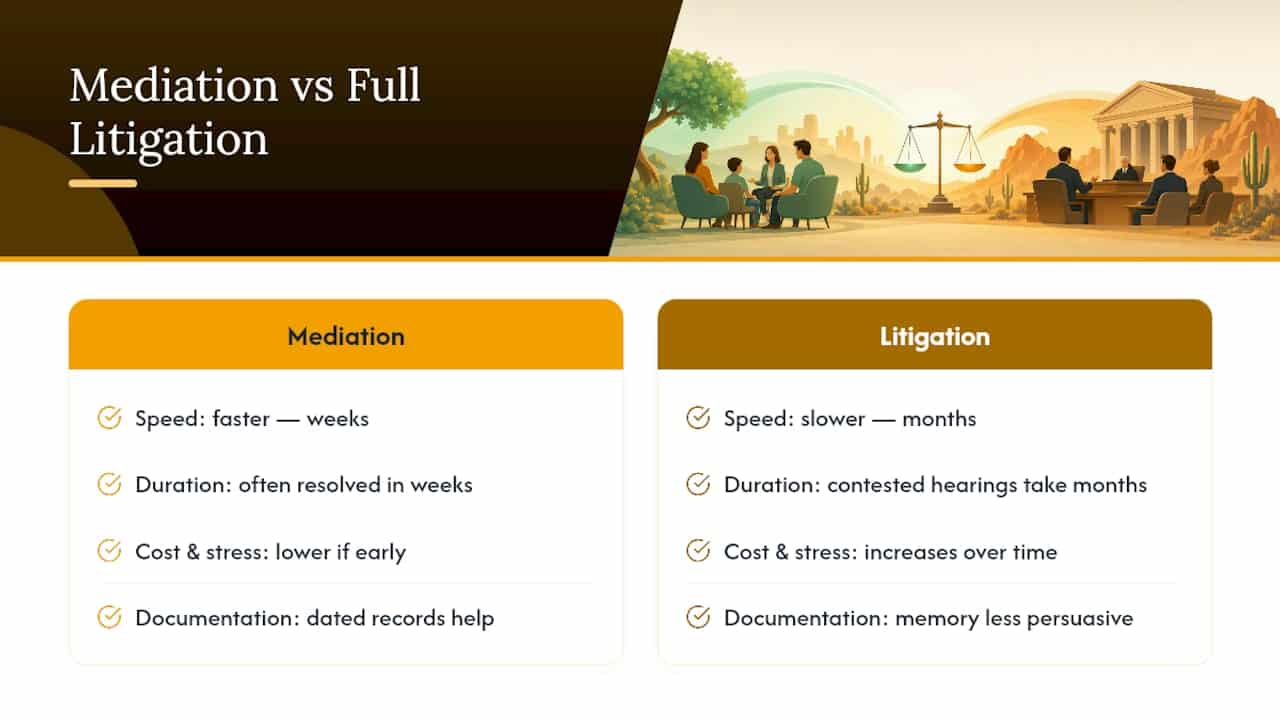
Mediation and conciliation move faster than full litigation, often resolving disputes in weeks rather than the months a contested hearing can take. That speed is exactly why early documentation matters so much. A parent who shows up to conciliation with dated, factual records gets taken more seriously than one relying on memory and frustration.
Financially and emotionally, high-conflict cases cost more the longer they drag on. Every hearing, every failed exchange, and every unnecessary motion adds expense and stress that a court program or an early legal consultation could have shortened. Prioritize your child’s stability over winning every small argument. Judges notice which parent is actually trying to reduce conflict and which one is escalating it, and that observation shapes outcomes more than most parents expect.
— Brett
How High Desert Family Law Group Helps With Custody and Enforcement
A family law firm can assist with modifying parenting plans, filing enforcement petitions when schedules aren’t followed, and representing clients through conciliation and mediation to avoid prolonged conflict. Bring your documented timeline of violations, any existing parenting plan, and a list of specific concerns to your first consultation, and the team builds a strategy around what’s actually happening in your case, not a generic script.

If missed parenting time, hostile communication, or a stalled modification request is wearing you down, the firm’s child custody team can review your situation and outline what enforcement or modification realistically looks like for you. Schedule a consultation to find out where your case actually stands.
Where to Verify Arizona’s Rules Directly
For readers who want to check the underlying law and county procedures themselves:
- A.R.S. §25-403.02 covers parenting plan requirements and best-interest factors.
- Maricopa County Family Conciliation Services explains conciliation conferences and report timelines.
- Pinal County’s High Conflict Class page shows what a local court-ordered class actually requires.
- The Maricopa County Clerk of Court has current filing and payment procedures for petitions and class fees.
This article is general information, not a substitute for advice from a qualified lawyer. Consult a qualified legal professional about your own circumstances before acting on anything here.
Sources
- Family Conciliation Services | Maricopa County Superior Courts
- 25-403.02 – Parenting plans
- High Conflict Class
FAQ
What Makes a Custody Case “High Conflict” in Arizona?
Arizona courts look at patterns, repeated parenting time violations, excessive filings, threats, or communication breakdowns that harm the children, rather than a single bad argument. Once flagged, a case often gets routed toward conciliation, a High Conflict Class, or a parenting coordinator under A.R.S. §25-403.
How Long Does the Parental Conflict Resolution Class Take?
The Parental Conflict Resolution Class, also called the High Conflict Class in some counties, runs four hours and is typically completed in a separate session from the other parent. Fees vary by county and provider, sometimes up to $50, as outlined on Maricopa County’s conciliation services page.
Can I Modify a Parenting Plan Because of High Conflict?
Yes, but you generally need to show a substantial change in circumstances under A.R.S. §25-411, and courts usually won’t revisit legal decision-making within a year of the last order unless safety is at issue. An attorney can help determine whether your documented pattern of violations meets that threshold.
Does High Desert Family Law Group Handle High Conflict Custody Cases?
Yes. Some family law firms represent parents through custody disputes, parenting plan modifications, and enforcement petitions, including cases involving repeated violations or hostile co-parenting. Current consultation details are available through the firm’s child custody page.
What Should I Bring to a Consultation About a High Conflict Case?
Bring your current parenting plan, a dated log of missed exchanges or violations, and copies of relevant texts or app messages. That documentation lets an attorney assess whether enforcement, modification, or a parenting coordinator request fits your situation.