



Avoid a Year in Court: Arizona Checklist to Choose Settlement or Trial

Most divorces settle. Only about 2% to 10% of cases go to full trial, and for good reason: settlement usually costs less, moves faster, keeps your finances private, and lets you and your spouse control the outcome instead of a judge. Trial makes sense when settlement fails or when safety, hidden assets, or a spouse negotiating in bad faith leave no other option.
TL;DR:
- Most divorce cases settle because settlement is quicker, less expensive, and preserves privacy, whereas trial typically takes over a year and costs significantly more with expert fees.
- Settlement involves mutual agreement on all issues, often through negotiation, mediation, or collaborative divorce, resulting in a legally binding agreement approved by a judge.
- Trial preparation includes financial disclosures, expert reports, and multiple court-mandated procedures, and can be delayed or complicated by unresolved issues or non-compliance.
- Choosing trial is justified when safety, hidden assets, or bad-faith negotiations make settlement unfeasible, but it often results in higher costs and less control over the outcome.
- The key to a favorable resolution is gathering comprehensive financial documentation early to inform realistic negotiations or trial strategies.
Table of Contents
- What Do “Settlement” and “Trial” Actually Mean in Divorce?
- How Does Divorce Settlement Actually Work?
- What Happens During a Divorce Trial?
- Settlement vs Trial Divorce: Comparing the Real Trade-Offs
- When Should You Settle, and When Should You Go to Trial?
- How Do You Prepare for Settlement or Trial?
- What Two Decades of Family Law Practice Teach About This Choice
- An Honest Take on the Settlement vs Trial Debate
- How Highdesertfamilylawgroup Helps You Weigh Settlement Against Trial
- Sources
- FAQ
What Do “Settlement” and “Trial” Actually Mean in Divorce?
Settlement means you and your spouse agree on every issue, from asset division to parenting time, and submit that agreement to the court for approval. Trial means a judge hears evidence and decides the issues you and your spouse could not resolve on your own. Both paths end in a legally binding divorce decree. The difference is who writes the terms.
A quick snapshot of how the two paths typically diverge:
- Time: Settlements can close in weeks to a few months; contested trials often stretch past a year once discovery, expert reports, and court scheduling are factored in.
- Cost: Settlement generally limits attorney hours and avoids expert witness fees; trial adds deposition costs, expert testimony, and days of courtroom time billed at hourly rates.
- Who decides: In settlement, you and your spouse set the terms; at trial, a judge weighs the evidence and issues a ruling neither side can revise.
- Privacy: Settlement talks and mediation sessions stay confidential; trial testimony and exhibits become part of the public court record in most jurisdictions.
That 2% to 10% trial rate isn’t an accident. Courts actively push cases toward resolution through mandatory settlement conferences and disclosure deadlines, and most spouses, once they see the real cost of litigation, decide it isn’t worth the fight. Still, a small percentage of cases genuinely need a judge’s ruling, and knowing which category you fall into early saves both money and stress.
How Does Divorce Settlement Actually Work?
Settlement happens through three main channels: direct negotiation between attorneys, mediation with a neutral third party, or collaborative divorce, where both spouses and their lawyers commit in writing to resolving everything outside court. Each works a little differently, but all three aim at the same document: a marital settlement agreement that spells out property division, support, and custody terms.
Mediation puts a trained neutral in the room to help both sides find common ground, and it tends to work. The American Bar Association notes that mediation preserves party control over outcomes and consistently produces higher satisfaction than judge-decided cases. Collaborative divorce takes that a step further, with both attorneys agreeing to withdraw from the case entirely if it heads to trial, which keeps everyone motivated to find middle ground. You can compare mediation and arbitration paths if you’re weighing which structure fits your situation.
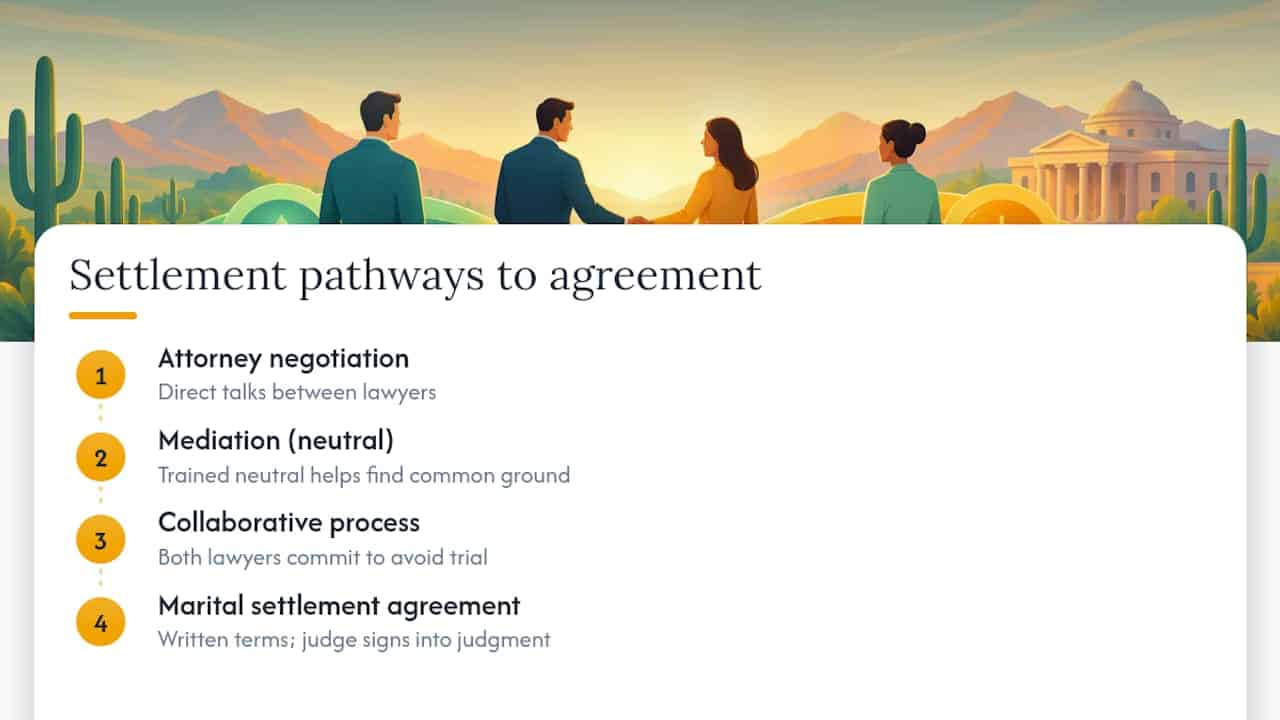
Once terms are set, they get written into a marital settlement agreement, which becomes part of the final judgment once a judge signs off. At that point, it’s an enforceable contract, and courts hold both sides to it much like any other legal agreement, with modification allowed only under limited legal standards.
The advantages: faster timelines, lower legal costs, confidentiality, and room for creative solutions a court can’t order, like a custom holiday schedule or a phased buyout of the house. The risks: if one spouse has more bargaining leverage, financial knowledge, or legal representation, the agreement can end up lopsided, and a badly drafted settlement can be nearly impossible to unwind later.
Pro Tip: Never sign a settlement agreement you don’t fully understand just to end the process faster. Ask your attorney to walk through the long-term financial impact, not just the immediate terms, before you sign anything.
What Happens During a Divorce Trial?
Trial doesn’t start the day you walk into a courtroom. Courts require a series of steps first, and skipping them can delay your case or draw sanctions.
- Final financial disclosures. Courts typically require both spouses to exchange complete financial disclosures, often at least 45 days before trial, covering income, debts, assets, and property values.
- Settlement conference. Nearly every jurisdiction mandates at least one formal settlement conference before trial, and local court rules often require pre-filed settlement statements and can penalize noncompliance.
- Expert reports and appraisals. Custody evaluations, business valuations, and property appraisals get filed and exchanged so both sides can prepare.
- Trial brief and exhibit prep. Courts generally expect a trial brief, a property and debt worksheet, and proposed final orders filed before the trial date.
- The trial itself. Both sides present evidence, question witnesses, and argue their positions before a judge who issues a ruling, sometimes the same day, sometimes weeks later.
Not every contested issue needs a full trial. Courts often resolve narrower disputes through a Request for Order hearing, which handles a single issue in far less time than a full trial requires. But when multiple issues stay contested, expect months of discovery and preparation before you ever see a courtroom.
Settlement vs Trial Divorce: Comparing the Real Trade-Offs
Put the two paths side by side and the differences show up on every axis that matters to your daily life, not just your legal bill.
- Control: Settlement lets you write the terms; trial hands that authority to a judge who has never met your family and won’t always rule the way you expect.
- Cost: Settlement limits spending to attorney negotiation time; trial adds expert witness fees, deposition costs, and court appearance billing that can run into tens of thousands of dollars for complex estates.
- Time: Settlement can close in weeks or a few months; trial timelines commonly stretch past a year once discovery and court calendars are factored in.
- Privacy: Settlement negotiations stay behind closed doors; trial testimony becomes part of the public record.
- Custody and support predictability: Negotiated agreements let parents design a parenting plan around real schedules; a judge’s custody ruling depends on evidence presented in a single hearing and may not reflect either parent’s daily reality.
- Enforceability and finality: Settlement agreements folded into the final judgment are difficult to modify except under narrow legal standards, while trial verdicts can be appealed, extending the case and the legal bill even further.
Trial isn’t automatically the wrong choice, but experts frame it correctly as a risk-based decision: you’re handing the outcome to someone else and agreeing in advance to live with whatever they decide. That’s a very different posture than negotiating your own terms, even an imperfect compromise.
When Should You Settle, and When Should You Go to Trial?
Run through this checklist with your attorney before committing to either path:
- Is there a safety concern? Documented abuse, threats, or an unsafe home environment often make direct negotiation unworkable and can justify moving toward trial or protective orders.
- Is your spouse hiding assets? If financial disclosures don’t add up or your spouse won’t produce documentation, that’s a red flag worth investigating before you settle for less than your share.
- Is the other side negotiating in bad faith? Stalling tactics, repeated demands to reopen settled issues, or refusal to engage constructively can mean mediation has run its course.
- How complex is the estate? Business interests, multiple properties, or retirement accounts with complicated valuation questions sometimes need a judge’s ruling to resolve fairly.
- What’s your tolerance for cost and delay? If you can’t absorb a year or more of litigation costs, that alone often tips the decision toward settlement.
Ask your attorney directly: “What’s the realistic worst case if we go to trial?” and “What would a fair settlement actually look like for our situation?” Those two questions cut through most of the uncertainty.
Pro Tip: If your spouse agrees to nearly everything except one issue, like the family home, don’t let that single sticking point drag the entire case into trial. Ask about narrowing the dispute to just that issue through a limited hearing.
How Do You Prepare for Settlement or Trial?
Whichever path your case takes, the prep work looks similar at the start.
- Gather your financial documents. Pull together tax returns, bank statements, pay stubs, retirement account summaries, and any property appraisals you already have.
- Track key deadlines. Financial disclosures are often due at least 45 days before trial, and missing that window can delay your case. Review the disclosure requirements and timelines that apply to your case early.
- Prepare for the settlement conference. Treat it as a real negotiation session, not a formality. Bring documentation, know your bottom line, and expect the other side to test it.
- Loop in financial experts early if trial looks likely. Business valuators and forensic accountants need lead time, and waiting until weeks before trial to hire one usually costs you leverage.
Use a pre-divorce checklist or divorce settlement checklist to organize documents before your first attorney meeting. Even if you ultimately head to trial, mediation or informal settlement talks can narrow the issues in dispute, which shortens the trial itself and reduces cost either way.
What Two Decades of Family Law Practice Teach About This Choice
Handling thousands of family law cases over more than 20 years shows a consistent pattern: clients who settle successfully are the ones who compiled their financial records early and negotiated from a position of clarity, not urgency. The clients who end up disappointed by trial outcomes usually underestimated expert costs or delayed gathering documentation until the settlement conference was already scheduled.
Highdesertfamilylawgroup’s approach treats every settlement conference as a genuine negotiation opportunity, not a box to check. That means walking clients through a realistic settlement value before ever discussing what a judge might order, so the comparison is honest instead of one-sided.
An Honest Take on the Settlement vs Trial Debate
Most advice on this topic treats settlement as automatically virtuous and trial as automatically hostile. That’s lazy thinking. Settlement is usually smarter, but “usually” isn’t “always,” and the readers who get hurt are the ones who settle out of exhaustion rather than judgment.
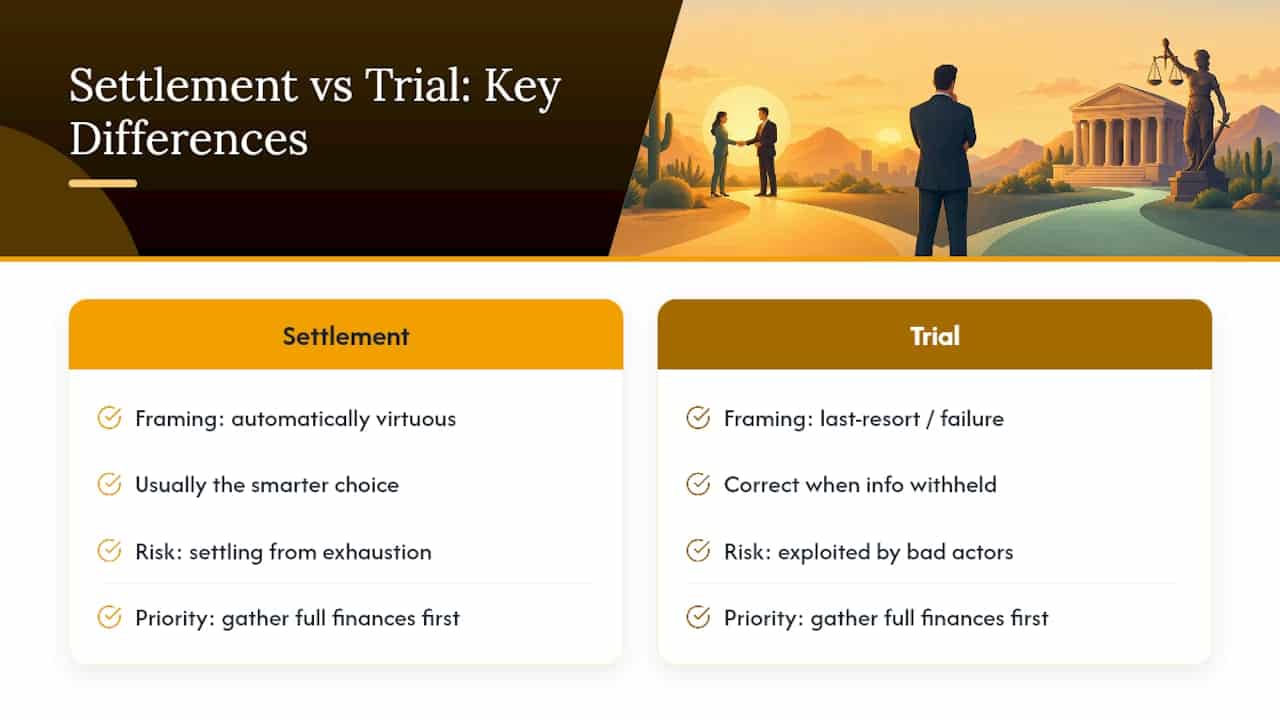
The bigger failure I see in how this topic gets discussed elsewhere is the framing that trial is a last resort for people who “couldn’t work it out.” Sometimes trial is the correct legal strategy, full stop, especially when one spouse holds financial information hostage or negotiates in bad faith knowing the other side wants to avoid conflict. Treating every trial as a failure of negotiation lets bad actors exploit a spouse’s desire for peace.
What should you prioritize first? Get your financial documentation together before you negotiate anything. Every leverage point in a settlement conversation depends on knowing exactly what you’re dividing. Spouses who walk into mediation without full financial clarity aren’t negotiating. They’re guessing, and guesses rarely favor the person who made them.
— Brett
How Highdesertfamilylawgroup Helps You Weigh Settlement Against Trial
Deciding between settlement and trial isn’t a decision you should make alone, and it’s not one where guesswork should cost you your financial future. Highdesertfamilylawgroup brings over 20 years of family law experience to that exact decision, walking you through what a realistic settlement looks like before comparing it to what a trial outcome might actually cost you in time, money, and certainty.

The firm handles the full range of paths this article covers: collaborative divorce for spouses who want structured negotiation, divorce mediation for those who want a neutral third party at the table, and full contested trial representation when a spouse won’t negotiate fairly or safety concerns rule out direct talks. During an initial consultation, clients review their financial situation, custody priorities, and receive an assessment of settlement value compared to trial risk to make informed decisions. If you’re weighing which path fits your situation, start with the firm’s divorce services page and schedule a consultation to talk through your specific circumstances.
This article is general information, not a substitute for advice from a qualified lawyer. Consult a qualified legal professional about your own circumstances before acting on anything here.
Sources
- Steps to complete before trial (California Courts self-help)
- Marital settlement agreement (Cornell Law Wex)
- Santa Cruz County Local Rule on Settlement Conferences
FAQ
Is It Better to Take a Settlement or Go to Trial?
Settlement is usually better because it costs less, resolves faster, and lets you control the outcome instead of a judge. Trial becomes the better option when your spouse is hiding assets, negotiating in bad faith, or when safety concerns make direct negotiation unworkable.
How Much Does a Wife Get in a Divorce Settlement?
There’s no fixed percentage or formula, since settlement terms depend on the specific assets, debts, income, and custody arrangements of each case. A marital settlement agreement reflects whatever both spouses negotiate and a court approves, which is why gathering complete financial documentation before negotiating matters so much.
Is It Better to Settle a Divorce Out of Court?
For most couples, yes. Settling out of court keeps the process private, moves faster, and typically costs less than the 2% to 10% of cases that proceed all the way to trial, though it only works when both spouses negotiate honestly and disclose finances fully.
Why Would a Divorce Case Go to Trial?
A case usually heads to trial when spouses can’t agree on major issues like custody or property division, when one side suspects hidden assets, or when a settlement conference fails to produce an agreement despite required procedural steps. Trial then lets a judge issue a binding ruling on the unresolved issues.
What Does Highdesertfamilylawgroup Charge for Divorce Representation?
Current pricing for divorce, mediation, and collaborative divorce services is available directly through Highdesertfamilylawgroup’s divorce page, since fees vary based on case complexity and the services needed.