



4 Steps Arizona Attorneys Resolve School Choice Custody Disputes

If a parent has sole legal decision-making authority, that parent decides a child’s school. With joint legal decision-making, both parents must agree, or one must ask a court to resolve the impasse through a petition or an Education Order. Arizona courts rely on A.R.S. §25-403.02 and best-interests factors to break these ties, and mediation is usually the faster, cheaper first step.
TL;DR:
- Courts can resolve school-choice disputes between joint decision-makers but cannot override a sole decision-maker’s authority without evidence that the child’s health or emotional well-being is at risk.
- Enrollment procedures for public, charter, private, ESA, and homeschool options depend on custody authority and often involve timing, residency, and documentation requirements that may complicate disputes.
- Starting with a written proposal and attempting mediation can prevent costly court battles, as courts typically reverse unilateral school enrollment actions under joint decision-making.
- School choices that geographically affect the child’s residence may trigger relocation statutes, requiring specific legal notices and considerations for parenting time impact.
- Maintaining detailed records of communications, deadlines, and consent attempts is essential to protect your legal position in custody and school decision disputes.
Table of Contents
- Joint versus sole legal decision-making: what each means for school choice
- The statutes and cases behind Arizona school-choice disputes
- Public, charter, private, ESA, or homeschool: what custody status changes
- Steps to resolve a school-choice disagreement before it reaches a judge
- When a school pick turns into a relocation case
- Do’s and don’ts that protect your position
- How we approach school-choice disputes at High Desert Family Law Group
- Getting help with a school-choice or custody dispute
- Primary sources for statutes, orders, and opinions
- Sources
- FAQ
Joint versus sole legal decision-making: what each means for school choice
Arizona law separates legal decision-making (authority over major decisions like education, health care, and religion) from parenting time (the schedule). A parent with sole legal decision-making authority can generally pick the school without the other parent’s sign-off, though that authority has limits. A parent under joint legal decision-making cannot enroll or withdraw a child from school without the other parent’s agreement or a court order, even if that parent has the majority of parenting time.
Many parenting plans go further and assign “final” or “presumptive” authority over education to one parent within an otherwise joint framework, meaning that parent effectively controls school decisions unless the other parent successfully petitions to modify it. An Education Order supplements the parenting plan by spelling out specifics for schools: who enrolls the child, who accesses IEP or 504 records, and who receives report cards and portal logins.
- Sole legal decision-making generally allows one parent to choose the school without consent.
- Joint legal decision-making requires agreement or a court ruling on disputed school choices.
- “Final” or “presumptive” authority clauses can function like sole authority for that specific decision.
- A sole decision-maker cannot use school choice to unilaterally change the parenting-time schedule.
The statutes and cases behind Arizona school-choice disputes
Two statutes do most of the work. A.R.S. §25-403 sets the best-interests standard and directs courts to maximize parenting time while assigning legal decision-making. A.R.S. §25-403.02 lets a judge decide disputed elements of a parenting plan, school choice included, when parents cannot agree.
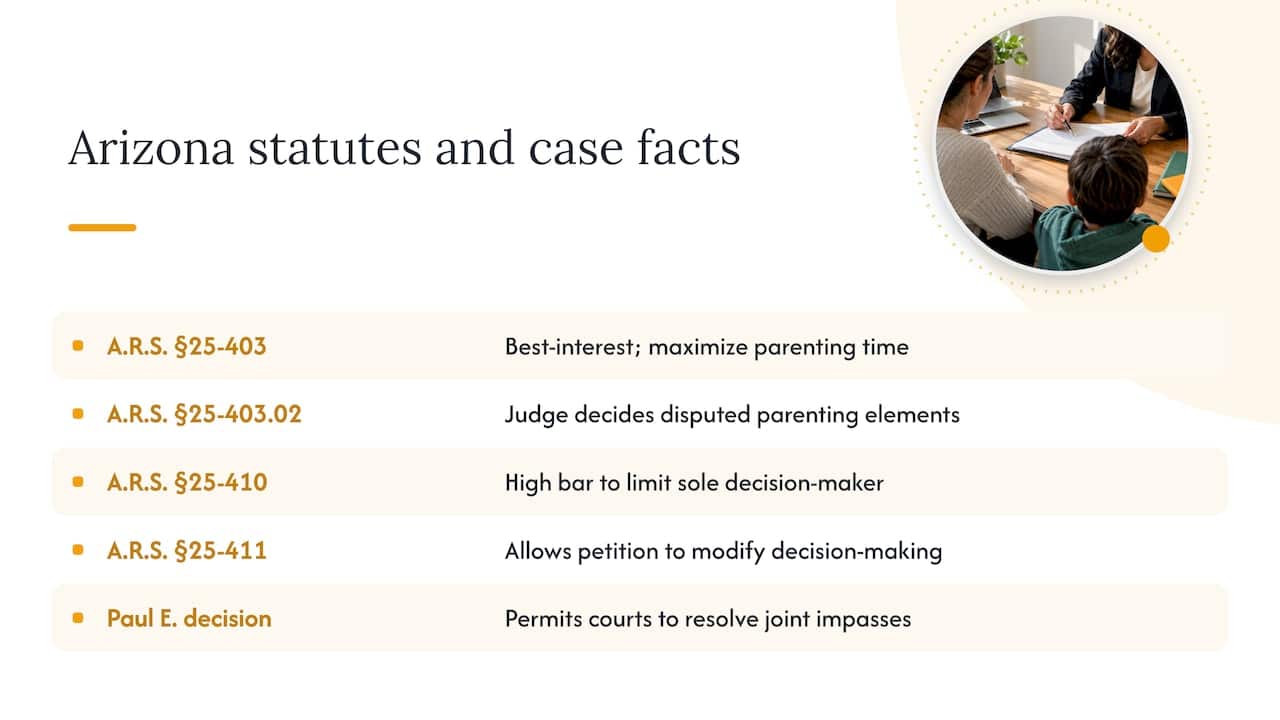
A.R.S. §25-410 sets a high bar for limiting a sole decision-maker’s authority: a court will only step in if the other parent shows the child’s physical health would be endangered or emotional development significantly impaired. A.R.S. §25-411 governs how a parent petitions to modify legal decision-making when circumstances change.
Arizona’s Paul E. v. Courtney F. decision confirms courts can resolve school-choice impasses for joint decision-makers while clarifying limits on how far a court can intrude into a parent’s authority once it has been granted.
Courts may resolve a school-choice impasse between joint legal decision-makers, but they cannot override a sole decision-maker’s authority absent the statutory showing required under Arizona law.
Practitioners consistently see one misconception play out in filings: parents assume joint legal decision-making means agreeing on every homework policy or teacher conference, when the statute reserves it for major decisions only.
Public, charter, private, ESA, or homeschool: what custody status changes
School type changes the paperwork, not the underlying custody rule. Whoever holds decision-making authority for education still makes the call, but each enrollment path carries its own constraints that can complicate a dispute.
District enrollment typically requires proof of residency tied to one parent’s address, and open-enrollment transfers to another district often run on waitlists with application windows that close months ahead. Charter schools set their own authorizer rules and frequently have waitlists too, so timing matters more than in traditional district enrollment.
Arizona’s Empowerment Scholarship Account program, administered by the Arizona Department of Education, makes the enrolling parent an Account Holder with contract obligations tied to state funds, which raises the stakes if the other parent disputes the enrollment after the fact. Private school and homeschool choices generally require the same underlying decision-making authority, plus proof of enrollment or an affidavit filed with the state.
- District enrollment depends on residency documentation and open-enrollment deadlines.
- Charter enrollment follows the charter’s own waitlist and authorizer rules.
- ESA enrollment ties the parent to contract terms as the Account Holder.
- Private school and homeschool paths still require the underlying legal authority to choose them.
Pro Tip: Before signing any ESA contract or charter application, confirm in writing that you currently hold the authority to make that decision alone.
Steps to resolve a school-choice disagreement before it reaches a judge
Start with a written, narrowly tailored proposal rather than a demand. A short email naming the specific school, the enrollment deadline, and the reason it fits the child gives the other parent something concrete to respond to and creates a record if the dispute escalates.
- Document your proposal and the other parent’s response, including dates and deadlines.
- Try mediation or a parenting coordinator, both of which can facilitate agreement but generally cannot impose a binding decision without both parents’ consent to that authority.
- If mediation fails, request an Education Order that spells out enrollment authority, records access, and special-education decision-making.
- If the underlying legal decision-making designation itself needs to change, file a Petition for Modification under A.R.S. §25-411 with supporting evidence.
Courts that see a parent enroll or withdraw a child unilaterally under joint decision-making often reverse the enrollment, and the acting parent risks an attorney-fee award and a credibility hit that follows them through the rest of the case.
Pro Tip: Keep every school-related email and text in one folder. Judges respond to a clear timeline far more than to a verbal account of who said what.

When a school pick turns into a relocation case
A school choice becomes a relocation issue once it moves the child far enough to affect the other parent’s parenting time, triggering the notice and findings required under Arizona’s relocation statute. That is a different legal question from a routine legal-decision-making dispute, and it demands its own pleading.
- Relocation analysis applies when the move affects the other parent’s ability to exercise parenting time, not just which building the child attends.
- Courts require specific findings on the child’s best interests and the practical effect on the existing schedule.
- When a proposed school sits near a district or state line, file both a modification petition and a relocation notice to cover either outcome.
Do’s and don’ts that protect your position
- Do keep dated records of every school conversation, application deadline, IEP or 504 meeting, and ESA document.
- Do send the school a copy of any Education Order or the relevant parenting-plan language before the first day of class.
- Do not enroll or withdraw a child unilaterally under joint decision-making, even to hold a seat, without first documenting the attempt to reach agreement.
- Do gather attendance and adjustment records, teacher statements, and any evaluation reports that speak to the child’s needs.
Pro Tip: If you must reserve a seat before an agreement is reached, get it in writing that the reservation is contingent and non-binding on either parent.
How we approach school-choice disputes at High Desert Family Law Group
We favor narrowly targeted Education Orders and low-conflict resolutions over drawn-out litigation whenever the facts allow it. A typical engagement starts with a consultation and document review, moves to a proposed order or mediation plan, and treats court as the last resort rather than the first move.
— Brett
Getting help with a school-choice or custody dispute
Sorting out who decides a child’s school should not come down to guesswork or a rushed unilateral choice. 
Our child custody team handles modification petitions and Education Order drafting, and our best interest attorney services focus specifically on arguing what serves the child in a school-choice hearing. A first consultation typically includes a review of your current parenting plan, a recommendation on temporary orders if needed, and a proposed mediation approach before anyone files.
- Custody modification petitions under §25-411.
- Drafting and negotiating Education Orders.
- Mediation preparation and representation.
- Representation in contested school-choice hearings.
Reach out through our family law page to schedule a consultation and get a straight answer on where your case stands.
Primary sources for statutes, orders, and opinions
- A.R.S. §25-403.02, §25-410, and §25-411
- Paul E. v. Courtney F. opinion
- Maricopa County sample Education Order
- Arizona Department of Education ESA Handbook
- Track Arizona legislative changes to family law statutes
This article is general information, not a substitute for advice from a qualified lawyer. Consult a qualified legal professional about your own circumstances before acting on anything here.
Sources
- Arizona Revised Statutes §25-403.02
- Paul E. v. Courtney F., Arizona Supreme Court (2019)
- Sole Legal Decision-making Education Order (Maricopa County sample)
- Arizona Department of Education — ESA Handbook (2025–2026)
FAQ
At what age can children choose which parent to live with in Arizona?
Arizona law does not set a fixed age at which a child’s preference controls; a judge may consider a child’s wishes as one of several best-interests factors, giving more weight as the child matures. There is no statute that hands a teenager an automatic right to decide, so the court still weighs the full picture under A.R.S. §25-403.
Can you lose custody for bad-mouthing the other parent?
Disparaging the other parent in front of the child can factor into a best-interests analysis under A.R.S. §25-403, particularly the factor addressing each parent’s willingness to foster a healthy relationship with the other. Courts generally treat it as one consideration among several rather than an automatic basis to strip custody.
How can I avoid a 50/50 parenting-time schedule?
A parent seeking something other than equal time needs to show the court why a different schedule serves the child’s best interests, since Arizona statute directs judges to maximize parenting time for both parents where appropriate. Evidence about the child’s needs, each parent’s involvement, and logistical realities matters more than a general preference for a different split.
Is joint legal decision-making a good idea?
Joint legal decision-making works well for parents who can communicate on major decisions like schooling and health care, but it requires ongoing cooperation that not every family can sustain. When parents cannot agree, they still have recourse through mediation or a petition under A.R.S. §25-403.02 rather than being stuck at an impasse indefinitely.