



Arizona Child Support Modification: 15% Rule, Forms, Deadlines

Yes, Arizona allows you to modify a child support order, and you have two main paths: the simplified process when a guideline recalculation changes the amount by 15% or more, or a standard petition when the change is smaller but still substantial and continuing. Start by completing the Parent’s Worksheet for Child Support Amount to see where you land, then ask DCSS for a review or file your own petition. Because Arizona modifications apply only going forward, file as soon as your situation changes.
TL;DR:
- An increase in parenting time generally supports modification only after a custody order formally records the new schedule; informal arrangements alone do not qualify.
- DCSS reviews orders every three years; an earlier review can take up to six months and may run alongside enforcement in open cases.
- After service, parents have 20 days in Arizona or 30 days elsewhere to request a hearing; without one, the court may rule on paperwork.
- Courts allow income estimates when a parent’s pay records are unavailable, but you must explain your basis with prior tax returns or employer pay scales.
Table of Contents
- Standard vs simplified modification: which path fits your case
- Step-by-step filing checklist: exact forms, worksheets, and filing logistics
- How DCSS works and when to use a DCSS review
- Evidence and calculations judges expect
- Service, hearing deadlines, and effective dates: what to expect after you file
- Practical tips to avoid delays and common filing mistakes
- How High Desert Family Law Group approaches child support modifications
- If you want help with your modification, talk to our team
- FAQ
- Sources
Standard vs simplified modification: which path fits your case
Arizona courts use two different legal tests depending on how much your support amount would change. The simplified process applies when recalculating support under the Arizona Child Support Guidelines produces a figure that differs from your current order by 15% or more.
Here, you carry the burden of showing the change is both substantial and likely to continue, not temporary.
A few situations fall outside the simplified track entirely:
- Spousal maintenance modifications always require the standard process, never the simplified packet.
- A parenting time change that has not been formally modified in a custody order does not automatically justify a support change, even if you are informally sharing more time.
- Cases involving interstate enforcement or multiple state orders typically need standard filings so the court can address jurisdiction.
Consider two quick scenarios. A parent whose new partner starts contributing to household expenses, with no change to either parent’s actual income, usually does not have grounds for modification at all, since the guidelines calculate support based on parental income, not household income.
Step-by-step filing checklist: exact forms, worksheets, and filing logistics
Once you know which path applies, the paperwork is mostly the same shape. Here is the order most parents follow:
- Pull your existing order. You will need the case number, the current support amount, and the judge’s name for the caption of your new petition.
- Complete the Parent’s Worksheet for Child Support Amount. This worksheet drives the entire analysis and must be signed under oath, per the Arizona Child Support Guidelines.
- Choose your petition form. Maricopa County’s simplified packet includes the Petition to Modify, Child Support Worksheet, and proposed Order forms, identified as DRMSS11F, DRS12F, DRS81F, and DRS88F.
- Gather an Affidavit of Financial Information (AFI) along with current pay stubs, your most recent tax return, and employer contact details.
- Calculate your percentage change. Subtract your current order amount from the new worksheet result, divide by the current amount, and multiply by 100.
- Make enough copies. You will typically need one for the court, one for the other parent, and one for your own records.
- File with the clerk and pay the filing fee, or request a fee deferral if you cannot afford it.
- Serve the other parent following the service rules in the Arizona Rules of Family Law Procedure, since proper service determines when the hearing-request clock starts.
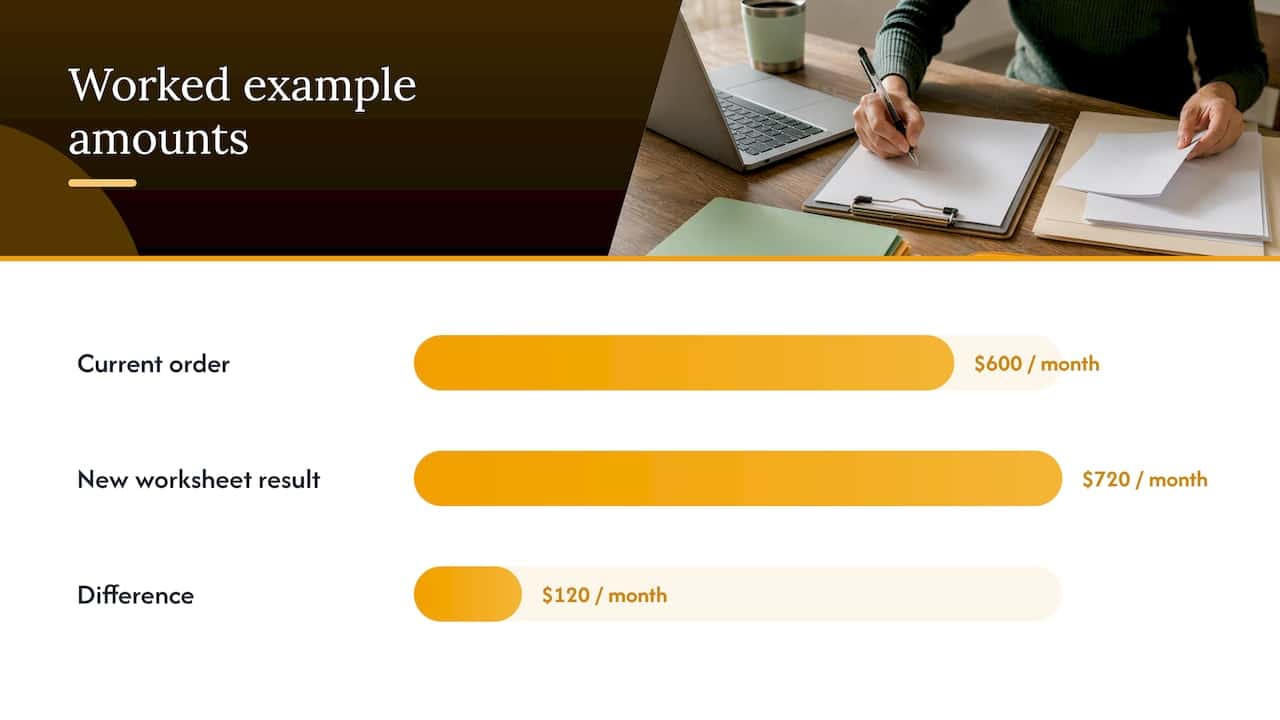
Here is a worked example using illustrative numbers. Say your current order is $600 a month, and the new worksheet calculation comes out to $720. The difference is $120, divided by $600, equals 0.20, or a 20% increase.
Pro Tip: Attach a copy of your math to the worksheet packet. Clerks and judges move faster when they can see exactly how you arrived at the new number instead of recalculating it themselves.
Filing logistics vary slightly by county, but most courts want the original petition, the worksheet, your AFI, and proof of service filed together rather than piecemeal. If you are unsure whether your county uses the same form numbers as Maricopa County, the Arizona Courts self-service center lists the statewide templates and points to online worksheet tools.
How DCSS works and when to use a DCSS review
The Arizona Division of Child Support Services offers a second route that does not require you to draft your own petition. DCSS reviews orders every three years automatically, without you needing to prove anything changed. If you need a review sooner than that, you have to show a substantial and continuing change yourself, the same standard that applies in standard court filings.
DCSS modification reviews can take time:
- A routine three-year review generally moves faster because DCSS already has your case file and income history on record.
- An earlier review, triggered by your documentation, can take up to six months depending on how complete your paperwork is and how quickly the other parent responds.
- DCSS asks for the same categories of proof courts want: recent pay stubs, tax returns, and employer information.
There is a tradeoff worth understanding before you choose this route. If your case is open with DCSS because one parent applied for Title IV-D services, DCSS can pursue a modification while simultaneously continuing enforcement activity on the existing order. That means a parent who owes support should expect administrative review and potential enforcement action to run in parallel, not one after the other. DCSS brings real enforcement tools to the table, which helps when arrears are part of the picture, but the administrative timeline is usually slower than filing your own petition when you simply need a fast recalculation.
Evidence and calculations judges expect
Courts and DCSS both want to see the numbers behind your request, not just a statement that your income changed. Acceptable documentation generally includes:
- Recent pay stubs covering the last several pay periods.
- W-2 or 1099 forms and your most recent filed tax return.
- Unemployment benefit notices if you are currently receiving them.
- A letter from your employer confirming hours, pay rate, or a layoff date.
A 15% swing in the guideline calculation is treated as evidence of a substantial and continuing change on its own. That single figure, set out in the Arizona Child Support Guidelines, is often what decides whether you qualify for the faster simplified packet.
The Parent’s Worksheet has to be completed accurately and signed under oath before you file. When you cannot get the other parent’s current pay records, Arizona courts allow you to attribute or estimate their income, as long as you explain your basis. Past tax returns, a known employer’s pay scale, or a sworn statement about their work history can all support an estimate, but you need to show your reasoning rather than guess at a number.
If your modification involves a change to medical insurance coverage, there is a related but separate procedure: a medical insurance assignment modification updates who carry the child’s coverage without reopening the full support calculation, which can be faster when income itself has not changed.
Service, hearing deadlines, and effective dates: what to expect after you file
Once you serve the other parent, the clock starts running on their chance to object. The deadlines differ based on where they were served:
- A parent served within Arizona has 20 days to file a request for hearing.
- A parent served outside Arizona has 30 days to request a hearing, per the simplified process packet instructions.
- If no hearing request arrives within that window, the court can review the paperwork and enter the new order without a hearing at all.
Keep in mind that Arizona does not allow retroactive modification of child support. The new amount generally takes effect on the date stated in the order itself, often the month following the signed order, according to DCSS guidance on unemployment and support. That means waiting months to file costs you real money: the old amount stays in effect for every day before your petition is filed and served, regardless of when your circumstances actually changed.
Practical tips to avoid delays and common filing mistakes
A few habits separate a smooth modification from one that gets bounced back. Double-check your Parent’s Worksheet math before filing. A simple arithmetic error can send the whole packet back for correction and cost you weeks.
If you are unemployed, document your job search activity. Arizona counts unemployment benefits as income for support purposes, so losing a job does not automatically lower your obligation, but a documented search strengthens your case if you are asking the court to attribute less income to you.
Pro Tip: Keep a dated log of every job application, interview, and unemployment claim. Judges weigh effort heavily when deciding whether to attribute additional income to an unemployed parent.
Finally, track your service date carefully. The 20 or 30-day hearing window starts from service, not from filing, and a missed deadline on either side can change the entire outcome.
How High Desert Family Law Group approaches child support modifications
We have extensive experience handling Arizona family law matters, and modification cases are a regular part of that work. We review your current order, verify your Parent’s Worksheet calculations, and prepare the AFI and supporting documentation before anything gets filed.
We generally recommend retaining counsel when a case involves a guideline deviation, service on an out-of-state parent, existing arrears, or a dispute over how to attribute the other parent’s income. In a consultation, we walk through your packet, flag anything that could slow the court down, and talk through whether negotiation or a contested hearing makes more sense for your situation.
— Brett
If you want help with your modification, talk to our team
Preparing a modification packet correctly the first time saves months of back-and-forth with the court. We help clients prepare Petitions to Modify, complete the Parent’s Worksheet and Affidavit of Financial Information accurately, coordinate with DCSS when enforcement is part of the picture, and represent clients at hearings when the other parent contests the request.

If your situation also involves custody or parenting time questions tied to the same case, our child custody services and broader family law practice cover both sides of the dispute together. Many modification requests surface during or after a divorce, so if that applies to you, our divorce team can fold the support question into that case. Start with a packet review so you know exactly where your numbers stand, then decide whether you need full representation at a hearing.
This article is general information, not a substitute for advice from a qualified lawyer. Consult a qualified legal professional about your own circumstances before acting on anything here.
FAQ
Can I modify custody without hiring a lawyer?
You can file a custody modification on your own using Arizona’s self-help court forms, though custody cases often involve more subjective factors than support cases, which rely on worksheet math. If parenting time changes alongside support, reviewing custody modification steps before filing can help you understand how the two issues interact.
How do I get child support if the other parent isn’t working?
Arizona courts can attribute income to an unemployed parent based on past earnings, job qualifications, and local job availability, rather than simply setting support at zero. If the other parent is receiving unemployment benefits, those benefits count as income under Arizona DCSS guidance, and that figure feeds into the worksheet calculation.
Can I get a loan to cover child support I owe?
Child support arrears are a legal debt, not a lender-specific product, so there is no dedicated “child support loan” recognized under Arizona law. Parents facing arrears are generally better served by requesting a modification or working out a payment plan through DCSS enforcement rather than taking on separate debt to cover a past-due balance.
How much is child support for one child in Arizona?
Arizona calculates support using the Parent’s Worksheet under the Arizona Child Support Guidelines, which weighs both parents’ incomes, parenting time, and costs like health insurance and childcare, so there is no single statewide dollar figure for one child. The only way to get an accurate number for your situation is to run your actual income and parenting time through the worksheet itself.
Can I change child support if my parenting time increases?
A genuine increase in parenting time can support a modification request, but Arizona generally requires that change to be reflected in a formal custody or parenting time order first. Without that formal update, an informal shift in schedules alone usually will not meet the substantial and continuing change standard used in a standard modification filing.
Sources
- How to Change Child Support Using the Simplified Process in Maricopa County, Arizona
- Modify a Child Support Order — Arizona Department of Economic Security (DCSS)
- Arizona Child Support Guidelines (adopted by the Arizona Supreme Court)
- Petition to Modify – Simplified Process packet (Maricopa Superior Court)