



When You Need a Child Support Lawyer Near Me: What to Know First
Finding a child support lawyer near me is often the first step Arizona parents take when facing one of the most stressful situations of their lives — making sure their children are financially protected after a separation or divorce.
Here’s a quick answer if you’re in a hurry:
| What You Need | What a Local Child Support Lawyer Does |
|---|---|
| Establish child support | Files the initial order using Arizona’s Child Support Guidelines |
| Modify an existing order | Petitions the court when income or custody changes |
| Enforce unpaid support | Pursues wage garnishment, license suspension, or contempt action |
| Handle complex income | Analyzes self-employment income, bonuses, or hidden earnings |
| Navigate local courts | Knows Maricopa County and Pinal County procedures |
The stakes are high. Approximately 13.6 million U.S. children received child support in 2021 — yet fewer than half of custodial parents received the full amount they were owed. A local attorney who knows Arizona law and your county’s courts can make a real difference in that outcome.
Child support cases are rarely straightforward. Income disputes, custody schedules, and enforcement battles can quickly become overwhelming without the right legal guidance.
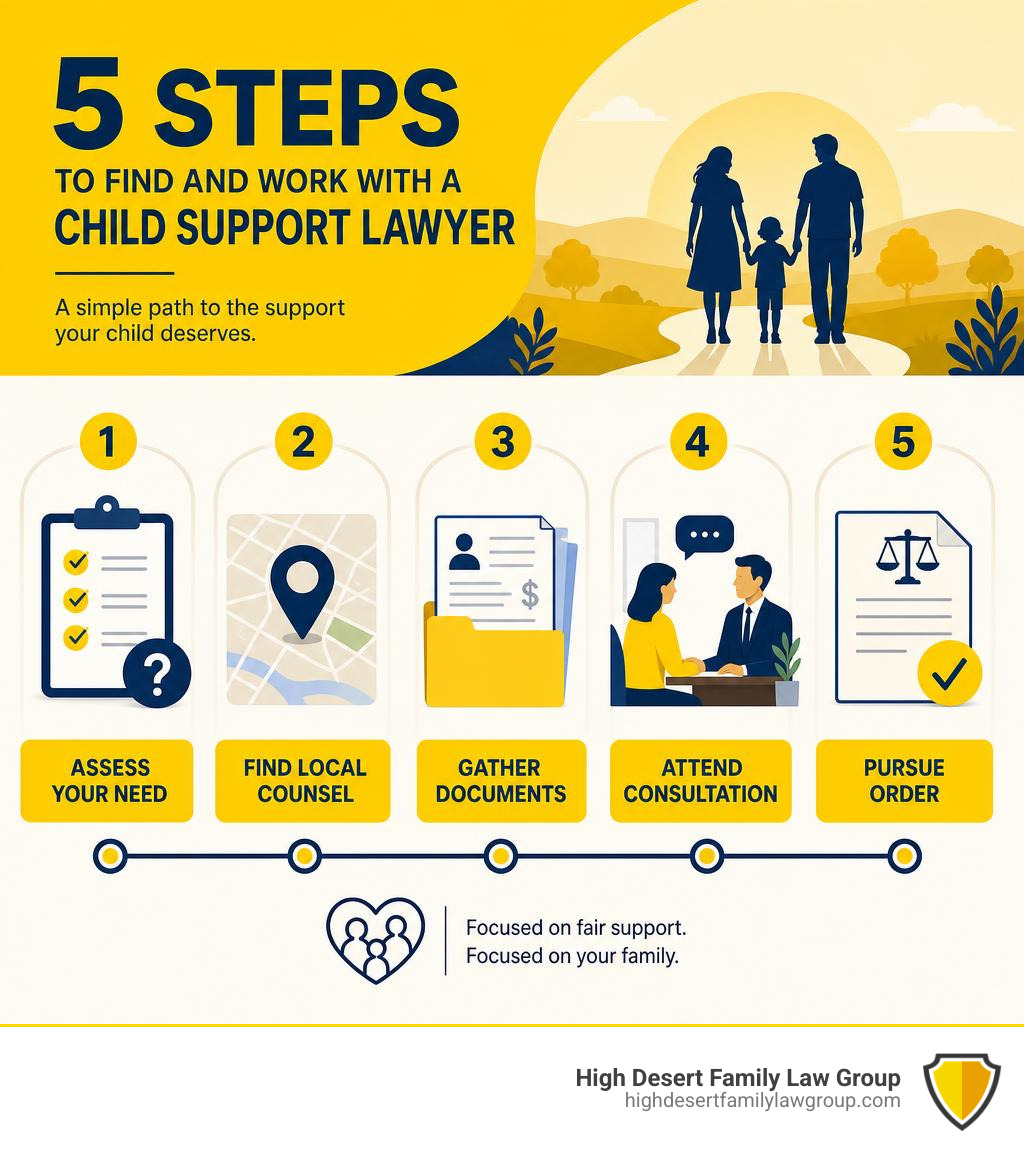
What Does a Child Support Lawyer Do?
A child support attorney is your legal advocate, financial detective, and navigator through the Arizona family court system. While the state uses a standardized calculator to determine payments, getting to the “correct” numbers to plug into that calculator is where the real work happens.
An experienced attorney handles the heavy lifting, including establishing paternity, managing financial disclosures, and ensuring that the final court orders are legally binding and fair.

In Arizona, child support is governed by the Arizona Child Support Guidelines. These guidelines are based on the Income Shares Model, which assumes that children should receive the same proportion of parental income that they would have received if the parents lived together. To calculate this accurately, the court looks at several critical factors:
- Gross Income: This includes wages, salaries, bonuses, commissions, self-employment income, and even seasonal or overtime pay if it is consistent.
- Parenting Time: The number of parenting days or overnights each parent has directly impacts the calculation. The more time a child spends with a parent, the more expenses that parent directly incurs, which can adjust the support amount.
- Health Insurance & Childcare: The cost of medical, dental, and vision insurance for the child, as well as work-related childcare expenses, are factored directly into the monthly obligation.
- Extraordinary Expenses: Special educational needs, medical conditions, or extracurricular costs may justify deviations from the standard formula.
Understanding the distinction between what is and isn’t covered by these payments is a common point of confusion for many parents. For a deeper dive into these rules, you can read about What Does Child Support Cover and see how specific state laws apply by reading What Does Child Support Cover in Arizona.
Generally, basic child support is designed to cover food, housing, clothing, and basic education. To prevent future disputes, it is equally important to understand What Does Child Support Payments Cover versus What Does Child Support Not Cover—such as private school tuition or elite sports leagues, which must be negotiated separately.
Another frequent question is how custody arrangements alter your financial obligations. Many parents ask, “Do You Pay Child Support with Joint Custody?” The short answer is yes; even in equal 50/50 physical custody arrangements, the parent with the higher income may still be required to pay support to ensure the child enjoys a similar standard of living in both households. You can find more details on this dynamic in our guide, Do You Still Pay Child Support with Joint Custody.
To illustrate how Arizona evaluates resources, consider the difference between how gross income and net income are treated under the guidelines:
| Financial Element | Gross Income (Arizona Guideline Starting Point) | Net Income (For Tax & Take-Home Reference) |
|---|---|---|
| Definition | Total earnings before taxes, retirement, or health insurance deductions. | Take-home pay after taxes and mandatory deductions. |
| What’s Included | Wages, bonuses, commissions, self-employment, pensions, trust income. | The actual cash available in your paycheck. |
| Use in Calculator | Mandatory. Court starts with gross income and applies specific legal deductions. | Used primarily to assess a parent’s overall financial health or deviation requests. |
| Deductions Allowed | Court-ordered spousal maintenance, support for children of other relationships. | Standard tax withholdings (not directly used to lower the baseline gross income). |
Why You Need a Child Support Lawyer Near Me
While online calculators can give you a rough estimate, they cannot account for the nuances of local court procedures or complex financial situations. This is why searching for a child support lawyer near me who understands the specific landscape of Maricopa County or Pinal County family courts is so critical.
Local court systems have their own administrative rules, filing preferences, and even judicial tendencies. An attorney practicing regularly in Scottsdale or Chandler knows how local judges interpret the guidelines, how to efficiently submit financial affidavits, and how to avoid costly procedural delays.
Furthermore, child support calculations become highly complex when dealing with non-traditional income. If you or the other parent are self-employed, own a business, receive fluctuating bonuses, or work on a commission-only basis, standard pay stubs do not tell the whole story. A skilled local attorney knows how to conduct forensic financial reviews, trace business cash flows, and uncover hidden income to ensure the court works with accurate numbers.
If you are navigating the system in surrounding areas, we can help you understand the local administrative processes, such as Understanding Child Support Payments in Pinal County AZ. Additionally, while state agencies like the Arizona Department of Economic Security Child Support Services offer basic administrative help, they cannot provide you with individualized legal strategy, aggressive representation, or argue for custom deviations in court. For that level of protection, private legal counsel is essential.
Key Services Provided by a Child Support Attorney
A dedicated family law attorney provides comprehensive legal support throughout the lifecycle of a child support order. Whether you are starting from scratch, adjusting to a major life change, or fighting to collect what you are owed, a lawyer can step in to handle the heavy lifting.
- Establishing Support: Drafting and filing the initial petition, establishing legal paternity if necessary, and presenting financial evidence to secure a fair initial order.
- Modifying Orders: When financial realities shift, a lawyer can petition the court to legally adjust the monthly payments.
- Enforcing Payments: If a parent refuses to pay, an attorney can initiate aggressive collection efforts, including wage garnishment, driver’s or professional license suspension, and filing for contempt of court, which can carry jail time for non-compliance.
Finding a Qualified Child Support Lawyer Near Me for Modification
Life does not stand still, and a child support order that worked three years ago may no longer make sense today. In Arizona, child support orders can be modified if there has been a “substantial and continuing change in circumstances.”

Common triggers for a modification include:
- A significant, involuntary reduction in income (such as a job loss or medical disability).
- A major increase in the other parent’s earnings.
- A permanent shift in the parenting time schedule (e.g., a child moving in full-time with the paying parent).
- A substantial change in the child’s needs, such as rising healthcare costs or new educational requirements.
It is vital to file a legal petition for modification as soon as these changes occur. Informal “handshake” agreements between parents are not legally binding, and back support (arrears) will continue to accrue at the original rate until the court signs a new order. To learn more about how we partner with parents to handle these transitions smoothly, read Child Support Attorneys: Your Partners in Parenting.
Choosing a Child Support Lawyer Near Me for Enforcement
When a parent falls behind on court-ordered child support, it can quickly throw your family’s financial stability into chaos. If you are owed back payments, a local attorney can bypass bureaucratic delays and go directly to court to enforce the order.
Enforcement mechanisms in Arizona are powerful. A judge can order:
- Wage Garnishment: Direct withholding from the paying parent’s paycheck.
- License Suspension: Suspending driver’s, recreational, or professional licenses.
- Asset Seizure: Freezing bank accounts or placing liens on real estate.
- Contempt of Court: A legal finding that can result in fines and incarceration until a purge payment is made.
If you are a father seeking to protect your custodial rights and ensure fair support terms, or if you are facing unfair enforcement actions, it is helpful to review Child Support Rights for Father to understand how the law protects both parents’ roles in their children’s lives.
Frequently Asked Questions About Child Support
How much does it cost to hire a child support lawyer?
The cost of hiring a child support attorney varies based on the complexity of the case, whether the matter is contested, and the attorney’s experience level. Most family law attorneys charge an hourly rate backed by an initial retainer fee. For an in-depth breakdown of what to expect financially, check out our guide on Child Support Lawyer Costs 2023. Investing in skilled counsel often pays for itself by preventing long-term, costly errors in support calculations.
Can child support be waived in a prenuptial agreement?
No. Under Arizona law, child support is a legal right that belongs to the child, not the parents. Because of this, courts will not enforce any clauses in prenuptial or postmarital agreements that attempt to limit, waive, or predetermine child support. The court always retains ultimate authority to calculate support based on the child’s best interests at the time of separation.
What should I bring to my initial consultation?
To make the most of your first meeting with a child support lawyer near me, you should gather and bring the following documents:
- Your last two years of federal and state tax returns (including W-2s or 1099s).
- Your most recent pay stubs (covering at least the last three months).
- Any existing court orders, divorce decrees, or parenting plans.
- Documentation of child-related expenses, such as health insurance premiums and monthly childcare invoices.
Conclusion
Navigating child support issues requires a balance of financial precision and deep legal knowledge. Whether you are establishing an initial order, seeking a modification due to a job change, or pursuing unpaid back support, having the right team in your corner is invaluable.
At High Desert Family Law Group, we provide aggressive, individualized representation designed to protect your children’s financial future and give you peace of mind. Our experienced family law team serves clients throughout Greater Scottsdale, Chandler, and the surrounding Arizona communities. We understand that no two families are alike, and we work tirelessly to craft legal strategies tailored to your unique circumstances.
If you are ready to discuss your case and explore your legal options, we invite you to reach out to us today. Contact High Desert Family Law Group to learn more about our comprehensive family law services and take the first step toward securing a stable future for your family.