



Parenting Coordinator Arizona: What Parents Need to Know

A parenting coordinator in Arizona is a neutral professional appointed by the court under Rule 74 of the Arizona Rules of Family Law Procedure to help parents resolve day-to-day parenting disputes after a legal decision-making or parenting time order is already in place. If you are stuck in a cycle of arguments over school pickups, holiday schedules, or extracurricular activities and you already have a court order, a parenting coordinator (PC) may apply directly to your case.
Three things every parent should know before going further:
- Role: A PC facilitates agreement and, when parents cannot agree, makes binding decisions on day-to-day parenting issues within the scope authorized by the court.
- Limits: A PC cannot change legal custody, modify child support, or divide property. Those decisions stay with the judge.
- Fees: Parents pay the PC’s fees as ordered by the court. Most PCs require a retainer upfront.
Rule 74 and Form 11 are the two primary sources governing parenting coordination in Arizona. Rule 74 sets the legal framework for appointment, authority, and objection procedures. Form 11 (Information for Parents Regarding the Use of Parenting Coordinators) explains the process in plain language. Both are published by the Arizona Judicial Branch and should be your first stop before agreeing to any PC appointment.
Table of Contents
- What is a parenting coordinator and when do Arizona courts use one?
- How parenting coordination works in Arizona: process, meetings, and decisions
- What a parenting coordinator can and cannot do under Arizona practice
- Who qualifies as a parenting coordinator and how to find one in Arizona
- Costs, retainers, and how fees are handled in Arizona PC cases
- How parenting coordinators are appointed and how you can object to their decisions
- Benefits and limitations of using a parenting coordinator
- Alternatives to parenting coordination and when each one fits
- How Highdesertfamilylawgroup helps Arizona parents with parenting coordination
- Key Takeaways
- Why the conventional wisdom about parenting coordinators often misleads parents
- Highdesertfamilylawgroup: local help for Arizona parents navigating the PC process
- Primary sources and helpful resources for Arizona parenting coordination
What is a parenting coordinator and when do Arizona courts use one?
A parenting coordinator is a court-appointed professional whose job is to help parents work through recurring disputes about their children without returning to court every time a disagreement flares up. Under Rule 74, parenting coordination is formally defined as a child-focused alternative dispute resolution process. The goal is to protect and support safe, healthy, and meaningful parent-child relationships while keeping minor conflicts out of the courtroom.
Courts use PCs specifically in post-order situations. The appointment can only happen after a judge has already entered a legal decision-making or parenting time order. A PC is not a tool for the initial custody determination.
A common trigger: two parents share joint legal decision-making but cannot agree on which school the child attends in the fall. They have already been to mediation. The disagreement keeps resurfacing. Rather than file another motion and wait months for a hearing, the court appoints a PC to work through the issue and, if necessary, make a binding call. Form 11 specifically lists schedule disputes, holiday timing, school choice, and pickup logistics as the kinds of issues a PC is designed to handle.
Qualifying professionals who may serve as a PC under Rule 74 include licensed attorneys, psychiatrists, psychologists, independently licensed behavioral health clinicians, court conciliation staff, and others deemed qualified by the court. Courts may set additional requirements beyond the Rule 74 baseline.
How parenting coordination works in Arizona: process, meetings, and decisions
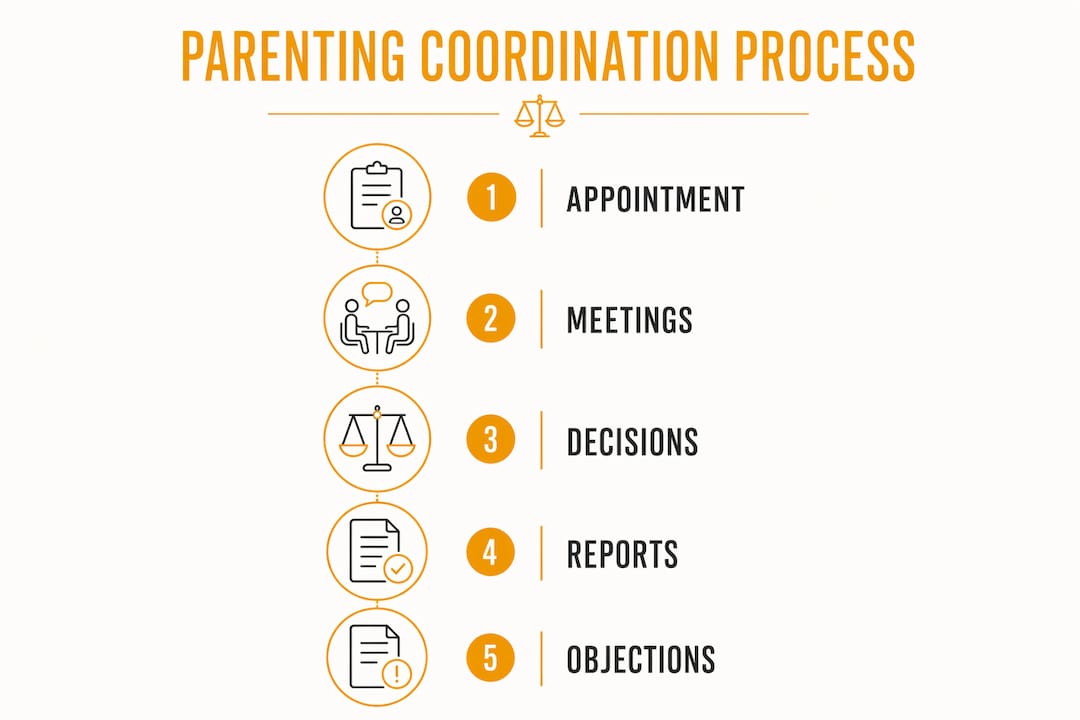
The workflow from referral to resolution follows a fairly consistent path, though the PC controls the pace and structure based on the complexity of each dispute.
- Referral or request. Either parent, both parents jointly, or the court initiates the process. The judge may order a PC on the court’s own motion or based on a stipulation filed by the parties.
- Intake and fee disclosure. The PC meets with each parent separately or together to explain the scope of authority, fee structure, and ground rules. A written fee agreement is standard at this stage.
- Initial meeting. The PC reviews the existing parenting plan and court orders to understand the boundaries of the appointment.
- Information gathering. The PC may request documents, school records, medical records, or other relevant materials. When appropriate and within the court’s authorization, the PC may also consider the child’s perspective.
- Sessions to resolve disputes. The PC works with both parents to reach a voluntary agreement. This is always the first objective.
- Decision or report. If parents cannot agree, the PC makes a binding decision within the authorized scope or files a report with recommendations to the court. The court may accept, modify, or reject those recommendations.
The PC’s binding decisions are effective immediately unless a parent files a timely objection. Reports filed with the court become part of the court record.
Pro Tip: Keep a running log of every communication related to disputed parenting issues, including texts, emails, and voicemails. PCs rely on documentation when parents give conflicting accounts, and a clear paper trail often resolves disputes faster.

What a parenting coordinator can and cannot do under Arizona practice
Understanding the PC’s actual authority prevents two common mistakes: parents who expect the PC to fix everything, and parents who are blindsided when the PC makes a call they did not expect.
What a parenting coordinator can do:
- Make binding decisions on day-to-day schedule details, exchange logistics, and extracurricular activity conflicts
- Resolve disputes about holiday scheduling, school-year calendars, and pickup/drop-off locations
- Gather information from third parties (teachers, doctors, therapists) when authorized
- File reports and recommendations with the court
- Seek emergency temporary orders when imminent risk to a child is identified
- Resign from the appointment with proper notice if the PC determines they cannot be helpful to the family
What a parenting coordinator cannot do:
- Change legal custody or legal decision-making authority
- Modify child support amounts
- Divide or reallocate marital property
- Override a judge’s existing orders on major parenting decisions
- Act as a therapist or provide mental health treatment to either parent or the child
One critical point on confidentiality: parenting coordination is not privileged the way mediation is. Communications with a PC are not protected, and the PC files reports that become part of the court record. Treat every session as if a judge could read the transcript, because in effect, one might.
When a PC observes safety concerns, substance abuse, or signs of domestic violence, mandatory reporting obligations apply. The PC may also seek emergency relief under Rule 48 of the Arizona Rules of Family Law Procedure when a child faces imminent risk.
Who qualifies as a parenting coordinator and how to find one in Arizona
Not everyone who advertises co-parenting services in Arizona meets the Rule 74 standard. Before agreeing to a specific PC, verify their qualifications and ask the right questions.
Qualifying credentials under Rule 74:
- Licensed attorney with family law experience
- Psychiatrist or psychologist
- Independently licensed behavioral health professional (licensed clinical social worker, licensed professional counselor, licensed marriage and family therapist)
- Court conciliation services staff
- Any person the court specifically deems qualified based on education, experience, and expertise
Questions to ask a prospective PC before agreeing to an appointment:
- How many Rule 74 cases have you handled in Arizona?
- What is your fee structure, and what does the retainer cover?
- Can you describe a situation where you had to make a binding decision rather than facilitate agreement?
- Have you ever been removed or resigned from a PC appointment, and why?
- Do you have any conflicts of interest with either parent, their attorneys, or the child’s attorney?
Local superior courts and conciliation services maintain rosters of approved PCs. In Pima County, for example, the Parenting Coordination program is administered through the Conciliation Court. Check your local superior court’s conciliation services office for an updated roster and any county-specific appointment forms. If both parents agree on a specific PC, they can jointly propose that person to the judge for approval.
Costs, retainers, and how fees are handled in Arizona PC cases
Parenting coordination is not free, and the costs can add up quickly in high-conflict cases. Understanding the fee structure before the appointment is signed protects both parents from surprises.
Most parenting coordinators require a retainer before beginning work, and courts typically specify how fees are split between parents in the appointment order. The split is often 50/50, but judges have discretion to order a different allocation based on each parent’s financial situation or conduct. In limited cases, Pima County conciliation services may be available for families with demonstrated financial need.
Public-facing sources and local court forms commonly cite an illustrative range of hourly rates as a market example. These figures are illustrative, not guaranteed, and actual rates vary by the PC’s credentials, the complexity of the case, and the county.
| Fee Component | What to Expect |
|---|---|
| Retainer | Paid upfront before services begin; amount varies by PC |
| Hourly rate | Illustrative range: $250–$450 per hour (market example, not a fixed rate) |
| Fee allocation | Set by court order; often split equally between parents |
| Reappointment costs | New retainer typically required if the PC is reappointed after the initial term |
Steps to protect yourself on fees:
- Request a written fee agreement before the PC begins any work
- Ask the judge to specify fee allocation in the appointment order, especially if cost sharing is disputed
- Clarify what the retainer covers and what triggers additional billing
- Review child custody lawyer costs alongside PC fees so you budget for both if you have legal representation
How parenting coordinators are appointed and how you can object to their decisions
Requesting a parenting coordinator
- Stipulation route. Both parents draft and sign a stipulation agreeing to PC appointment, naming the proposed PC (or a method for selecting one), and specifying the scope of authority and fee allocation. The judge reviews and signs the order.
- Motion route. One parent files a motion requesting a PC appointment. The other parent may respond. The judge decides based on the best interests of the child and the nature of the ongoing disputes.
- Court-initiated. The judge may order a PC on the court’s own motion, particularly in high-conflict cases where repeated filings are disrupting the court’s docket.
For a PC to be appointed, both parents must agree in writing or on the record unless the court uses its own conciliation services. The initial term of appointment cannot exceed one year unless both parents and the PC agree to extend it. Reappointment after the term expires also requires agreement from all three parties.
Objecting to a PC’s report or decision
20-day rule: If a parent disagrees with a report filed by the PC, Arizona rules require that parent to file a formal objection within 20 days of the report being filed with the court. Missing that window can significantly limit your options for relief.
If you believe the PC exceeded the scope of authority granted in the appointment order, file your objection promptly and specifically identify which decision went beyond the authorized scope. Rule 74(H)(3) of the Arizona Rules of Family Law Procedure lists examples of authority overreach.
Discharging a PC requires a court order. One parent cannot unilaterally remove the PC. Both parents can jointly agree to discharge, or one parent can file a motion explaining why discharge is warranted. Disagreeing with the PC’s decisions alone does not justify removal.
Benefits and limitations of using a parenting coordinator
Benefits
- Faster resolution. A PC can address a dispute in days or weeks rather than the months a court hearing might take.
- Child-focused decisions. The PC’s mandate centers on the child’s best interests, not the parents’ preferences.
- Fewer court appearances. Routine disputes stay out of the courtroom, reducing legal fees and stress for everyone involved.
- Skill-building. A major goal of parenting coordination, per Pima County implementing guidelines, is helping parents develop their own problem-solving skills so they eventually no longer need a coordinator.
Limitations
- Cost. Retainers and hourly fees accumulate, especially in high-conflict cases with frequent disputes.
- No confidentiality. Unlike mediation, PC communications are not privileged and reports go to the court.
- Limited scope. The PC cannot resolve major custody or financial issues, so parents may still need court hearings for those matters.
- Perceived bias. If one parent feels the PC consistently favors the other, that perception can erode the process’s effectiveness even when the PC is acting appropriately.
Pro Tip: When negotiating the appointment order, push for a clearly defined scope of authority and explicit terms for reappointment or discharge. Vague scope language is the single biggest source of “authority creep” complaints down the road.
For parents who want to lower conflict before reaching the PC stage, resources like True Parenting offer ongoing parenting development tools that can complement the coordination process.
Alternatives to parenting coordination and when each one fits
Not every custody dispute needs a parenting coordinator. Choosing the right process depends on the conflict level, safety concerns, and what kind of resolution you actually need.
- Mediation. A family mediator facilitates voluntary agreement but cannot make binding decisions. Best for parents who can communicate and just need a structured setting to negotiate. If you are not yet at the point of needing binding decisions, mediation is worth exploring first.
- Collaborative law. Both parents and their attorneys commit to resolving disputes outside of court through structured negotiation. Works well when both sides are motivated to avoid litigation and willing to share information openly.
- Custody litigation. When safety, domestic violence, or substance abuse is involved, a judge’s authority is often the only appropriate path. A PC cannot protect a child from an unsafe parent the way a court order can. If you are in that situation, consult an attorney before agreeing to any PC process.
- Conciliation services. Arizona superior courts offer conciliation services that can include short-term counseling and mediation. These services are often lower-cost and may be available before a PC is needed.
- Therapeutic parenting support. A licensed therapist working with the family on co-parenting communication can reduce conflict without any court involvement. This is a good option when the core problem is communication style rather than a specific legal dispute.
The amicable divorce path and collaborative options tend to work best when both parents are genuinely committed to reducing conflict. When one parent is not, a PC or litigation may be unavoidable.
How Highdesertfamilylawgroup helps Arizona parents with parenting coordination
Highdesertfamilylawgroup works with Arizona parents at every stage of the parenting coordination process, from the initial question of whether a PC makes sense for their case through representation at PC-related hearings and formal objections to PC reports.
Specific ways the firm helps:
- Advising whether a PC appointment is appropriate given the existing orders and conflict level
- Drafting stipulations and motions to request or oppose a PC appointment
- Reviewing and negotiating the scope of authority and fee allocation before the order is signed
- Representing clients in hearings where a PC’s report or decision is being reviewed by the court
- Filing timely objections when a PC exceeds the authorized scope
- Counseling clients on how to document disputes and communicate with a PC effectively
A typical client pathway looks like this: initial consultation to review the existing parenting plan and court orders, document review to assess whether a PC is the right tool, drafting the stipulation or motion, and then representation at any hearings that follow. The firm serves clients in Scottsdale and throughout Arizona.
Key Takeaways
A parenting coordinator in Arizona operates under Rule 74 as a court-appointed neutral who can make binding decisions on day-to-day parenting disputes but cannot change legal custody, child support, or property division.
| Point | Details |
|---|---|
| PC purpose | Resolves recurring post-order parenting disputes without repeated court hearings. |
| Authority limits | Cannot change legal custody, child support, or property division; those stay with the judge. |
| Fee responsibility | Parents pay PC fees as ordered by the court; most PCs require an upfront retainer. |
| Objection deadline | File a formal objection within 20 days of a PC report being filed with the court. |
| Highdesertfamilylawgroup | Advises, drafts motions, and represents Arizona parents through every stage of the PC process. |
Why the conventional wisdom about parenting coordinators often misleads parents
Most articles frame a parenting coordinator as a straightforward cost-saver that keeps families out of court. That framing is not wrong, but it is incomplete in ways that matter.
The part that gets glossed over: a PC is only as effective as the appointment order that creates the role. When the scope of authority is vague, when fee allocation is left undefined, or when the term and reappointment conditions are not spelled out, parents end up back in court anyway, now fighting about what the PC was even supposed to do. The PC process does not eliminate conflict. At its best, it redirects conflict into a more manageable channel.
The other thing worth saying plainly: because PC communications are not privileged, everything you say in a session can end up in a court filing. Parents who treat PC meetings as informal venting sessions sometimes discover that their own words became the basis for a recommendation they did not expect. Treat every interaction with a PC the way you would treat testimony. Be factual, be calm, and bring documentation.
The skill-building goal embedded in Rule 74 is real and worth taking seriously. The best outcome of parenting coordination is not a long-term PC relationship. It is parents who eventually do not need one.
Highdesertfamilylawgroup: local help for Arizona parents navigating the PC process
Twenty-plus years of Arizona family law experience means Highdesertfamilylawgroup has seen what happens when parents enter a PC appointment without clear terms and what happens when they do it right. The difference usually comes down to preparation: a well-drafted appointment order, a realistic scope of authority, and a clear plan for objecting if the PC steps outside it.

The firm handles consultations, motions, stipulations, and court representation for parents in Scottsdale and across Arizona who are dealing with parenting coordination questions. Whether you are trying to get a PC appointed, push back on a PC’s decision, or understand whether coordination is even the right tool for your situation, the conversation starts with a consultation. All client communications are confidential. To schedule, visit Highdesertfamilylawgroup or review what a family lawyer does to understand how legal representation fits into the PC process.
Primary sources and helpful resources for Arizona parenting coordination
The sources below are the authoritative starting points for any parent researching parenting coordination in Arizona.
| Source | What it covers | Why it matters |
|---|---|---|
| Rule 74, Arizona Rules of Family Law Procedure | Full legal framework: appointment, authority, limits, objection procedure | The governing rule; everything else flows from it |
| Form 11: Information for Parents Regarding the Use of Parenting Coordinators | Plain-language explanation of the PC process, fee expectations, and parent obligations | Required reading before agreeing to any PC appointment |
| Arizona Judicial Branch Rules Forum | Updates to court rules, including Rule 74 amendments | Check here for any rule changes after the date of this article |
| Pima County Parenting Coordination Program | Local implementing guidelines, roster information, and conciliation services | Essential for Pima County cases; other counties have similar pages |
| Pima County Implementing Guidelines | Detailed local procedures for fee allocation, appointment mechanics, and financial need exceptions | Fills in the procedural gaps Rule 74 leaves to local discretion |
Form 11 is available through the Arizona Judicial Branch and is typically provided by the court when a PC appointment is being considered. If you have not received it, ask your attorney or the court clerk.
Every superior court in Arizona maintains its own conciliation services office. Check your local court’s website for an updated PC roster and any county-specific appointment forms, since roster availability and local procedures vary by county.
This article is general information about Arizona parenting coordination, not legal advice for your specific situation. Consult a qualified Arizona family law attorney to understand how Rule 74 and current court procedures apply to your case.