



Shuttle Mediation in Divorce: How It Works and When It Fits

Shuttle mediation is divorce mediation in which you and your spouse stay in separate rooms, or separate video sessions, while the mediator moves between you. The mediator carries information, questions and settlement proposals back and forth until you either agree or run out of room to move. You never have to sit across a table from someone you can barely speak to.
This guide explains what happens in a session, who it suits, where it falls short and how to prepare. We are a Scottsdale family law firm, so we also explain how it fits into an Arizona divorce.
TL;DR
- Shuttle mediation means the mediator meets each spouse separately and passes offers between you. You can settle without a face-to-face conversation.
- It suits high-conflict couples and people who feel intimidated or shut down in joint sessions. It is not a safe substitute for legal protection if there has been abuse.
- The trade-offs are time, less direct communication and the risk that messages get filtered. A good mediator manages all three.
- An agreement still has to be put into writing and approved by the court. If you do not settle, you keep your right to litigate.
- A lawyer who is not the mediator can advise you privately between rounds. That advice is often what makes the process work.
Table of Contents
- What shuttle mediation means in a divorce
- What happens during a shuttle mediation session
- When shuttle mediation helps
- Pros and cons compared with joint mediation
- Can shuttle mediation be done online?
- How to prepare
- Confidentiality and the legal effect of an agreement
- What shuttle mediation costs
- Shuttle mediation versus other options
- Our perspective
- Talk to us about your options
- FAQ
- Sources
What shuttle mediation means in a divorce
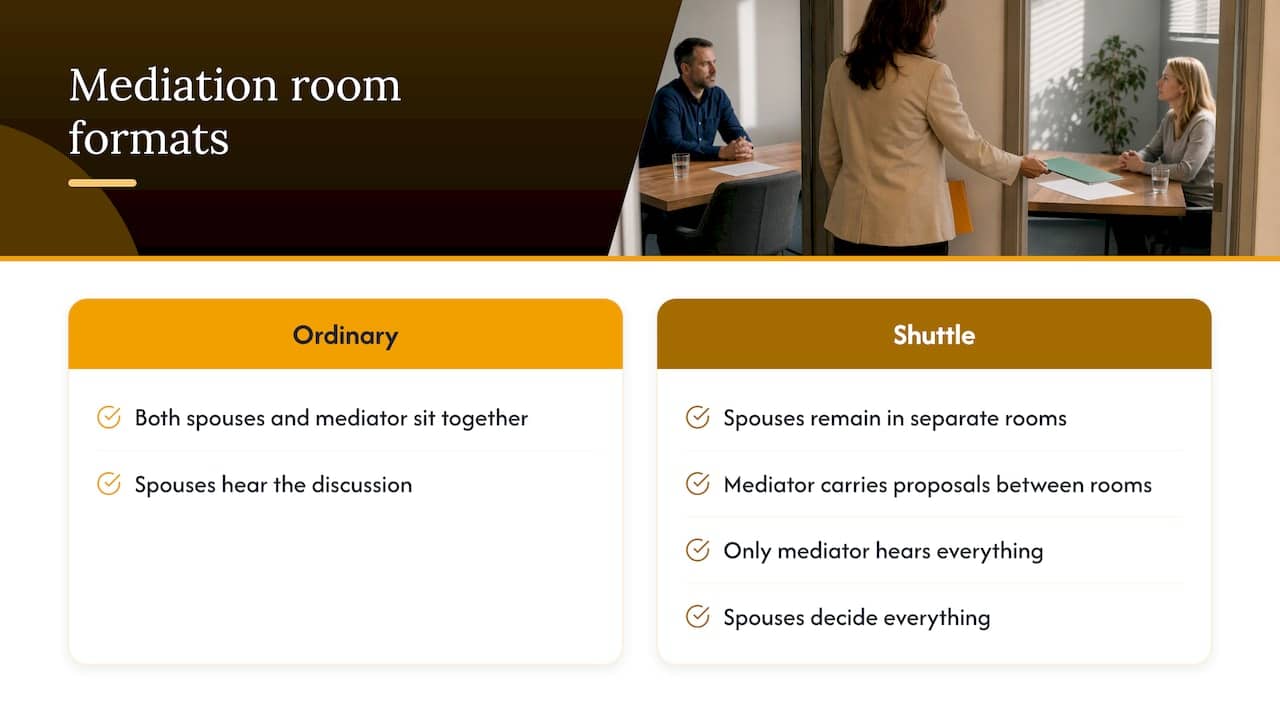
In ordinary mediation, both spouses and the mediator sit together. In shuttle mediation, the parties remain in separate rooms and the mediator moves between them to pass on information and negotiate. The term comes from the image of a shuttle going back and forth. It is sometimes called caucus-style mediation, because the private meetings with each side are called caucuses.
The mediator’s role does not change. Mediators are neutral third parties who do not make decisions or give legal advice. You and your spouse still decide everything. Mediation is an extension of negotiation in which the parties control the substance of the discussion and any agreement. Only the logistics differ.
One feature surprises people. In shuttle-style mediation the mediator is the only person who hears everything, and the parties do not hear each other’s settlement proposals or see how the other reacts. That is the point of the format, and it is also the main thing to understand before you choose it.
What happens during a shuttle mediation session
Sessions vary by mediator, but most follow the same arc.
- Opening. The mediator may bring everyone together briefly, in person or on screen, to explain the ground rules. In a stricter shuttle format, even that happens separately.
- Private exploration. The mediator meets with each spouse to learn their concerns, needs and interests. The exploration phase is where those interests surface, well before numbers are traded.
- Carrying proposals. You make an offer on the house, the parenting schedule or spousal maintenance. The mediator takes it to your spouse, brings back a response and helps each of you test what is realistic. During negotiation, mediators may coach parties on effective negotiation skills.
- Reframing. Mediators can act like translators, repeating what they have heard and asking for clarification when the parties struggle to listen to each other. In shuttle mediation this matters more, because an angry message can be turned into a usable one before it reaches the other room.
- Closing. If you reach consensus, the mediator outlines the terms and may write a draft agreement. If you do not, the mediator may sum up where you left off and discuss alternatives to settlement.
A session often takes longer than a joint one, since every message makes a round trip. Plan for a half day or a full day on a complex case, and ask your mediator how they schedule.
When shuttle mediation helps
High conflict without safety concerns
If every conversation with your spouse becomes an argument, a joint session can burn its first hour on old grievances. Private meetings let you vent emotions, which can reduce the risk of destructive behavior in joint sessions. Many couples find they negotiate more rationally once the other person is out of the room.
Power imbalance or fear of speaking up
Some spouses go quiet around a dominant partner and agree to things they regret. Separate rooms remove the pressure of that person’s presence. They do not remove the imbalance itself, so a mediator who screens for it and a lawyer who reviews the terms both matter.
Domestic violence and abuse
Handle this one carefully. Family dispute resolution may not be appropriate in cases of high conflict, power imbalance or family violence, and sometimes it cannot be done safely. Courts do use shuttle formats in these cases. In the DC Superior Court, shuttle and videoconference mediation are options for families reporting high levels of intimate partner violence, because joint mediation is not allowed under court policy. That is a court-managed program with its own screening.
If you are afraid of your spouse, talk to a family law attorney before agreeing to any mediation, and ask about an order of protection if you need one. If you are in immediate danger, call 911. The National Domestic Violence Hotline is also available at 1-800-799-7233.
Disputes over children
Parents who must co-parent for years sometimes do better when the first agreement is reached without a blow-up. In Maricopa County, mediation lets parents make decisions about their children after separation or divorce. A shuttle format can get you to a parenting plan when you cannot manage a joint conversation yet. Our child custody page explains how Arizona parenting time is decided if mediation does not resolve it.
Pros and cons compared with joint mediation
| Factor | Shuttle mediation | Joint mediation |
|---|---|---|
| Contact with your spouse | None or minimal | Face to face throughout |
| Emotional temperature | Usually lower | Can escalate quickly |
| Speed | Slower, because messages travel through the mediator | Faster when both can talk |
| Directness | The mediator filters and frames what each side says | You hear each other’s tone and intent |
| Fit for high conflict | Often better | Often poor |
| Fit for cooperative couples | More than they need | Usually best |
The honest downsides:
- It can take longer. Every proposal needs a round trip, so you may use more mediator time.
- You lose the human moment. Sometimes hearing your spouse say “I know this is hard for the kids too” does more than any term sheet. Separate rooms rule that out.
- The mediator holds a lot of information. Because they hear both sides privately, you rely on them to relay your position accurately and to keep confidences you ask them to keep. Before you start, ask which things they will and will not repeat.
- Agreements can feel less owned. People who never saw the other side’s reasoning sometimes second-guess the deal later. Written summaries help.
If you want a fuller picture of the pros and cons of mediation in general, see our guide to divorce mediation advantages.
Can shuttle mediation be done online?
Yes. Virtual breakout rooms replicate separate rooms well, and your mediator can move between them as easily as walking down a hall. Online formats can cost less because mediators do not pay for office space, though that saving does not always reach the client’s bill. The same source lists the drawbacks: technology problems, trouble reading body language and distractions at home.
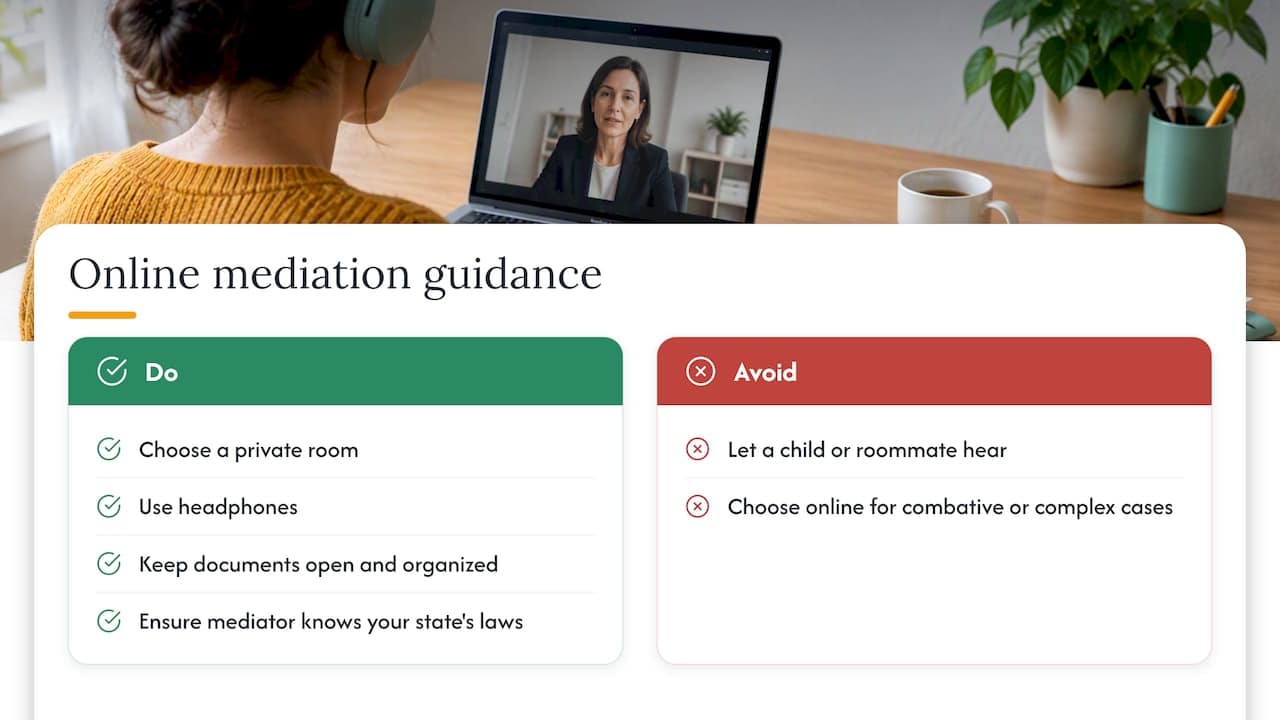
If you mediate online, choose a private room, use headphones and keep your documents open and organized. Do not let a child or a roommate hear the session. Make sure your mediator is familiar with your state’s laws, ideally by being located or experienced there. For an Arizona divorce, that means knowing Arizona community property rules, parenting time statutes and court forms.
Some cases are a poor fit for online work. Extremely combative spouses, or complex business and financial issues needing many experts and documents, may need an in-person setting with more structure.
How to prepare
Shuttle mediation rewards preparation more than joint mediation does, because you will not get to read the room in real time.
- List your priorities in order. Separate must-haves (for example, the school your children attend) from nice-to-haves.
- Gather your financial records. Bring recent pay stubs, tax returns, account statements, mortgage information and a list of debts. Our divorce mediation checklist and pre-divorce checklist walk through the paperwork.
- Decide your range before you start. Know your ideal outcome, your acceptable outcome and the point at which you would rather go to court.
- Talk to your own attorney first. The mediator cannot advise you. A lawyer can tell you whether a proposal is fair under Arizona law.
- Plan what you will say about the other side. Anything critical you say will be filtered. Frame it around needs and facts, not character.
- Ask to review every written term. Before you sign a draft, read it as if you were reading a contract, because you are.
On what not to say: avoid threats, ultimatums and statements you could not defend to a judge. Mediation is private, but your credibility with the mediator is what makes them willing to carry your offers well.
Confidentiality and the legal effect of an agreement
Mediation is generally confidential. One California court’s family mediation FAQ says the process is confidential, and parties who reach agreement can ask that it be made an order, with a hearing date available if they do not settle. That page describes California practice, so Arizona rules and forms differ. In Arizona, ask your attorney how confidentiality and court approval work for your case before you start.
Two points apply in most places. First, a mediated agreement is not a divorce. It becomes enforceable once a judge approves it and it is folded into your decree. Second, if you do not settle, you can still litigate. Nothing you decline in mediation is binding. See our article on how long after mediation a divorce is final for what happens once you have a signed agreement.
What shuttle mediation costs
Mediators typically bill by the hour or session, and fees are often split between spouses. Because shuttle sessions can run longer, the mediator’s time may add up. Rates vary widely, and we do not publish a price for mediation at our firm. Our article on divorce mediation costs covers what drives the total.
What usually matters more than the mediator’s hourly rate is how many issues you settle. A day of shuttle mediation that resolves custody and the house can cost far less than months of contested litigation. A day that ends without a deal costs you the fee and gives you a clearer view of the dispute.
Shuttle mediation versus other options
- Joint mediation works best when you can talk without escalation.
- Collaborative divorce puts both spouses and their attorneys at the table and commits everyone to settlement. It needs a baseline of good faith.
- Arbitration hands the decision to a neutral third party. Mediation does not. Our comparison of mediation vs arbitration in divorce explains the difference.
- Litigation gives you a judge’s decision but costs more time and privacy.
Our perspective
We have handled family law matters in Scottsdale for over 20 years, and we have watched good outcomes depend less on the format than on the people prepared to use it. Shuttle mediation is a tool, not a verdict on your marriage. For many clients it is the first time in months that a conversation about the children does not end in a shouting match.
What we tell clients is this. Do not choose separate rooms to avoid a hard decision. Choose them because they help you make better decisions. Know your financial goals and your children’s needs before you walk in, and have a lawyer in your corner who is not the mediator. We tailor our approach to each family because a plan that works for a couple with one child and a rental condo will not work for a couple with a business and three kids.
If safety is in question, we say so plainly and start there. No settlement is worth putting you at risk.
— Brett
Talk to us about your options
If you are weighing mediation, we can help you decide whether a shuttle, joint or collaborative approach fits your case, and we can advise you privately before and after each session. See our divorce mediation page, or contact High Desert Family Law Group to talk through your situation.
FAQ
What happens in shuttle mediation?
You and your spouse stay in separate rooms, in person or online, while the mediator moves between you. The mediator learns each side’s interests, carries proposals back and forth and helps you test what is realistic. If you agree, the mediator drafts the terms for your attorneys to review.
What is the downside to divorce mediation?
Mediation only works if both sides negotiate honestly, and a mediator cannot force a deal or give you legal advice. Shuttle formats can take longer and remove direct contact. If you do not settle, you may still pay for the session and then go to court.
Do I have to see my spouse during shuttle mediation?
Not in a strict shuttle format. Some mediators bring everyone together briefly at the start, but you can ask to skip that. If you have safety concerns, tell the mediator and your attorney before the session is scheduled.
Is a shuttle mediation agreement legally binding?
It becomes binding once it is signed as required and approved by the court as part of your decree. Until then, it is a proposed settlement. Have your attorney review it before you sign.
Sources
- Fact Sheet: Family dispute resolution, Department of Justice Canada
- Michigan Taxonomy of Alternative Dispute Resolution
- How Mediation Works, Program on Negotiation at Harvard Law School
- Stages of a Mediation, American Bar Association
- New Services for Families in the DC Superior Court, American Bar Association
- Online Divorce Mediation: Pros and Cons, DivorceNet
- Conciliation Services, Maricopa County Superior Court
- FAQs About Mediation, Superior Court of California, San Francisco