



Protect Credit in an Arizona Divorce: A.R.S. Guidance on Student Loans

Whether you or your spouse owe the student loan after an Arizona divorce depends mostly on when the debt was taken out. Loans signed before marriage stay separate debt; loans taken out during the marriage are presumptively community debt and get divided along with everything else under Arizona’s equitable division rules. Even then, your lender was never part of the divorce case, so it can still chase the original borrower or cosigner regardless of what the decree says.
TL;DR:
- Student loans taken out before marriage generally remain separate debt, while those incurred during marriage are presumed community debt and subject to equitable division.
- Courts consider who benefited from the education, each spouse’s post-degree earning capacity, and the use of community funds when dividing community student loan debt.
- A divorce decree does not release the responsible spouse from lender claims, so ongoing enforcement actions and creditor agreements are essential for long-term protection.
- Proper documentation of loan disbursement dates, bank records, and explicit settlement language are crucial to accurately allocate student debt in divorce settlements.
- Defaulted student loans can harm both spouses’ credit, and refinancing or segregating joint or cosigned loans post-divorce is often the best way to establish individual responsibility.
Table of Contents
- How Arizona law classifies student loan debt: pre-marriage vs. during-marriage
- How courts divide student loan debt in Arizona: equitable factors and example rulings
- Why a divorce order doesn’t necessarily release you from lender claims
- Practical checklist: documenting timing, negotiating settlement language, and managing repayment
- Joint consolidation loans and cosigner issues: options after divorce
- Impact of student loans on child support and spousal maintenance calculations
- Effect of defaulted student loans on divorce settlements and credit ratings
- Options for refinancing or consolidating student loans post-divorce in Arizona
- Perspective: what divorcing spouses consistently underestimate about student loan debt
- If you need help with student loan division in your Arizona divorce
- Sources
- FAQ
How Arizona law classifies student loan debt: pre-marriage vs. during-marriage
Arizona is a community property state, which means the law cares less about whose name is on the loan and more about when the money arrived. Under A.R.S. §25-211, property and debts acquired during the marriage are presumptively community, shared by both spouses regardless of who signed the paperwork. A loan taken out before the wedding stays the separate debt of the person who borrowed it.
That timing rule sounds simple until you try to prove it. Student loans often get disbursed in stages across several years, so a single loan balance might straddle the “before” and “during” line.
To establish when debt arose, courts look at concrete paperwork rather than memory:
- Promissory notes showing the date each loan was signed.
- Disbursement records from the loan servicer showing when funds were released.
- Account statements that track balances and payments over time.
Even a loan that started before the marriage can pick up community characteristics. When community funds, meaning income earned during the marriage, went toward tuition payments or loan installments, a court may treat that portion as community debt. This is why loan paperwork and bank records matter so much once a divorce is on the table; see our guide to Arizona community property laws for how this classification plays out with other types of debt.
How courts divide student loan debt in Arizona: equitable factors and example rulings
Once a loan is classified as community debt, the next question is how it gets split. A.R.S. §25-318 directs Arizona courts to divide community property and debts equitably, which is not the same as automatically splitting everything down the middle.
Judges weigh several factors when deciding who carries a student loan after divorce:
- Who actually benefited from the degree or training the loan paid for.
- Each spouse’s earning capacity after the degree was completed.
- The length of the marriage and how long community funds supported the education.
- Whether community income was used to make payments on the loan.
Arizona courts divide community debt equitably, not necessarily equally, under A.R.S. §25-318. That distinction gives judges room to assign a loan entirely to the spouse who earned the degree, especially when the other spouse never benefited from the increased income it produced.
Appellate guidance reinforces the separate side of this equation too. In Hernandez v. Hernandez, the Arizona Court of Appeals addressed an allocation that assigned pre-marital student loan debt to a non-debtor spouse without any agreement supporting that outcome. The case illustrates a consistent theme in Arizona practice: without an agreement or proof that community resources paid down the loan, pre-marital debt tends to stay with the person who signed for it.
Why a divorce order doesn’t necessarily release you from lender claims
A divorce decree is a contract between spouses. It is not a contract with your lender, and the lender never agreed to it. That means your student loan servicer can keep pursuing whichever name is on the promissory note, or any cosigner, no matter what the judge ordered about who is “responsible” for the debt between the two of you.
If your ex-spouse was ordered to pay a loan and stops, you have remedies, but they run between you and your ex, not against the lender directly:
- A contribution action to recover payments you made on your ex’s assigned debt.
- A contempt proceeding for violating the decree’s payment terms.
- A lien against property your ex owns, when a court authorizes one to secure payment.
These enforcement actions are time-limited. A recent appellate decision, In re Marriage of Duvall, underscored the two-year enforcement window under A.R.S. §25-318(P) for actions to enforce payment provisions in a dissolution decree. Miss that window and you may lose the ability to force compliance, even if your ex clearly violated the order. Because of that risk, securing a creditor agreement or loan refinance at the time of divorce, rather than relying on the decree alone, is often the more reliable protection.
Practical checklist: documenting timing, negotiating settlement language, and managing repayment
Protecting yourself starts with paperwork, continues through negotiation, and ends with follow-up on your federal loan accounts.
- Gather loan promissory notes, disbursement records, and a full payment history from each servicer.
- Trace which payments came from separate funds versus community income, using bank statements from the relevant years.
- Ask your attorney to request explicit debt allocation language in the settlement, not a vague reference to “existing debts.”
- Include creditor-facing protections where possible: indemnity clauses, offsets against other assets, or liens securing the assigned spouse’s promise to pay.
- Notify your loan servicer of your marital status change and recertify your income if you are on an income-driven repayment plan.
- Review whether filing taxes separately instead of jointly changes your income-driven repayment calculation, since federal guidance on marriage and student loans explains how joint filing can pull a spouse’s income into the calculation.
Pro Tip: Request your full loan disbursement history from the servicer before mediation starts. It settles timing disputes faster than trying to reconstruct dates from memory.
Cases get more complicated fast when a cosigner is involved, when loans were jointly consolidated, or when one spouse disputes the other’s evidence about timing. Those are the moments to bring in counsel rather than handle the settlement language yourself, since a poorly worded allocation clause can leave you exposed to a servicer years after the divorce is final. Our property division guidance covers how this fits into the broader asset and debt split.
Joint consolidation loans and cosigner issues: options after divorce
Joint consolidation loans, taken out jointly by two borrowers including some ex-spouses, create a separate problem because both parties remain liable to the lender regardless of the divorce decree. The Department of Education’s Combined Application to Separate a Joint Consolidation Loan outlines how to split one joint loan into two individual Direct Consolidation Loans, which is often the cleanest fix.
For a cosigned private loan, the decree does not touch the lender’s rights at all: a cosigner stays on the hook contractually until the loan is refinanced, paid off, or the lender agrees to release them.
Practical next steps include:
- Filing the joint consolidation separation application as soon as possible after divorce.
- Getting written confirmation from the lender on any agreed release of a cosigner.
- Adding indemnity language to the settlement so you have recourse if your ex defaults after separation.
Impact of student loans on child support and spousal maintenance calculations
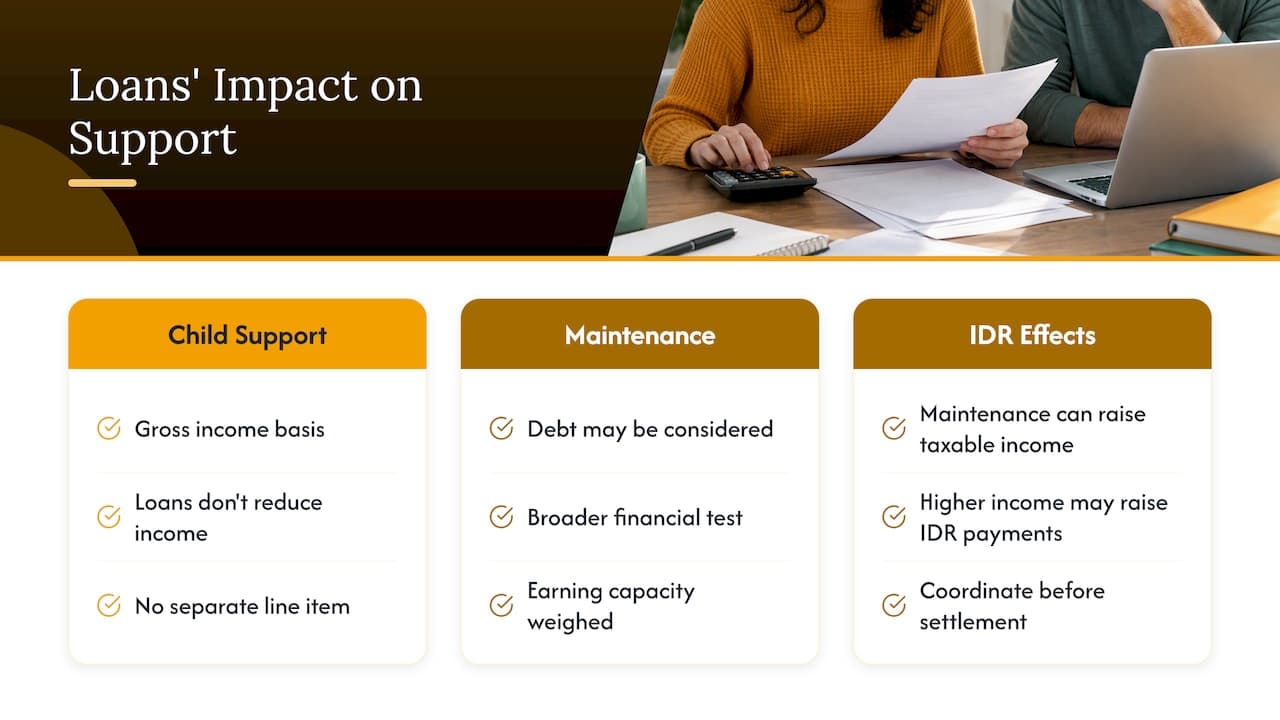
Student loan payments rarely appear as their own line item in an Arizona child support worksheet, but they shape the numbers indirectly. Child support calculations start with each parent’s gross income, and a heavy student loan payment does not reduce that income figure the way a pretax deduction might. Courts can, however, consider debt obligations when deciding spousal maintenance under the broader financial circumstances test, since maintenance looks at each spouse’s ability to meet their own needs after accounting for reasonable expenses.
A spouse carrying significant student debt from a professional degree, say a law or medical degree earned during the marriage, may argue that loan payments limit disposable income available for support. Courts weigh that alongside the earning capacity the degree created, which often cuts the other way: a professional degree usually increases income well beyond what the loan payment reduces it.
Spousal maintenance orders also interact with loan repayment plans in a less obvious way. Income-driven repayment plans calculate payments based on income, so a maintenance award that raises one spouse’s taxable income could increase their monthly loan payment under certain IDR formulas. That is one more reason to coordinate maintenance negotiations with a review of each spouse’s loan repayment plan before finalizing a settlement, rather than treating them as unrelated issues.
Effect of defaulted student loans on divorce settlements and credit ratings
A defaulted student loan complicates a divorce settlement because default changes what a lender can do. Once a federal loan goes into default, the government can garnish wages, intercept tax refunds, and report the default to credit bureaus, actions that hit the borrower on the loan regardless of what the decree assigns.
If the decree assigns a defaulted loan to one spouse and that spouse keeps missing payments, the damage to credit can extend to a cosigner or, in community property terms, to shared credit history built during the marriage. A joint consolidation loan in default affects both borrowers’ credit reports, not just the one a settlement calls “responsible.”
This is where creditor agreements earn their keep. A settlement that simply states “husband shall pay the loan” does nothing to stop a default from appearing on a wife’s credit report if her name remains on the account. Getting the loan refinanced into the responsible spouse’s name alone, or securing written servicer confirmation of a release, protects the other spouse’s credit in a way that decree language by itself cannot. When default has already happened before the divorce, document the default date carefully since it affects both the credit timeline and any contribution claims between spouses.
Options for refinancing or consolidating student loans post-divorce in Arizona
Refinancing is usually the cleanest way to separate loan responsibility once a divorce is final, because it replaces a joint or cosigned loan with a new loan in one person’s name only. Private lenders offer refinancing based on the applying spouse’s credit and income, so the spouse keeping the loan needs to qualify on their own financial standing, which can be harder shortly after a divorce reduces household income.
For federal joint consolidation loans specifically, refinancing into a private loan is one option, but the joint consolidation loan separation process through the Department of Education lets borrowers split the joint loan into two individual federal consolidation loans instead, preserving federal protections like income-driven repayment that a private refinance would eliminate.
Before refinancing, check whether the loan carries federal benefits worth keeping, since giving those up for a lower private rate is not always a net win. A spouse should also review how a new separate loan interacts with income-driven repayment calculations, since separating the loan from a joint account can change which income counts toward the payment formula going forward.
Perspective: what divorcing spouses consistently underestimate about student loan debt
Most people walking into divorce negotiations focus on who gets the house or the retirement account and treat student loans as an afterthought because the balance already exists and someone is already paying it. That is a mistake. A loan with 15 years left on it is a bigger long-term liability than most furniture or vehicle disputes combined, and the paperwork trail required to prove when it was incurred has to be built early, not reconstructed later under pressure. The spouses who come out ahead are the ones who treat loan documentation with the same seriousness as a bank account statement, and who get creditor agreements in writing instead of trusting a decree to do work it was never designed to do.
If you need help with student loan division in your Arizona divorce
Working out who owes what on a student loan takes more than reading a statute: it takes someone who can pull disbursement records, negotiate creditor agreements, and draft settlement language that actually protects you after the ink dries. We handle divorce, collaborative divorce, uncontested divorce, divorce mediation, and property division matters, offering personalized representation rather than one-size-fits-all paperwork.

If mediation fits your situation better than litigation, our divorce mediation service can get loan allocation resolved without a courtroom fight. For contested cases where creditor agreements and documentation disputes are in play, visit our divorce services page to schedule a consultation and talk through your specific loan situation.
Sources
- Azleg
- How marriage affects your student loan payments – Federal Student Aid
- In re Marriage of Duvall — Appellate opinion (Justia)
FAQ
What happens to your student loans if you get divorced?
Loans taken out before marriage generally stay the separate debt of the borrower, while loans taken out during the marriage are presumptively community debt subject to equitable division under A.R.S. §25-318. The lender is not part of the divorce case, so it can still collect from whoever’s name is on the loan no matter how the decree divides responsibility between spouses.
What is a spouse entitled to in a divorce in Arizona?
Arizona law entitles each spouse to an equitable share of community property and debt accumulated during the marriage under A.R.S. §25-318, which is not automatically an equal split. Separate property and debts owned before the marriage generally remain with the original owner, subject to tracing and any community contributions made to them.
What assets cannot be touched in divorce?
Property and debt that one spouse owned or incurred before the marriage, along with gifts and inheritances received individually during the marriage, generally stay separate under Arizona community property rules. Keeping clear records, such as the date a student loan was signed or when an inheritance was received, is what allows a spouse to prove an asset or debt should stay outside the community division.
Can my spouse be forced to pay my student loans?
A court can assign a student loan to a spouse as part of the equitable division under A.R.S. §25-318, but that order only binds the spouses to each other, not the lender. If the assigned spouse fails to pay, the original borrower can pursue a contribution action or other enforcement remedy against their ex, but must act within the two-year enforcement window described in appellate guidance like In re Marriage of Duvall.