



Temporary Guardianship in Arizona: How to File

Yes, you can get temporary guardianship in Arizona, including emergency appointments with no prior notice to the ward. A.R.S. §14-5310 is the governing statute for temporary guardianship of adults, and it explicitly permits the court to appoint a guardian without notice when an affidavit or verified petition shows that immediate and irreparable injury would otherwise result. For minors, A.R.S. §14-5207 sets the same six-month ceiling on temporary appointments unless the court finds good cause to extend. The first concrete step: file a petition in the Superior Court of the county where the ward lives or owns property. In Maricopa County, that means downloading the PBGCT1 packet for adults or the JG1 packet for minors before you do anything else. If the situation is urgent and you need guidance before the filing window closes, Highdesertfamilylawgroup handles emergency guardianship petitions for clients across Arizona.
Table of Contents
- Who can petition for temporary guardianship in Arizona?
- What does Arizona law require for an emergency (no-notice) appointment?
- How to file for temporary guardianship in Arizona: step by step
- Which forms and packets do you actually need to file?
- What happens at the hearing and what rights does the ward have?
- How long does a temporary guardianship last, and can you extend it?
- What can a temporary guardian actually do, and what are the limits?
- Fingerprinting and background checks for proposed guardians
- What does temporary guardianship cost, and how long does it take?
- When should you hire an Arizona family law attorney?
- Key Takeaways
- What Arizona guardianship attorneys see that the forms don’t tell you
- Highdesertfamilylawgroup can handle your guardianship filing from start to finish
- Authoritative sources and official links for Arizona guardianship filings
Who can petition for temporary guardianship in Arizona?
Under A.R.S. §14-5303, any person interested in the welfare of an alleged incapacitated adult may petition for a guardianship appointment. For minors, A.R.S. §14-5207 uses similar “interested person” language, which courts read broadly to include grandparents, aunts and uncles, family friends, and even neighbors with a genuine connection to the child’s welfare.
Common situations that actually trigger these petitions include:
- A parent is hospitalized suddenly or incarcerated and a grandparent or sibling needs legal authority to enroll the child in school or authorize medical care.
- An adult family member suffers a stroke, serious accident, or acute psychiatric crisis and cannot manage their own affairs while a permanent guardianship petition works through the court.
- A child faces immediate safety concerns at home and a relative needs protective authority before a Department of Child Safety investigation concludes.
- A gap exists between the death or removal of a permanent guardian and the appointment of a successor, leaving the ward without anyone legally authorized to act.
When multiple people petition at the same time, A.R.S. §14-5311 sets a priority order for adult guardianship appointments. The court generally prefers a person already serving as guardian in another jurisdiction, then a spouse or domestic partner, then adult children, then parents, and then other relatives. The court can pass over any priority person for good cause, including a criminal history or a demonstrated conflict of interest.
Temporary guardianship is not the same as an emergency protective order from DCS or a short-term custody arrangement under a parenting plan. DCS has its own statutory authority to remove children; a guardianship petition runs through the probate division of the Superior Court and gives the guardian ongoing legal authority rather than a one-time protective intervention.
What does Arizona law require for an emergency (no-notice) appointment?
The no-notice route under A.R.S. §14-5310 is an extraordinary remedy, not a shortcut. The court will grant an ex parte temporary guardianship only when the petitioner’s affidavit or verified petition demonstrates that waiting for standard notice and a hearing would cause immediate and irreparable injury to the ward.
That affidavit needs to do specific work. Vague statements about general concern are not enough. The petition should identify:
- The exact harm that will occur if the court does not act before notice can be served, stated in concrete, factual terms.
- Who will be harmed and how, with dates, locations, and names where possible.
- Why delay of even a few days is dangerous, not merely inconvenient.
- What steps the petitioner will take to serve notice on the ward immediately after the order issues.
The 72-hour rule is non-negotiable. After an ex parte order is granted, the petitioner must serve the ward with both the petition and the order within 72 hours. The court will also set an expedited hearing, and the petitioner must be prepared to appear and defend the appointment on short notice. Courts expect the petitioner to have a plan for less restrictive alternatives on the record at that hearing. An emergency order is typically limited in duration, often to 30 days or until the expedited hearing, whichever comes first.
Pro Tip: Attach contemporaneous records directly to the emergency affidavit. Medical charts, police reports, and school records that document the specific harm are far more persuasive than a narrative alone. Judges respond to specificity, not urgency claims without evidence.

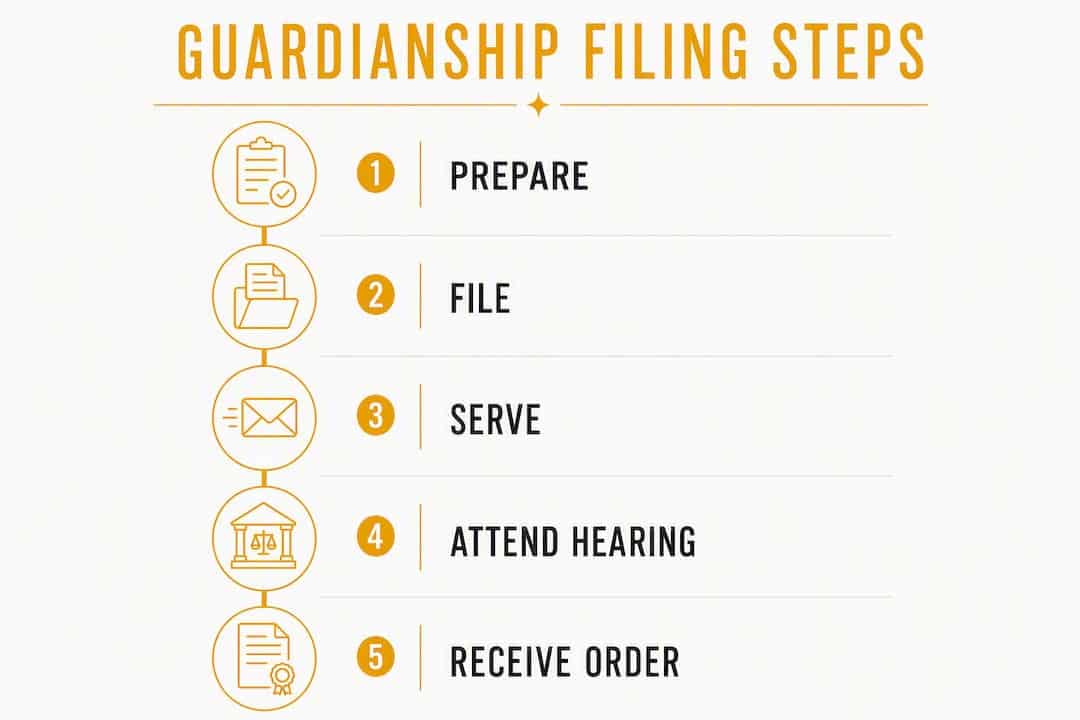
How to file for temporary guardianship in Arizona: step by step
The filing process follows a predictable sequence, but each step has details that can stall a case if missed.
- Determine the correct court and county. File in the Superior Court of the county where the ward currently resides or owns real property. If the ward is in Maricopa County, the probate division of the Maricopa County Superior Court handles the case. Other counties have their own probate or family court divisions.
- Download the correct county packet. For Maricopa County adults, use the PBGCT1 packet. For Maricopa County minors, use the JG1 packet. Other counties publish their own packets on their Superior Court websites. Using the wrong packet causes clerks to return the filing.
- Complete the required documents. The core documents are the probate cover sheet, the petition for temporary appointment, and the affidavit of the proposed guardian. The petition must explain the factual basis for the appointment and, if requesting emergency relief, check the appropriate box and attach a supporting affidavit showing immediate and irreparable injury.
- Prepare supporting attachments. Medical records, police reports, school enrollment records, and any prior court orders relevant to the ward’s situation should be organized and attached as labeled exhibits.
- File with the clerk and pay the filing fee. Filing fees vary by county and are updated periodically. Verify the current fee on the county Superior Court’s fee schedule before you go to the clerk’s window.
- Serve notice on required parties. For standard temporary petitions, serve the ward, the ward’s parents (for minors), the ward’s spouse (for adults), and any other interested parties identified in the statute. For ex parte emergency orders, serve the ward within 72 hours of the order.
- Attend the hearing. Bring organized evidence, a one-page chronology of events, and any witness affidavits. For emergency petitions, the court sets the hearing quickly. For standard temporary petitions, expect a wait of several weeks depending on the county’s docket.
The table below shows the key differences between the two filing tracks:
| Factor | Emergency (ex parte) | Standard temporary |
|---|---|---|
| Notice before filing | None required | Required |
| Affidavit showing immediate harm | Required | Not required |
| Typical time to hearing | 24–72 hours after order | Several weeks |
| Initial order duration | Often 30 days or until hearing | Up to six months |
| Post-order service deadline | 72 hours | Per court schedule |
| Statutory basis | A.R.S. §14-5310 | A.R.S. §14-5310 / §14-5207 |
Which forms and packets do you actually need to file?
Getting the form codes right prevents the single most common delay: a clerk returning an incomplete packet. The PBGCT1 packet for Maricopa County adult temporary guardianship contains the following documents:
| Form code | Form name | Purpose |
|---|---|---|
| — | Petition for Temporary Appointment | Core petition stating facts, requested authority, and emergency basis if applicable |
| — | Affidavit of Person to be Appointed | Proposed guardian’s background, qualifications, and consent to serve |
| — | Probate Information Form | Court administrative form identifying parties and case type |
| Temporary Order | Temporary Order template | Signed by the judge; grants the temporary appointment |
| Letters of Appointment | Letters template | Official document the guardian presents to third parties (hospitals, schools) |
For minors in Maricopa County, the JG1 packet covers the appointment of a guardian for a minor and includes instructions for temporary appointments of six months or less. The packet structure is similar but uses minor-specific petition language and different form codes.
Outside Maricopa County, check the Superior Court website for the ward’s county. Mohave County, for example, publishes its own temporary and emergency guardian/conservator packet with county-specific instructions. The Arizona Judicial Branch website also maintains a statewide forms index as a starting point.
Practical notes on completing the forms: the proposed guardian’s affidavit typically requires notarization. Some counties require a wet signature on the petition itself. Attach medical records or police reports as numbered exhibits and reference each exhibit by number in the petition text. Courts expect the petition to be narrowly tailored, meaning you should define the specific authority you are requesting and the anticipated duration rather than asking for open-ended powers.
What happens at the hearing and what rights does the ward have?
Notice requirements
For a standard temporary petition, the petitioner must give advance notice to the ward, the ward’s parents (if the ward is a minor), the ward’s spouse or domestic partner (if an adult), and any other interested parties the court identifies. The notice must be served within the timeframe the court specifies, typically several days before the hearing. For ex parte emergency orders, the 72-hour post-order service rule substitutes for pre-hearing notice.
Rights of the proposed ward
The ward is not a passive subject of the proceeding. Under Arizona law, the proposed ward has the right to:
- Attend the hearing and present evidence.
- Be represented by an attorney; if the ward is indigent, the court may appoint counsel.
- Move to dissolve or modify an ex parte emergency order after it is served.
- Object to the appointment and require the petitioner to prove the statutory criteria.
- Request that the court impose limits on the guardian’s authority rather than granting full guardianship.
What to bring to the hearing
Organize evidence chronologically. A one-page affidavit summary that references attached documentary exhibits helps the judge move through the record quickly. Bring:
- The signed and filed petition with all attachments.
- Medical records, psychiatric evaluations, or hospital discharge summaries.
- Police reports or DCS reports if applicable.
- School records showing attendance, behavioral concerns, or enrollment gaps.
- Witness affidavits from teachers, doctors, or neighbors who have direct knowledge of the ward’s situation.
- Documentation showing you considered less restrictive alternatives before seeking guardianship.
Possible outcomes
The court can grant the full temporary appointment, grant a scope-limited order (for example, medical decisions only), deny the petition, or order additional investigation such as a guardian ad litem report before ruling.
How long does a temporary guardianship last, and can you extend it?
The statutory ceiling is six months. Both A.R.S. §14-5310 and A.R.S. §14-5207 cap temporary appointments at six months unless the court finds good cause to extend. In practice, “good cause” means a documented reason the underlying situation has not resolved, such as an ongoing medical recovery or a pending permanent guardianship petition that has not yet reached a hearing.
To request an extension, file a motion with the court before the current order expires. The motion should explain what has changed or not changed since the original appointment and why the ward still needs a temporary guardian. Courts do not automatically extend; you need to make the affirmative showing.
If the need for guardianship is ongoing rather than truly temporary, filing for permanent guardianship is the right move. Relying on repeated temporary extensions creates procedural risk: each extension requires a new court filing, another fee, and another hearing. More importantly, a ward who needs long-term protection deserves the stability of a permanent appointment. You can file for permanent guardianship at the same time as the temporary petition, or immediately after the temporary order is granted, to avoid gaps in authority. Understanding how long permanent guardianship lasts helps you plan the transition from temporary to permanent status.

What can a temporary guardian actually do, and what are the limits?
A.R.S. §14-5312 gives a guardian of an incapacitated person the same powers and duties a parent has over an unemancipated minor child, with important qualifications. For a temporary guardian, those powers are further constrained by the court order itself and by the statute’s preference for the least restrictive alternative.
Common powers a temporary guardian typically holds:
- Making day-to-day care and custody decisions for the ward.
- Authorizing routine and emergency medical treatment.
- Determining the ward’s place of abode during the appointment period.
- Enrolling a minor in school or communicating with educational institutions.
- Managing the ward’s daily personal needs.
A temporary guardian’s authority can also suspend the authority of a previously appointed permanent guardian while the temporary appointment is in effect, which matters in cases where the permanent guardian is the source of the problem.
What a temporary guardian cannot do without separate court approval:
- Permanently terminate or restrict parental rights.
- Relocate the ward out of state.
- Consent to major elective surgery or experimental treatment not covered by the original order.
- Enter into long-term financial transactions on the ward’s behalf (that requires a conservatorship, not just guardianship).
- Take any action that exceeds the specific authority granted in the letters of appointment.
The court also expects temporary guardians to file required reports and to actively work toward the ward’s self-reliance and independence where possible, not simply to maintain the status quo. Understanding the distinction between a guardian’s role versus a parent’s role helps set realistic expectations before you file.
Fingerprinting and background checks for proposed guardians
Arizona courts take the safety of wards seriously, and background checks are a standard part of the guardianship process. For most proposed guardians, the court will require a fingerprint-based criminal background check before or shortly after the appointment. This applies to both temporary and permanent guardianship matters, though the timing can vary by county and by whether the petition is emergency or standard.
To obtain fingerprints, most petitioners go to a local law enforcement agency, a fingerprinting service, or an approved Arizona Department of Public Safety provider. The court clerk’s office or the county packet instructions will specify the required format, whether ink cards or electronic submission. Submit proof of the completed background check to the court as directed in the packet.
Non-relative petitioners face additional scrutiny. If you are not a family member of the ward, expect the court to look more closely at your relationship to the ward, your qualifications, and your reasons for seeking appointment. Supporting documentation for non-relative petitions typically includes:
- Character references from people who know both you and the ward.
- A written explanation of your relationship to the ward and why you are the appropriate person to serve.
- Disclosure of any prior criminal history, even if charges were dismissed.
- In some cases, a declaration that you have completed or will complete relevant training.
The court’s priority list under A.R.S. §14-5311 places non-relatives lower in the order of preference, but a well-documented petition from a non-relative who has a genuine relationship with the ward can succeed, particularly when family members are unavailable, unwilling, or disqualified.
What does temporary guardianship cost, and how long does it take?
Cost has several components, and the honest answer is that the total varies significantly depending on whether the case is contested, whether you hire an attorney, and which county you file in.
Court filing fees are set by each county Superior Court and change periodically. Check the fee schedule on the county clerk’s website before filing; do not rely on figures from older guides. In addition to the filing fee, budget for process server fees if you need professional service of process, fingerprinting fees, and any costs for obtaining medical records or certified copies of documents.
Attorney fees vary widely based on complexity. An uncontested temporary guardianship with a cooperative family and clear documentation costs far less than a contested emergency petition where the ward objects or a family member challenges the appointment. Most family law attorneys in Arizona work on a retainer basis for guardianship matters.
On timing: emergency ex parte petitions can result in an order within 24–72 hours of filing if the affidavit is strong and the court’s emergency docket has capacity. Standard temporary petitions typically take several weeks from filing to hearing, depending on the county’s probate docket. Once the judge signs the order, letters of appointment are usually issued the same day or within a few business days.
If you anticipate converting to permanent guardianship, plan for additional filing fees and a longer timeline. Permanent guardianship proceedings involve more notice requirements and a more thorough evidentiary hearing.
When should you hire an Arizona family law attorney?
Some temporary guardianship filings are straightforward: a cooperative family, a clear factual record, and a ward who does not object. In those cases, a careful petitioner can work through the county packet with the court’s self-help resources.
But several situations make legal representation worth the cost:
- The petition involves an emergency no-notice request, where a weak affidavit gets denied and the ward remains unprotected.
- The ward or a family member is likely to contest the appointment.
- The proposed ward has capacity and objects to the guardianship.
- There are cross-jurisdictional issues, such as a ward who recently moved from another state.
- The petitioner has a criminal history that may complicate the background check.
- The facts involve alleged abuse, neglect, or a disputed incapacity diagnosis.
An attorney drafts the petition and affidavit to meet the specific statutory criteria, prepares the evidence package, coordinates service, and appears at the hearing. For emergency matters, an experienced attorney can often get an expedited hearing scheduled faster than a self-represented petitioner navigating an unfamiliar court system.
Pro Tip: Before your first attorney consultation, gather your supporting documents: medical records, police reports, school records, and a written timeline of the events that led to the petition. Attorneys can work faster and more precisely when the factual record is already organized.
When the ward has capacity and objects, the case almost always requires an attorney. The ward’s right to contest the appointment is real and meaningful, and a contested hearing without legal representation puts the petitioner at a significant disadvantage.
Understanding what a family lawyer does in guardianship matters can help you decide whether the complexity of your situation warrants professional representation.
Key Takeaways
Temporary guardianship in Arizona is available under A.R.S. §14-5310 and §14-5207, capped at six months, and requires filing in the Superior Court of the ward’s county using the correct packet such as PBGCT1 for adults or JG1 for minors in Maricopa County.
| Point | Details |
|---|---|
| Six-month statutory limit | Temporary appointments under A.R.S. §14-5310 and §14-5207 last up to six months unless the court extends for good cause. |
| Emergency orders require specific facts | Ex parte no-notice appointments demand an affidavit showing immediate and irreparable injury, plus service on the ward within 72 hours. |
| File in the ward’s county | Use the correct county packet: PBGCT1 for Maricopa County adults, JG1 for Maricopa County minors; other counties have their own packets. |
| Convert early if need is ongoing | Filing for permanent guardianship alongside or immediately after the temporary petition avoids gaps in authority and repeated extension filings. |
| Highdesertfamilylawgroup | The firm handles emergency filings, full temporary and permanent guardianship petitions, and hearing representation for clients across Arizona. |
What Arizona guardianship attorneys see that the forms don’t tell you
Most temporary guardianship petitions that fail do not fail because the petitioner lacked a valid reason. They fail because the affidavit is too vague, the service steps are missed, or the petitioner used a temporary filing as a substitute for the permanent appointment they actually need.
The emergency affidavit is where most self-represented petitions fall apart. Judges read dozens of these. A paragraph that says “the ward is in danger and needs immediate protection” tells the court nothing it can act on. What works is a specific, dated, fact-based account: what happened, when, where, who witnessed it, and exactly what harm will occur if the court does not act today. Attach the police report. Attach the hospital discharge summary. A one-page chronology with exhibit references is not overkill; it is what moves a judge to sign the order.
The 72-hour service requirement after an ex parte order catches petitioners off guard more often than it should. The order is not a finish line. It is the starting gun for a new obligation, and missing that window can give the ward grounds to dissolve the order at the expedited hearing.
County-specific procedural differences are real. What Maricopa County’s probate division expects in terms of form codes, notarization, and exhibit formatting is not identical to what Pinal or Yavapai County expects. Verify the local rules before you file, not after the clerk returns your packet.
Highdesertfamilylawgroup can handle your guardianship filing from start to finish
Temporary guardianship petitions move fast, especially emergency filings, and the margin for error is narrow. Highdesertfamilylawgroup brings over 20 years of Arizona family law experience to guardianship matters, from drafting the initial petition and emergency affidavit to representing clients at probate hearings across Maricopa County and the surrounding region.

The firm handles the full scope of guardianship work: emergency ex parte filings, standard temporary appointments, background check coordination, service of process, hearing preparation, and conversion to permanent guardianship when the situation calls for it. Clients come in with a stack of medical records and a deadline; the team turns that into a properly filed, court-ready petition.
If your situation involves immediate danger, a contested family member, or a ward who may object, this is not the moment for a DIY filing. Schedule a consultation with Highdesertfamilylawgroup to review your facts, identify the right filing track, and get the paperwork moving. The firm is based in Scottsdale and works with clients navigating Arizona’s county Superior Courts statewide.
Authoritative sources and official links for Arizona guardianship filings
| Resource | What it covers |
|---|---|
| A.R.S. §14-5310 | Temporary guardianship of adults: emergency/no-notice criteria, 72-hour service rule, duties of temporary guardians |
| A.R.S. §14-5207 | Formal appointment of guardian for a minor: procedure and six-month limit on temporary appointments |
| A.R.S. §14-5311 | Priority order for who may be appointed guardian of an incapacitated adult |
| A.R.S. §14-5312 | General powers and duties of a guardian; least restrictive alternative preference |
| Maricopa County PBGCT1 packet page | Instructions and links for temporary guardianship/conservatorship of an adult in Maricopa County |
| PBGCT1 packet PDF | Full downloadable packet including —, —, —, Temporary Order, and Letters of Appointment |
| — petition form PDF | Petition for Temporary Appointment form with emergency request checkboxes and instructions |
| Mohave County temp/emergency guardian packet | Example of a non-Maricopa county packet for temporary and emergency guardian/conservator appointments |
This article provides general legal information about Arizona guardianship procedures and is not a substitute for advice from a licensed Arizona attorney. Laws and court procedures change; confirm current requirements with the relevant county Superior Court or a qualified family law attorney before filing.
