



Family court attorney fees are one of the biggest financial concerns for anyone going through a divorce, custody dispute, or spousal support case — and for good reason.
Here’s a quick snapshot of what to expect:
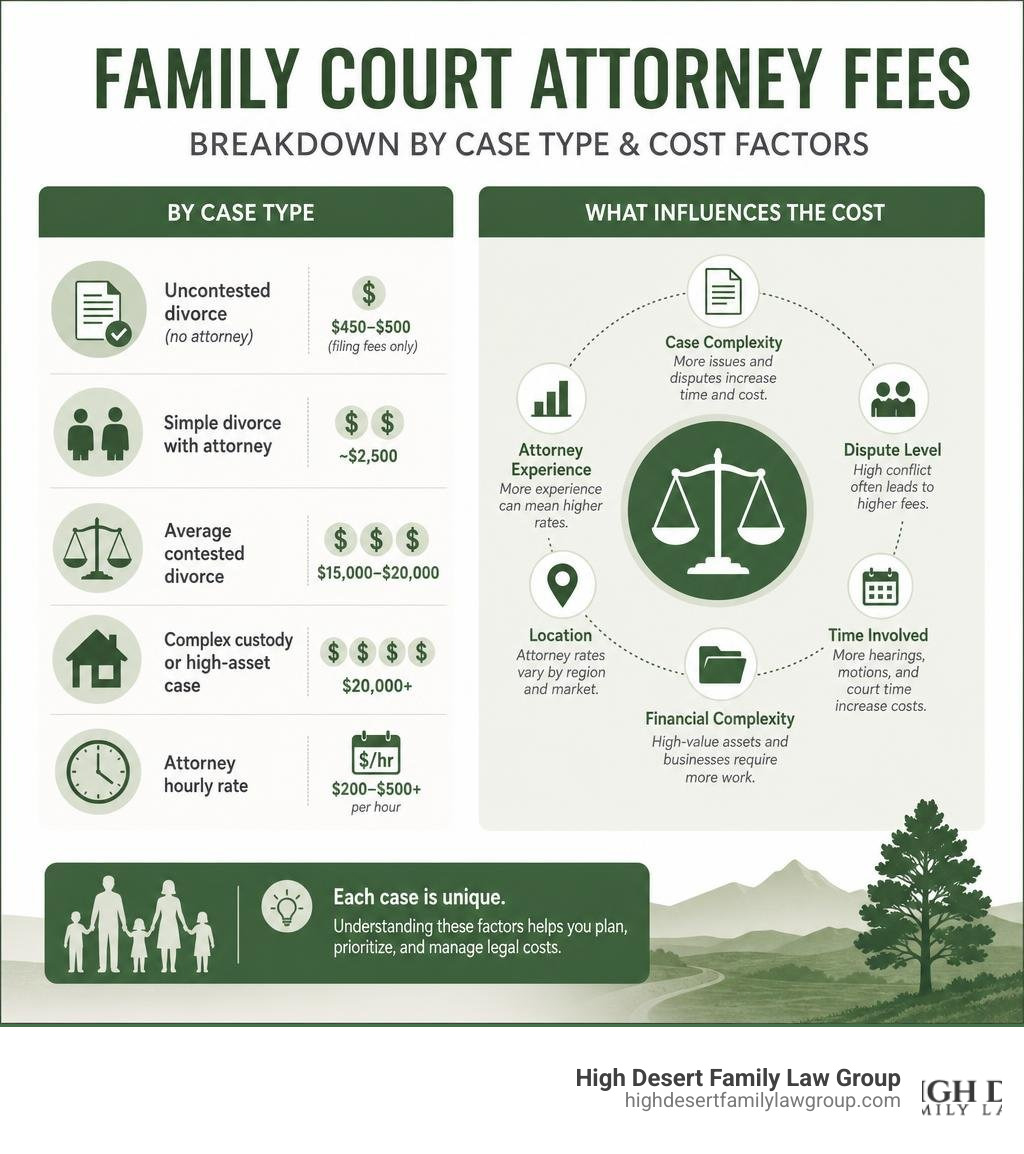
| Situation | Typical Cost Range |
|---|---|
| Uncontested divorce (no attorney) | $450–$500 (filing fees only) |
| Simple divorce with attorney | ~$2,500 |
| Average contested divorce | $15,000–$20,000 |
| Complex custody or high-asset case | $20,000+ |
| Attorney hourly rate | $200–$500+ per hour |
A few key things to know upfront:
- Each party usually pays their own attorney — but courts can order the other side to contribute.
- Courts can shift fees if there is a big income gap or one party is acting in bad faith.
- Community property can often be used to pay your attorney, even during an ongoing divorce.
- Alternatives exist — limited scope representation, mediation, and pro bono services can reduce costs significantly.
The costs are real, and the stakes are high. Whether you’re trying to protect your relationship with your children or secure a fair financial outcome, understanding how attorney fees work in family court is the first step to making smart decisions.
Understanding Family Court Attorney Fees and Average Costs
When you start looking into hiring a family law attorney, the first question on your mind is almost certainly: How much is this going to cost me? The honest answer is that it depends on the complexity of your case, but we can look at averages to give you a realistic baseline.
In the United States, the average cost of a divorce ranges from $15,000 to $20,000, with attorney fees making up the vast majority of that expense. However, family law is highly localized, and regional economic differences play a major role in what you will pay.
In Arizona, particularly in high-demand areas like Scottsdale and Chandler, hourly rates for experienced family law attorneys typically range from $250 to over $500 per hour. If your case is straightforward and both parties agree on major issues, your total costs will sit on the lower end of the spectrum. If you are facing a highly contested battle over child custody or high-value assets, those numbers can climb quickly.
To understand how these hourly rates translate into real-world costs, it helps to understand the Average Retainer Fee for a Divorce Lawyer. A retainer is an upfront down payment that you pay to secure an attorney’s services. As the lawyer works on your case, they bill their hourly rate against this retainer. Once the retainer is depleted, you will either need to replenish it or pay ongoing monthly invoices.
Depending on the complexity of your situation, the initial retainer can vary widely. For a detailed breakdown of these upfront structures, you can read our How Much Does a Divorce Lawyer Cost Average Price Ranges Explained guide.
To give you a clearer picture of how case complexity directly impacts your total financial commitment, we have broken down the average custody lawyer costs below:
| Case Complexity | What is Involved | Typical Total Cost Range |
|---|---|---|
| Low Complexity | Fully agreed parenting plans, cooperative co-parents, no asset disputes. | $1,500 – $4,000 |
| Medium Complexity | Minor disagreements on parenting schedules, mediation required, basic asset division. | $5,000 – $15,000 |
| High Complexity | Contested custody, allegations of parental unfitness, forensic accounting, expert witnesses. | $15,000 – $40,000+ |
Who Pays Family Court Attorney Fees? Rules and Fee-Shifting Statutes

A common misconception is that the “loser” always pays the other side’s legal fees in court. In the United States, we follow what is known as the “American Rule.” Under this rule, each party is generally responsible for paying their own family court attorney fees, regardless of who wins or loses the case.
However, family law is unique. Because the state has a vested interest in ensuring a fair playing field—especially when the welfare of children is at stake—legislatures have created “fee-shifting statutes.” These laws allow a judge to override the American Rule and order one party to pay some or all of the other party’s legal bills.
In Arizona, this is governed by a very specific statute: ARS 25-324 Attorney Fees. Under this law, the court can order one party to pay a reasonable amount of the other party’s fees after considering two primary factors:
- The financial resources of both parties.
- The reasonableness of each party’s positions throughout the proceedings.
Other states have similar frameworks. For example, the 2024 Wisconsin Statutes & Annotations Chapter 767 allows Wisconsin courts to order fee-shifting after evaluating the financial resources of both spouses. The core philosophy across these states is the same: legal representation should not be a luxury reserved only for the wealthier spouse.
In some cases, the court may also appoint neutral third parties to protect the best interests of the children. This includes appointing a Guardian Ad Litem (GAL) or a custody evaluator. Because these professionals charge fees for their services, the court must decide how to divide these expenses. If you are wondering how these costs are split, you can read our guide on Who Pays for a Guardian Ad Litem to understand your potential financial obligations.
How Courts Assess Financial Need and Ability to Pay Family Court Attorney Fees
When a judge reviews a request for attorney fees based on financial need, they look closely at the economic disparity between the parties. The goal is to ensure that both sides have access to competent legal representation so that the case can be decided on its merits, rather than who has the deeper pockets.
To do this, the court examines:
- Income Disparity: Is one spouse a high-earning executive while the other has been a stay-at-home parent?
- Liquid Assets: Does one party have immediate access to cash, savings, or investment accounts, while the other is struggling to pay basic living expenses?
- Ability to Pay: Does the higher-earning spouse have enough discretionary income to contribute to the other’s legal expenses without facing financial ruin?
While Arizona judges use ARS 25-324 to make these determinations, other jurisdictions use similar guidelines. In California, for instance, need-based fee awards are heavily regulated under California Family Code Part 5, which mandates that courts ensure both parties have equal access to legal representation to present their cases effectively.
When Courts Order Sanctions and Penalties as Family Court Attorney Fees
While need-based fee awards are designed to level the financial playing field, courts also use fee-shifting as a penalty. If one party behaves badly, stalls the litigation, or files frivolous motions, the judge can order them to pay the other side’s fees as a sanction.
This is often referred to under the “overtrial doctrine” or bad-faith litigation. Examples of behavior that can trigger these financial penalties include:
- Refusing to hand over court-ordered financial documents (hiding assets).
- Filing repeated, meritless motions to modify custody just to harass the other parent.
- Canceling depositions or mediation sessions at the last minute without a valid reason.
- Taking completely unreasonable positions that frustrate the possibility of a settlement.
Under ARS 25-324, an Arizona judge can award fees solely because one party acted unreasonably, even if there is no significant income disparity between the parties. In other words, if you act in bad faith and run up your ex-spouse’s legal bills, you may find yourself forced to write a check to cover their attorney.
How to Pay for a Custody Lawyer and Manage Legal Expenses

If you are facing a family law case, you might be wondering how you will pull together the money to hire a qualified attorney. Fortunately, there are several pathways to fund your legal defense, even if you do not have a large pile of cash sitting in a personal bank account.
To start, you should understand how retainer structures work. Our Family Law Retainer Fee Guide explains how these initial payments are held in trust and billed over time.
If you are specifically entering a custody dispute, you will also want to read our detailed guide on How Much Is a Custody Lawyer to understand the unique costs associated with parenting time disputes, custody evaluations, and mediation.
Here are the most common ways people fund their family court representation:
- Community Property and Joint Assets: In Arizona, which is a community property state, assets acquired during the marriage belong to both spouses equally. Generally, you are permitted to use community funds (such as money in a joint savings account) to pay a retainer for a divorce attorney, provided you do so transparently and do not waste the assets.
- Third-Party Payments: It is very common for family members (like parents or siblings) to help pay for an attorney. Attorneys can accept payments from third parties, but the attorney-client privilege and the loyalty of the lawyer remain strictly with you, not the person paying the bills.
- Credit Cards and Personal Loans: Many clients use low-interest credit cards or secure personal loans to fund their legal representation, viewing it as an investment in their children’s future and their long-term financial security.
Requesting Attorney Fees from the Court: Required Forms and Evidence
If you lack the funds to hire an attorney but your spouse has ample resources, you can formally ask the court to order them to pay your fees. To do this, you cannot simply ask the judge during a hearing; you must follow a strict procedural path.
In Arizona, this requires filing a formal motion for temporary attorney fees. You must provide the court with clear, documented evidence of your financial situation, including tax returns, recent pay stubs, and a detailed affidavit of financial circumstances.
If you want to see how other states handle the mechanics of this process, you can look at California’s highly structured system. Litigants there must file a FL-319 Request for Attorney’s Fees and Costs Attachment along with a comprehensive Income and Expense Declaration. The exact procedural standards for these financial requests are laid out under California’s Rule 5.427. Attorney’s fees and costs. While Arizona has its own specific forms, the requirement for absolute financial transparency is universal.
Cost-Saving Alternatives: Limited Scope Representation and Pro Bono Services
If hiring an attorney for full, ongoing representation is financially out of reach, you do not have to navigate the court system entirely alone. There are several cost-saving alternatives designed to help you manage your expenses:
- Limited Scope Representation (Unbundled Legal Services): This allows you to hire an attorney to handle specific tasks rather than your entire case. For example, you might pay an attorney to draft your custody agreement or represent you at a single, critical hearing, while you handle the day-to-day paperwork yourself.
- Mediation: Instead of fighting in court, you and your ex-spouse can hire a neutral mediator to help you reach an agreement. Mediation is significantly cheaper than a trial and allows you to maintain control over the final outcome.
- Pro Bono and Legal Aid: For low-income individuals, local legal aid organizations or pro bono programs through the state bar may offer free or low-cost legal representation.
To explore how these different representation models affect your overall budget, check out our resource on Custody Lawyer Costs 2023 for practical budgeting tips.
Frequently Asked Questions About Custody Lawyer Costs
Navigating the financial realities of family court can be overwhelming. Here are answers to some of the most common questions we receive about managing custody lawyer costs.
Can I use community property or joint assets to pay my attorney?
Yes. In Arizona, you are generally allowed to use community property funds—such as money in a joint bank account—to pay your initial divorce or custody lawyer retainer.
While filing for divorce triggers automatic preliminary injunctions that prevent you from hiding or wasting marital assets, these injunctions contain specific exceptions allowing you to use community funds for “necessities of life,” which includes hiring legal counsel to protect your rights. However, you must keep meticulous records, as these expenditures will be accounted for during the final division of property.
Are attorney fees awarded in domestic violence or child custody cases?
Yes, courts frequently award attorney fees in these sensitive matters. In child custody cases, the court’s primary focus is the best interests of the child. If one parent is forcing litigation that harms the child’s stability, or if there is a severe income gap, the court will use fee-shifting to ensure the child’s interests are properly represented.
Historically, this is tied to the “necessaries doctrine,” which holds a parent responsible for essential expenses required to protect a child’s welfare. In the landmark case Paine v. Paine, the court established that legal fees incurred to protect a child’s welfare in custody disputes can be considered reimbursable “necessaries.”
Additionally, in cases involving domestic violence, Arizona courts take safety and economic abuse very seriously. If domestic violence is proven, judges are highly inclined to order the abusive party to pay the victim’s attorney fees to ensure the victim is not financially coerced into giving up custody or support rights.
How can I keep my custody lawyer costs manageable?
The most effective way to keep your fees down is to treat your attorney’s time as a precious resource. You can do this by:
- Consolidating Communication: Instead of sending five short emails a day, write down your questions and send one comprehensive email at the end of the week.
- Organizing Your Evidence: Do not hand your lawyer a shoebox of unorganized receipts. Organize your financial documents chronologically in a digital folder to save billable paralegal and attorney hours.
- Utilizing Paralegal Assistance: For routine administrative questions or basic document drafting, ask if a paralegal (who bills at a much lower hourly rate) can handle the task.
- Focusing on Settlement: Choose your battles wisely. Fighting over minor household items or small parenting schedule adjustments will cost you far more in attorney fees than the items or hours are actually worth.
Conclusion
Understanding family court attorney fees is essential to protecting both your financial health and your family’s future. While the costs of family litigation can be significant, knowing how fee-shifting works, how to utilize community assets, and how to keep your attorney’s billable hours focused on what truly matters will save you thousands of dollars.
At High Desert Family Law Group, we provide aggressive, individualized representation tailored specifically to your unique goals. Our dedicated four-person legal team serves clients throughout Greater Scottsdale and Chandler, Arizona, bringing deep local expertise to every divorce, custody, and spousal support case we handle. We work closely with you to build a smart, cost-effective legal strategy that protects what matters most without unnecessary financial waste.
Do not let financial uncertainty prevent you from securing the strong legal representation you deserve. Schedule a consultation with an experienced custody lawyer at High Desert Family Law Group today, and let us help you navigate your family law journey with confidence.