



Contempt of Court in Arizona Family Law: What You Need to Know

When someone ignores a family court order in Arizona, the legal mechanism to force compliance is contempt of court. Under Rule 92 of the Arizona Rules of Family Law Procedure and A.R.S. §25-414, Arizona courts have real teeth: they can order make-up parenting time, impose fines, and in serious cases, jail the noncompliant party. If you are on either side of a violation, your first moves matter. Preserve every piece of evidence you have, identify the correct county enforcement packet, and seriously consider calling a family law attorney before you file anything.
Key Takeaways
Arizona family law contempt cases turn on four elements: a valid order, notice, willful noncompliance, and present ability to comply, and courts must make a factual finding on that last element before imposing incarceration.
| Point | Details |
|---|---|
| Rule 92 governs civil contempt | It requires notice, a hearing, written findings, a purge provision, and 35-day review hearings for incarcerated contemnors. |
| A.R.S. §25-414 sets the timeline | Verified parenting time petitions trigger a hearing or conference within 25 days; civil penalties cap at $100 per violation. |
| Use the correct county packet | Maricopa and Pima packets are county-specific and for enforcement only, not modification of existing orders. |
| Purge evidence is critical | Document present ability to comply with current bank statements, paystubs, and financial records before your hearing. |
| Highdesertfamilylawgroup | The firm handles enforcement and contempt representation in Scottsdale and surrounding Arizona communities. |
Table of Contents
- What contempt of court means in Arizona family law
- Key Arizona statutes and court rules you need to cite
- How to start an enforcement or contempt action in Arizona
- What sanctions and remedies the court can order
- Common defenses and how to document inability to comply
- What happens at a contempt hearing
- When you should hire a family law attorney
- Frequent mistakes petitioners and respondents make
- A practitioner’s perspective on what actually moves these cases
- Highdesertfamilylawgroup handles enforcement and contempt in Arizona
- Sources
What contempt of court means in Arizona family law
Civil contempt and criminal contempt are not the same thing, and courts treat them very differently. Civil contempt is remedial: the goal is to push the noncompliant party into compliance or to compensate the other party for the harm caused. Criminal contempt is punitive: it punishes conduct that undermines the court’s authority, and the sanctions are not tied to future compliance.
In Arizona family law cases, civil contempt is by far the more common vehicle. To succeed on a civil contempt petition, you generally need to establish four elements:
- A valid, existing court order that is clear and specific enough to be followed
- That the respondent had notice of the order (was properly served with it)
- That the respondent failed to comply with the order
- That the respondent had the present ability to comply and chose not to
Those elements apply across the full range of family law violations: unpaid child support, missed parenting time exchanges, failure to maintain court-ordered medical insurance, and ignored requirements like parenting education or counseling.
The “purge” concept sits at the heart of civil contempt. A valid civil contempt order must include a purge provision: specific conditions the respondent can satisfy to end the contempt. The court must make a separate factual finding that the respondent currently has the ability to comply before imposing incarceration or other coercive sanctions. Skipping that finding is one of the most common grounds for appeal in Arizona contempt cases, according to practitioner commentary on Rule 92.
Key Arizona statutes and court rules you need to cite
Three sources form the legal backbone of any Arizona family law contempt or enforcement action.
Rule 92, Arizona Rules of Family Law Procedure governs civil contempt in family cases. It sets out the petition requirements, service rules, the Order to Appear process, hearing procedures, written findings, and the purge requirement. It also requires review hearings at least every 35 days when a contemnor is incarcerated under a civil contempt order. The University of Arizona Law compiled version is a useful reference for the full rule text.
A.R.S. §25-414 specifically addresses parenting time and visitation violations. If a verified petition alleges a violation, the court must schedule a hearing or conference within 25 days. When a violation is found without good cause, the court can order make-up parenting time, require the violating parent to pay for counseling or parenting education, and impose civil penalties up to $100 per violation. Those civil penalties go to the state treasurer for the alternative dispute resolution fund.
A.R.S. §§25-681 et seq. covers child support enforcement tools, including the authority to issue arrest warrants for noncompliance with child support orders. This is the statutory basis for the more aggressive enforcement options available when support goes unpaid.
| Source | What It Covers | Where to Find It |
|---|---|---|
| Rule 92, Ariz. R. Fam. Law P | Civil contempt procedure, purge, review hearings | Westlaw / AZCourts |
| A.R.S. §25-414 | Parenting time violations, 25-day hearing, $100 penalty cap | AZ Legislature site |
| A.R.S. §§25-681 et seq. | Child support arrest warrants and enforcement tools | AZ Legislature site |
| AZCourts Self-Service Center | Official family law forms statewide | Azcourts |
| AZCourtHelp.org | Self-help FAQ and filing instructions | AZCourtHelp.org |
| Maricopa County Superior Court | Enforcement packet: Petition to Enforce, Order to Appear | Maricopa enforcement packet |
How to start an enforcement or contempt action in Arizona
The procedural path is more specific than most people expect. Here is the sequence that gives you the best chance of avoiding dismissal.
- Gather your evidence first. Before you touch a form, collect everything that documents the violation: payment records, bank statements, text messages, emails, call logs, photos of missed exchanges, and any written communications where the other party acknowledged the obligation. Courts want concrete proof, not summaries.
- Choose the right filing: Petition to Enforce vs. Petition for Contempt. A Petition to Enforce asks the court to compel compliance and may include a request for a contempt finding. A Petition for Contempt specifically invokes Rule 92 and requests an Order to Appear. Both are available in county enforcement packets. The Maricopa County enforcement packet includes the Petition to Enforce, instructions, and an Order to Appear form. The Pima County packet covers in-state orders only and includes a checklist for relief sought, including a contempt finding.
- Use the correct county packet. The packet must match the county where the original order was issued. Using a Maricopa packet to enforce a Pima order, or vice versa, creates procedural problems. Out-of-state orders require a separate registration process entirely.
- Complete the packet carefully. Fill out the Petition to Enforce accurately, attach copies of the original court order, and include your supporting evidence. Do not ask the court to modify the order in this filing. Enforcement packets are strictly for enforcement of existing terms. If you want different terms, that requires a post-decree modification filed separately.
- Obtain the Order to Appear. In Maricopa, you get this from the Family Court Conference Center after submitting your petition. The Order to Appear directs the respondent to come to court and explain the noncompliance.
- Arrange personal service. Rule 92 requires personal service of the Order to Appear and petition on the respondent. Maricopa County instructions specify acceptable methods: personal service by a process server, return-receipt certified mail, or commercial delivery with signature confirmation. Keep your proof of service. Without it, the hearing cannot proceed.
- Know the timeline. For parenting time violations under A.R.S. §25-414, the court must hold a hearing or conference within 25 days of a verified petition. Child support enforcement timelines vary by the tools used, including wage garnishment, license suspension, and arrest warrants under A.R.S. §§25-681 et seq.
What sanctions and remedies the court can order
The range of available remedies depends on whether the court is acting in civil or criminal contempt mode, and on the specific type of violation.
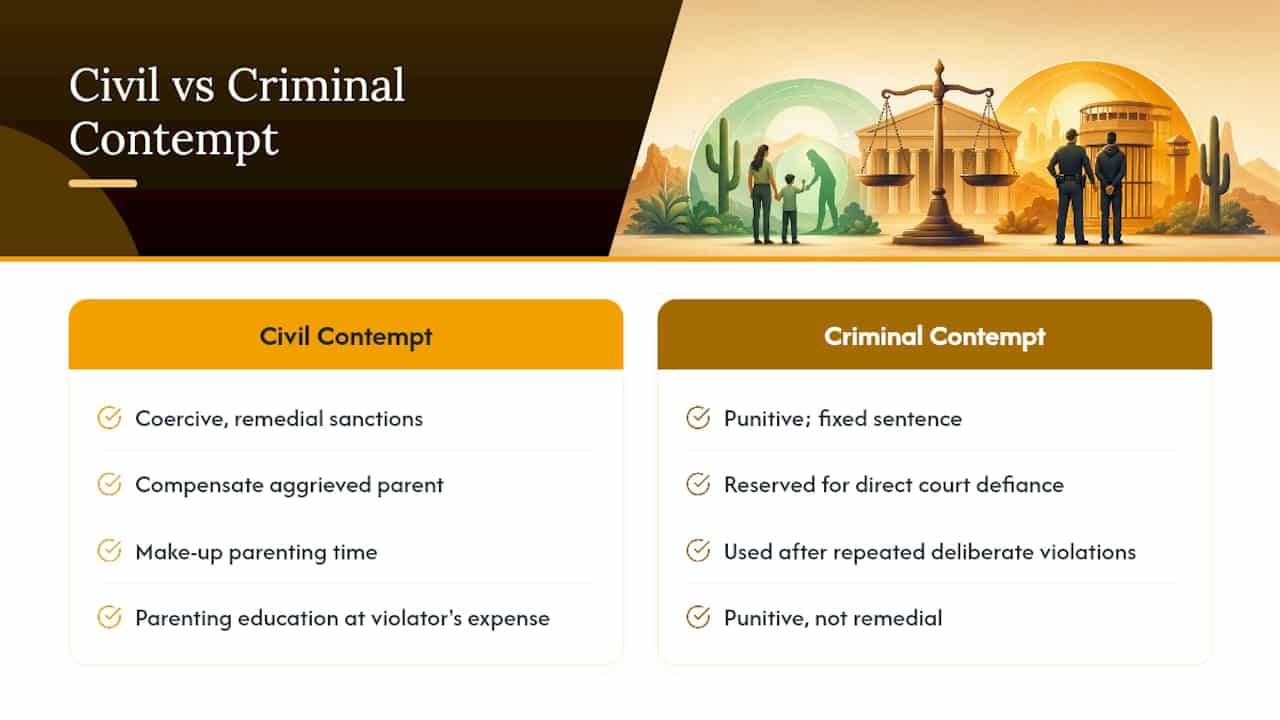
For parenting time violations, A.R.S. §25-414 authorizes make-up parenting time equivalent to the time lost, parenting education or counseling at the violating parent’s expense, and civil penalties up to $100 per violation. These are remedial: they compensate the aggrieved parent and push the violating parent toward compliance.

For child support nonpayment, the enforcement toolkit is broader. Courts can order wage assignment, intercept tax refunds, suspend driver’s and professional licenses, report to credit bureaus, and issue arrest warrants under A.R.S. §§25-681 et seq. These tools can be pursued through the court or through the Arizona Department of Economic Security’s Division of Child Support Services.
Civil contempt sanctions under Rule 92 can include compensatory fines, reimbursement of the petitioner’s attorney fees and costs, and incarceration. Incarceration under civil contempt is coercive, not punitive: the contemnor holds the key to their own release by complying with the purge conditions. The moment they comply, the basis for continued incarceration disappears.
Criminal contempt is punitive and carries a fixed sentence. It is reserved for conduct that directly defies the court’s authority, such as repeated, deliberate violations after multiple warnings. Criminal contempt proceedings carry additional due process protections, including the right to appointed counsel if incarceration is a possibility.
Courts generally prefer civil remedies in family cases. Judges are reluctant to incarcerate a parent for child support nonpayment if doing so eliminates the parent’s ability to earn and pay. The practical preference is for purge conditions that are achievable.
Common defenses and how to document inability to comply
The most frequently raised defense in Arizona contempt cases is inability to comply, and it is also the most frequently botched. Courts do not accept a general claim of financial hardship. They want specific, current evidence.
Common defenses courts recognize include:
- Lack of notice: The respondent was never properly served with the original order or the enforcement petition.
- Inability to comply: Genuine financial incapacity, documented with current bank statements, paystubs, tax returns, and evidence of job loss or medical hardship.
- Substantial compliance: The respondent complied with the material terms, and any shortfall was minor or inadvertent.
- Good cause for missed parenting time: A documented emergency, the child’s illness, or a safety concern that prevented the exchange.
- Need for modification, not enforcement: The circumstances have changed so substantially that the existing order is no longer workable. This is a defense, but it does not excuse noncompliance with the current order while a modification is pending.
Pro Tip: Prepare a written ability-to-pay analysis before your hearing. List your monthly income from all sources, your fixed monthly obligations, and any extraordinary expenses. Attach supporting documents as numbered exhibits. Judges respond to organized, factual presentations. A vague claim that you “can’t afford it” without documentation will not satisfy the court’s requirement for a factual finding on present ability to comply.
The Rule 92 commentary on Westlaw is explicit: judges must make an affirmative factual finding about present ability to comply before ordering incarceration. If you are the respondent and you can document genuine inability, that documentation is your most important asset at the hearing.
What happens at a contempt hearing
The hearing typically begins as a conference, not a full evidentiary proceeding. The judge or a court officer reviews the petition, hears from both sides briefly, and tries to resolve the matter. If the parties cannot resolve it, the matter proceeds to an evidentiary hearing.
At an evidentiary hearing, the respondent has the right to:
- Be represented by counsel
- Cross-examine the petitioner’s witnesses
- Present their own evidence and witnesses
- Remain silent (in criminal contempt proceedings, where Fifth Amendment protections apply)
The judge’s fact-finding covers four questions: Was there a valid order? Did the respondent have notice? Did the respondent fail to comply? Did the respondent have the present ability to comply? All four must be answered affirmatively for a civil contempt finding.
If the court finds contempt, it issues a written order that includes the specific violation, the sanction, and the purge conditions. If the respondent is incarcerated, Rule 92 requires a review hearing at least every 35 days. The respondent can also file an affidavit of compliance to trigger an earlier review. Post-ruling options include a motion for reconsideration, a motion to modify the purge terms if circumstances change, or an appeal to the Arizona Court of Appeals. For custody-related contempt findings, the appellate process in Arizona custody cases follows its own procedural track.
When you should hire a family law attorney
Some contempt matters are straightforward enough for a self-represented party to handle with a county enforcement packet and the self-help resources at Azcourts. Many are not. Hire an attorney when:
- Incarceration is a realistic possibility, either for you or the other party
- The financial dispute is complex: large arrears, disputed income, business ownership, or self-employment
- The order was issued in another state and needs to be registered in Arizona before enforcement
- There have been repeated violations and you need a strategy, not just a single petition
- The other party has an attorney and you do not
- The contempt finding could affect custody arrangements or lead to a modification proceeding
An experienced attorney does more than fill out forms. They draft petitions that are harder to dismiss, gather and organize evidence strategically, argue the ability-to-pay analysis in a way that courts find credible, and negotiate purge terms that are actually achievable. Local knowledge matters too: a family law attorney who knows Maricopa County’s Family Court Conference Center procedures and individual judicial preferences will move your case more efficiently than someone learning the local rules on your dime.
Attorney costs vary. For a realistic picture of what legal representation in Arizona family matters typically involves, the attorney fee guidance on the Highdesertfamilylawgroup site gives useful context.
Frequent mistakes petitioners and respondents make
The procedural errors that sink contempt cases are almost always avoidable.
- Using the wrong county packet. Each county’s packet is specific to that court. A Cochise County enforcement action requires Cochise County forms, not Maricopa’s.
- Trying to modify through an enforcement filing. Courts will not grant new or different terms through an enforcement petition. That request belongs in a separate modification action.
- Failing to serve personally. Mailing the petition to the respondent’s last known address is not sufficient under Rule 92. Personal service is required, and proof of service must be filed before the hearing.
- Missing proof of service. Even if service was done correctly, failing to file the proof of service with the court means the hearing cannot go forward.
- Emotional courtroom behavior. Judges are deciding a legal question, not a moral one. Venting frustration, interrupting, or arguing about issues outside the petition damages your credibility.
- Bringing disorganized evidence. A folder of unsorted screenshots and bank statements slows the hearing and frustrates the judge.
Pro Tip: Organize your exhibits before the hearing. Number each one, prepare a one-page index, and bring three copies: one for the judge, one for opposing counsel or the other party, and one for yourself. Label each exhibit with the date of the violation it documents and the specific term of the order it relates to. A judge who can confirm a violation in 30 seconds is more likely to rule quickly and in your favor.
A practitioner’s perspective on what actually moves these cases
The contempt cases that resolve quickly share a common trait: the petitioner proves the violation cleanly and concisely, without trying to relitigate the underlying custody or support dispute. Judges in Arizona family court see enforcement petitions regularly. They can tell within the first few minutes whether a petitioner is genuinely trying to enforce an order or using the enforcement mechanism to score points in a broader conflict.
What judges want to see is straightforward: clear evidence of a specific violation, a reasonable purge condition the respondent can actually meet, and a petitioner who is not asking the court to do something the enforcement packet cannot do. When a petitioner walks in with organized exhibits, a verified petition, and proof of service, the hearing moves. When they walk in with a narrative about everything that has gone wrong over the past two years, it stalls.
For respondents, the calculus is different. Showing up without documentation of your financial situation is the single biggest mistake you can make. The court is required to find present ability to comply before imposing incarceration. Give the judge the facts they need to make that finding in your favor. Bank statements, a recent paystub, a letter from your employer if hours were cut: these are not optional extras. They are the substance of your defense.
Before any first appearance or conference, prepare these items: a copy of the original court order with the specific term at issue highlighted, your evidence of compliance or noncompliance, your financial documentation if ability to comply is at issue, and a written list of the specific relief you are requesting or the specific defense you are raising. Courts move faster when the parties come prepared.
Highdesertfamilylawgroup handles enforcement and contempt in Arizona
Facing a contempt proceeding, whether you are the one filing or the one responding, is one of the more stressful situations in family law. The procedural stakes are real: a dismissed petition means more delay, and an unprepared respondent can face sanctions that were entirely avoidable.

Highdesertfamilylawgroup has spent over 20 years representing clients in enforcement and contempt matters across Scottsdale and the surrounding Arizona communities. The firm handles the full range: drafting petitions that survive procedural challenge, gathering and organizing evidence, arguing ability-to-pay at evidentiary hearings, and negotiating purge terms that courts will actually approve. When incarceration is on the table, complex financial disputes are involved, or violations have been repeated, that is exactly when experienced representation makes the difference between a resolved case and a prolonged one. If you are dealing with a child support enforcement issue or a parenting time violation, contact Highdesertfamilylawgroup to schedule a consultation and get a clear picture of your options before your next court date.
Sources
Use the source that matches the county where your order was issued. A Maricopa packet cannot be used to enforce a Pima order, and neither county’s packet applies to out-of-state orders.
- 25-414 – Violation of visitation or parenting time rights
- How to Enforce a Court Order for Child Support
This article provides general legal information about contempt of court in Arizona family law. It is not legal advice and does not create an attorney-client relationship. Confirm current rules, forms, and procedures with the applicable court or a licensed Arizona attorney before filing.
This article is general information, not a substitute for advice from a qualified lawyer. Consult a qualified legal professional about your own circumstances before acting on anything here.