



60 Day Rule 76 Deadline: Arizona RMC Checklist and Avowals

A Resolution Management Conference (RMC) is a short, court-ordered hearing under Rule 76 of the Arizona Rules of Family Law Procedure, designed to manage your divorce or custody case and push it toward settlement. Expect the judge to clarify disputed issues, set deadlines, and possibly enter binding orders on the record. Don’t expect a trial. No witnesses testify, and no new evidence gets admitted.
TL;DR:
- Most Arizona RMCs are scheduled within a few months after filing and require thorough meet-and-confer discussions beforehand, unless safety issues prevent direct contact.
- Attendees must file a detailed Resolution Statement and supporting documents, ensuring consistency with disclosures to avoid undermining their case.
- A judge can accept and make binding a settlement on record, set discovery deadlines, or schedule trial dates, but will not hear live evidence or weigh contested testimony.
- Court orders issued after the RMC control procedural steps and remain in effect unless formally modified, emphasizing preparation’s importance.
- Self-represented parties should contact court staff early, bring organized documents, and draft factual avowals to improve outcomes and avoid delays.
Table of Contents
- What Is a Resolution Management Conference in Arizona: Purpose, Timing, and Who Sets It
- What Happens at the RMC: Judge Actions, Limits, and Common Procedural Steps
- Preparing for the RMC: Resolution Statements, Meet-and-Confer, and Disclosures
- Timelines, Attendance, and Rule 76 Deadlines You Can’t Ignore
- Possible Outcomes and Next Steps After the RMC
- The Role of Counsel and Self-Represented Litigants at the RMC
- Day-Of Checklist and Short Avowal Scripts
- Local Rules and Court-Specific RMC Procedures Across Arizona
- How RMCs Differ Across Arizona’s Family Courts
- Common Disputes Arizona Courts Address at RMCs
- What Experienced Arizona Family Law Attorneys Recommend for RMC Prep
- Why RMC Preparation Makes the Biggest Difference in Outcomes
- Get Help Preparing for Your Resolution Management Conference
- Sources
What Is a Resolution Management Conference in Arizona: Purpose, Timing, and Who Sets It
An RMC is a case management hearing, not a fact-finding one. Arizona courts created it to stop divorce and custody cases from drifting for months without direction. The judge reviews where the case stands, identifies what’s actually contested, and pushes both sides toward either a settlement or a concrete plan for trial.
Timing varies by court and case type, but many Maricopa County family cases see their first RMC set within a few months after a petition or a motion triggers one. Self-represented litigants often get routed instead to an Early Resolution Conference (ERC), a related but distinct process that runs longer and leans more heavily on court staff to help unrepresented parties reach an agreement.
Either party can request an RMC, and judges frequently order one on their own when a case shows signs of stalling. Courts use the conference to:
- Confirm which legal decision-making, parenting time, support, or property issues remain unresolved
- Set discovery deadlines and identify what evaluations or experts the case needs
- Push settlement discussions before the parties spend more money on litigation
- Establish a trial timeline if settlement isn’t realistic yet
What Happens at the RMC: Judge Actions, Limits, and Common Procedural Steps
The judge runs the RMC like a working session, not a courtroom drama. Attorneys or self-represented parties summarize their positions, often through short factual statements called avowals rather than sworn testimony. The judge then decides what the case needs next.
Under Rule 69, a judge presiding over an RMC can accept an on-the-record settlement and make it binding immediately, even for just one or two contested issues. Courts also use the conference to schedule discovery deadlines, order custody or financial evaluations, and set trial dates. What they generally will not do is hear live testimony or weigh disputed evidence, since discovery and evidentiary hearings serve a different procedural function than a management conference.
Common outcomes from an RMC include:
- A partial or full settlement read into the record
- A discovery schedule with firm cutoff dates
- Referral to mediation or another evaluator
- A trial date if the parties remain far apart
One detail catches many self-represented litigants off guard: the court must issue a written order after the RMC reciting exactly what happened at the conference, and that order controls the case going forward unless someone formally asks the judge to change it.
Preparing for the RMC: Resolution Statements, Meet-and-Confer, and Disclosures
Arizona courts expect real preparation before you walk into an RMC, and skipping steps tends to backfire. The process starts with a mandatory conversation between the parties.
- Meet and confer several days before the RMC. Both sides (or their attorneys) must discuss the contested issues and try to narrow them down before the hearing. Courts waive this requirement when a protective order or documented domestic violence makes direct contact unsafe. Anyone navigating that situation should also look at resources like Unmasked’s guidance on abusive relationships before deciding how to handle the meet-and-confer step.
- Draft and file your Resolution Statement. Maricopa Superior Court’s packet walks through the required format: a summary of contested issues, your proposed resolution for each one, and confirmation that you attempted to meet and confer.
- Serve a file-stamped copy on the other party and deliver one to the assigned judge’s office, following the exact steps the court packet lays out. Missing this step is one of the most common self-inflicted delays in family court.
- Cross-check your Resolution Statement against your Rule 49 disclosures. The two documents need to tell a consistent story. A Resolution Statement that contradicts your own financial disclosures gives the other side (and the judge) an easy reason to distrust your position.
- Gather supporting documentation, including a pre-divorce checklist of financial records, parenting schedules, and any prior court orders.
Pro Tip: Write your avowals as plain factual statements, not arguments. “My proposed parenting time schedule is attached as Exhibit A” lands better with a judge than “The other party has been unreasonable about scheduling,” which invites pushback instead of agreement.
Timelines, Attendance, and Rule 76 Deadlines You Can’t Ignore
Rule 76 gives courts room to move quickly. A judge can require an RMC within 60 days of a request, which is fast by family court standards, so waiting to prepare until the hearing feels imminent often leaves too little time.
Proof of service matters more than most people expect. If you served the other party with notice of the RMC, you generally need to file proof of that service before the hearing, or the court may question whether the conference can proceed at all.
Attendance isn’t optional. Arizona courts can proceed without an absent party or dismiss claims outright when someone fails to appear without a legitimate excuse. A few points worth remembering:
- Both parties are expected to attend, even when attorneys are handling most of the talking.
- An ERC for self-represented litigants typically runs longer than a standard RMC and may end with a signed consent decree the same day.
- Missing an ERC can trigger a No-Show fee in addition to any procedural consequences.
- Rescheduling requests need to go through the court, not an informal agreement between the parties.
Possible Outcomes and Next Steps After the RMC
Not every RMC ends the same way, and the outcome shapes what your case looks like for months afterward. Some conferences resolve everything on the spot.
- On-the-record stipulations or consent decrees. When both sides agree, the judge can finalize the terms right there, which can end the case entirely for simpler matters.
- Discovery scheduling. If issues remain contested, expect a firm timeline for exchanging financial records, parenting evaluations, or expert reports.
- Referrals to mediation or evaluation. Judges frequently send unresolved custody or property disputes to a neutral third party before setting a trial date.
- Trial dates. When settlement isn’t realistic, the RMC becomes the moment the court locks in a path toward trial.
- Temporary orders. Interim custody, support, or property arrangements set at the RMC often stay in effect until the next hearing, so they carry more weight than people assume.
Every one of these outcomes gets memorialized in a written court order, and that order becomes the roadmap for everything that follows.
The Role of Counsel and Self-Represented Litigants at the RMC
Attorneys carry specific obligations heading into an RMC. They’re expected to have genuinely conferred with opposing counsel beforehand, not just exchanged a perfunctory email, and to bring settlement proposals grounded in the actual facts of the case rather than opening positions designed to stall. When they present avowals to the judge, they’re building the factual record the court will rely on, so precision matters more than persuasion.
Self-represented litigants face a steeper climb but aren’t left without support:
- Bring every document the Resolution Statement references, organized and labeled.
- Contact the Family Law Case Manager ahead of time if you’re unsure about local procedure or paperwork.
- Know the difference between an RMC and an ERC; if you were routed to the latter, expect more built-in guidance from court staff.
- Recognize when the issues are complex enough (contested custody, significant assets, community property questions) that hiring counsel changes your outcome.
Pro Tip: If you’re self-represented and the other side has an attorney, ask the Family Law Case Manager whether a settlement conference or short mediation session makes more sense before your RMC date. It costs nothing to ask, and it can reset the entire tone of the case.
Day-Of Checklist and Short Avowal Scripts
Walking into an RMC prepared changes how the judge perceives your case from the first five minutes. Bring physical copies of everything, because courtroom Wi-Fi and phone access are not guaranteed.
- File-stamped copy of your Resolution Statement, plus proof of service
- Any prior orders (temporary orders, decrees, protective orders)
- A current parenting time calendar if custody is contested
- Financial disclosures matching your Resolution Statement
- Contact information for the Family Law Case Manager and opposing counsel
For quick, factual avowals:
- Custody: “I’m requesting the parenting time schedule attached as Exhibit B, based on the children’s current school enrollment.”
- Support: “My proposed child support figure follows the Arizona Child Support Guidelines calculation attached as Exhibit C.”
- Property: “I’m asking the court to divide the marital home as outlined in my Resolution Statement, Section 3.”
If you need a continuance, request it in writing before the hearing date, not the morning of. If the other party doesn’t show, be ready to ask the judge how the court intends to proceed.
Local Rules and Court-Specific RMC Procedures Across Arizona
Every Arizona county’s superior court follows Rule 76, but the paperwork, filing counters, and scheduling systems differ enough to trip up someone who assumes one county’s process transfers directly to another.
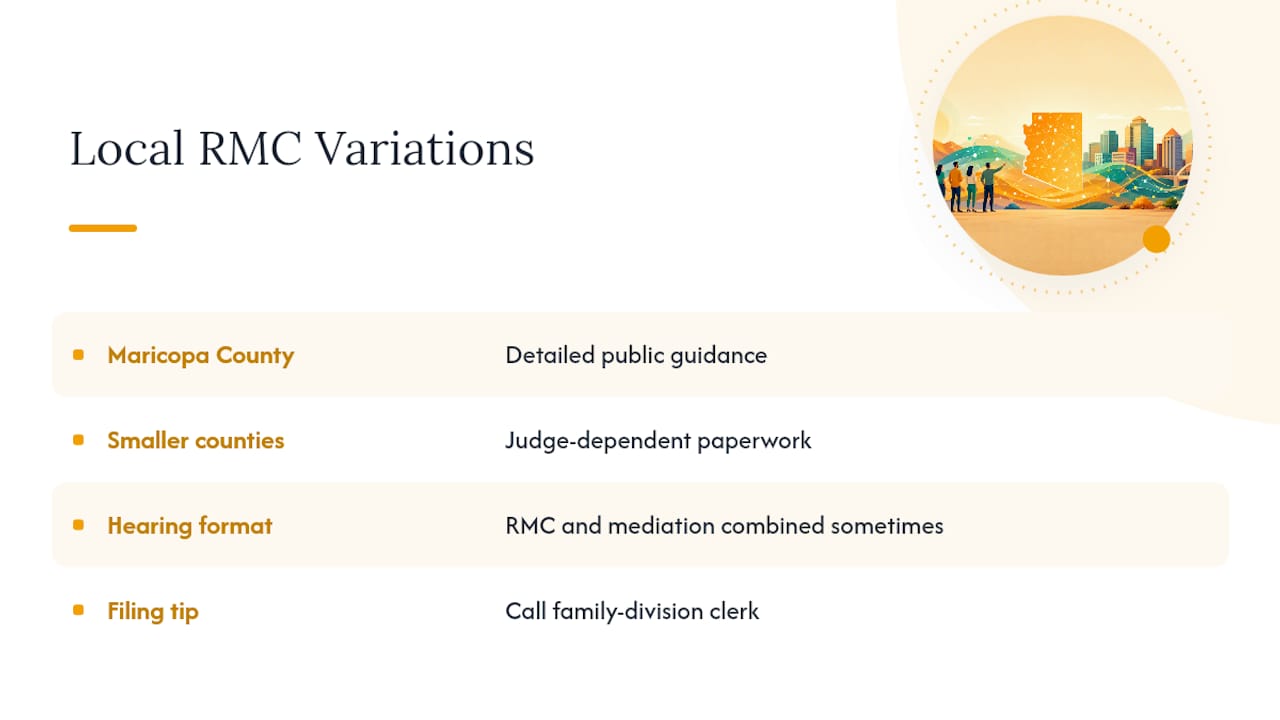
Maricopa County publishes the most detailed public guidance, including downloadable Resolution Statement packets and step-by-step filing instructions specific to paternity and legal decision-making cases. Its family court department page also lists where to physically file documents, which matters because some divisions still require hand delivery to a judge’s office rather than electronic service alone.
Smaller counties often handle RMCs with less standardized paperwork, relying more on the assigned judge’s individual practices. That means the exact format of a Resolution Statement, and how strictly the five-day meet-and-confer window gets enforced, can vary depending on which judge’s calendar your case lands on.
Some divisions consolidate the RMC and mediation referral into a single hearing to save time. Others keep them entirely separate, requiring a second scheduled event before mediation begins. If you’re filing in a county outside Maricopa, calling the assigned court’s family division clerk before your hearing date to confirm local formatting requirements saves you from a rejected filing or a wasted trip to the courthouse.
How RMCs Differ Across Arizona’s Family Courts
The core purpose of an RMC stays consistent statewide because Rule 76 governs every Arizona superior court, but the experience of attending one can look noticeably different depending on where your case sits.
Maricopa County, the state’s largest and busiest family court system, runs a more structured process with published forms, a defined Early Resolution Conference track for self-represented litigants, and Family Law Case Managers available to answer procedural questions. Smaller counties, with fewer cases and fewer support staff, tend to give judges more latitude in how they run the conference, which can mean shorter hearings but also less predictability for someone unfamiliar with that judge’s expectations.
Rural counties sometimes combine RMCs with other scheduled events, like a status conference or a settlement conference, into one hearing block to manage limited court dates efficiently. Urban counties with heavier caseloads are more likely to keep each hearing type separate and strictly timed.
The practical takeaway: don’t assume a friend’s experience with an RMC in one county tells you exactly what to expect in another. If your case moved counties through a relocation or venue change, ask the new court’s clerk about local RMC scheduling and paperwork norms before assuming the old rules still apply.
Common Disputes Arizona Courts Address at RMCs
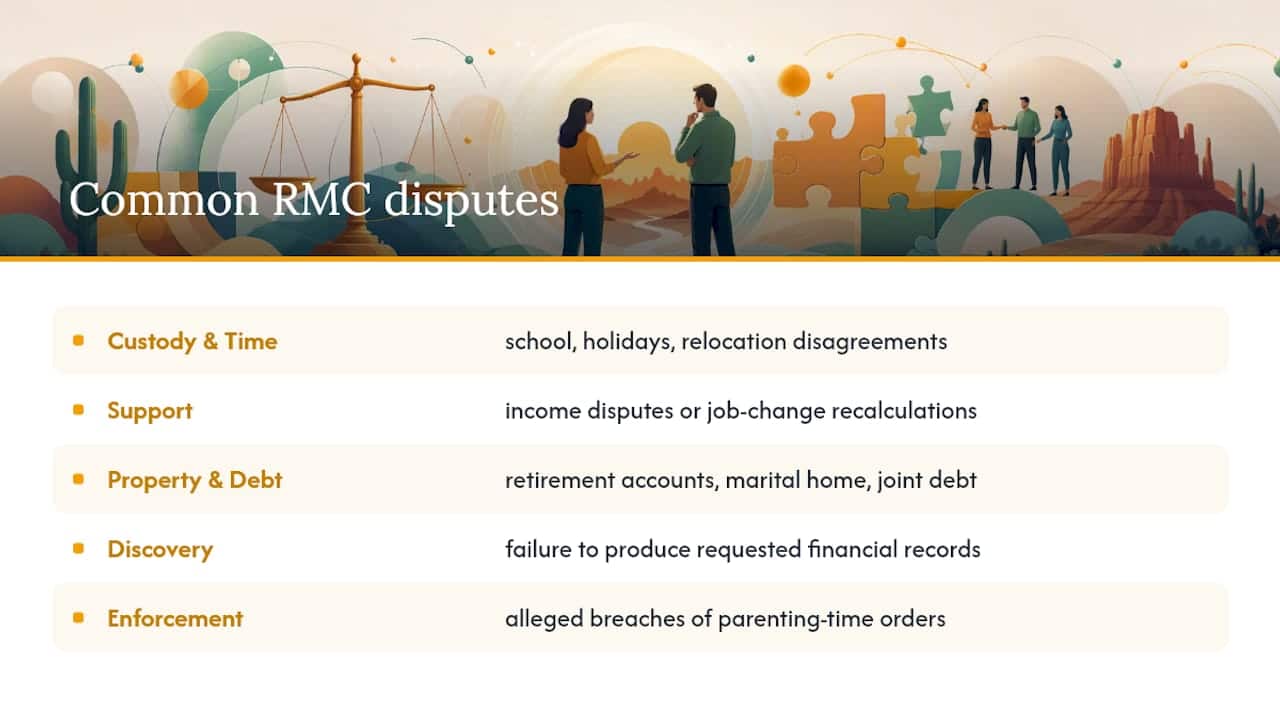
Most RMCs in Arizona revolve around a predictable set of issues, even though every case has its own details. Legal decision-making (Arizona’s term for custody) and parenting time top the list, particularly when parents disagree on school enrollment, holiday schedules, or relocation. Judges use the RMC to narrow these disputes down to specific, decidable questions rather than letting them remain vague grievances.
Child support and spousal maintenance disputes come up constantly, especially when one party disputes the other’s reported income or claims a recent job change should adjust the calculation. Property and debt division, including retirement accounts, the marital home, and joint debt, often gets addressed at the RMC stage because these issues frequently resolve through negotiation rather than trial.
Discovery disputes, one party claiming the other hasn’t produced requested financial records, also surface regularly, and the RMC gives the judge a chance to set a firm deadline before the issue snowballs. Enforcement questions, when one parent alleges the other isn’t following an existing parenting time order, sometimes get preliminary attention at an RMC even though full enforcement hearings happen separately. Understanding how Arizona’s divorce process generally unfolds helps put these individual disputes into context.
What Experienced Arizona Family Law Attorneys Recommend for RMC Prep
Attorneys who handle these conferences regularly tend to agree on a few practices that separate a productive RMC from a wasted one. Coming in with a narrow, settlement-ready proposal on at least the simpler issues, rather than treating every point as contested, tends to shorten the overall case and cut down on discovery costs that add up fast in a drawn-out dispute.
Preparing tight, factual avowals ahead of time matters more than most self-represented litigants realize. Judges rely on those short statements to frame the entire conference, so vague or emotional language tends to muddy the record rather than clarify it. Attorneys who’ve done dozens of these conferences often draft their avowals the night before and review them with the client, so nothing said in the hearing surprises anyone.
Another recurring piece of advice: treat the meet-and-confer requirement as a real negotiation opportunity, not a box to check. Cases where one side treats the pre-RMC conversation as a formality tend to walk into the hearing further apart than they need to be, which pushes more issues toward a contested trial track instead of a faster resolution. Reviewing your parental rights under Arizona law before that conversation gives you a stronger, more realistic starting position.
Why RMC Preparation Makes the Biggest Difference in Outcomes
Most people assume the RMC is a minor procedural checkpoint. It isn’t. It’s often the single hearing where a case’s entire trajectory gets set, and the parties who treat it that way tend to come out ahead.
What surprises people most is how much weight judges give to a well-drafted Resolution Statement and a clean set of avowals. A vague, argumentative filing signals to the court that the case isn’t ready to settle, which pushes it toward a longer, more expensive discovery and trial track. A tight, specific filing signals the opposite, and judges respond to that signal by moving cases faster.
At Highdesertfamilylawgroup, we’ve built our approach around exactly this insight: over 20 years of family law work in Scottsdale has shown that cases prepared thoroughly before the RMC, with disclosures that match the Resolution Statement and avowals grounded in real financial and parenting facts, consistently move toward resolution faster than cases where the RMC becomes just another stop on a long docket. Open communication with clients about their actual financial goals, not just legal positions, shapes every Resolution Statement our team drafts. That’s the difference between an RMC that resolves your case and one that just delays it.
— Brett
Get Help Preparing for Your Resolution Management Conference
A well-drafted Resolution Statement and a clear negotiation strategy at the RMC can shorten your entire case by months, but getting there without missing a filing deadline or a service requirement is harder alone than it looks on paper. Highdesertfamilylawgroup handles the parts of RMC prep that trip up self-represented litigants most often: drafting the Resolution Statement itself, running the meet-and-confer conversation, and negotiating directly with the other side or their counsel before you ever step into the courtroom.

Our team represents clients at RMCs, mediation sessions, and hearings across Scottsdale family law matters, from custody disputes to property division. If you’re not sure whether your situation calls for full representation or a more limited scope of help, our breakdown of types of family lawyers is a good place to start. From there, reach out to schedule a consultation so we can review your upcoming RMC date and build a Resolution Statement that actually moves your case forward.
This article is general information, not a substitute for advice from a qualified lawyer. Consult a qualified legal professional about your own circumstances before acting on anything here.