



Default Divorce Arizona: Step-by-Step Filing Guide

You can pursue a default divorce in Arizona once your spouse has been properly served and fails to file a response within the statutory window. From there, you have two routes: schedule a default hearing, or ask the court for a default decree without a hearing under Arizona Rule of Family Law Procedure 44.1, if you meet a strict set of conditions.
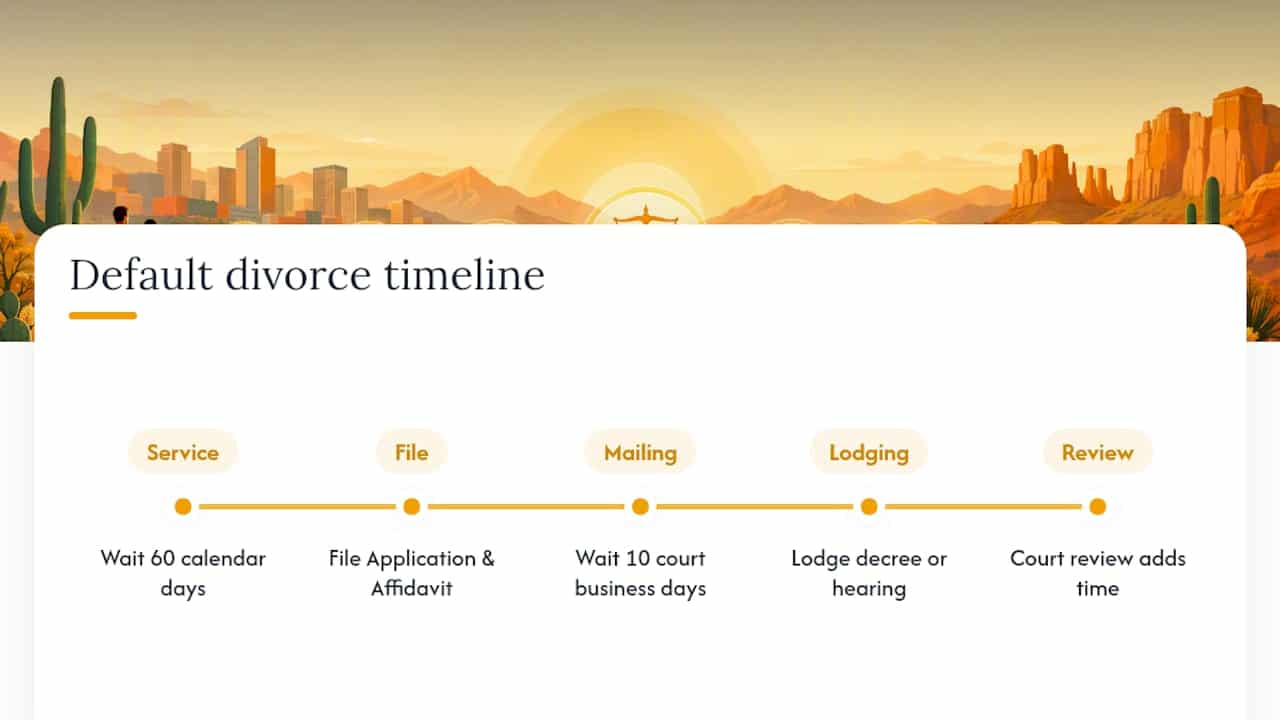
The single rule that trips up more DIY filers than anything else is timing. You must wait the legally required minimum period after service before filing your Application and Affidavit for Default, and then wait a separate required court-business-day period after filing and mailing that application before you can lodge a decree or ask the court to schedule a hearing.
The 60-day clock and the 10-day clock are not the same clock, and they don’t run together. Miss that distinction and your paperwork bounces back.
Quick eligibility checklist:
- Your spouse was served according to Arizona’s service rules (not by publication, if you want the no-hearing route).
- The legally required minimum time has passed since service was completed.
- Your spouse has not filed an Answer or Response.
- You’ve filed the Application and Affidavit for Default and mailed a copy to your spouse.
- At least 10 court business days have passed since that mailing.
Key Takeaways
A valid default divorce in Arizona requires proper service, an unanswered petition after 60 calendar days, and strict compliance with either the default hearing or Rule 44.1 no-hearing process.
| Point | Details |
|---|---|
| Two timing clocks | Wait 60 calendar days after service, then a separate 10 court-business-day wait after filing and mailing the Application & Affidavit for Default. |
| Two available routes | Choose a scheduled default hearing or, if eligible, a default decree by motion without a hearing under Rule 44.1. |
| Publication service blocks the shortcut | You cannot use the no-hearing route if the respondent was served by publication. |
| Decree must match the petition | Courts reject or reverse default decrees that request more than what the original petition asked for. |
| Get help for complex cases | Highdesertfamilylawgroup reviews service, drafts QDRO language, and prepares default packets for Scottsdale-area filers before submission. |
Table of Contents
- What Is Default Divorce in Arizona and Who Qualifies?
- Steps for Default Divorce in Arizona: Filing to Finalization
- Can You Get a Default Decree Without a Hearing in Arizona?
- What Judges Check, and Why Defaults Get Denied or Reversed
- How Long Does a Default Divorce Take in Arizona?
- When Should You Hire an Attorney for a Default Divorce?
- What Experienced Filers Get Wrong About Timing
- How High Desert Family Law Group Can Help With Your Default Divorce
- Forms, Rules, and County Pages to Download Now
- Frequently Asked Questions
- Sources
What Is Default Divorce in Arizona and Who Qualifies?
A default divorce in Arizona is what happens when the responding spouse never answers the petition, so the court finalizes the case without their participation. It’s a subset of the broader Arizona divorce process, and it exists specifically for cases where one spouse has gone silent, disappeared, or simply refuses to engage.
Eligibility rests on three pillars. First, residency: under A.R.S. §25-312, at least one spouse must have been domiciled in Arizona, or stationed here as military personnel, for a set period before filing, and the court must find the marriage irretrievably broken. Second, proper service. Third, the respondent’s failure to answer within the deadline set by the summons. Get any one of those wrong, and the whole filing can unravel.
This differs from an uncontested divorce Arizona courts process through mutual agreement, where both spouses sign off on terms. A default judgment divorce Arizona case moves forward specifically because one party didn’t show up to negotiate anything.
Steps for Default Divorce in Arizona: Filing to Finalization
Getting a default divorce in Arizona right the first time means following the sequence exactly, not skipping steps because they seem redundant.
- Confirm and document service. Your Proof of Service must be filed with the court before anything else starts. This is the foundation of the entire filing; if service was defective, the whole default can later be set aside.
- Wait out the 60-calendar-day clock. This period starts the day service was completed, not the day you filed the petition. You can file your Application and Affidavit for Default on day 61 or later.
- File the Application and Affidavit for Default (form DRD61F). Prepare an original plus two date-stamped copies. File the original with the clerk, keep one copy for your records, and mail the other date-stamped copy to the respondent at their last known address, according to AZCourtHelp’s default process instructions.
- Wait the separate 10-court-business-day period. This clock starts after you’ve filed and mailed the Application, per Maricopa County’s divorce decree resources. Weekends and court holidays don’t count.
- Choose your path: default hearing or decree by motion. If you don’t qualify for the no-hearing route (covered next), you’ll schedule a default hearing through your county’s family court division.
- Assemble your hearing packet. Bring the proposed Decree of Dissolution, a parenting plan and child support worksheet if you have children, proof of income, and stamped, addressed envelopes for the clerk to mail the signed decree.
What to bring to a default hearing:
- Proposed Decree of Dissolution matching your original petition
- Parenting Plan and Child Support Worksheet, if applicable
- Proof of Service already on file
- Two self-addressed, stamped envelopes
- Any Qualified Domestic Relations Order paperwork if retirement accounts are being divided
Counties don’t run this identically. Maricopa County publishes a default screening checklist and offers ezCourtForms for guided document assembly, while Pinal County posts its own default hearing instructions with slightly different scheduling logistics. Always pull your specific county’s packet before filing rather than assuming Maricopa’s rules apply statewide.
Pro Tip: Make five copies of everything before you file anything. Clerks reject incomplete default packets constantly, and having spares on hand saves you a second trip to the courthouse.
Can You Get a Default Decree Without a Hearing in Arizona?
Sometimes, yes. Rule 44.1 of the Arizona Rules of Family Law Procedure lets a petitioner request a default decree by motion, without a hearing, but the eligibility bar is narrow and unforgiving.
If the respondent was served by publication, if either party is a minor or found incompetent, or if your requested decree terms differ from what you originally petitioned for, Rule 44.1 bars the no-hearing route entirely.
To qualify, you generally need:
- Service completed by a method other than publication.
- No response or appearance filed by the respondent.
- Decree requests that mirror exactly what the original petition asked for.
- A completed SCRA (Servicemembers Civil Relief Act) waiver if military status is a factor.
- A separate Default Information for Spousal Maintenance form and worksheet, if you’re requesting spousal support.
The core paperwork is the Motion and Affidavit for Default Decree without Hearing, often called the DRD68F/DRD68P packet in Maricopa County. It requires supporting affidavits, the proposed decree, and two preaddressed, stamped 9×12 envelopes so the clerk can mail back the signed order, according to the Maricopa Superior Court’s DRD68P instructions. The court still has to review everything for compliance before signing, so filing a clean, complete motion the first time matters more here than almost anywhere else in the process.
What Judges Check, and Why Defaults Get Denied or Reversed
Judges reviewing a default filing aren’t rubber-stamping paperwork. They check that residency requirements under A.R.S. §25-312 are met, that your Proof of Service holds up, and that the decree you’re requesting actually matches what you asked for in the original petition, a point Maricopa’s own divorce and legal separation process packet emphasizes directly.
The mistakes that sink default filings most often:
- Filing the Application and Affidavit for Default before the 60-day or 10-court-business-day windows have actually closed.
- Attempting a no-hearing default when service was completed by publication.
- Missing required attachments like the child support worksheet or spousal maintenance information form.
- Asking for more in the decree than what the petition originally requested, without the other party’s written consent.
A default judgment can also be set aside months later if service turns out to have been defective. That’s not a small risk. It means the entire case reopens.
Pro Tip: Keep your Proof of Service and your decree language internally consistent from day one. If the addresses, dates, or requested relief shift between documents, that’s exactly the inconsistency a judge, or a later motion to set aside, will catch.
How Long Does a Default Divorce Take in Arizona?
Expect two hard waiting periods stacked back to back: 60 calendar days from service before you can even file your Application and Affidavit for Default, then 10 court business days after filing and mailing it before you can lodge a decree or schedule a hearing.
- Statutory minimum: 60 calendar days post-service (dissolution cases)
- Additional wait: 10 court business days after filing/mailing the Application & Affidavit for Default
- Judge/Commissioner review and signature: variable, depending on court caseload
- Filing and response fees: vary by county; if the respondent later files an appearance, they typically owe a separate appearance fee
- Routine out-of-pocket costs: clerk fees, copy costs, certified mail or postage for required mailings
Maricopa County runs its own default screening checklist and ezCourtForms system, while Pinal County and others maintain separate local instructions. Confirm current fee schedules with your county clerk directly, since they change and vary by jurisdiction.
When Should You Hire an Attorney for a Default Divorce?
Plenty of straightforward default cases get handled without an attorney. But certain fact patterns raise the stakes enough that DIY filing becomes genuinely risky.
Consider hiring counsel if:
- Retirement accounts are being divided and you need a Qualified Domestic Relations Order (QDROs are notoriously easy to draft incorrectly).
- Custody or child support terms are contested, unclear, or involve a special-needs child.
- You’re requesting spousal maintenance and need supporting documentation the court will actually accept.
- The respondent is active-duty military, which triggers SCRA protections and specific waiver requirements.
- You suspect service may have been improper or incomplete.
An attorney can confirm your Proof of Service is bulletproof, draft decree language that holds up to enforcement later (particularly for retirement division), and advise whether the no-hearing route or a scheduled hearing better fits your situation. If you’re weighing alimony calculations or unsure which type of divorce actually applies to your case, that’s usually the moment to stop guessing and get a second set of eyes on the file.
Pro Tip: A 30-minute consult before you file often costs less than the delay caused by a rejected packet or a default that gets set aside six months later.
What Experienced Filers Get Wrong About Timing
The paperwork isn’t what trips people up. It’s the two separate clocks. I’ve seen filers count the 10-day wait from the day they filed, forgetting it actually starts after the mailing to the respondent is complete, which can push their entire hearing date back by a week they didn’t plan for.
How High Desert Family Law Group Can Help With Your Default Divorce
Highdesertfamilylawgroup gives Scottsdale-area filers something a self-service center can’t: someone who reviews your specific packet before the clerk does, so you’re not the one discovering a missing worksheet or a defective service issue at the counter.

Our team handles the pieces that trip up default filings most often: confirming your Proof of Service will actually hold up, drafting QDRO language that survives enforcement later, running accurate child support worksheets, and deciding with you whether the no-hearing motion route or a scheduled default hearing fits your case better. If spousal maintenance is part of your request, we’ll also make sure your worksheets and supporting evidence meet what Rule 44.1 actually requires.
You can absolutely file a default divorce on your own in Arizona. But if you’d rather not risk a rejected packet or a decree that gets challenged months from now, schedule a consultation with our team and bring your service documents, petition, and any financial paperwork you have. We’ll tell you plainly whether you’re ready to file or what’s missing first.
Forms, Rules, and County Pages to Download Now
- Application & Affidavit for Default and family law forms
- Rule 44.1 full text
- Pinal County default hearing instructions
Check your county’s self-service center for local checklist variations before filing.
Frequently Asked Questions
How long does a default divorce take in Arizona?
Expect a minimum of 60 calendar days after service before you can file your Application and Affidavit for Default, plus another 10 court business days after mailing it before you can lodge a decree or schedule a hearing. Court review time adds more on top of that.
What happens if my spouse never responds to divorce papers in Arizona?
If they don’t file an Answer within the deadline stated on the summons, you can pursue a default divorce once the statutory waiting periods pass, provided service was completed correctly.
Can I get a default decree without going to court in Arizona?
Yes, if you meet Rule 44.1’s conditions: service wasn’t by publication, neither party is a minor or incompetent, and your decree requests match your original petition exactly.
Does a default divorce mean I automatically get everything I asked for?
Not necessarily. The judge still reviews the decree for legal compliance and won’t approve terms beyond what your petition requested without the other party’s consent.
What county-specific rules should I check before filing?
Maricopa County publishes a default screening checklist and ezCourtForms, while counties like Pinal maintain separate instructions. Confirm current forms and fees with your specific county clerk before filing.
This article is general information, not a substitute for advice from a qualified lawyer. Consult a qualified legal professional about your own circumstances before acting on anything here.
Sources
- Divorce & Legal Separation resources (Maricopa County Superior Court)
- Rule 44.1. Default Decree or Judgment by Motion and Without a Hearing
- Instructions and Procedures for a Default Decree by Motion, without a Hearing (Maricopa Superior Court packet DRD68P/DRD68F)
- Azcourthelp
- A.R.S. §25-312 — Dissolution of marriage; findings necessary