



Custody Evaluation Arizona: What Parents Need to Know

A custody evaluation in Arizona is a court-ordered investigation into a family’s circumstances, conducted so a judge can decide legal decision-making and parenting time based on a child’s best interests rather than either parent’s version of events. Judges order these evaluations under A.R.S. §25-406 and the Arizona Rules of Family Law Procedure, specifically Rule 68, which govern who can perform them and how the findings reach the court.
A court-approved mental health professional, not a judge or attorney, usually conducts the evaluation and submits a written report with recommendations.
A custody evaluation is not a verdict. It’s an investigation whose findings a judge weighs alongside everything else in the case file.
What the report typically addresses:
- Each parent’s capacity to meet the child’s daily and emotional needs
- The child’s relationship with each parent and, when age-appropriate, their preferences
- Safety concerns, including abuse, neglect, or substance use
- Practical logistics like school stability and existing routines
Key Takeaways
A custody evaluation in Arizona weighs documented, consistent parental behavior more heavily than any single statement made during an interview.
| Point | Details |
|---|---|
| Statutory authority | Judges order evaluations under A.R.S. §25-406, and evaluators must affirm training requirements before submitting a report. |
| County procedures vary | Conciliation Court programs like Pima County’s use settlement-based evaluations that differ from adversarial full evaluations. |
| Documentation wins cases | Consistent logs, school records, and third-party corroboration matter more to evaluators than one-off impressions. |
| Reports are influential, not binding | Judges weigh evaluator recommendations alongside all other evidence and retain final decision-making authority. |
| Counsel matters early | Highdesertfamilylawgroup helps parents prepare for evaluations, vet evaluators, and challenge flawed findings when necessary. |
This article is general information, not a substitute for advice from a qualified lawyer. Consult a qualified legal professional about your own circumstances before acting on anything here.
Table of Contents
- When Do Arizona Courts Order a Custody Evaluation?
- Who Performs Custody Evaluations in Arizona?
- What Types of Custody Evaluations Exist in Arizona?
- What Do Evaluators and Judges Look For?
- What Does the Custody Evaluation Process Look Like Step by Step?
- How Should You Prepare for a Custody Evaluation?
- What’s in the Evaluator’s Report, and How Do Judges Use It?
- How Long Does a Custody Evaluation Take, and What Does It Cost?
- What If You Disagree With the Evaluator’s Findings?
- How Can an Arizona Family Law Attorney Help With a Custody Evaluation?
- What Contested Custody Cases Usually Reveal
- How Highdesertfamilylawgroup Supports Parents Through Evaluations
- Sources
When Do Arizona Courts Order a Custody Evaluation?
Judges don’t order evaluations automatically. Under A.R.S. §25-406, a court may order an investigation into legal decision-making or parenting time whenever the facts are contested enough that an outside professional’s assessment would help resolve them. The person conducting the investigation must affirm, in writing, that they meet the statute’s training requirements, and they’re required to disclose the names and addresses of everyone they consulted during the process.
Rule 68 governs the procedural mechanics, and many counties route these cases through a Conciliation Court, which screens referrals under Rule 3.12 and can consider a family’s finances before assigning an evaluator.
Common triggers for an order include:
- Sharply contested parenting time or decision-making disputes
- Allegations of abuse, neglect, or domestic violence
- Questions about a parent’s mental health, substance use, or fitness
- A proposed relocation that would disrupt the child’s current arrangement
The court doesn’t need proof of wrongdoing to order an evaluation. Disagreement alone, if serious enough, can justify one.
Who Performs Custody Evaluations in Arizona?
Arizona courts rely on court-approved psychologists, psychiatrists, licensed clinical social workers, and court social services investigators to conduct evaluations. Private practitioners handle many cases, and their intake process typically covers interviews, testing, observations, and collateral contacts before a report gets written.

Neutrality is the whole point. An evaluator works for the court, not for either parent, and the statute requires them to affirm they’ve met training standards before the report can be used.
What to look for in an evaluator:
- Confirmed inclusion on the court’s approved list, if the county maintains one
- Specific experience with contested custody, not just general clinical practice
- Willingness to explain their methodology and testing tools in plain terms
Pro Tip: Ask your attorney to request the evaluator’s CV and a sample of past evaluation reports (with identifying details redacted) before the process starts. It tells you how thorough and how neutral their prior work actually was.
What Types of Custody Evaluations Exist in Arizona?
Not every evaluation looks the same. A full or comprehensive evaluation covers interviews with both parents, the child, and collateral witnesses, plus psychological testing where warranted. A limited-scope evaluation narrows the focus to one disputed issue, like relocation or a specific safety concern, and moves faster.
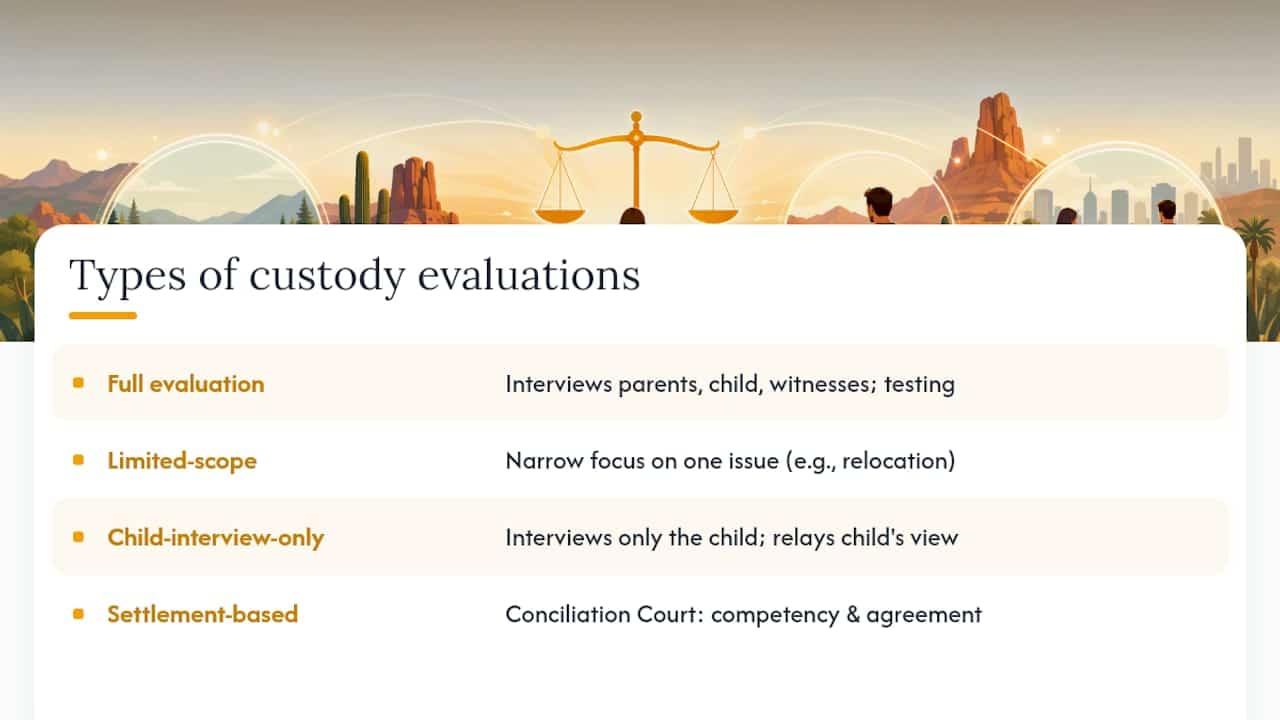
Some cases involve a child-interview-only evaluation, where the evaluator’s role is simply to relay the child’s perspective to the court. Then there’s the settlement-based track through Conciliation Court, which focuses on parental competency and encouraging agreement rather than building an adversarial record. Courts typically reserve full evaluations for cases with the most serious allegations, saving limited evaluations for narrower, faster-moving disputes.
What Do Evaluators and Judges Look For?
Arizona’s best-interests standard drives everything an evaluator investigates, and it draws on the broader statutory framework surrounding legal decision-making and parenting time. Evaluators aren’t grading parents on likability. They’re gathering evidence on specific, recurring factors that judges have to weigh under the law.
Core areas evaluators examine:
- The strength and quality of each parent-child relationship
- Each parent’s practical capacity to provide care, structure, and supervision
- The level of conflict between parents and how it affects the child
- The child’s own needs, adjustment, and, when appropriate, stated preferences
- Any history of domestic violence, abuse, substance use, or untreated mental health issues
- Stability in schooling, peer relationships, and daily routines
Evaluators build their findings from documented patterns, not from a single good or bad interaction they happen to witness.
Evidence that tends to support a positive finding includes consistent school pickup and drop-off records, documented attendance at medical appointments, and corroboration from third parties like teachers or coaches who’ve observed the parent-child relationship over time.
Pro Tip: Keep a simple shared calendar or log of parenting time, appointments, and activities well before an evaluation is ever ordered. Evaluators trust documentation created in the normal course of parenting far more than records assembled after litigation starts.
Family structures involved in custody disputes vary widely, and Pew Research Center data on parenting arrangements underscores just how much variation evaluators account for when assessing what stability actually looks like for a given child.
What Does the Custody Evaluation Process Look Like Step by Step?
The process runs on a fairly predictable sequence, though the pace varies by county and evaluator caseload.
- The court issues an order for an evaluation, specifying full, limited, or settlement-based scope.
- An evaluator gets selected or appointed, sometimes through Conciliation Court referral.
- Parents complete intake paperwork, often pulled from official Arizona court forms.
- The evaluator interviews each parent, the child, and relevant collateral contacts like teachers or relatives.
- Home observations and, in many cases, psychological testing follow.
- In settlement-based tracks, the evaluator may share preliminary feedback aimed at resolving disputes before a final report.
- A written report with findings and recommendations gets finalized.
- The report is filed and distributed to the parties, often at least ten days before any related hearing.
Timeline snapshot: Intake and scheduling typically consume the first few weeks. Interviews and observations often stretch across several weeks more, especially when collateral contacts are hard to reach. Courts frequently schedule hearings only after the report has circulated, giving both sides time to review it.
How Should You Prepare for a Custody Evaluation?
Preparation matters more than most parents expect, and it starts well before the first interview.
Documents worth gathering:
- School records and report cards
- Medical and counseling records for the child
- A parenting-time calendar or log
- Texts, emails, or messages showing consistent involvement
- Prior court orders and any relevant third-party statements
Behavior matters just as much as paperwork. Keep routines steady, avoid disparaging the other parent in front of the child, and answer the evaluator’s questions honestly rather than performing for them. Dress and speak the way you normally would; evaluators notice when something feels staged.
Pro Tip: Never coach your child on what to say, and never withhold information you think makes you look bad. Evaluators are trained to spot coaching, and it tends to backfire harder than the original concern would have. If you have genuine worries about the other parent, document them and raise them through your attorney rather than through the child.
What’s in the Evaluator’s Report, and How Do Judges Use It?
A typical report walks through background information, summaries of each interview, testing results, direct observations, and a findings section that ends in specific recommendations for legal decision-making and parenting time.
Confidentiality practices vary by county. Conciliation Court reports are often filed under seal, meaning they’re only opened by court order rather than sitting in the public case file. Parties involved in the case still retain access to review the findings that concern them.
A judge reads the recommendation, but the judge signs the order. The evaluator’s findings are influential, not automatic.
Judges treat evaluator recommendations as one important input, not a binding verdict. A judge can, and sometimes does, rule differently than the evaluator suggested, particularly when other evidence in the case points a different direction.
How Long Does a Custody Evaluation Take, and What Does It Cost?
Full evaluations commonly take a few months from court order to final report, while limited-scope or settlement-based evaluations tend to move faster. Delays usually stem from scheduling collateral interviews or backlogged evaluator caseloads, and local court resources like Maricopa County Superior Court publish county-specific procedures that affect timing.
Cost drivers include:
- The evaluator’s hourly rate and total hours billed
- Psychological testing fees, when testing is ordered
- Whether the county provides evaluation services or the family hires a private evaluator
Courts can allocate evaluation costs between parents or require an advance deposit, and Conciliation Court’s screening process factors in a family’s finances before assigning a case. Parents budgeting for this alongside attorney fees should plan for both costs together, not just one.
What If You Disagree With the Evaluator’s Findings?
Disagreeing with a report doesn’t mean you’re stuck with it. Start by reviewing the document line by line with your attorney and flagging any factual errors, then gather evidence that directly contradicts the parts you dispute.
Your realistic options include:
- Cross-examining the evaluator at a hearing about methodology or conclusions
- Moving to exclude testing or findings that don’t meet reliability standards
- Requesting a second, independent evaluation
- Filing targeted objections to specific factual inaccuracies rather than attacking the whole report
Pro Tip: Under A.R.S. §25-406, you have the right to know who the evaluator consulted and to request their contact information. Move quickly with counsel here. The window to request examination of the investigator and challenge specific findings is tighter than most parents expect.
How Can an Arizona Family Law Attorney Help With a Custody Evaluation?
An attorney’s value shows up at nearly every stage: negotiating the evaluation’s scope, vetting the evaluator’s background, preparing you for interviews, and cross-examining the evaluator if the findings need to be challenged.
Where an attorney adds the most:
- Advising on which documents and evidence actually matter to the evaluator
- Handling procedural filings and deadlines tied to the report
- Advocating on cost allocation between parents
- Navigating county-specific procedures, since Conciliation Court practices differ between counties like Pima and Maricopa
If you’re weighing whether representation makes sense for your situation, understanding what a family lawyer actually does during a contested custody matter is a reasonable place to start.
What Contested Custody Cases Usually Reveal
Most contested cases don’t hinge on one dramatic incident. They hinge on which parent can show a consistent, documented pattern of putting the child first. Evaluators reward parents who cooperate reasonably, even when it’s uncomfortable, and who keep the child out of the conflict entirely.
The parents who fare best treat the evaluation as a chance to demonstrate stability, not a battle to win outright.
How Highdesertfamilylawgroup Supports Parents Through Evaluations
Going through a custody evaluation without someone who knows Arizona’s county-specific procedures puts you at a real disadvantage, especially when the other side has counsel and you don’t. Highdesertfamilylawgroup has spent over 20 years handling contested custody matters across Scottsdale and the surrounding Arizona courts, and that means knowing which evaluators tend to get assigned locally, how to prepare a client for interviews, and how to challenge a flawed report when one comes back.

The firm’s team helps with everything from negotiating the scope of an evaluation before it starts to cross-examining an evaluator whose findings don’t hold up. If your case involves contested parenting time, allegations that need a careful response, or a report you’re not sure how to challenge, understanding what a family lawyer does in a custody matter is a good first step. Reach out to Highdesertfamilylawgroup to schedule a consultation, bring your existing court orders and any documentation of your parenting time, and walk through your specific situation before the evaluation process moves further along.
Sources
- 25-406 – Investigations and reports
- Evaluation Program – Conciliation Court
- Azcourts
- Rule 3.12. Conciliation Court Services–Assessments and Evaluations