



Arizona Parenting Plan Enforcement: File Right, Bring Proof to Court

Yes, you can enforce a parenting plan in Arizona by filing a Petition to Enforce with the court that issued your order. Under A.R.S. §25-414 and Rule 91 of the Arizona Rules of Family Law Procedure, the court must hold a hearing or conference within 25 days after service. Judges can order makeup parenting time, civil contempt, civil penalties up to $100 per violation, attorney fees, or supervised exchanges.
TL;DR:
- Arizona requires a hearing or conference within 25 days of service; eligible single issue cases in Maricopa County may get a hearing within 14 days.
- Use your county’s packet, document each violation by date, serve the other parent properly, and file proof promptly to avoid delay or dismissal.
- Keep dated logs, messages, and witness details; Rules 91 and 49 generally require you to share evidence before the hearing.
- Judges may order makeup time, supervised exchanges, or contempt, while civil penalties cap at $100 per violation and attorney fees may be added.
- An enforcement petition makes an existing order effective; parents seeking a permanent schedule change need a separate modification petition, not enforcement.
Table of Contents
- How to Start an Enforcement Case in Arizona
- What Happens After You File: Hearings and Deadlines
- Remedies and Safety Protections the Court Can Order
- Building Your Evidence Before the Hearing
- Mediation, Coordinators, and Supervised Exchanges
- Common Mistakes and When to Call a Lawyer
- How We Help Parents Enforce Parenting Plans
- FAQ
- Sources
How to Start an Enforcement Case in Arizona
Filing starts with the right paperwork. Maricopa County publishes a Petition to Enforce parenting time packet that walks you through every required form, and other Arizona counties offer similar packets through their superior court clerk’s office. Skipping a page or filing the wrong form is one of the fastest ways to get your case delayed.
Here’s the general sequence:
- Download the enforcement packet for your county and complete the petition, describing each violation with dates and details.
- Make the required number of copies (the packet specifies how many) and file the original with the Clerk of the Court.
- Deliver a conformed copy to the Family Court Conference Center to receive an Order to Appear, which sets your case in motion.
- Serve the other parent using an approved method, then file proof of service promptly so the court can confirm the case is ready to proceed.
A few practical notes make the difference between a smooth filing and a stalled one:
- Keep an extra copy of everything for your own records before you leave the courthouse.
- Use a process server or sheriff’s service when personal service is required, since mailed notice alone often does not satisfy the rules.
- File your fee waiver application at the same time if you cannot afford filing or service costs. The Maricopa County Clerk allows deferrals and waivers, but you need an approved application and an affidavit showing financial hardship before the court will excuse the fee.
If you are unsure which forms apply to your situation, our parenting time in Arizona guide covers the schedules and filing basics that typically come up before an enforcement case even starts.
What Happens After You File: Hearings and Deadlines
Arizona law builds urgency into the process. A.R.S. §25-414 requires the court to hold a hearing or conference within 25 days of service once a verified petition alleges a violation, and Rule 91 sets the disclosure and service timing that keeps the case moving toward that deadline.
In Maricopa County, the Expedited Parenting Time Enforcement Pilot Program adds another layer for eligible single-issue petitions:
- A Return Hearing is typically scheduled within 14 days for qualifying cases.
- A follow-up hearing or conference must still occur within 25 days of service, matching the statutory deadline.
- If proof of service is filed late, the court may push the hearing date or dismiss the petition without prejudice until service is properly documented.
- Either parent can request a continuance for good cause, but repeated no-shows can result in the court ruling based on the evidence presented by the parent who did appear.
Remedies and Safety Protections the Court Can Order
When a judge finds a violation occurred, Arizona law gives several enforcement tools. The most common include civil contempt findings, makeup parenting time to replace what was missed, an award of attorney fees and costs to the parent who filed, civil penalties, and orders for supervised exchanges going forward.
A civil penalty under A.R.S. §25-414 cannot exceed $100 per violation, though the court can still award attorney fees and costs on top of that penalty, which often matters more to a parent who has spent money fighting repeated violations.
- Civil contempt, which can include fines and, in rare cases, jail time for willful noncompliance.
- Makeup parenting time to restore missed visitation.
- Civil penalties capped at $100 per violation under state law.
- Attorney fees and court costs awarded to the nonviolating parent.
- Supervised exchanges or supervised visitation where safety is a concern.
Child safety always takes priority. A.R.S. §25-403 creates a rebuttable presumption against awarding parenting time to a parent found to have committed domestic violence, and it allows courts to order supervised exchanges, restrict overnight time, or require counseling or testing. In extreme cases of willful contempt, a judge can issue a warrant, though courts generally reserve that step for repeated and deliberate violations. Our page on contempt of court in Arizona family law explains how these sanctions work in more detail.
Building Your Evidence Before the Hearing
Judges decide enforcement cases on documentation, not frustration. The stronger your paper trail, the easier it is for the court to see a pattern instead of a single misunderstanding.
- Keep a parenting-time log noting each missed exchange, late pickup, or denied visitation with specific dates and times.
- Save dated text messages, emails, or app communications that show the other parent’s response or lack of one.
- Collect witness names, such as a relative or neighbor present during an exchange, along with their contact information.
- Note sign-in sheets or timestamps from supervised exchange locations if you use one.
- Request a subpoena through the court if a witness or record holder will not cooperate voluntarily.
When you write the violation summary in your petition, match the structure the packet expects: brief, dated, and specific. “Father did not return the children on March 3, 2026, at the scheduled 6:00 PM exchange” is far more useful to a judge than a general complaint about unreliability. Rule 91 and Rule 49 disclosure deadlines mean you typically need to share this documentation with the other parent before the hearing, not spring it on them that day.
Pro Tip: Store your parenting-time log in a shared note or spreadsheet you update the same day an incident happens, since contemporaneous records carry more weight than a summary written weeks later.
Mediation, Coordinators, and Supervised Exchanges
Arizona courts generally prefer resolving enforcement disputes without a full contested hearing. The Family Court Conference Center often tries mediation or a negotiation conference first, and a well-documented petition that leaves room for a negotiated remedy tends to move faster than one that demands maximum sanctions.
- A conciliator or mediator may help parents agree on makeup time or clarified terms without a judge’s order.
- A Parenting Coordinator appointed under Rule 74 can issue a report that becomes an interim order unless a parent objects within 10 days.
- Courts order supervised visitation or safe exchanges when domestic violence, substance abuse, or long unexplained absences raise safety concerns, and supervisors document each exchange for the court’s review.
- These tools frequently resolve recurring conflicts without forcing a parent back to court for every new incident.
Our overview of court tools for high-conflict parenting in Arizona covers how these options fit together when violations keep happening. A partner resource on ADR processes also explains how mediation and related approaches function outside the courtroom.
Common Mistakes and When to Call a Lawyer
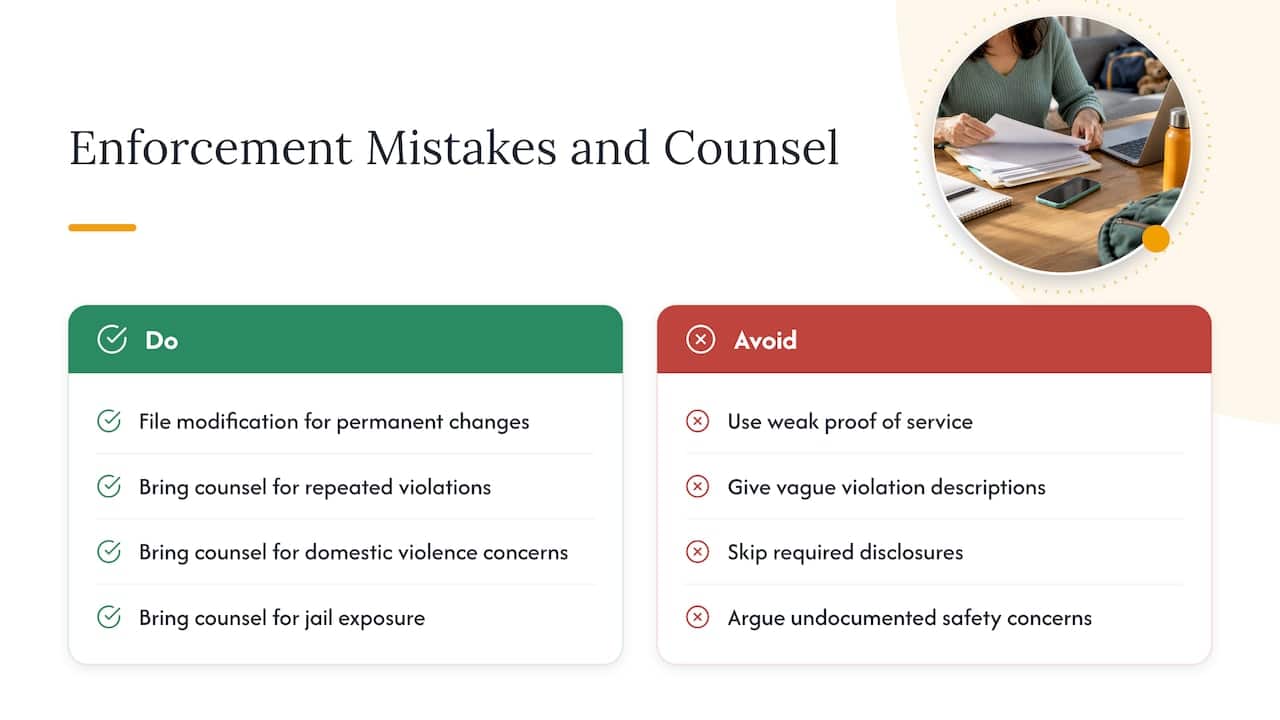
An enforcement petition makes an existing order work. It does not change the schedule itself, so parents who want a permanent change need a modification petition instead. The most frequent missteps we see are weak proof of service, vague violation descriptions, skipped disclosures, and trying to argue safety concerns without documentation to back them up.
Repeated violations, domestic violence concerns, or a request for supervision or contempt with jail exposure are strong signs it’s time to bring in counsel rather than handle it alone.
— Brett
How We Help Parents Enforce Parenting Plans
Enforcement cases move fast once filed, and a missed deadline or thin evidence file can cost you the relief you need. We represent parents in decree enforcement, child custody matters, and cases requiring supervised-visit navigation, and we help clients prepare fee-waiver requests when cost is a barrier to filing.

Before your consultation, bring your current parenting plan, the court order you believe was violated, your communication logs, and any proof of service attempts you’ve already made. We’ll review what’s missing and map out next steps together.
- Decree and parenting-time enforcement representation
- Child custody and best interest attorney services
- Guidance on supervised exchanges and safety-based remedies
- Help with fee waiver and deferral paperwork
If you’re dealing with repeated violations or a parent who won’t comply, visit our child custody page to schedule a consultation and talk through your options.
This article is general information, not a substitute for advice from a qualified lawyer. Consult a qualified legal professional about your own circumstances before acting on anything here.
FAQ
What happens if a parent misses visitation in Arizona?
A missed visitation can be reported to the court through a Petition to Enforce, and under A.R.S. §25-414 the court must hold a hearing or conference within 25 days of service. The judge can order makeup time, civil penalties up to $100 per violation, or attorney fees depending on the circumstances.
Does co-parenting ever get easier after enforcement issues?
Many parents find that a clear court record of violations, combined with tools like parenting coordinators or supervised exchanges, reduces future conflict because both sides know expectations are being tracked. It rarely becomes effortless, but documented compliance tends to improve once consequences are in place.
What should I do if I can’t get my child to cooperate with a custody exchange?
Document the specific incident with dates, times, and any witnesses, since courts look at patterns rather than one difficult exchange. If the issue continues, raising it with the court or requesting a parenting coordinator under Rule 74 can help address the underlying conflict.
What is the difference between enforcing a parenting plan and modifying one?
Enforcement asks the court to make an existing order effective when one parent isn’t following it, while modification asks the court to change the order’s terms going forward. Filing an enforcement petition when you actually want a new schedule is a common mistake that can delay the outcome you’re seeking.
Do I need a lawyer to file a parenting plan enforcement petition in Arizona?
You can file an enforcement petition on your own using your county’s packet, such as the Maricopa Superior Court enforcement packet. Representation becomes more valuable when violations are repeated, safety concerns are involved, or you’re seeking remedies like supervised visitation or contempt sanctions.
Sources
- 25-414 – Violation of visitation or parenting time rights; penalties
- To enforce a court order for parenting time (Maricopa Superior Court packet)