



Arizona: 14+ Consent for Child Name Changes, DIY or a Lawyer

Yes, a parent or guardian can ask an Arizona superior court to change a minor’s legal name. A parent or guardian files in the county where the child lives, and if the judge finds the change serves the child’s best interests, the court issues an order you use to amend the birth certificate with Vital Records.
TL;DR:
- Use Arizona’s minor name change packet: CVNCM11F starts the case, CVNCM81F stays unsigned, and children 14 or older must sign notarized consent or appear at the hearing.
- Court filing fees vary by county; hearings are typically set one to four weeks after filing, and certified orders arrive about ten days later.
- After the hearing, request a certified order; Arizona’s order changes only Arizona birth certificates, while out of state births require filing with the issuing agency.
- Do it yourself when both parents agree and custody is not disputed; objections, unresolved parentage, or contested custody make notice errors riskier and warrant legal help.
Table of Contents
- Which court forms do you need to request a child’s name change?
- How do you file the name change packet and schedule a hearing?
- What are the notice and consent rules for the other parent?
- What happens at the hearing and how does the judge decide?
- How much does it cost and how long does the process take?
- How do you update the birth certificate after the judge signs the order?
- What about multiple children, guardians, or unresolved paternity?
- When does a child’s name change call for an attorney’s help?
- Can a child’s name change affect custody or visitation?
- What should you update after the court grants the name change?
- How do you handle it when the other parent objects?
- Our take on DIY name changes versus hiring counsel
- Get help filing your child’s name change with High Desert Family Law Group
- FAQ
- Sources
Which court forms do you need to request a child’s name change?
Arizona courts use a standard packet of forms for a minor’s name change, and the statewide forms hub lists each one by number. Having the right forms ready before you go to the clerk’s counter saves you a second trip.
- CVNCM11F, the Application for Change of Name for a Minor Child, is the primary petition that starts the case.
- CVNCM81F, the Order Changing Name of a Minor, gets typed out in full but stays unsigned until the judge approves it at the hearing.
- CVNC17F is the Optional Consent of Other Parent, used when the other parent agrees in writing and does not need to appear.
- CVNC13F is the Consent of Minor, required when the child is 14 or older.
- CVNCM24F, the Affidavit of Notice by Certified Mail, documents that you notified any interested party who did not sign a consent.
How do you file the name change packet and schedule a hearing?
Filing a minor’s name change application in Maricopa County follows a fairly predictable sequence, and most other Arizona counties use a near-identical process.
- Fill out the original application packet completely, including the child’s current legal name and the requested new name.
- Type the proposed Order Changing Name of a Minor, but never sign or date it yourself: the judge signs it at the hearing.
- Make one original plus two copies, and add one extra copy for every interested party you need to serve, such as the other parent.
- File in person at the Clerk of Superior Court or through eFiling where your county offers it, bringing a valid ID and your filing fee or a fee-deferral request.
- Call the Civil Court Administration office for your county to get a hearing date; many clerks advise waiting about four business days after filing before you call.
Pro Tip: Keep a copy of every form you file in a labeled folder, since you’ll need the same packet again later when you request your certified order.
What are the notice and consent rules for the other parent?
When another parent or interested party has a legal stake in the child’s name, Arizona requires you to notify them before the judge rules, according to the statewide name-change packet guidance.
- A notarized waiver or the Acceptance of Service form lets the other parent agree without attending the hearing.
- Certified mail with a signed Affidavit of Notice documents that you reached an other parent who did not respond.
- A child age 14 or older must sign a notarized consent or appear at the hearing in person; without that, the court can still consider the application but may ask more questions about the child’s own wishes.
- If a party’s criminal history is relevant to the case, the court may require notice to a prosecutor’s office or a victim under separate statutory rules.
What happens at the hearing and how does the judge decide?
You, as the applicant, must attend the hearing, and the child may need to appear too if they are 14 or older or if the judge specifically orders it. Hearings are often brief, and some counties hold them virtually unless a judicial officer orders an in-person appearance, according to Maricopa County’s packet instructions.
The judge’s central question is whether the name change serves the child’s best interests, weighing factors like the child’s own preference, the reason for the request, and whether the change could interfere with another parent’s rights or an ongoing custody matter. If the judge grants the request, they sign the Order Changing Name of a Minor on the spot and may direct the Bureau of Vital Records to amend an Arizona-issued birth certificate.
How much does it cost and how long does the process take?
Superior court filing fees for a name-change petition are set by each court’s own fee schedule, and you can ask the clerk about a fee deferral if paying up front isn’t possible.
A certified correction to an Arizona birth certificate commonly carries a $30 fee through Vital Records, though you should confirm the current amount before you submit your paperwork. Plan on your hearing getting scheduled within one to four weeks of filing depending on your county, a certified copy of the signed order arriving by mail roughly ten days after the hearing, and then separate processing time once Vital Records receives your amendment request.
How do you update the birth certificate after the judge signs the order?
Once your order is signed, updating the birth record is a document-driven process through the Bureau of Vital Records.
- Request a certified copy of the signed Order Changing Name of a Minor from the clerk’s office where you filed.
- Submit that certified order along with the Application to Correct or Amend a Birth Certificate and the required fee to the Arizona Bureau of Vital Records, or to your county’s vital records office if it handles corrections locally.
- If the child was born outside Arizona, send the certified order to the issuing state’s vital records agency, since Arizona’s order only directs changes to Arizona-issued certificates.
- Expect different evidence requirements depending on how long ago the birth occurred, since corrections made long after birth may call for additional supporting documents.
What about multiple children, guardians, or unresolved paternity?
When siblings share both parents, one family packet, one case number, one filing fee, and one hearing can usually cover all the children at once. Children who don’t share the same two parents need separate applications, separate fees, and separate hearings, even if you file them on the same day.
A name-change order does not establish paternity or add a father’s name to a birth certificate; those require a separate paternity action. Guardians filing on a child’s behalf need to bring proof of guardianship or legal custody to the courthouse, since the clerk and judge will ask to see it.
When does a child’s name change call for an attorney’s help?
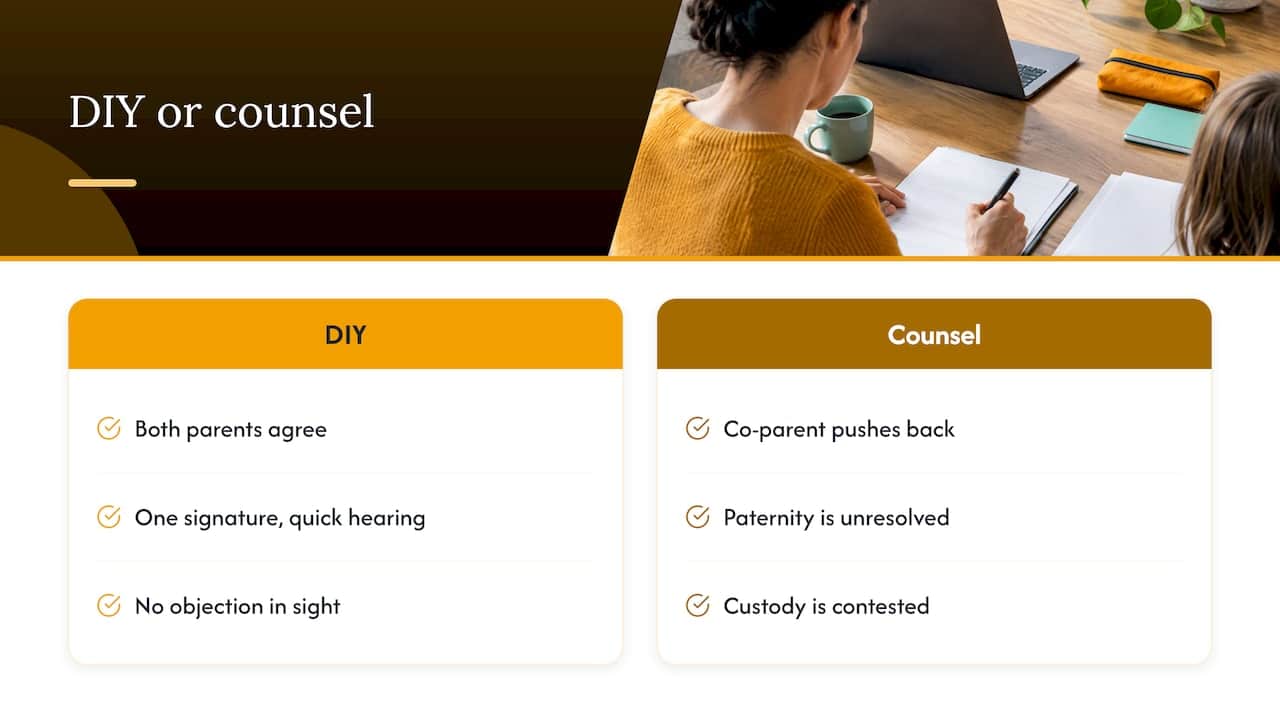
Most straightforward requests, where both parents agree and no one disputes custody, move through the process without a lawyer. Contested cases look different: unclear or disputed parentage, an objecting co-parent, difficulty completing service, or custody litigation running in parallel all raise the stakes of a filing mistake.
An attorney prepares a packet that matches what your local clerk expects, handles service so notice holds up if challenged, represents you at the hearing, and coordinates the post-order paperwork with Vital Records so nothing stalls. At High Desert Family Law Group, our attorneys draw on more than 20 years of Arizona family law experience and have represented clients through thousands of cases, including matters where a child’s name change intersected with a best-interest custody dispute.
Can a child’s name change affect custody or visitation?
Changing a child’s surname does not, by itself, transfer custody, alter a parenting plan, or change visitation rights. The name-change court and the custody court in Arizona are handling two distinct legal questions, even when the same family is involved in both.
That said, a contested name change can surface the same tensions as a custody dispute, and a judge weighing the child’s best interests may ask how the proposed change fits with an existing parenting plan or custody arrangement. If one parent believes a name change is really an attempt to weaken the other parent’s role or confuse the child’s sense of identity, that argument can come up at the hearing even though the judge isn’t formally modifying custody.
Parents who are mid-divorce or who recently finalized one sometimes pursue a name change for themselves at the same time they consider one for a child; the two processes use different statutes and forms, so it helps to understand how post-divorce name restoration works separately from a child’s petition. If custody is already contested, resolving or at least stabilizing that dispute first often makes the name-change hearing go more smoothly, since a judge is unlikely to grant a change that one parent is actively using as leverage in an open custody fight.
What should you update after the court grants the name change?
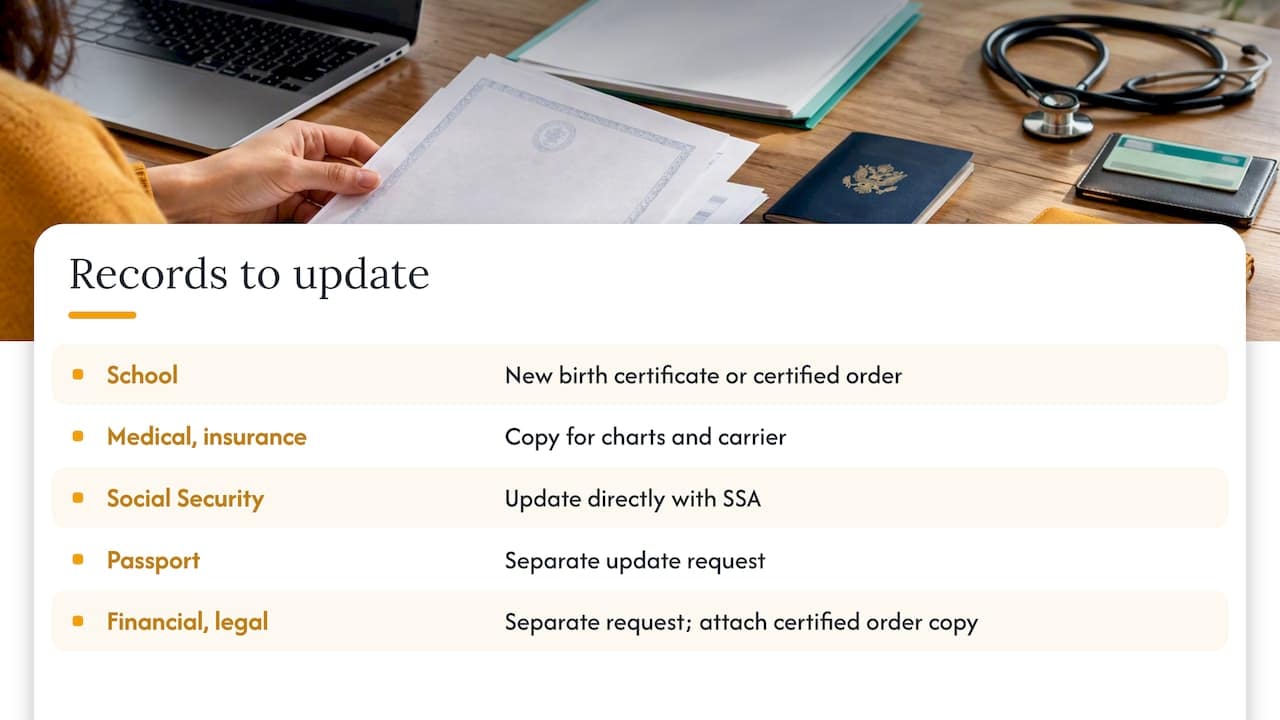
The certified court order and the amended birth certificate are your starting documents, not the finish line. Most families need to update several other records once the paperwork from Vital Records comes back.
Schools need a copy of the new birth certificate or certified order to update enrollment records, report cards, and any individualized education plans on file. Pediatricians’ offices, dentists, and any specialist your child sees should get a copy for their medical charts, along with the child’s health insurance carrier if the child is listed as a dependent on a policy.
Social Security records need updating directly with the Social Security Administration, since a new birth certificate alone won’t automatically update a Social Security card. If your child has a passport, a savings account, or is named in a will, trust, or custody order, each of those records needs its own update request, typically with a certified copy of the court order attached. Keeping several certified copies on hand from the start avoids repeated trips back to the clerk’s office for more.
How do you handle it when the other parent objects?
An objection doesn’t automatically stop a name-change case, but it does change how the hearing unfolds. If the other parent files a formal objection or shows up at the hearing to oppose the change, the judge will hear both sides before deciding whether the change still serves the child’s best interests.
Documentation matters most here. Keep records of why you’re requesting the change, any history of the child already using the proposed name informally, and anything relevant to the other parent’s level of involvement in the child’s life. A judge weighing an objection often wants to understand the child’s own preference, if the child is old enough to express one, and whether the change appears aimed at strengthening the child’s identity or at cutting out the other parent.
When disagreement escalates into a broader custody or parenting-time dispute, it may be worth addressing that underlying conflict directly rather than litigating it through the name-change case alone. Courts that see high-conflict co-parenting patterns sometimes prefer that the parties resolve custody friction before or alongside the name petition, since a judge is cautious about approving a change that looks like one parent trying to win a larger fight through a smaller court filing.
Our take on DIY name changes versus hiring counsel
The paperwork for a child’s name change is genuinely accessible to a motivated parent, and most of the advice circulating online gets that part right. Where that advice falls short is in treating every case as equally simple. A packet that sails through when both parents agree can stall for months when one parent is unreachable, disputes service, or raises the request in the middle of a custody fight.
The form numbers, the fee amounts, and the filing steps matter, but they are not where most cases actually go wrong. The real risk sits in service and notice: an improperly documented waiver or a missed certified-mail step gives an objecting parent grounds to delay or challenge the order later, sometimes well after the birth certificate has already been amended.
If your situation involves one signature, one quick hearing, and no objection in sight, handling it yourself is reasonable. The moment a co-parent pushes back, paternity is unresolved, or custody is already contested, the cost of getting notice wrong outweighs any savings from skipping an attorney.
— Brett
Get help filing your child’s name change with High Desert Family Law Group
Filing a name-change packet correctly the first time means fewer trips to the courthouse and fewer chances for an objection to stick. We prepare the petition, handle service and notice on the other parent, represent you at the hearing, and coordinate the paperwork with Vital Records once the order is signed.

Bring your completed court packet, any custody orders, and proof of guardianship if you’re filing as a guardian rather than a parent to your first meeting. Reach out through our family law services page to schedule a consultation and get your child’s name change moving.
This article is general information, not a substitute for advice from a qualified lawyer. Consult a qualified legal professional about your own circumstances before acting on anything here.
FAQ
How much does it cost to legally change your name in AZ?
Arizona superior courts set their own petition filing fee under the court’s fee schedule, and a fee deferral is available if you can’t pay it up front. Amending the birth certificate afterward adds a separate $30 Vital Records fee, which you should confirm before submitting.
Can I change my child’s last name if there is no father listed on the birth certificate?
Yes, you can still file the Application for Change of Name of a Minor Child as the custodial parent, since no father is listed as an interested party who needs notice. The judge still decides based on whether the requested name serves the child’s best interests.
How much is it to legally change a child’s last name?
The cost has two parts: the superior court’s petition filing fee, which varies by county fee schedule, and the $30 Vital Records fee to amend the birth certificate once the order is signed. Fee deferral options exist at the court level for applicants who qualify.
How long does a name change take in AZ?
Most counties schedule the hearing within one to four weeks of filing, and a certified copy of the signed order typically arrives by mail about ten days after the hearing. Updating the birth certificate through Vital Records adds its own separate processing time once you submit the certified order.
Sources
- Application to Change the Name of a Minor Child (Maricopa Superior Court)
- Name change forms (Arizona Judicial Branch)
- How to correct or change a birth certificate (Pima County)