



Stop Post Decree Debt Surprises in Arizona: Statute First Checklist

Under Arizona law, most debts incurred during marriage are community debts and the court divides them equitably. Service of the petition is the key cutoff date, and a divorce decree does not erase creditor contracts. That last point catches people off guard: a judge can assign a joint credit card to your spouse, but the bank can still call you if the payment stops.
TL;DR:
- Debts incurred during marriage are presumed community debts until the service of the divorce petition, after which they generally belong only to the incurring spouse.
- Secured debts like mortgages and auto loans follow the property they finance, while unsecured debts such as credit cards are divided based on court orders or negotiations, but remain liable to creditors regardless of divorce decrees.
- A divorce decree does not bind creditors; joint accounts and loans can still be pursued from either spouse unless the creditor agrees to reassign or release the debt in writing.
- Creating a detailed debt distribution plan and recording all account and property transfers improves enforceability and reduces post-divorce financial surprises.
- Arizona law limits creditor pursuit to six years for written debt and three years for oral claims, so understanding statute of limitations is crucial before making payments on old debts.
Table of Contents
- How Arizona law defines community and separate debt
- Secured versus unsecured debt in an Arizona divorce
- When does community liability for debt end?
- How courts divide debt equitably
- Court orders versus creditors: what a decree can and cannot do
- Action checklist for limiting debt-related risk
- What we see in practice at High Desert Family Law Group
- How High Desert Family Law Group helps with debt division
- Primary statutes and official resources
- Sources
- FAQ
How Arizona law defines community and separate debt
Arizona is a community property state, and A.R.S. § 25-211 sets the baseline: property and debt acquired during marriage is presumed community, with exceptions for gifts, inheritances, and anything acquired after one spouse is served with a divorce petition. That service date matters because it marks when new debts generally stop being shared and start belonging only to the spouse who incurred them.
A.R.S. § 25-215 covers liability: community property can be reached to satisfy debts incurred during the marriage, and in some cases even premarital separate debt can attach to community property to the extent the community benefited from it. Separate property, by contrast, is generally shielded from a spouse’s separate debts.
The mechanics matter as much as the labels. Under A.R.S. § 25-318, courts can require the parties to submit a debt distribution plan and can notify creditors, though creditors themselves are never made parties to the divorce case.
- Debts from the date of marriage until service of the petition are typically community debts.
- Gifts and inheritances received by one spouse usually stay separate, even during marriage.
- A written debt distribution plan under § 25-318(J) gives the court a concrete framework to assign specific accounts.
Secured versus unsecured debt in an Arizona divorce
Whether a debt is secured or unsecured changes how a court handles it and how much leverage a creditor has if payments lapse. Secured debts are tied to collateral (a house or a car), so the lender can repossess or foreclose regardless of what the decree says. Unsecured debts, like credit cards, give the creditor only a contractual claim against whoever signed for the account.
- Mortgages typically follow the home: whoever is awarded the house usually takes on the mortgage, often paired with a refinance to remove the other spouse’s name.
- Auto loans generally follow the vehicle in the same way, with the receiving spouse expected to refinance or assume the loan.
- Credit card balances and other unsecured debt are often split by the court or negotiated directly with the creditor, since no collateral is at stake.
- Student loans taken out before the marriage typically remain the separate debt of the borrowing spouse, while those taken out during the marriage may be treated as community debt depending on how the funds were used.
- Tax debt from jointly filed returns during the marriage is usually community debt, while tax debt tied to income or filings from before the marriage generally stays separate.
When does community liability for debt end?
The clean answer is service of the petition, but the real world has exceptions worth watching. A.R.S. § 25-211 treats that service date as the line between shared and individual liability, yet a few situations blur it.
- Debt incurred after service to buy something that becomes new community property (like a joint purchase that both spouses still use) can still be treated as shared.
- A settlement agreement or decree can override the default cutoff if both spouses agree to different terms in writing.
- Continuing joint charges, such as a shared credit card neither spouse closes, keep generating community exposure even after service, since both names remain on the account.
Temporary orders issued early in the case often address this directly, restricting new debt or requiring notice before either spouse opens new credit. Asking for that protection early is one of the simplest ways to avoid a post-filing surprise.
How courts divide debt equitably
Equitable does not mean automatic 50/50. Judges have discretion under A.R.S. § 25-318 to weigh income, custody arrangements, and how assets are being divided when they decide who carries which debt.
- A judge often pairs a specific debt with the asset it financed, so the spouse keeping the car keeps the loan.
- When one spouse receives a larger share of the assets, the court may offset that by assigning more than half of the remaining debt to them.
- Debt is not part of the standard spousal maintenance guidelines calculator, but a court can still factor it in when deciding whether to deviate from those guidelines or when assessing a spouse’s ability to pay.
Pro Tip: Ask your attorney to model how a proposed debt split changes if certain assets, like retirement accounts, are divided differently. Small shifts in asset allocation can significantly change what debt load makes sense for each spouse.
Court orders versus creditors: what a decree can and cannot do
A divorce decree settles who owes what between spouses, but it has no power over the bank. A.R.S. § 25-318 explicitly recognizes that creditors are not parties to the case, which means a joint credit card or shared auto loan still lists both names no matter what the judge orders. If your ex stops paying, the creditor can still come after you.
The statute does give judges some tools to make enforcement real: liens against property, orders transferring specific accounts, and contempt sanctions when a spouse ignores the assigned debt. Arizona also allows either spouse to request account information directly from a creditor.
Within 30 days of a written request that includes the court and case number, a creditor must provide balance and account status information for debts the requesting spouse may be liable for, which makes it far easier to verify what is actually owed before the decree is finalized.
- Get any agreement to reassign a joint account confirmed in writing by the creditor, not just implied by the decree.
- Record deed and title changes promptly when a mortgage or auto loan is being assumed by one spouse.
- Pull credit reports for both spouses before finalizing the decree, since hidden or forgotten accounts surface here more than anywhere else.
Action checklist for limiting debt-related risk
A debt distribution plan submitted under § 25-318(J) tends to produce more enforceable outcomes than leaving the assignment to a judge’s general order, mainly because building the plan forces both spouses to contact creditors and document agreements along the way.
- List every account, balance, and creditor for both spouses, including anything either party might have forgotten about.
- Request a credit report or court-ordered account information if you suspect your spouse is hiding a debt.
- Draft a proposed debt distribution plan and file it with the court rather than waiting for a judge’s default assignment.
- Get any creditor agreement to release or reassign a joint account in writing, and record property transfers where required.
- Consider nonprofit credit counseling, a debt management plan, or bankruptcy only as a last resort when unsecured debt is unmanageable.
- Track Arizona’s statute of limitations on old debts before agreeing to take one on, since a partial payment can sometimes restart the clock.
Pro Tip: If you’re unsure whether an old balance is still collectible, ask a creditor for its origination date in writing before making any payment. Arizona generally gives creditors six years to sue on credit card debt, and even a small payment on a stale account can revive claims that were close to expiring.
What we see in practice at High Desert Family Law Group
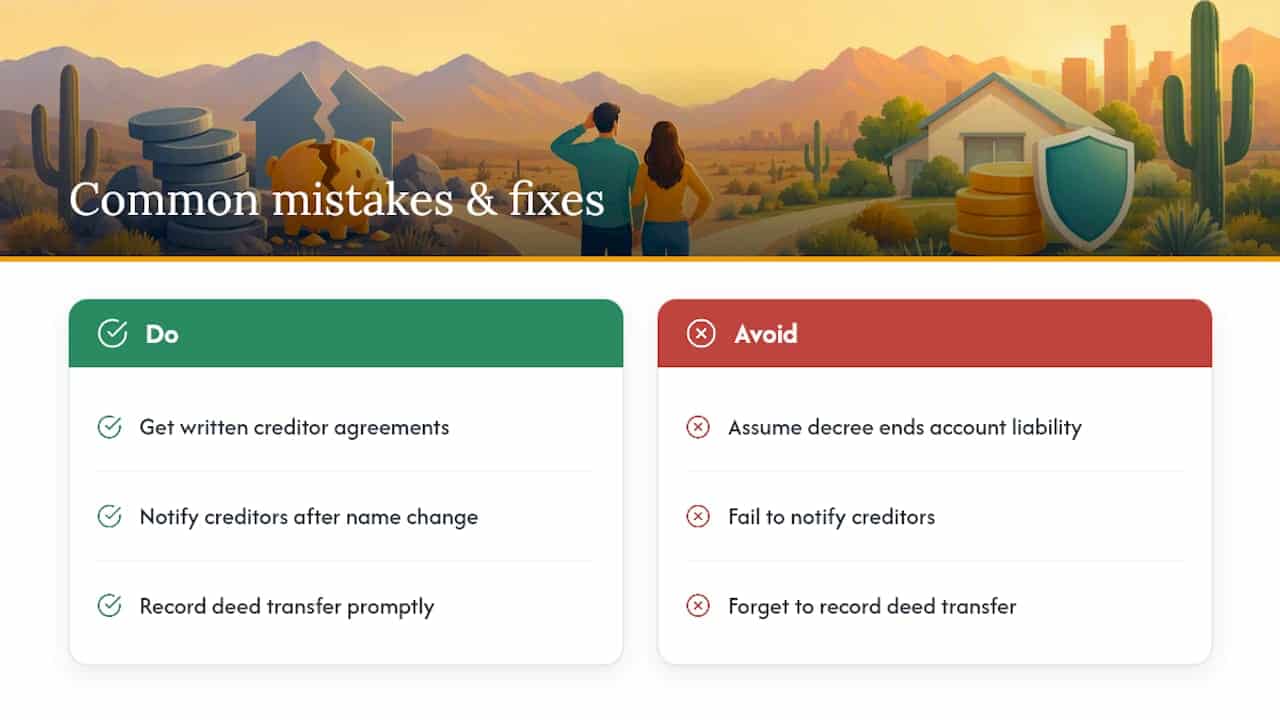
Over more than 20 years of family law work, the most common mistake we see is a spouse assuming the decree itself ends their liability on a joint account. It doesn’t. Others fail to notify creditors of a name change or forget to record a deed transfer after the house is awarded to one spouse.
Mediation often works better than litigation for debt disputes specifically, since a negotiated creditor agreement in writing tends to hold up far better than a court order the bank was never part of.
— Brett
How High Desert Family Law Group helps with debt division
Sorting out who owes what after a marriage ends takes more than a court order. Our team helps Scottsdale clients build a real debt distribution plan, negotiate directly with creditors, and record the agreements and title changes that make a division actually stick.

- We help draft and file debt distribution plans under applicable statutory frameworks.
- We assist clients in negotiating with creditors when an account needs to be reassigned or refinanced.
- We assist with coordinating paperwork to record liens, deed changes, and title transfers related to your decree.
If you’re working through a divorce and want debt handled correctly the first time, schedule a consultation with our divorce team to talk through your specific accounts and options.
Primary statutes and official resources
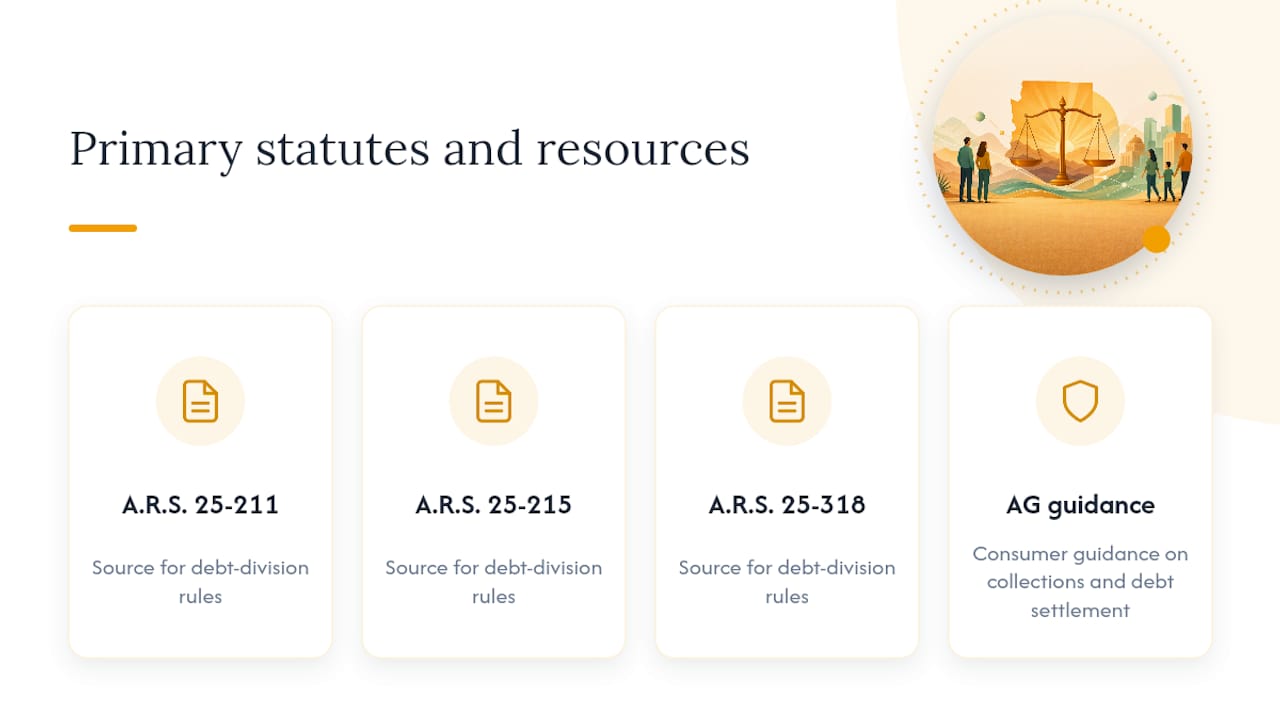
This article’s claims about debt division are drawn directly from A.R.S. § 25-211, A.R.S. § 25-215, and A.R.S. § 25-318, along with consumer guidance from the Arizona Attorney General on collections and debt settlement.
This article is general information, not a substitute for advice from a qualified lawyer. Consult a qualified legal professional about your own circumstances before acting on anything here.
Sources
- 25-211 – Property acquired during marriage as community property; exceptions; effect of service of a petition
- Collections and debt settlement — Arizona Attorney General consumer tips
- Arizona Debt Collection Statute of Limitations (SOL) | Ezel
FAQ
How long can a debt collector pursue you in Arizona?
Arizona generally gives creditors six years to sue over written contracts and credit card debt, and three years for oral or open-account claims, under the state’s statute of limitations rules. A debtor has to raise the limitations defense in court themselves, since it isn’t applied automatically.
What assets are protected from division in a divorce?
Property one spouse received as a gift or inheritance during the marriage is typically treated as separate property and stays out of the division under A.R.S. § 25-211. Property acquired before the marriage or after service of the divorce petition generally falls into the same protected category.
Do I have to pay a debt that was sold to another company?
Yes. Selling a debt to a collection agency doesn’t erase the underlying contract, and the new owner typically has the same legal right to collect that the original creditor had, subject to the same statute of limitations. A divorce decree assigning that debt to your ex-spouse doesn’t change your contractual obligation to the collector if your name is still on the account.
Can you walk away from collections debt?
Not safely. Ignoring collections debt can lead to a lawsuit and judgment even if the balance is old, and only a successful statute of limitations defense or bankruptcy discharge actually ends the legal obligation. Working directly with the creditor, or getting nonprofit credit counseling involved, is a safer path than simply stopping payment.