



Quitclaim Deeds After an Arizona Divorce: Court Backed A.R.S. Steps

A quitclaim deed can transfer your ex-spouse’s interest in the marital home during an Arizona divorce, but only after the decree is final, only when properly notarized, and only once recorded with the county. It does not remove either spouse from the mortgage. The deed moves title; it does not touch the loan you signed with the bank.
TL;DR:
- A quitclaim deed in Arizona must be finalized after the divorce decree is final, properly notarized, and recorded within a few months to prevent title disputes.
- The deed transfers ownership but does not remove the spouse from the mortgage, leaving both liable until refinancing or lender approval occurs.
- Using a court reference and legal description in the deed simplifies recording, but the key timing is signing after the decree to avoid losing settlement leverage.
- The A5 exemption generally covers recording costs if the deed references the court case and a certified decree copy, but missing paperwork can delay recording.
- Enforcing a court-ordered deed may require court action if a spouse refuses to sign, and pairing the deed with title insurance offers additional protection against unknown title issues.
Table of Contents
- What a quitclaim deed is in Arizona and why parties use it in divorce
- Timing and sequence: why the decree must come before the deed
- Step-by-step: preparing, signing, notarizing, and recording a quitclaim deed in Arizona
- Recording logistics, fees, and the A5 court-order exemption
- Key risks and limitations: mortgage liability, title defects, and tax and insurance consequences
- When a spouse refuses to sign or deliver a deed: enforcement and alternatives
- Practical checklist: documents and steps to complete a deed transfer after your Arizona divorce
- Author perspective and High Desert Family Law Group’s practical guidance
- What this process actually rewards, and what gets overrated
- How High Desert Family Law Group can help with your property transfer
- Authoritative statutes, court opinion, and county recorder guidance
- Sources
- FAQ
What a quitclaim deed is in Arizona and why parties use it in divorce
A quitclaim deed conveys whatever interest the grantor currently holds in a property, with no promises about the condition of that title. Unlike a warranty deed, it offers no guarantee that the title is free of liens, judgments, or competing claims. Arizona’s statutory framework for conveyances, including quitclaim language, is laid out in A.R.S. §33-402, which provides the standard form structure attorneys and title companies use across the state.
Divorcing spouses favor quitclaim deeds for a few practical reasons.
- Both parties already know the property’s condition and any encumbrances, so the lack of warranty rarely matters between them.
- The deed can be drafted quickly to match the exact language already ordered in the decree.
- Recording it under the court-order exemption avoids extra fees tied to a sale-style transfer.
A warranty deed makes more sense when the grantee wants assurance against unknown claims, such as an undisclosed lien from a contractor or a prior owner. Title insurance can fill that gap regardless of which deed type you use, and it is worth considering whenever the property has a complicated ownership history or was recently refinanced.
Timing and sequence: why the decree must come before the deed
Signing a quitclaim deed before the divorce is finalized is one of the most common mistakes spouses make. Arizona courts treat a signed separation agreement as a binding contract once it is properly incorporated into the decree, under A.R.S. §25-317. Once that happens, the terms become part of a court order and are enforceable, but until then, a spouse who signs away an interest early may lose negotiating leverage before the rest of the settlement, including spousal maintenance or debt division, is locked in.
- The parties negotiate or litigate property division, and the terms are written into a settlement agreement or trial ruling.
- The court adopts those terms into the final decree, at which point they become enforceable and generally cannot be modified later.
- Only after the decree is entered should the deed be signed, notarized, and recorded to reflect the court’s order.
Typical Arizona divorce timelines vary widely depending on whether the case is contested, but an uncontested case with a signed decree incorporated agreement can move faster than a contested one heading to trial. Whatever the pace, the deed should always come last, not first.
Step-by-step: preparing, signing, notarizing, and recording a quitclaim deed in Arizona
Once the decree is final, the mechanics of the deed itself follow a fixed sequence.
- Use the statutory quitclaim form or a county-specific template, and include the full legal description of the property, not just the street address.
- Reference the divorce case number, the court, and the date the decree was entered, so the deed ties directly to the court order.
- Sign the deed in front of a notary public. Arizona law requires a proper acknowledgment before the document can be recorded, under A.R.S. §33-401.
- Take the signed, notarized deed to the county recorder’s office where the property sits, along with a certified copy of the decree if the office requires one to apply the A5 exemption.
Recording should ideally happen within a couple of months of the court order to limit the risk of a title dispute. Delayed recording leaves a window where a subsequent purchaser or lienholder could claim priority, since A.R.S. §33-411 ties constructive notice to the act of recording, not the date the deed was signed.
Recorders’ offices reject deeds for missing legal descriptions, unclear notarization, or absent case references more often than for any other reason. Double-checking those three items before you drive to the recorder saves a second trip.
Recording logistics, fees, and the A5 court-order exemption
Arizona exempts court-ordered property transfers from the Affidavit of Property Value and its related reporting requirements. This is commonly called the A5 exemption, drawn from A.R.S. §11-1134(A)(5). Counties apply the A5 code when the deed clearly references the decree and, in many cases, when a certified copy accompanies the filing.
- Most Arizona counties charge a modest flat recording fee per document, according to A.R.S. §11-1134, which governs the exemption categories that keep this transfer type simple and inexpensive.
- Notary fees typically run in the $10 to $20 range, separate from the recorder’s fee.
- Bring the original signed and notarized deed, a certified copy of the decree (or a clear reference to it on the deed itself), and any county-specific cover sheet required for indexing.
| Item | Typical requirement |
|---|---|
| Recording fee | About $30 per document under A5 |
| Notary fee | About $10 to $20 |
| Decree reference | Case number and court named on the deed |
| Supporting document | Certified copy of decree, if the recorder requires it |
Skipping the cover sheet or arriving without the case number is the fastest way to get sent home. Calling the recorder’s office ahead of your visit to confirm their exact A5 documentation policy takes a few minutes and avoids a wasted trip.
Key risks and limitations: mortgage liability, title defects, and tax and insurance consequences
A quitclaim deed changes who own the property. It does nothing to the loan. If both spouses’ names are on the mortgage note, both remain personally liable to the lender until the loan is refinanced or the lender agrees to a release, regardless of what the deed or decree says about ownership.
- The spouse who quitclaims away their interest can still be pursued by the lender if the remaining spouse misses payments, unless the loan is refinanced.
- Title defects, such as an old lien or a boundary dispute, can survive the transfer since a quitclaim deed carries no warranty against them.
- The A5 exemption generally covers the transfer itself, but separate tax liens or judgments against either spouse are not automatically cleared by the deed.
- When there is any doubt about the property’s title history, a title search before recording is worth the modest cost.
Pro Tip: Set a refinance deadline in the settlement itself, not as a vague future promise, so the spouse keeping the house has a concrete date to remove the other from the loan.
When the grantee wants stronger assurance against unknown claims, pairing the quitclaim deed with title insurance or, in higher-risk situations, using a warranty deed instead, gives more protection than the quitclaim alone.
When a spouse refuses to sign or deliver a deed: enforcement and alternatives
A decree that orders a spouse to sign a deed is a court order, and refusal to comply is not the end of the matter. Courts have tools to compel performance.
- A motion to enforce the decree asks the court to order compliance with the specific terms already ordered, including the deed transfer.
- A motion for contempt can follow if the refusing spouse ignores a direct court order, potentially leading to sanctions.
- In some cases, the court can appoint someone to sign the deed on the noncompliant spouse’s behalf, or the judgment itself can serve as the instrument of transfer.
- Recording the Judgment of Divorce, rather than waiting on a deed, is an alternative way to put the world on notice of the ownership change, though it makes the entire decree, not just the property terms, part of the public record.
Courts generally expect clear documentation before compelling a transfer: the decree language itself, proof of the refusal (such as correspondence attempting to secure a signature), and confirmation that the property description matches what was ordered. Vague settlement language is the most common reason these motions turn into drawn-out disputes.
Practical checklist: documents and steps to complete a deed transfer after your Arizona divorce
Once your decree is entered, work through this sequence without much delay.
- Confirm exactly what the final decree or settlement agreement requires regarding the deed and property.
- Order a title search and pull current mortgage statements for the property.
- Prepare the quitclaim deed with the legal description and decree reference, sign it before a notary, gather a certified copy of the decree if your county requires one for A5, record it at the county recorder, and keep the recorded copy in a safe place.
- Set a firm refinance deadline and start that process with the lender right away if removing a spouse from the mortgage is part of the plan.
Author perspective and High Desert Family Law Group’s practical guidance
After more than 20 years handling Arizona family law matters, the pattern that shows up most often is the same one: clients sign a deed before the decree is final, then discover it complicated their own negotiating position. The sequence that works is simple. Decree first, deed second, refinance deadline third.
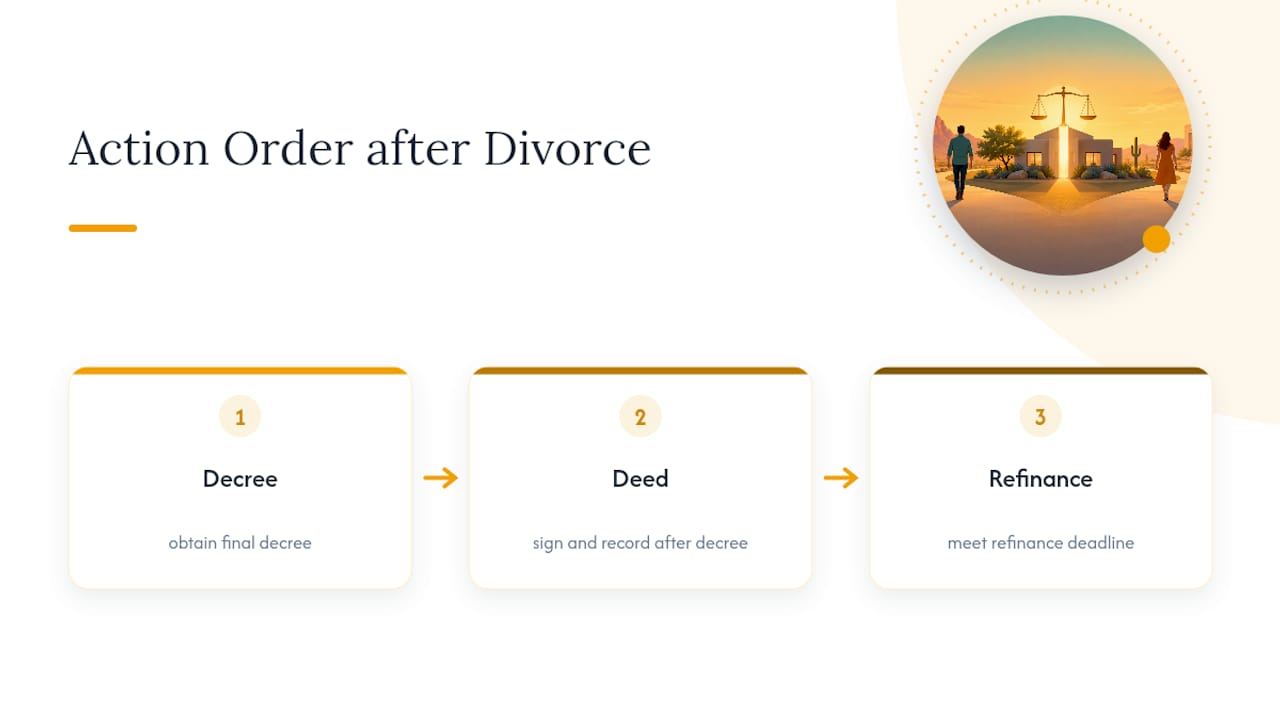
When there is any question about liens, prior ownership issues, or a spouse dragging their feet on signing, a title search before recording removes a lot of guesswork. It costs little compared to the cost of untangling a title dispute later.
Contact an attorney when the transfer is contested, when the property carries an encumbrance nobody fully understands, or when a spouse refuses to cooperate with a court-ordered deed. Straightforward, uncontested transfers with clean title rarely need much beyond careful paperwork, but anything murkier deserves a second set of eyes before you record.
What this process actually rewards, and what gets overrated
The paperwork around a quitclaim deed is simple. The sequencing is where people get hurt. Too much advice online treats the deed as the finish line of a divorce property settlement, when it is really just the last mechanical step after the real work, dividing the community property fairly and locking in a refinance plan, is already done.
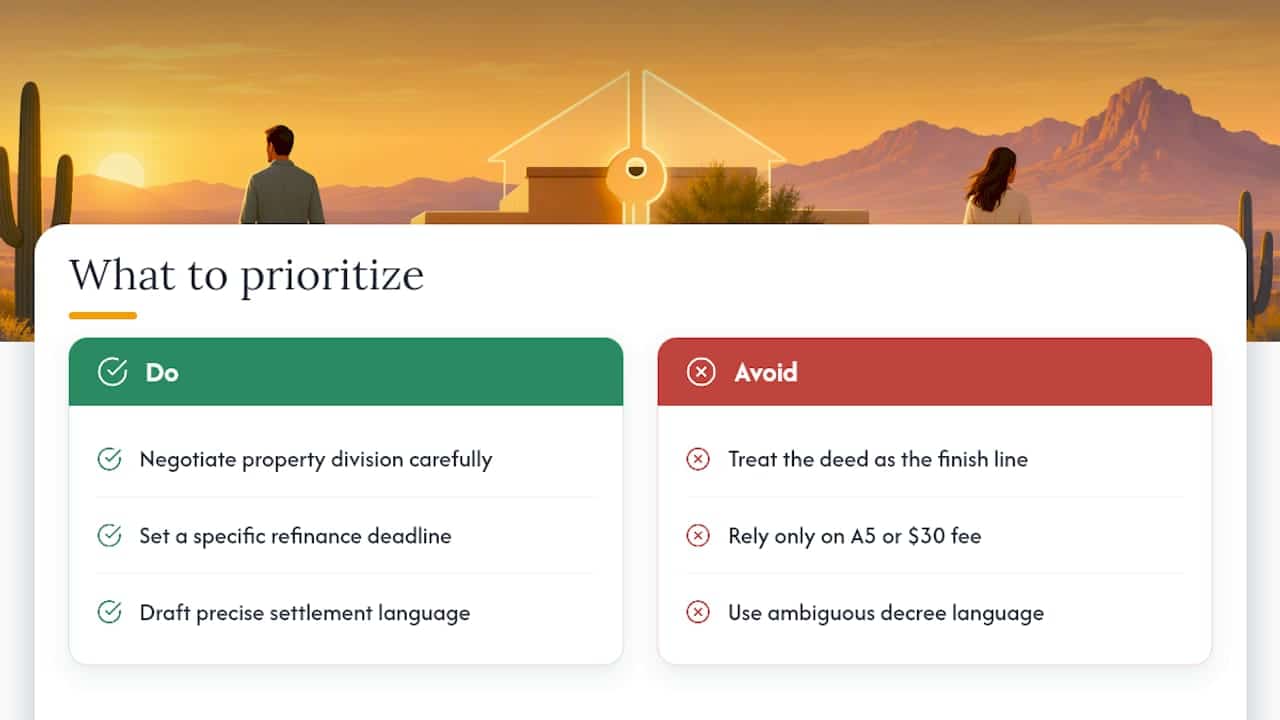
The A5 exemption and the $30 recording fee get a lot of attention because they are easy facts to state. They matter far less than making sure the settlement language is specific enough that nobody has to fight over what “transfer the house” actually means six months later. Ambiguous decree language, not the deed form, is what sends people back to court.
If you take one thing from this: negotiate the property division and the refinance deadline with real care, because the deed itself is the easy part once those are settled.
— Brett
How High Desert Family Law Group can help with your property transfer
Getting a quitclaim deed right after an Arizona divorce is rarely about the form itself. It is about making sure your settlement language, your decree, and your recorded deed all say the same thing, so nobody has to go back to court to sort out a mismatch. Experienced family law firms work with clients through uncontested divorce, collaborative divorce, and mediated settlements, drafting the property terms so the deed transfer, refinance deadline, and title questions are all addressed before the decree is signed, not after.

Bring your draft decree or settlement agreement, the property’s legal description, current mortgage statements, and a title report if you have one. From there, schedule a case review through our divorce services page to talk through what your specific property transfer needs.
Authoritative statutes, court opinion, and county recorder guidance
The legal backbone of this process sits in a handful of Arizona statutes: A.R.S. §33-401 and its companion sections on acknowledgment and recording, A.R.S. §25-318 on community property division, and A.R.S. §11-1134 on the A5 exemption. Arizona’s Court of Appeals opinion on separation agreement incorporation explains how courts must adopt or reject settlement terms in full once presented, and why clear language in that agreement matters for later enforcement.
This article is general information, not a substitute for advice from a qualified lawyer. Consult a qualified legal professional about your own circumstances before acting on anything here.
FAQ
Does a quitclaim deed override a divorce decree?
No. A quitclaim deed carries out what the decree already ordered; it does not override or replace the decree’s terms. If the deed’s language conflicts with the decree, the decree controls, and a court can order a corrected deed under A.R.S. §25-318.
Are quitclaim deeds legal in Arizona?
Yes, quitclaim deeds are a recognized form of conveyance in Arizona under A.R.S. §33-402, provided they are properly signed, acknowledged, and recorded. They must meet the same acknowledgment and recording requirements as other deeds under A.R.S. §33-401.
What are the disadvantages of a quitclaim deed?
A quitclaim deed offers no warranty against title defects, liens, or competing claims, so any hidden problem with the property’s history transfers along with the interest. It also does nothing to remove a grantor from an existing mortgage, meaning both spouses can remain personally liable to the lender even after the deed is recorded.
What is the fastest way to get divorced in Arizona?
An uncontested divorce, where both spouses agree on property division, custody, and support terms in advance, is generally the quickest path through Arizona’s court system. Mediation or a collaborative divorce process can help spouses reach that agreement faster than litigating disputed issues at trial.