



Arizona Divorce Costs Vary by County, and Fee Relief Takes Two Steps

Filing fees depend on your county: the clerk lists $376 to file in Maricopa County, while other counties charge more or less. Attorney involvement is the biggest cost driver, and contested issues push the total up fastest. You can lower what you pay with an uncontested filing or summary consent decree, mediation, and a fee waiver or deferral if you qualify.
TL;DR:
- County totals include local surcharges: Pima lists $436 and Pinal $321, while Maricopa charges $287 for an answer; check schedules before filing.
- Parents with minor children must attend the Parent Information Program, capped at $50, and its fee may follow a court fee waiver or deferral.
- SSI recipients typically receive waivers; TANF or SNAP recipients and people earning about 150% to 225% of poverty guidelines may qualify for deferrals.
- Applicants must submit applications at filing and after the final decree; unpaid deferred fees can lead to a consent judgment and collection.
- Disputed custody, business valuations, or missing financial records can add evaluations, experts, motions, and billable hours; organized disclosures and early agreements limit that work.
Table of Contents
- Why divorce filing fees differ from county to county
- What attorney fees look like and what pushes them up
- Other court costs and timeline choices that change your total
- Fee waivers and deferrals: who qualifies and how the process works
- Practical ways to reduce and control divorce costs in Arizona
- How mandatory financial disclosures affect your legal fees
- Typical costs of child custody and support proceedings
- Spousal maintenance and what it means for your budget
- Cost implications of property division disputes
- Collaborative divorce versus traditional litigation: how the costs compare
- How a Best Interest Attorney affects your overall cost
- What most people get wrong about divorce costs
- How we can help you estimate and manage your divorce costs
- FAQ
- Sources
Why divorce filing fees differ from county to county
Arizona sets the base court filing fees by state statute (A.R.S. § 12-284), but each county Board of Supervisors can add local surcharges under A.R.S. § 11-251.08. That is why two people filing the same petition in different counties pay different totals. The Arizona Judicial Branch fee schedule lists the current numbers by county.

Maricopa County lists $376 for a petition for dissolution of marriage, Pima County lists $436 (as of 6/1/2026), and Pinal County lists $321 (as of 12/28/2024). The spread comes from local add-ons, so your county’s page is the number that counts.
The clerk’s total usually bundles several line items:
- The base filing fee set by statute
- Document storage and records charges
- Administrative charges tied to the Parent Information Program for cases with children
- Miscellaneous local fees, such as law library or county surcharges
The responding spouse pays too. Maricopa’s table lists the response or answer at $287.00, so budget for both sides if you are splitting costs. Before you file, confirm the current total on your county clerk’s website, because these schedules change. If you are in Maricopa County, our page on the Maricopa County divorce filing fee walks through the clerk’s guidance.
What attorney fees look like and what pushes them up
For most people, attorney fees dwarf the court’s filing charge. We see several common arrangements:
- Hourly billing with a retainer: You deposit money upfront, and the attorney bills against it as work is done.
- Flat fees: Common for limited or uncontested matters where the scope is predictable.
- Capped or phased fees: Some attorneys will cap the cost of a defined phase, such as drafting a settlement agreement.
What makes a case more expensive is rarely the paperwork. It is the fights. Contested hearings, discovery requests, custody evaluations, forensic accountants or business valuation experts, and repeated court appearances all add billable hours. A case where you and your spouse agree on everything can be a fraction of the work of one where every asset is in dispute.
When you interview attorneys, ask these questions so you can compare estimates fairly:
- What is your hourly rate, and what do paralegals bill?
- How many hours do similar cases typically take?
- Which experts would my case likely need?
- How often will you send itemized invoices?
Pro Tip: Ask for task-based pricing or a capped fee for discrete phases, such as mediation preparation or a financial disclosure package, so you know your exposure before the work starts.
Other court costs and timeline choices that change your total
Beyond filing and attorney fees, a handful of predictable costs show up in almost every case:
- Parent Information Program: Parents in dissolution cases with minor children must attend a court-administered class. Providers charge a fee that cannot exceed $50, unless it is deferred or waived because your court fees were.
- Service of process: If your spouse will not sign acceptance of service, you pay to have the papers formally served.
- Certified copies: You will want certified copies of the final decree for name changes, retirement accounts and property transfers.
- Court reporter fees: These apply if a hearing or deposition must be transcribed.
- Expert fees: Custody evaluators and valuation experts bill by the hour, so costs climb with the complexity of the dispute.
Timeline matters as much as line items. When both spouses agree on everything before filing, the summary consent decree process under Arizona law streamlines the case and removes much of the procedural burden of a standard contested divorce. It does require carefully completed forms that meet court standards. Contested litigation, by contrast, stretches costs over months of hearings. If you are unsure what a charge covers, ask the clerk for an itemized statement.
Fee waivers and deferrals: who qualifies and how the process works
If you cannot afford court fees, Arizona offers two relief options, and it is a formal two-step process. First, you file the Application for Deferral or Waiver (Form AOCDFGF1F) when you start the case, as the court’s Step 1 instructions explain. Second, after the final decree, you file the Supplemental Application (Form AOCDFGF9F), as described on the court’s fee waivers and deferrals page.
Waivers typically go to SSI recipients, while deferrals may be granted for TANF or SNAP recipients or for income between about 150% and 225% of federal poverty guidelines. Documentation of income or benefits is required.
A waiver absolves payment. A deferral only postpones it, and if fees remain unpaid after your case ends, the court may enter a consent judgment against you, which means collection follows. Skipping the second step can trigger the same result.
Your action steps:
- Gather proof of benefits or income before you apply
- Ask the clerk for an itemized fee statement
- If your application is denied, consider requesting a hearing
Practical ways to reduce and control divorce costs in Arizona
The cheapest divorce is the one with the fewest disputes, and several Arizona routes are built for that:
- Summary consent decree or uncontested filing: When you fully agree, you skip contested hearings and shrink attorney time.
- Mediation or collaborative divorce: Resolving issues outside the courtroom limits billable hours and keeps you in control of outcomes.
- Limited-scope representation: Hire an attorney for specific tasks, such as reviewing your settlement agreement, instead of the whole case.
- Capped or phased billing: Ask for an itemized estimate and a ceiling for each phase.
- Early fee relief: If cost is a barrier, apply for a waiver or deferral at the start. Parent Information Program fees can also follow your court fee deferral.
Preparation saves money too. Organize your income records, account statements and property lists before the first meeting. Every hour a paralegal spends chasing documents is an hour you pay for.
Pro Tip: Agree with your spouse on the easy issues first, then bring only the real disagreements to counsel or a mediator. You pay professionals to solve problems, not to relitigate points you already share.
How mandatory financial disclosures affect your legal fees
Arizona requires both spouses to share their finances openly: income, debts, bank and retirement accounts, real estate, businesses and monthly expenses. These disclosures are the factual backbone of property division, child support and spousal maintenance, so the quality of your records directly shapes your bill.
When your documents are organized and complete, disclosure is a modest line item. Your attorney or paralegal reviews them, flags gaps and builds the numbers. When records are missing or one side is slow to produce them, the work expands: follow-up requests, motions to compel, and sometimes a forensic accountant to trace money. Each step adds hours.
Some practical habits keep this cost down. Gather recent statements for every account now. Collect recent tax returns and pay stubs. List every debt with its balance and monthly payment. If you own a business or have stock options, tell your attorney early, because valuation is where disclosure turns expensive.
Honest, thorough disclosure is also the cheaper path in the long run. Hidden assets that surface later lead to extra hearings and fee disputes. Complete numbers up front let a case settle faster, which is exactly what keeps total spending down.
Typical costs of child custody and support proceedings
Children do not change the court’s base filing fee much, but they change the work. A parenting plan, a child support worksheet and the Parent Information Program all attach to a case with minor children, and the class fee is capped at $50 unless deferred or waived.
The real variable is whether parents agree. When you share a workable parenting schedule, the attorney’s job is drafting and review, and costs stay predictable. When custody is contested, expect added hearings, possible custody or psychological evaluations, and more attorney time preparing testimony and exhibits.
Child support is more formulaic. Arizona uses guidelines that start from both parents’ incomes, so the main cost is gathering accurate income and expense records rather than arguing about a number. Disputes arise over self-employment income, bonuses and who claims certain expenses, and those are the items that stretch the timeline.
If you are weighing a contested versus agreed approach, our team can walk you through how child custody matters typically unfold. Agreeing early on a schedule, holiday rotation and decision-making authority is among the most reliable ways to keep a custody case affordable.
Spousal maintenance and what it means for your budget
Spousal maintenance, often called alimony, is not automatic in Arizona. It is decided case by case, and the cost question is how much work it takes to decide it. Whether it applies, how much and for how long depend on factors such as the length of the marriage, each spouse’s earning ability, and the standard of living during the marriage.
When both spouses agree on maintenance, or agree there will be none, the issue adds little to your legal bill. When it is contested, it often becomes one of the more expensive pieces of the case. Each side may need detailed income evidence, and sometimes a vocational expert to speak to earning capacity. That means more discovery, more preparation and more hearing time.
There is also a downstream cost to consider. Maintenance affects the rest of your finances: it can change what you can afford in a settlement, how you divide property, and whether you can keep the house. Because everything connects, negotiating maintenance together with property division usually costs less than fighting each issue in isolation.
If you expect to pay or receive maintenance, bring a realistic monthly budget to your first consultation. Clear numbers let your attorney assess the issue quickly and propose a settlement range, which is far cheaper than litigating toward an unknown outcome. Our spousal maintenance work starts from exactly that kind of financial picture.
Cost implications of property division disputes
Arizona is a community property state, so most assets and debts acquired during the marriage are divided between spouses. The cost of that division depends almost entirely on how complicated your property is and how much you disagree about it.
A couple with a home, retirement accounts and a few vehicles can often divide everything with modest attorney time. Costs climb when the estate includes a family business, rental properties, stock compensation or assets that need appraisal. Each one may require an expert, and experts bill by the hour on top of attorney fees.
Disputes over the family home are a common pressure point. One spouse wants to keep it, the other wants cash, and the choice between a buyout, a refinance or a sale shapes both timing and expense. If a sale is the practical answer, selling quickly can limit carrying costs, and some owners look at options like selling a house during divorce to turn real property into cash for budgeting.
To keep this category affordable, exchange complete asset lists early, agree on how to value major items, and consider mediation for the sticking points. Our divorce team can help you sort which assets are likely to cause disputes before they become expensive ones.
Collaborative divorce versus traditional litigation: how the costs compare
Both paths end in the same court order, but they spend your money differently.
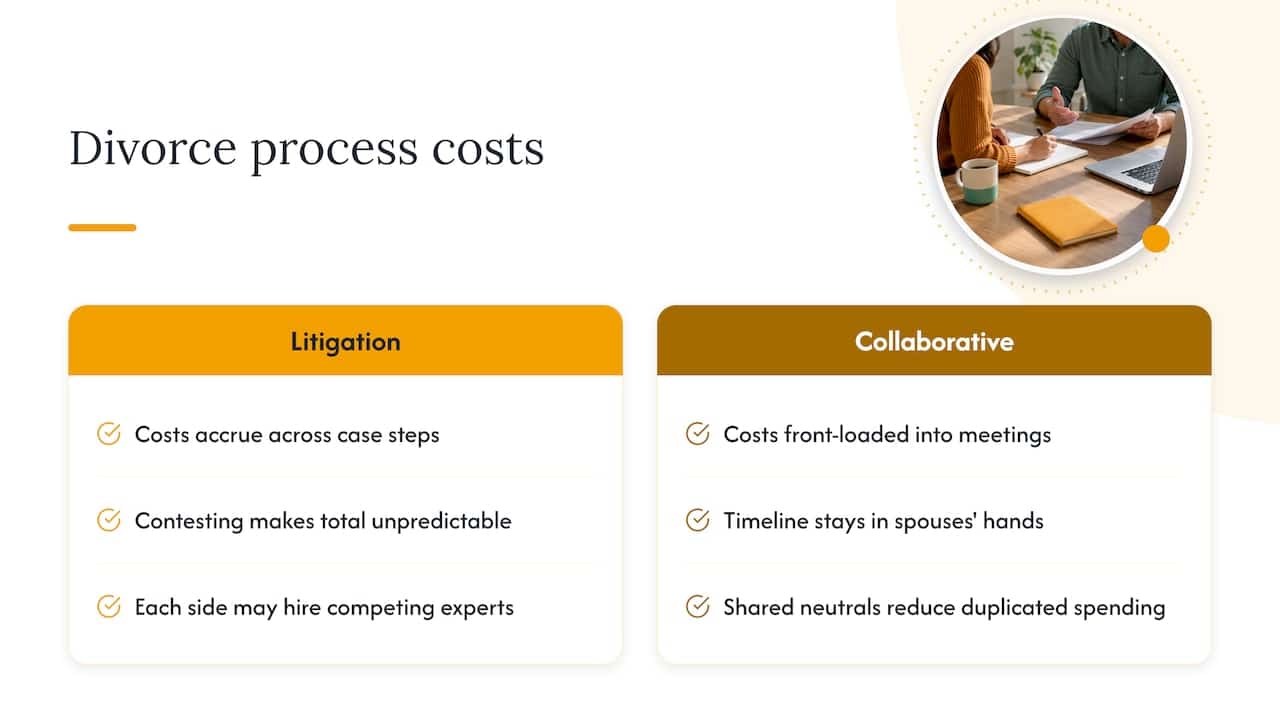
In traditional litigation, costs are spread across the whole process: motions, discovery, hearings and trial preparation. You pay for each step, and the total depends on how long the other side keeps contesting. It can be unpredictable, because one aggressive filing invites a response and the meter runs on both sides.
In a collaborative divorce, both spouses and their attorneys commit to resolving issues through structured meetings instead of court. Costs are front-loaded into those sessions, and you often share neutral professionals, such as a financial specialist, rather than each hiring a competing expert. That shared approach tends to reduce duplicated spending and keeps the timeline in your hands.
Neither route is free. Collaborative divorce requires both spouses to participate in good faith, and if the process breaks down, you may need to start over with new counsel. Litigation is sometimes unavoidable, particularly where there are safety concerns or one spouse refuses to disclose finances.
If you and your spouse can talk civilly, collaborative divorce is worth pricing next to a litigated estimate. Ask each attorney for a written range for both approaches so you can compare the realistic worst case, not just the best case.
How a Best Interest Attorney affects your overall cost
In some contested custody cases, the court appoints a Best Interest Attorney to represent what is best for the children rather than either parent. This is a separate lawyer, and someone has to pay for that role, so it adds to the total expense of the case.
The court typically allocates the attorney’s fees between the parents based on the circumstances. That means you should plan for the possibility of a second professional billing hours in your case: interviewing the children, speaking with each parent, reviewing records and making recommendations to the judge.
The cost is not always a burden in disguise. A Best Interest Attorney can bring clarity to a stalled dispute, and a credible recommendation often moves parents toward settlement faster than another round of hearings. When parents reach agreement on a parenting plan early, the court is less likely to need this appointment at all, which is one more reason cooperation saves money.
If you suspect your case may head in this direction, speak with counsel early about how the role works and how fees are typically shared. You can read more about our Best Interest Attorney services, and the same early-budgeting habits apply here: ask for an estimate, ask who pays what, and decide where an agreement could make the appointment unnecessary.
What most people get wrong about divorce costs
The headline numbers people search for, such as the filing fee, are the smallest part of what they will spend. The fee on the clerk’s page is predictable and fixed. Everything else is a function of behavior: how willing you and your spouse are to agree, how organized your records are, and how early you start planning.
Conventional wisdom says to hire the toughest lawyer you can find. In our view, the better question is which lawyer will help you finish the case with the least conflict that your situation allows. Fighting over every issue feels powerful, yet it is the most reliable way to turn a manageable divorce into an expensive one.
Cost control is mostly decided before the first hearing. Ask for written estimates, discuss capped or phased fees, and tell your attorney your budget in plain terms. A good lawyer will build a strategy around it instead of treating it as an afterthought.
How we can help you estimate and manage your divorce costs
When you want a number for your own case instead of a general range, we can help you build one. We handle divorce, divorce mediation, uncontested divorce and collaborative divorce, so we can match the approach to what you can afford.

Maricopa County filers can also review our filing fee page. Book a consultation with our team through our divorce page.
This article is general information, not a substitute for advice from a qualified lawyer. Consult a qualified legal professional about your own circumstances before acting on anything here.
FAQ
How much does a divorce cost if both spouses agree in Arizona?
An agreed divorce costs the least because you avoid contested hearings. You still pay the court filing fee, which is $376 in Maricopa County, plus any attorney or mediator time. A summary consent decree can reduce attorney work further.
How can I save money before filing for divorce?
Start by gathering financial records, such as account statements, tax returns and a list of debts. Agree with your spouse on as many issues as you can before involving lawyers. Ask attorneys for written estimates and capped fees for specific phases.
What is the cheapest way to get a divorce in Arizona?
The lowest-cost route is an uncontested divorce or summary consent decree when you and your spouse fully agree. If you cannot afford court fees, you can apply for a deferral or waiver. Mediation is the next most economical option for resolving disagreements.
How can I get through a divorce with less conflict?
Keep communication focused on decisions rather than blame, and settle the simple issues first. Mediation or collaborative divorce gives you a structured setting to work through harder topics without courtroom fights. Less conflict usually means fewer hours billed.