



Lis Pendens in an Arizona Divorce: What It Does and Risks

A lis pendens is a recorded public notice that a lawsuit affecting a piece of real estate is pending. In an Arizona divorce, a spouse can use one to warn buyers and lenders that the house is in dispute. It is not a lien, it does not give you ownership, and it does not freeze the rest of your case. Used correctly, it protects your claim. Recorded carelessly, it can cost you at least $5,000 in damages plus the other side’s attorney fees.
This guide explains what the notice does, when Arizona law allows it, how a 2025 appellate decision changed the risk calculation, and what to do about a notice recorded against you.
TL;DR
- A lis pendens in Arizona is recorded with the county recorder. It puts later buyers and lenders on notice of your case. It does not decide who gets the property.
- Under A.R.S. § 12-1191, it may be recorded only in an action that affects title to real property. A claim for money, support or maintenance alone does not qualify.
- If the property is owned by an LLC or another third party who is not joined in the case, the notice may be groundless and expose you to damages.
- If the case is dismissed without prejudice for lack of prosecution, you must issue a recordable release within 30 days.
- Talk to a family law attorney before recording or fighting a notice. The deed, the pleadings and the notice all have to line up.
Table of Contents
- What a lis pendens actually is
- When Arizona law allows one in a divorce
- Where you record it
- The risk most people miss: the owner has to be a party
- Recording a notice: a practical sequence
- If a lis pendens is recorded against your home
- “Quiet title” after the divorce
- Other states work differently
- Can you handle this without a lawyer?
- Our perspective
- How we can help
- FAQ
- Sources
What a lis pendens actually is
The Latin phrase means “suit pending.” As Investopedia explains, it is an official public notice that a property is the subject of a lawsuit, meant to alert potential buyers. Think of it as a flag on the property’s record.
Three things it is not:
- Not a lien. It does not secure a debt or put a dollar amount against the house.
- Not an ownership award. The divorce court still decides who keeps the property, whether it is sold, and how the equity is divided.
- Not an automatic injunction. It does not by itself stop your spouse from living in the home, listing it or refinancing. What it does is make a later buyer or lender take the property subject to the outcome of your case. In practice, title companies are reluctant to insure a sale with an open notice, so it often stops a transaction anyway.
The statute describes this as constructive notice to later purchasers or encumbrancers. The notice protects your place in line. It does not guarantee you a share of anything.
When Arizona law allows one in a divorce
Arizona’s statute is narrow. A.R.S. § 12-1191 allows a notice only in an action, or an affirmative defense, that affects title to real property. The notice must state the names of the parties, the object of the action, the relief demanded and a description of the property.
In a divorce, that raises a practical question: does your petition, response or counterclaim actually ask the court to do something to title? Compare:
| Your claim | Does it affect title? |
|---|---|
| Ask the court to award the marital home to you, or order it sold and the proceeds divided | Usually yes |
| Ask the court to declare property community property and divide it | Often yes, depending on how it is pleaded |
| Ask for spousal maintenance or child support | No, a money claim alone does not qualify |
| Ask for reimbursement of separate funds spent on the house | Depends on the relief requested, and needs a careful look |
| Custody and parenting time | No, these have nothing to do with title |
The filing is often described as something that “goes with” every divorce. It does not. It is a conditional, separate step that makes sense only when there is a real risk the property will be sold or borrowed against before the court rules. Even an uncontested divorce may involve one in some states, because a settlement still has to address the property. The Georgia court’s instructions for divorce without children show that the notice is a separate filing used only when the real estate issue calls for it. The exact rule depends on the state and county.
The notice also has nothing to say about custody. Parenting time, legal decision-making and child support are decided on their own track, regardless of what is recorded against the house.
Where you record it
In Arizona, the notice goes to the county recorder where the property sits, not just the superior court clerk. For a home in Scottsdale, that is the Maricopa County Recorder. Filing your petition with the court does not by itself put anyone on notice. The recording does.
Before you record, build the notice from the deed and your pleadings, not from a utility bill or a casual description of the address. The legal description on the recorded deed is what a title company searches. A mismatch between the notice and the underlying documents can undermine the notice and invite expensive release litigation.
The risk most people miss: the owner has to be a party
The most useful recent Arizona authority is the Court of Appeals decision of July 16, 2025 in Westbrook Rental LLC v. Goodman. Here is the short version.
During a dissolution case, one spouse set up an LLC with herself as sole member. The LLC then used what the other spouse believed were community funds to buy property. The other spouse recorded a lis pendens against it. The court held the notice was groundless because the LLC was never joined or sued in the divorce, so the dissolution court could not enter an order affecting the LLC’s title.
The consequences were real. The court upheld $5,000 in damages and $30,000 in attorney fees. The opinion also explains that under A.R.S. § 33-420, a property owner facing a groundless notice can seek release, title-clearing relief, attorney fees, and damages of not less than $5,000 when the person who recorded it knew or had reason to know it was groundless.
The lesson is about legal power, not fairness. You may sincerely believe marital money bought that property. But a notice is unsafe unless your underlying case can legally bind the person whose name is on the title. Before recording, a careful attorney identifies:
- every record owner on the deed
- any LLC, trust or relative that holds title
- lenders and trustees on the deed of trust
- any transferee after the case began
If title is held by an entity or someone other than your spouse, that party may need to be joined in the case first. For more on how property is characterized in the first place, see our guide to community property in Arizona.
Recording a notice: a practical sequence
This is the order a careful practitioner follows. It is a general outline, not a substitute for advice on your facts.
- Pull the current deed and title report. Confirm who actually holds title and what encumbrances exist.
- Read your own pleadings. Confirm the petition, response or counterclaim asks for relief that affects title, not only a money judgment.
- Join the necessary parties. If an LLC, trust or third party holds title, address that before you record.
- Draft the notice from the recorded documents. Include the parties’ names, the object of the action, the relief demanded and the property description.
- Record with the county recorder, and keep the recorded copy with your case file.
- Calendar the end of the notice. Plan to release or replace it when the case settles, is dismissed or the property issue is resolved.
Step six is where people get hurt. If an Arizona action is dismissed without prejudice for lack of prosecution, the filer must issue a recordable release within 30 days. Failing to do so exposes the filer to $1,000 in liability plus actual damages under the same statute.
If a lis pendens is recorded against your home
Being on the receiving end is stressful, especially if you are trying to refinance, sell or buy out your spouse. Start with these questions:
- Does the underlying case really affect title? If it only seeks support or reimbursement, the notice may be vulnerable.
- Are you, or your entity, a party to the case? The Westbrook decision shows that a notice against an owner who was never joined can be groundless.
- Does the notice match the deed? Errors in names or legal description matter.
- Was the case dismissed or resolved? If so, a release may be owed.
Arizona law provides remedies, including release, an order clearing title, attorney fees and damages. The right route depends on whether the notice is part of a live divorce, which court has the case and who holds title. Do not try to ignore it, and do not retaliate by transferring the property. Once a petition has been filed, moves like that can create bigger problems in the case. Bring the notice, the deed and the case documents to a family law attorney early.
“Quiet title” after the divorce
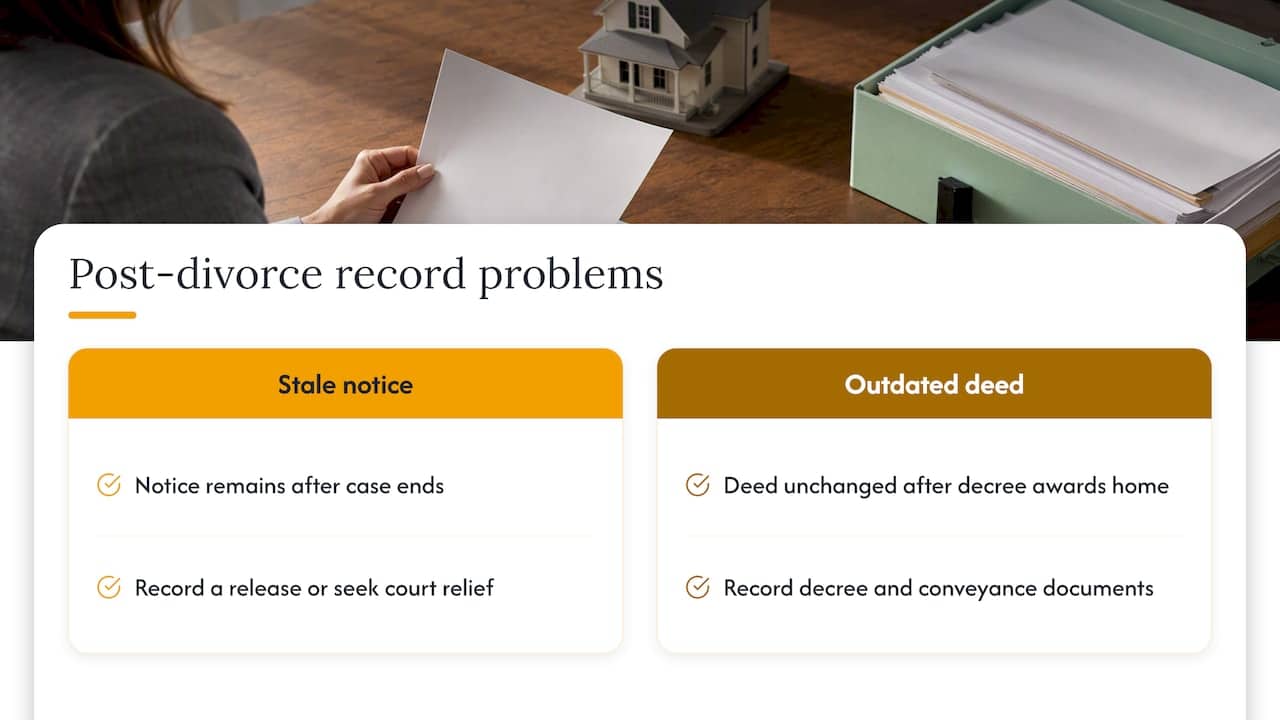
People who search for quiet title after a divorce usually have one of two problems: an old notice still sits on the property record after the case ended, or the decree awarded the home to one spouse but the deed was never updated.
The two problems have different fixes. A stale notice is addressed through a release, which the filer can record, or through court relief if the filer will not cooperate. An outdated deed is normally fixed by making sure the decree and the proper conveyance documents are recorded so the public record matches the court’s order. Ownership questions that were left unresolved in the decree may require further court action. Because that depends on what your decree says and what is on record, have an attorney review both before you try to sell or refinance.
If the real issue is that you co-own a house with an ex and cannot agree on selling it, read about partition actions in Arizona. For a broader look at who keeps the home, see who gets the house in a divorce without children and our article on luxury real estate in a Scottsdale divorce.
Other states work differently
Do not borrow rules from another state. Georgia, for example, has a statute on transfers of property after a divorce petition is filed that addresses lis pendens notice specifically. Some Georgia counties tell self-represented spouses to file a notice when the home is titled in the other spouse’s name alone. Arizona’s rules, the recorder’s requirements and the remedies for groundless notices are different. If you found a form online, check that it is for Arizona and for your county before it goes anywhere near a recorder.
Can you handle this without a lawyer?
As a general matter, self-representation is legally possible in many US divorce courts. But official guidance, such as the D.C. Family Court handbook for self-represented parties, warns that you must follow the same procedural rules as everyone else and that court staff cannot give legal advice. That handbook is specific to D.C., not a worldwide rule, but the point travels well.
A property filing is where the cost of an error is highest. A groundless notice can mean damages and fee awards, as the Westbrook case shows. A generic form cannot tell you whether an LLC needs to be joined, whether your pleading seeks relief affecting title, or whether the legal description matches the deed. If you cannot afford a lawyer, our guide on Arizona divorce costs and fee relief explains how costs vary by county and how fee deferral and waiver work. Note that a fee waiver does not give you a lawyer and does not cover recording, appraisal or title costs.
Our perspective
We see lis pendens questions come up when trust has already broken down. One spouse fears the house will be sold or borrowed against, and wants to do something right now. That instinct is understandable. Our advice is to slow down for a day and get the paperwork right.
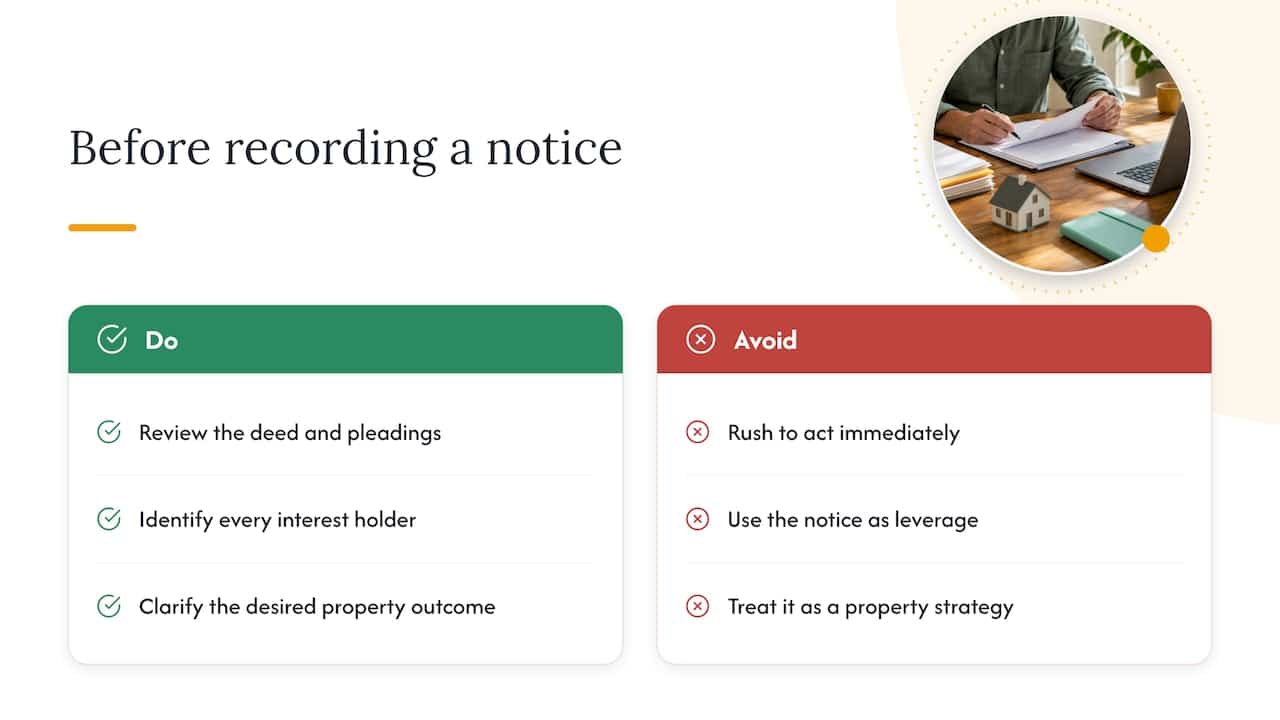
The notice is a tool for a specific job: protecting a real claim to title against a real risk of transfer. It is not leverage, and it is not a substitute for a good property strategy. We start with the deed and the pleadings, identify everyone who holds an interest, and ask what outcome you actually want: keeping the home, a fair buyout, or a clean sale. Often the answer shapes the whole case, including how we handle the financial goals and the children’s stability at the same time.
Our team has more than 20 years of family law experience in Scottsdale, and we work with clients on property division, community property questions and real estate disputes tied to divorce. Sometimes that means recording a notice. Sometimes it means a quicker route, such as a negotiated agreement, mediation or a stipulated order that keeps the property from moving.
— Brett
How we can help
If your divorce involves a house, a rental or property held through an entity in Scottsdale or elsewhere in Maricopa County, we can review the deed, the pleadings and any notice already on record, then advise whether to record one, challenge one or skip it. We handle divorce, contested divorce and property division, and we also offer divorce mediation and uncontested divorce for couples who can agree on the property. Our fees are not published online, so ask about them when you contact us.
FAQ
Does a lis pendens stop my spouse from selling the house?
It does not legally prohibit a sale, but it gives buyers and lenders constructive notice of your case. Title companies are often unwilling to close over it, so it can stall a sale in practice. If you need a real prohibition on selling or borrowing, ask your attorney about a court order.
Can I record a lis pendens in a divorce that only involves custody and support?
No. Arizona allows the notice only in an action that affects title to real property. Custody, parenting time, child support and maintenance claims do not. The notice needs a pleading asking for relief that touches title.
What happens if I record one and it was wrong?
If the notice is groundless and you knew or had reason to know it, Arizona law can require release, clearing of title, attorney fees and damages of not less than $5,000. In the 2025 Westbrook decision, the court upheld $5,000 in damages and $30,000 in attorney fees. Get legal review before you record.
How do I remove one after my divorce ends?
Start with the party who recorded it and ask for a recordable release. If the case was dismissed without prejudice for lack of prosecution, the filer must issue one within 30 days. If they refuse, court relief may be available, so speak with an Arizona family law or real estate attorney.
Sources
- Arizona Revised Statutes § 12-1191
- Westbrook Rental LLC v. Goodman, Arizona Court of Appeals opinion
- What Is a Lis Pendens? Investopedia
- Georgia Code § 19-5-7, Justia
- Instructions for divorce without minor children, Fulton County Superior Court
- Handbook for Self-Represented Parties, D.C. Family Court