



90–120 Days: Arizona Divorce Timeline, 60 Day Rule & Lawyer Checklist

Arizona law requires at least a 60-day waiting period after your spouse is served before a judge can finalize your divorce, and that clock is a floor, not an estimate. Most uncontested cases wrap up in roughly 90 to 120 days once you account for court processing, while contested cases involving custody fights, business valuations, or a spouse who won’t cooperate commonly stretch to 6 to 18 months or longer. The next section walks through exactly how filing and service start that clock.
TL;DR:
- Most uncontested divorces in Arizona typically conclude within 90 to 120 days after filing, while contested cases can extend beyond 6 to 18 months.
- The 60-day waiting period begins only after spouse service, and submitting a complete, error-free consent decree before day 60 can prevent delays.
- Complex cases involving custody disputes, significant assets, or out-of-state spouses usually slow down the process due to extended discovery and hearings.
- Early organization of financial documents, timely disclosures, and proper paperwork significantly speed up case resolution.
- Mediation and summary consent decrees can shorten timelines, but contested cases with trial delays and appeals often take the longest.
Table of Contents
- Step-By-Step: Filing, Service, and Response in an Arizona Divorce
- How the 60-Day Waiting Period Actually Works
- Typical Timelines by Case Type
- Discovery, Temporary Orders, and Why They Slow Things Down
- Settlement Paths: Mediation and Consent Decrees
- Contested Cases: Trial and Post-Trial Timelines
- What Speeds Up or Slows Down Your Case
- Your First 30 to 60 Days: A Practical Checklist
- How an Arizona Family Law Firm Approaches Timeline Management
- Get Timeline Clarity From an Arizona Divorce Attorney
- Official Arizona Divorce Resources
- Sources
Step-By-Step: Filing, Service, and Response in an Arizona Divorce
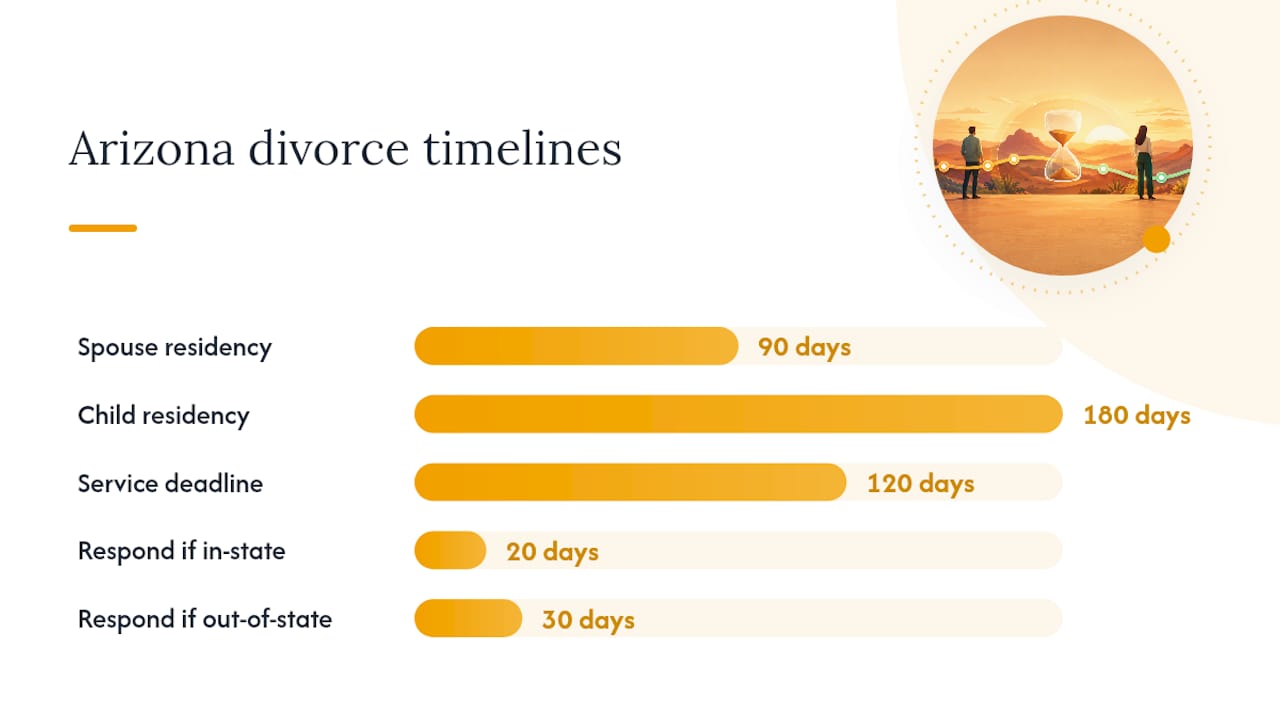
Before you file anything, one spouse has to have lived in Arizona for at least 90 days. If you have minor children, Arizona’s residency rules generally require the kids to have lived in the state for six months so the court has authority to decide custody. Skip this step and a judge can dismiss your petition outright.
Filing itself is the easy part. You (the “petitioner”) submit a Petition for Dissolution of Marriage using the state’s standard forms, available through Arizona’s official family law forms. You can file electronically, in person at the clerk’s office, or by mail, depending on the county.
Once filed, you have 120 days to serve your spouse. Common methods include:
- A licensed process server or the county sheriff
- Certified mail with a signed return receipt
- A signed Acceptance of Service, which is faster and often used when both spouses are cooperating
The respondent then has a set window to answer:
- 20 days if served within Arizona
- 30 days if served outside the state
If the deadline lands on a weekend or holiday, it rolls to the next business day. Miss the deadline entirely, and the petitioner can request a default judgment, which moves the case forward without the respondent’s input.
How the 60-Day Waiting Period Actually Works
A.R.S. § 25-329 sets a hard 60-day floor between service (or acceptance of service) and the earliest a judge can sign your decree. That clock starts the day your spouse is served, not the day you filed. File on January 1 but wait three weeks to serve, and your 60 days doesn’t begin until service happens.
Day 61 means you’re eligible for finalization, not automatically finalized. County processing, judge availability, and paperwork completeness all add real time on top of that statutory minimum.
Use the 60 days wisely:
- Gather financial documents and account statements
- Complete any required parenting classes if children are involved
- Draft or review your consent decree so it’s ready to submit the moment you’re eligible
Pro Tip: Submit a fully completed, error-free consent decree before day 60. Courts routinely bounce back incomplete paperwork for corrections, and that alone can add weeks to a case that was otherwise ready to close.
Typical Timelines by Case Type
Not every divorce follows the same clock. Where you land depends heavily on whether you and your spouse agree before you ever walk into a courtroom.
- Summary Consent Decree: The fastest route. Both spouses agree on every term before filing and sign the paperwork together, which can shave several weeks off the traditional service-based process.
- Uncontested/Consent Decree: Typically 90 to 120 days start to finish, once you factor in the 60-day wait plus filing and processing time.
- Default divorce: If the respondent never answers, expect 60 to 90 days after service, plus however long the county takes to process the default judgment.
- Contested divorce: Six to 18 months or more, driven by discovery disputes, custody battles, and crowded trial calendars.
Discovery, Temporary Orders, and Why They Slow Things Down
Under Rule 49, both spouses must exchange financial disclosures early, including tax returns, pay stubs, and property valuations. Skipping or delaying this step is one of the most common reasons cases stall.
Temporary orders covering custody, parenting time, or support require their own hearing, which adds a distinct phase to the schedule, especially if one side files on an emergency basis. Complex cases often need:
- Depositions
- Subpoenas for financial records
- Forensic business or retirement account valuations
Each of these can add weeks or months. Early, organized disclosure is the single most effective way attorneys shorten this phase.
Settlement Paths: Mediation and Consent Decrees
Mediation and conciliation court get used most often when custody or property division stalls. A neutral third party helps both sides reach terms without a trial, which is usually faster and cheaper than litigation.
Two settlement documents matter here:
- Consent Decree: Filed after the case is already underway and both sides reach agreement mid-process.
- Summary Consent Decree: Signed and filed together from the start, which streamlines county processing.
Judges still review every decree for completeness and for whether custody terms serve the children’s best interests. A clean, thorough submission moves through that review far faster than one a judge has to send back for corrections.
Contested Cases: Trial and Post-Trial Timelines
Contested cases follow a longer, more procedural path. Expect motion practice, discovery deadlines, and a resolution management conference before the court even sets a trial date.
Court calendars are the real bottleneck. Many Arizona counties book trial dates months out simply because of docket volume, and evidentiary scheduling around expert witnesses (appraisers, forensic accountants) adds further waits.
After trial, judges don’t always rule immediately. Some issue decisions from the bench, others take the matter under advisement for weeks. If either party appeals or the other side resists enforcing the final order, resolution can stretch well past the trial date itself.

What Speeds Up or Slows Down Your Case
A few factors do more to move your timeline than anything else.
What speeds things up:
- Full agreement on custody, support, and property before filing
- Early acceptance of service instead of formal process serving
- Minimal shared assets and no children
- Using a Summary Consent Decree
What slows things down:
- Contested custody or parenting time disputes
- Complex assets, retirement accounts, or a business requiring valuation
- One spouse living out of state
- Incomplete or delayed financial disclosures
Pro Tip: If you own a business or have significant retirement accounts, start the valuation process the same week you file. Waiting until discovery forces the issue almost always adds months.
Your First 30 to 60 Days: A Practical Checklist
Getting organized early saves real time down the line.
- Collect IDs, tax returns, pay stubs, deeds, vehicle titles, and retirement account statements
- Confirm your county’s exact filing and response fees, which vary by court
- Secure your own bank and credit accounts before filing
- Decide whether you need temporary orders for support or parenting time
- Track every deadline (service, response, disclosure) on a calendar the day it’s triggered
- Schedule a consultation early, even if your case looks simple
How an Arizona Family Law Firm Approaches Timeline Management
Most delays in Arizona divorces come from paperwork errors and missed deadlines, not the law itself. High Desert Family Law Group focuses on getting disclosures and consent decrees right the first time, which is usually what shortens a timeline more than anything else.
Litigation becomes unavoidable when a spouse refuses to negotiate on custody or hides assets, but even then, organized documentation from day one keeps the case moving instead of stalling in discovery disputes.
Get Timeline Clarity From an Arizona Divorce Attorney
A family law firm works through every stage of the Arizona divorce timeline covered here, from uncontested consent decrees to mediation to full contested litigation, and has experience with where cases in Scottsdale typically stall. Instead of guessing at fees, deadlines, or whether your paperwork will survive judicial review, you get experienced legal support that understands factors influencing case progress through the 60-day window and beyond.

Whether you’re preparing to file, already served, or negotiating a settlement, the right legal support keeps your case on the fastest realistic track for your situation. Explore the firm’s family law services and schedule a consultation to map out your specific timeline before deadlines catch you off guard.
Official Arizona Divorce Resources
- Arizona Revised Statutes § 25-329 — full statute text on the 60-day waiting period
- Maricopa County Superior Court — county procedure and decree types
- Arizona Judicial Branch forms — official filing forms
- Self-Service Divorce Guide — step-by-step procedural walkthrough
This article is general information, not a substitute for advice from a qualified lawyer. Consult a qualified legal professional about your own circumstances before acting on anything here.
Sources