



Protect Retirement After 50: Arizona Gray Divorce, QDROs and Medicare

Gray divorce means ending a marriage after age 50, typically after 20 or more years together, and it comes with far less runway to rebuild retirement savings than a divorce at 30. The first move isn’t calling a lawyer, it’s building a dated inventory of every account, deed, and debt in the marriage, then confirming Arizona’s residency and filing rules with your county Superior Court. Arizona requires a 60-day waiting period before any decree, and the financial stakes on retirement accounts make that inventory the foundation for everything that follows.
TL;DR:
- Confirmation with each plan administrator is essential before finalizing any retirement account split to avoid delays and rejection of generic QDRO language.
- Long marriages often involve complex property characterization, with inherited and pre-marriage assets becoming community property if commingled, impacting division.
- The 60-day Arizona waiting period can extend recovery time in complex gray divorce cases, sometimes pushing proceedings beyond the typical six-month timeline.
- Updating beneficiary designations and estate plans immediately after divorce is crucial, as previous designations legally override final decrees and can cause unintended inheritance.
- Proper coordination of tax implications, especially for large assets like real estate and retirement accounts, is vital to prevent unexpected liabilities post-divorce.
Table of Contents
- What Does Gray Divorce Mean Under Arizona Law?
- How Does Arizona Divide Assets and Debts in Long Marriages?
- Retirement Accounts, Pensions, and QDROs: Getting the Transfer Right
- What Are Arizona’s Spousal Maintenance Guidelines for Longer Marriages?
- Do Social Security Divorced-Spouse Benefits Apply to You?
- What Is the Arizona Divorce Filing Process and Timeline?
- How Should You Handle Health Insurance and Medicare Timing?
- What Should You Bring to Your First Divorce Consultation?
- Why Does Emotional Readiness Affect Your Divorce Outcome?
- How Does Gray Divorce Change Your Estate Plan?
- What Tax Issues Come Up in an Arizona Gray Divorce?
- How Do You Rebuild Your Finances After a Gray Divorce?
- How Does Gray Divorce Affect Adult Children and Family Relationships?
- How High Desert Family Law Group Helps With Gray Divorce
- Sources
- FAQ
What Does Gray Divorce Mean Under Arizona Law?
Arizona law treats a divorce at 55 the same as a divorce at 25, procedurally speaking. What changes is the math. A couple splitting assets after 25 years has less time before retirement to recover from a lopsided settlement, which is why financial planners and attorneys treat gray divorce as its own category rather than a variation on standard divorce. Divorce rates among Americans 50 and older have climbed steadily over the past few decades, according to Pew Research, making this a growing, not fringe, concern.
To file in Arizona, one spouse must have lived in the state for at least 90 days, and you file in the Superior Court of the county where you or your spouse resides. Once the other spouse is served or accepts process, Arizona courts require a 60-day waiting period before a judge can enter a final decree, even in uncontested cases. Statewide standards generally aim for most cases to close within about six months, but complex asset divisions common in gray divorce often push well past that.
How Does Arizona Divide Assets and Debts in Long Marriages?
Arizona is a community property state, which means most assets and debts acquired during the marriage belong equally to both spouses, regardless of whose name is on the account. That sounds simple until you factor in decades of commingled finances, inherited property, and businesses built over the course of a long marriage.
The tricky part is characterization. Money one spouse inherited stays separate property in Arizona, but only if it was never mixed with joint accounts. A house purchased before the wedding can turn partly community property if the mortgage was paid down with marital income for 20 years. Business interests built during the marriage typically count as community property even if only one spouse ever worked there. Arizona’s community property rules get more complicated, not less, the longer a marriage lasts.
A clean 50/50 split on paper can still leave one spouse worse off. The house might carry a bigger tax bill on sale than the brokerage account does. One spouse’s pension might have survivor benefits that disappear entirely without specific court language. Carrying costs like property taxes, HOA fees, and insurance premiums eat into value that never shows up in a simple asset list.
Before you sit down to negotiate anything, gather these records:
- Deeds and titles for real estate, vehicles, and other titled property
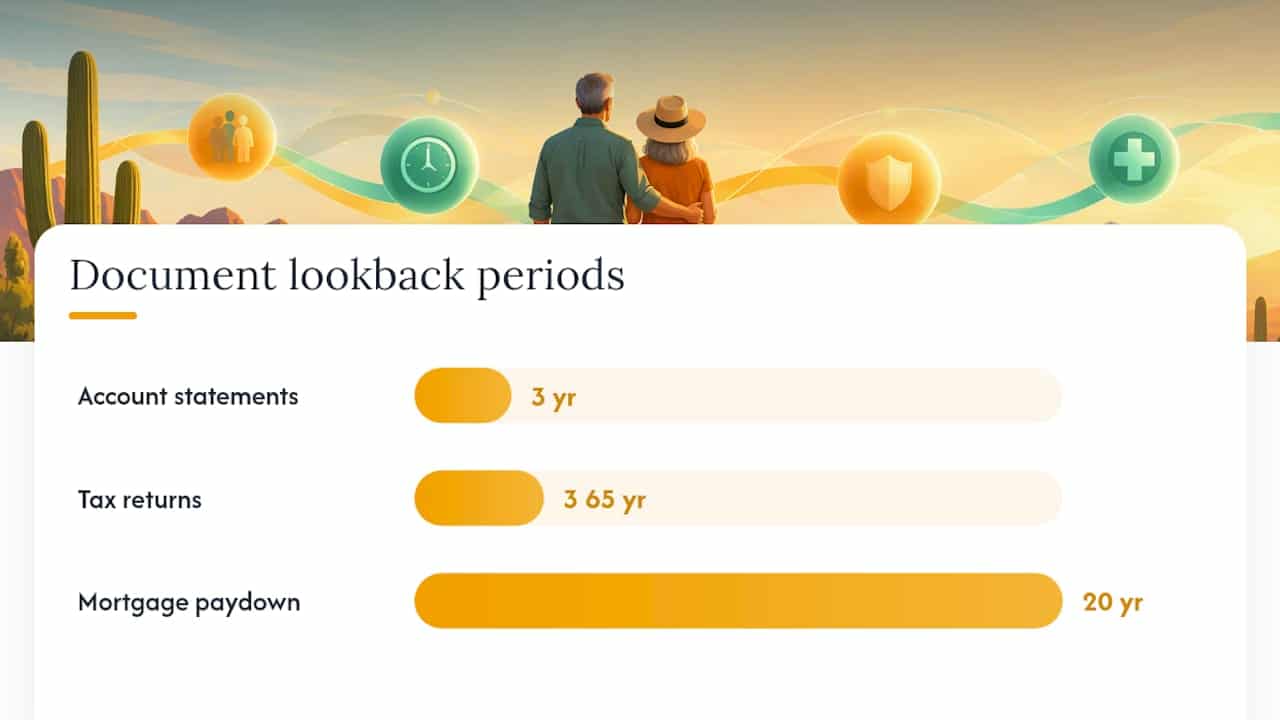
- Bank and brokerage account statements going back at least three years
- Business ownership records, partnership agreements, and recent valuations
- Tax returns for the last three to five years
- Any documentation of inherited or gifted assets, including how they were held
Pro Tip: Pull account statements showing balances from the date of marriage, not just current balances. Without that starting point, tracing what counts as separate property becomes a guessing game your attorney has to solve after the fact.
Retirement Accounts, Pensions, and QDROs: Getting the Transfer Right
Retirement accounts are usually the largest asset in a gray divorce, often bigger than the house. Pensions, 401(k)s, IRAs, and annuities all get treated differently under Arizona law and federal tax rules, and mixing up the mechanics of one for another is a common, expensive mistake.
A 401(k) or pension divided during divorce requires a Qualified Domestic Relations Order, or QDRO, a separate court order that tells the plan administrator how to split the account. An IRA transfer works differently and generally doesn’t need a QDRO at all, just specific language in the divorce decree. Publication 504 from the IRS lays out the tax treatment for these transfers, and getting it wrong can trigger taxes and penalties that a properly structured transfer would have avoided entirely.
Here’s where cases go sideways: someone signs a settlement agreement with generic language about “splitting the 401(k) equally,” then discovers the plan administrator won’t process it because it doesn’t match their required format. Every plan has its own model language and procedures. Request those procedures before you finalize anything.
- Ask your attorney to request the plan’s specific QDRO template early in the process
- Confirm whether the account requires a QDRO or a simpler decree provision
- Get written confirmation from the plan administrator that the language is acceptable before signing
Pro Tip: Never sign a settlement with retirement language you haven’t confirmed against the actual plan’s procedures. A 401(k) divorce in Arizona that looks finished on paper can stall for months if the administrator rejects the order.
What Are Arizona’s Spousal Maintenance Guidelines for Longer Marriages?
Eligibility for spousal maintenance in Arizona depends on factors laid out in A.R.S. § 25-319, including the length of the marriage, each spouse’s earning ability, age, and whether one spouse sacrificed career growth for the household. Qualifying and receiving an award of any particular size are two different things. The statute authorizes maintenance; the Arizona Spousal Maintenance Guidelines translate marriage length into duration ranges judges typically follow.
For marriages of 192 months (16 years) or longer, the standard guideline duration range runs from 12 to 96 months, though actual awards remain case-specific and depend heavily on the judge and the facts presented. This is where the Rule of 65 matters: in long marriages where both spouses are near or past 65, courts sometimes deviate from the standard duration range, occasionally extending maintenance closer to the length of the marriage itself given the shorter working years remaining.
Judges can deviate from guideline ranges based on:
- Health conditions limiting either spouse’s ability to work
- One spouse’s contribution to the other’s career or education
- Standard of living established during the marriage
- Actual versus potential earning capacity of each spouse
Run any proposed maintenance number against a real monthly budget before agreeing to it. The Arizona spousal maintenance guidelines look reasonable on a spreadsheet until you plug in actual housing, medical, and living costs at your current age.
Do Social Security Divorced-Spouse Benefits Apply to You?
Social Security isn’t divisible property in an Arizona divorce decree, no matter how long the marriage lasted. It’s a federal benefit governed entirely by federal rules, and no state court order can reassign it.
That said, divorced-spouse benefits exist for a reason. If your marriage lasted at least 10 years, you’re at least 62, and you haven’t remarried, you may be entitled to claim benefits based on your ex-spouse’s earnings record, according to Social Security Administration guidance. This claim doesn’t reduce what your ex-spouse receives, and they don’t need to approve it or even know you’ve filed.
Because this isn’t something a divorce decree controls, verify your specific eligibility directly with the SSA rather than assuming your attorney’s estimate covers every detail of your work history and marriage length. For a marriage sitting close to the 10-year mark, get written confirmation of the exact marriage duration on record before finalizing anything, since a few months can be the difference between qualifying and not.
What Is the Arizona Divorce Filing Process and Timeline?
Filing starts with a petition for dissolution filed in the Superior Court of the county where you or your spouse meets Arizona’s 90-day residency requirement. From there, a fairly predictable sequence unfolds, though gray divorce cases with complex assets tend to run longer than the state’s targets.
- File the petition and serve your spouse, or have them accept service
- The 60-day waiting period begins, during which no decree can be finalized
- Either spouse can request temporary orders covering support, property use, or bill payment while the case is pending
- Some couples use conciliation court services to attempt reconciliation or resolve disputes before proceeding
- Negotiation, mediation, or litigation resolves outstanding issues like property division and maintenance
- The court reviews and either accepts or rejects a full settlement agreement, then enters the final decree
Arizona’s case-processing standards target 75% of dissolution cases resolved within 180 days and 90% within 270 days, but retirement account tracing, business valuations, and real estate disputes routinely push gray divorce cases toward the longer end. If you and your spouse can’t afford to live under one roof during this period, ask the court for temporary orders rather than informally splitting up, since Arizona treats informal separation very differently from a court-recognized arrangement.
How Should You Handle Health Insurance and Medicare Timing?
If you’ve been covered under a spouse’s employer health plan, that coverage typically ends when the divorce is final, not before. COBRA continuation coverage is usually available for up to 36 months for a divorced spouse, though it comes at full premium cost with no employer subsidy. Marketplace coverage is another option, and divorce changes how you report income for premium tax credit purposes, so update that information promptly once the decree is final.
Timing matters even more for anyone approaching 65. If you’re relying on a spouse’s employer coverage and nearing Medicare eligibility, coordinate your Medicare enrollment window with the divorce timeline rather than letting the decree dictate it. Missing your initial enrollment period can mean permanent premium penalties.
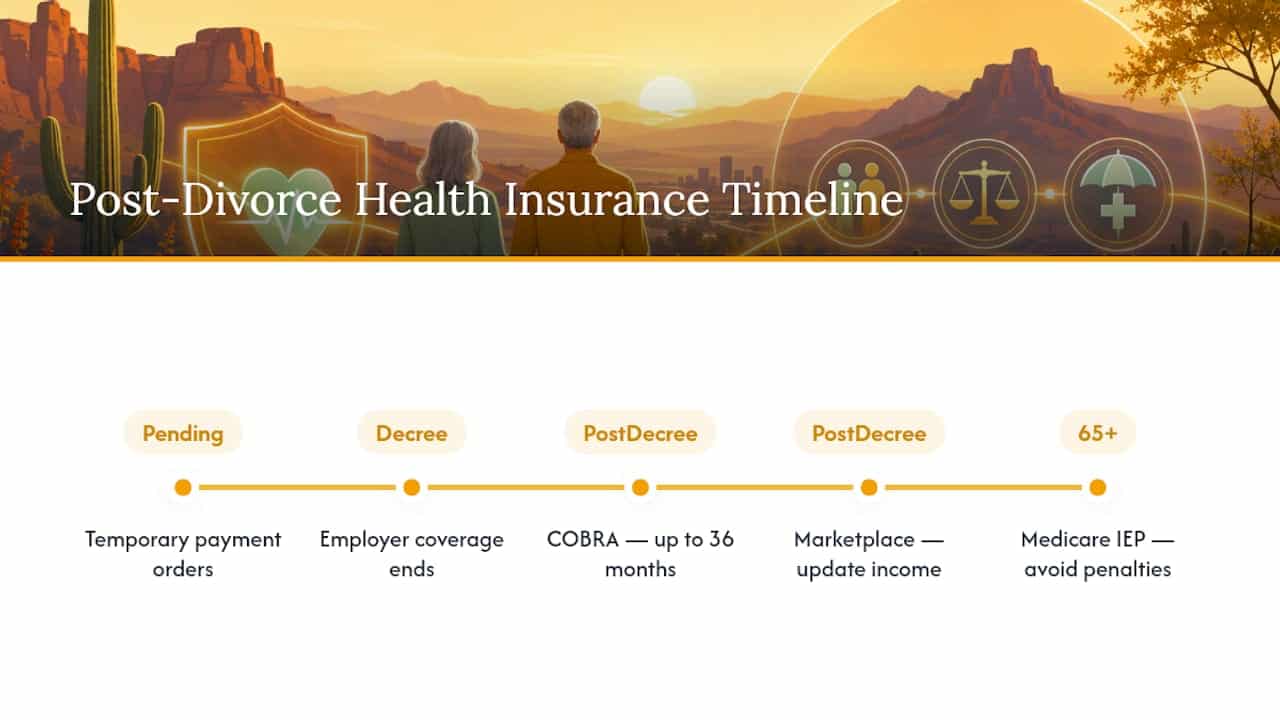
While a case is pending, temporary orders can require one spouse to keep paying for the other’s health coverage or reimburse premium costs. Don’t assume this happens automatically. Ask your attorney to address it specifically, and update beneficiary designations on any health savings accounts or supplemental policies once the divorce is final.
What Should You Bring to Your First Divorce Consultation?
Walking into a first meeting with boxes of unsorted paperwork wastes time and money. Walking in with an organized picture of your finances lets your attorney give you real answers instead of generic explanations.
Bring these documents:
- Three to five years of tax returns
- Bank, brokerage, and retirement account statements, including pension estimates
- Deeds, mortgage statements, and property tax records
- Wills, trusts, and current beneficiary designation forms
- Business records if either spouse owns a company
Before the meeting, build a rough one-person budget projecting your income and expenses after divorce, including estimated retirement income from Social Security and any retirement accounts you expect to receive. This single exercise does more to clarify what you actually need from a settlement than any amount of asset lists.
Come with specific questions: How will retirement accounts be transferred, and who handles the QDRO paperwork? What’s a realistic timeline given the complexity of your assets? Can you get temporary orders for housing or insurance costs right away? How does the attorney bill, hourly or with a retainer? Preparing for divorce with these answers in hand turns a first consultation into an actual planning session.
Pro Tip: Write your budget projection before the consultation, not after. Attorneys can negotiate around a number you understand. They can’t read your mind about what “enough” means to you.
Why Does Emotional Readiness Affect Your Divorce Outcome?
Grief, guilt, and pressure from adult children push people toward rushed settlements they later regret. Someone eager to end the conflict might sign away a fair share of retirement assets just to stop the arguing, then face a genuinely difficult retirement a decade later.
A therapist helps process the emotional weight of ending a long marriage separately from the financial decisions that marriage requires. A financial planner, particularly a Certified Divorce Financial Analyst, can stress-test a proposed settlement against your actual retirement timeline and life expectancy assumptions. Your attorney’s job is coordinating the legal mechanics, the QDRO filings, the deadlines, the court appearances, while these other professionals handle the parts of the process a law degree doesn’t cover. Building this team early, rather than after a settlement falls apart, tends to produce outcomes people can actually live with.
How Does Gray Divorce Change Your Estate Plan?
A divorce decree doesn’t rewrite your will, trust, or beneficiary designations automatically. That’s the mistake attorneys see constantly: someone finalizes a divorce, feels relieved it’s over, and never gets around to updating the estate documents that still name an ex-spouse as executor, trustee, or primary beneficiary.
Life insurance policies, retirement accounts, and payable-on-death bank accounts all transfer based on the beneficiary form on file, not based on what your will says and not based on what your divorce decree says. If you never update that form, your ex-spouse could still inherit those assets even after the divorce closes, regardless of your intentions.
Arizona law does automatically revoke certain provisions naming a former spouse in a will upon divorce, but this doesn’t extend to every account type, and relying on that default protection instead of actively updating documents is risky. Build a specific post-divorce checklist:
- Draft new wills and trust documents reflecting your current wishes
- Update beneficiary designations on life insurance, retirement accounts, and bank accounts
- Revise or create powers of attorney for healthcare and finances
- Review survivor benefit elections on any pension you’re keeping or receiving through a QDRO
- Update guardianship or trustee designations if minor grandchildren are involved in existing trusts
Treat this checklist as part of the divorce process itself, not a task for “someday.” The gap between finalizing a decree and updating an estate plan is exactly where costly mistakes happen.
What Tax Issues Come Up in an Arizona Gray Divorce?
Retirement accounts and real estate, the two biggest assets in most gray divorces, both carry tax consequences that a simple asset split can overlook. IRS Publication 504 covers the federal rules, but the practical impact shows up in how a settlement gets structured.
Transferring assets between spouses as part of a divorce is generally not a taxable event at the time of transfer. The tax bill often shows up later, when the receiving spouse eventually sells or withdraws from that asset. A house that’s appreciated significantly over 25 years of marriage may trigger capital gains tax when sold, depending on how much of the gain exceeds the available home-sale exclusion. A spouse who keeps the house instead of the 401(k) might be trading a tax-favored retirement asset for one that generates a tax bill down the road.
Withdrawing funds from a retirement account transferred via QDRO to satisfy an immediate cash need can trigger ordinary income tax and, in some cases, early withdrawal penalties if not handled correctly. The transfer itself avoids penalty under a properly executed QDRO, but subsequent withdrawals follow normal retirement account rules based on your age.
None of this means avoid retirement assets or real estate in a settlement. It means the headline value of an asset and its after-tax value can differ substantially, and a fair-looking 50/50 split on paper can be lopsided once taxes are factored in. Loop in a tax professional before finalizing which assets you keep, not after.
How Do You Rebuild Your Finances After a Gray Divorce?
The compressed timeline is the defining financial reality of gray divorce. Someone divorcing at 30 has three or four decades to recover from a mediocre settlement. Someone divorcing at 58 might have seven years before they’d hoped to retire, and far less flexibility to simply work longer or save more aggressively to make up ground.
Start with a realistic budget based on your actual post-divorce income, not your pre-divorce lifestyle. Many people underestimate how much a single household costs compared to a shared one; the same square footage, health insurance, and utilities now come from one income instead of two. Run projections showing how long retirement savings will last under different withdrawal scenarios and different retirement ages.
Protecting what you receive matters as much as what you receive. Update your investment allocation to match your actual timeline and risk tolerance now, not the joint strategy you and your former spouse built together. If you received a portion of a pension through a QDRO, confirm exactly how and when you can access those funds. Consider whether long-term care insurance makes sense now that you’re planning for aging without a spousal caregiver as an automatic backstop.
Work with a financial planner to build a multi-year projection rather than treating the settlement as the finish line. The settlement is the starting point for a financial plan that now has to work for one person instead of two.
How Does Gray Divorce Affect Adult Children and Family Relationships?
Adult children often assume their parents’ divorce affects them less than it would a young child, since custody and school schedules aren’t in play. That assumption undersells what actually happens. Adult children frequently take on informal roles as confidants, mediators, or even financial advisors to one or both parents during a gray divorce, and that role reversal creates its own strain.
Holidays, family gatherings, and milestone events like weddings or grandchildren’s births now require navigating two separate households instead of one, often for the first time in that adult child’s life. Some adult children feel pressure to take sides, even when neither parent explicitly asks them to. Others struggle watching a parent face financial uncertainty in their 50s or 60s after decades of assumed stability.
Being direct and age-appropriate with adult children about the practical realities, without recruiting them into the emotional or financial disputes, tends to preserve those relationships better than either oversharing or shutting them out entirely. If grandchildren are involved, clarify holiday and visitation expectations early rather than letting ambiguity create tension during the first several family events after the divorce.
How High Desert Family Law Group Helps With Gray Divorce
A skilled family law practice focuses on making retirement-heavy settlements actually work once the paperwork is signed. That’s the gap in most gray divorce guidance. Plenty of resources explain community property law; far fewer walk you through getting a QDRO accepted by a plan administrator on the first try.

Whether your situation calls for collaborative divorce, mediation, an uncontested filing, or contested representation when negotiation stalls, the approach starts the same way: a full inventory of assets, debts, and retirement accounts before anyone talks settlement numbers. An initial consultation often covers timeline expectations, the relevance of temporary orders while the case is pending, and what documentation retirement accounts may require for a smooth transfer.
If you’re ready to talk through your options, start with the firm’s divorce services page to see the full range of paths available and request a consultation to map out next steps for your situation.
This article is general information, not a substitute for advice from a qualified lawyer. Consult a qualified legal professional about your own circumstances before acting on anything here.
Sources
- Arizona Judicial Branch — Family Law Forms
- Publication 504 (2025), Divorced or Separated Individuals | IRS
- Arizona Revised Statutes § 25-319
FAQ
What Should You Not Forget in a Divorce Settlement?
Don’t finalize a settlement without confirming retirement account transfer mechanics directly with the plan administrator, since generic QDRO language often gets rejected. Also update beneficiary designations on life insurance, retirement accounts, and estate documents immediately after the decree, since these don’t change automatically.
How Do You Divorce When You Can’t Afford to Live Separately?
Request temporary orders from the court rather than informally splitting up, since Arizona treats a legally recognized separation differently from an informal one for support and bill-payment purposes. Temporary orders can address who pays the mortgage, utilities, and health insurance premiums while your case moves through the required 60-day waiting period and beyond.
What Is a Wife Entitled to in a Divorce in Arizona?
Arizona is a community property state, meaning assets and debts acquired during the marriage are generally divided equally regardless of gender or whose name is on the account. Spousal maintenance eligibility depends on factors under A.R.S. § 25-319 like marriage length and earning capacity, not on being the wife specifically, and outcomes are always case-specific.
How Do You Avoid Financial Ruin in Divorce?
Build a realistic post-divorce budget before agreeing to any settlement, and confirm retirement account transfer language works with the actual plan administrator before signing. Working with an attorney experienced in gray divorce alongside a financial planner catches the tax and implementation gaps that turn a fair-looking settlement into a financial setback years later.
Does Highdesertfamilylawgroup Handle Gray Divorce Cases in Arizona?
Yes, Highdesertfamilylawgroup handles divorce cases involving long-term marriages and retirement-heavy asset divisions, including collaborative divorce, mediation, and contested representation. Pricing depends on case complexity and is available directly through a consultation.