



60 Day Rule Won’t End High Asset Divorce in Arizona: Bring Experts

In Arizona, a high-asset divorce follows the same community-property rules as any dissolution, but valuation and discovery determine who ends up with what. Start preserving financial records and stop moving money between accounts the moment divorce becomes likely. Retain a family-law attorney and, in most cases, forensic accounting and business valuation experts before you file. The state has a statutory 60-day waiting period, but complex estates typically take far longer to resolve.
TL;DR:
- Valuation disputes are the primary driver of high-asset divorce litigation in Arizona and require early engagement of forensic accountants and business evaluators.
- The process often exceeds the state’s 60-day minimum waiting period due to complex property characterization, tax implications, and asset tracing.
- Properly drafted QDROs and thorough discovery are critical for accurately dividing retirement plans, stock options, and unvested equity without unnecessary penalties.
- Maintaining detailed records from the start, including trust, bank, and business documents, is essential to prove the separate nature of inherited or premarital assets.
- Early settlement discussions, including mediation, are most effective when based on complete, organized financial data and expert valuations.
Table of Contents
- Why High Asset Divorce Arizona Cases Play by Different Rules
- How Arizona Divides Complex Marital Assets
- Business Valuation and Disputes: Methods, Timing, and the Valuation Team
- Retirement Plans, Stock Options, RSUs, and QDROs
- Trusts, Premarital Assets, and Tracing: Proving What’s Really Separate
- Spousal Maintenance in High-Income Arizona Cases
- Discovery and Forensic Accounting: Finding What’s Hidden
- Timeline and Costs: What to Actually Expect
- Choosing Counsel for a High-Asset Divorce: A Practical Checklist
- Impact of Divorce on Estate Planning and Beneficiary Designations
- Child Custody and Support Issues Specific to High-Asset Divorces
- Mediation and Alternative Dispute Resolution in High-Asset Cases
- Enforcement Challenges and Post-Divorce Modifications
- What High-Asset Divorce in Arizona Actually Requires
- How High Desert Family Law Group Can Help With Your Case
- Quick Reference: Arizona Statutes and Court Resources
- Sources
Why High Asset Divorce Arizona Cases Play by Different Rules
A standard Arizona divorce might involve a house, a car, and a retirement account with a clean statement. A high-asset divorce in Arizona involves privately held businesses, stock compensation, multiple trusts, and financial records that don’t line up unless someone forces them to. Arizona’s community-property presumption still applies, but characterizing and valuing each asset becomes the entire fight.
That shift changes who sits at the table. Expect to work alongside:
- A forensic CPA who reconstructs cash flow and spots irregular transfers
- A business valuator who prices a closely held company or professional practice
- A tax advisor who models the after-tax impact of every proposed settlement
- A QDRO specialist who drafts the paperwork needed to split retirement accounts correctly
Concealment risk and tax exposure both rise with net worth, and that’s why the litigation strategy looks different from the start.
How Arizona Divides Complex Marital Assets
Arizona is a community-property state. Under Arizona’s Title 25 statutes, most assets and debts acquired during the marriage belong equally to both spouses, while property owned before marriage, inherited, or received as a gift generally stays separate. A.R.S. §25-318 gives judges authority to divide community property “equitably,” which does not always mean a straight 50/50 split once tax consequences and liquidity are factored in.
For a rental portfolio, that might mean one spouse keeps the properties while the other receives an offsetting cash award. For investment accounts holding highly appreciated stock, a court may weigh the embedded capital-gains tax before deciding who keeps which account.
Statistic Callout: Arizona law requires a minimum 60-day wait from filing to finalize a divorce under A.R.S. §25-329. Almost no contested high-asset case finishes in that window once valuation and discovery start.
Judges have several remedies beyond a straight split:
- Ordering one spouse to buy out the other’s interest in a business or property
- Structuring installment payments when a lump-sum buyout isn’t feasible
- Deferring the sale of an asset (a home, a stock position) until a set trigger date
- Awarding offsetting assets of comparable after-tax value instead of splitting one asset
Business Valuation and Disputes: Methods, Timing, and the Valuation Team
Valuation disputes drive more high-asset litigation than any other issue. Accurate valuation is usually the single most contested piece of the case, and the number an appraiser lands on depends heavily on which method they use.
- Market-based approach: compares the business to sales of similar companies.
- Income-based approach: projects future cash flow (often a discounted cash flow model) and capitalizes it into a present value.
- Asset-based approach: totals the fair market value of assets minus liabilities.
The same company can produce three different values depending on the method, which is why each side often hires its own expert. A second flashpoint is enterprise goodwill (the business’s value independent of the owner) versus personal goodwill (value tied to the owner’s own reputation and relationships) since Arizona courts treat them differently when dividing a professional practice.
Pro Tip: Start pulling three to five years of tax returns, bank statements, and profit-and-loss reports the day you decide to divorce. Valuators bill by the hour, and disorganized records are the fastest way to inflate that bill. Business valuation disputes rarely settle quickly when the underlying paperwork is incomplete.
Retirement Plans, Stock Options, RSUs, and QDROs
Vested stock options and fully vested 401(k) balances are usually easier to value than unvested RSUs still tied to a future service requirement. Courts often apply a time-based (coverture) formula to calculate what portion of unvested equity counts as marital property, based on how much of the vesting period occurred during the marriage.
- Confirm vesting schedules and grant dates for every equity award before negotiating.
- Request a Qualified Domestic Relations Order for any 401(k), pension, or similar qualified plan.
- Never assume a “buyout” of a retirement account is tax-neutral without running the numbers first.
Statistic Callout: A properly drafted QDRO lets a former spouse receive their share of a qualified retirement plan without triggering an early-withdrawal penalty, according to Department of Labor guidance. Skip the QDRO or draft it incorrectly, and that protection disappears.
Get a tax advisor to review any proposed asset swap before you sign. IRS guidance on filing after divorce covers many of the traps that surface when one spouse trades a retirement account for a house or business interest.
Trusts, Premarital Assets, and Tracing: Proving What’s Really Separate
Under A.R.S. §25-213, property owned before marriage, inherited, or received as a gift is separate property, but the burden of proving it falls on the spouse claiming it. Bank statements, brokerage records, and trust documents from before the wedding date are the backbone of that proof.
Separate property loses its protected status more easily than most people expect. Watch for these common mistakes:
- Depositing an inheritance into a joint checking account used for household bills.
- Using separate funds to pay down the mortgage on a jointly titled home.
- Retitling a premarital investment account into both spouses’ names “for convenience.”
Each of those actions can convert separate property into community property through commingling. Keep contemporaneous notes, transfer records, and trust paperwork organized from day one, because Arizona’s community property rules don’t give tracing claims the benefit of the doubt.
Spousal Maintenance in High-Income Arizona Cases
Arizona courts distinguish temporary maintenance, paid while the case is pending, from post-decree maintenance, awarded as part of the final settlement. Judges weigh the marital standard of living, each spouse’s earning capacity, the length of the marriage, and the requesting spouse’s ability to become self-sufficient.
In high-income cases, that standard-of-living analysis gets granular. Judges want documented evidence of typical spending: private school tuition, vacation homes, club memberships, and travel.
- Courts also look at whether a spouse sacrificed career growth to support the other’s business or income.
- Negotiated alternatives to court-ordered maintenance include lump-sum settlements, structured payments spread over years, and asset buyouts designed with tax consequences in mind.
Reviewing spousal maintenance strategies for high-income cases before your first hearing helps you understand which outcome actually serves your long-term finances better than a bigger monthly check.
Discovery and Forensic Accounting: Finding What’s Hidden
Discovery in a high-asset Arizona divorce goes well beyond exchanging financial disclosure statements. Attorneys routinely subpoena banks and brokerages, take depositions, send interrogatories, and request production of business records. When a spouse controls a company or manages complex accounts, that paperwork rarely tells the whole story on its own.
Watch for these red flags:
- A sudden spike in “business expenses” that coincides with the separation
- Transfers to friends, family members, or newly formed entities
- New cryptocurrency wallets or exchange accounts that weren’t disclosed
- Declining reported income despite no change in lifestyle
Hidden assets often show up as subtle shifts in spending patterns or related-party transfers rather than one obvious red flag, which is exactly why forensic accountants exist. Pro Tip: Save digital copies of joint account statements and tax returns before you file. Once a divorce is filed, some records become harder to access, and reconstructing them later costs far more than saving them now.
The cost of forensic accounting is justified whenever the estate includes a business, significant investment accounts, or any history of one spouse controlling the finances. Courts also have sanction power, including cost-shifting and adverse evidentiary rulings, against a spouse who conceals assets during divorce discovery.
Timeline and Costs: What to Actually Expect
The 60-day waiting period under A.R.S. §25-329 is a statutory floor, not a realistic estimate for a contested, high-asset case. Once valuation experts, forensic accountants, and contested hearings enter the picture, a complex case commonly runs well past a year.
- The biggest cost drivers are expert fees, forensic accounting hours, and the number of contested hearings.
- Phasing expert work (start with a preliminary valuation before committing to a full report) controls costs without sacrificing accuracy.
- Targeted discovery requests aimed at specific accounts, rather than blanket requests for everything, save both time and money.
- Mediation earlier in the process often resolves valuation disputes faster than litigating every disagreement in front of a judge.
Statistic Callout: Every Arizona dissolution must clear the same 60-day minimum before a court finalizes it, per statute. Nothing about a high-asset estate shortens that floor. It just makes the realistic timeline much longer.
Choosing Counsel for a High-Asset Divorce: A Practical Checklist
Not every family-law attorney handles seven-figure estates regularly, and that gap shows up fast once valuation disputes start. Use your first consultation to evaluate fit before you sign a retainer agreement.
- Ask for examples of similar cases the attorney has handled, including the asset types involved.
- Ask which forensic accountants and business valuators the firm works with regularly.
- Ask whether fees are billed hourly, blended, or through a different structure, and get an estimated range in writing.
- Ask for a realistic timeline and a list of deliverables you should expect at each stage.
- Ask how the firm handles trial preparation if settlement talks stall.
Red flags include an attorney who won’t discuss expert costs upfront, has no plan for forensic discovery, or can’t explain their fee structure clearly. Reviewing types of family lawyers and their areas of focus before your consultation helps you ask sharper questions once you’re in the room.
Impact of Divorce on Estate Planning and Beneficiary Designations
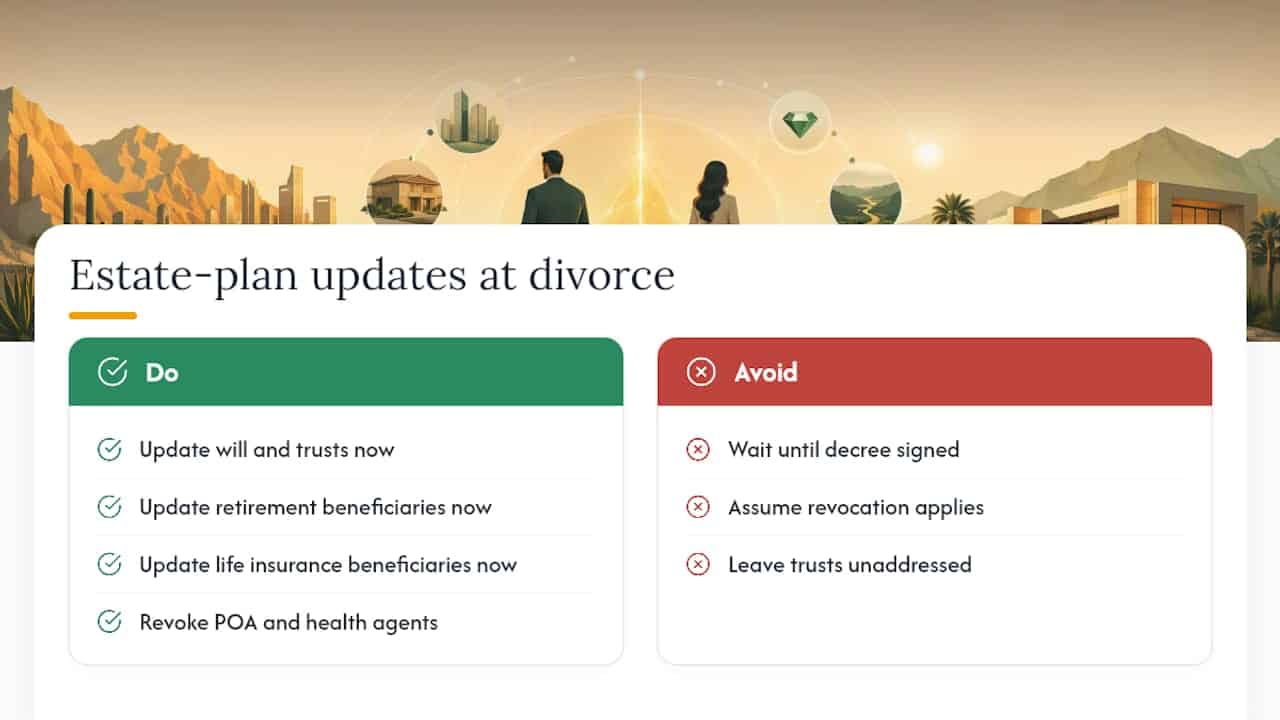
Divorce doesn’t automatically update your estate plan, and that gap creates real risk for high-net-worth spouses. A will, trust, or beneficiary designation written during the marriage often still names the soon-to-be ex-spouse until someone actively changes it.
Life insurance policies, retirement accounts, and payable-on-death bank accounts all use beneficiary designations that operate outside the will. Arizona law revokes some designations to a former spouse automatically after a divorce is finalized, but that revocation doesn’t apply to every account type and doesn’t help at all while the divorce is still pending. If you die mid-divorce, your current beneficiary designations generally control.
Trusts add another layer of complexity. A revocable living trust created during the marriage may need to be restated entirely, particularly if the former spouse was named as trustee, successor trustee, or beneficiary. Irrevocable trusts are harder to unwind, and any trust holding community property will likely need to be addressed as part of the settlement itself, not left for later.
Power-of-attorney and healthcare directive documents deserve the same scrutiny. Many spouses name each other as agents for financial and medical decisions, and those designations stay active until formally revoked, divorce decree or not.
The practical move is to update your will, trust documents, retirement account beneficiaries, life insurance beneficiaries, and power-of-attorney designations as soon as the divorce is filed, not after it’s finalized. Waiting until the decree is signed leaves a window where an outdated document could control a major asset or a life-or-death decision.
Child Custody and Support Issues Specific to High-Asset Divorces
Custody decisions in Arizona hinge on the same “best interests of the child” standard regardless of net worth. What changes in high-asset cases is the complexity surrounding parenting time, private education, and how support calculations interact with income far above the state’s standard guideline chart.
Arizona’s child support formula assumes a certain income ceiling. Above that threshold, judges have discretion to deviate from the standard calculation based on the child’s actual needs and the family’s historical spending on things like private school, specialized medical care, extracurricular travel, or multiple households.
Custody disputes in wealthy families often involve additional complications:
- Extensive travel schedules for work that affect proposed parenting-time plans
- Multiple homes in different school districts or even different states
- Nannies, tutors, or household staff whose schedules intersect with custody logistics
- Disputes over which parent’s residence should serve as the child’s primary home base for school enrollment purposes
Courts also scrutinize whether one parent’s business ownership or investment income should count toward support calculations, since business owners have more flexibility to control how income appears on paper compared to a salaried employee. That’s part of why forensic accounting sometimes extends into the support and custody fight, not just the property division.
Mediation and Alternative Dispute Resolution in High-Asset Cases
Mediation is frequently required or strongly encouraged by Arizona courts, and it tends to control costs far better than litigating every valuation dispute in front of a judge. A skilled mediator can help both sides narrow disagreements over business value, spousal maintenance, or asset division without the expense of a multi-day trial.
That said, mediation works best when both spouses have already completed enough discovery to negotiate from accurate numbers. Mediating before a business valuation or forensic accounting review is complete often produces a settlement based on guesswork, which tends to unravel or get challenged later.
Collaborative divorce is a related option where both spouses and their attorneys commit in writing to resolving the case without going to court, often bringing in neutral financial and valuation experts shared by both sides rather than duplicating that cost. Arbitration sits somewhere between mediation and litigation: a private arbitrator issues a binding decision, which can be faster than court but still requires each side to present evidence and arguments.
For high-asset couples who want privacy, control over timeline, and lower legal fees, exploring whether mediation is worth it before committing to full litigation is worth the conversation with your attorney. Complex estates don’t have to mean a courtroom fight on every issue. Many end up litigating only the one or two points that can’t be resolved through negotiation.
Enforcement Challenges and Post-Divorce Modifications
A signed decree doesn’t guarantee compliance, and high-asset estates create more opportunities for a spouse to delay or dodge their obligations. A business owner who controls cash flow can structure income to minimize support payments. A spouse awarded a buyout can simply stop paying installments.
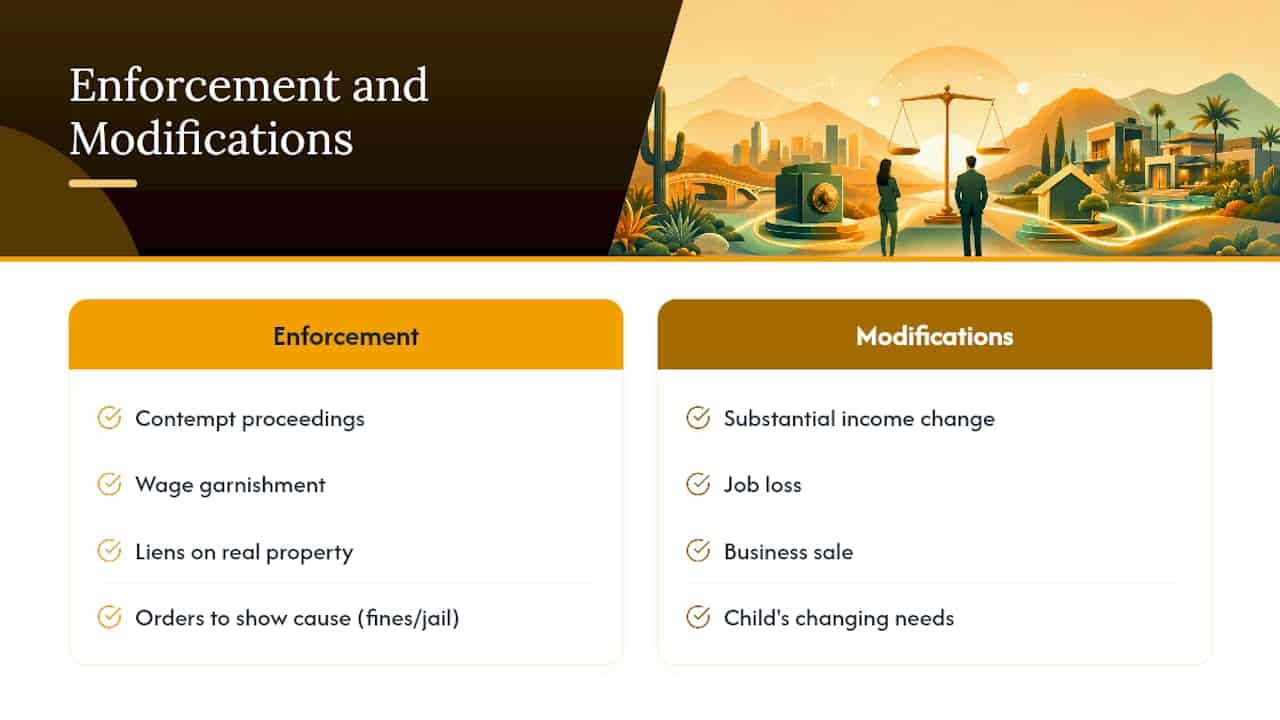
Enforcement tools in Arizona include contempt proceedings, wage garnishment, liens against real property, and, in serious cases, orders to show cause that can result in fines or even jail time for willful noncompliance. Retirement account divisions enforced through a QDRO carry their own separate compliance mechanism, since the plan administrator, not the ex-spouse, controls the actual transfer.
Post-divorce modifications become relevant when circumstances change significantly. A substantial change in either spouse’s income, a job loss, a business sale, or a child’s changing needs can justify revisiting spousal maintenance or child support. Property division itself is typically final and not subject to modification once the decree is entered, which is exactly why getting the valuation and division right the first time matters so much more in a high-asset case than in a standard one.
Complex estates are also more likely to surface post-decree disputes over hidden assets discovered after the fact. If evidence emerges that a spouse concealed assets during the original discovery process, Arizona courts can reopen specific portions of the settlement, though that process requires strong documentation and isn’t a routine remedy.
What High-Asset Divorce in Arizona Actually Requires
Most high-asset divorces don’t fall apart over the law. They fall apart over incomplete records, rushed valuations, and spouses who assume a “fair” split is obvious when it never is once tax consequences and liquidity enter the picture. The couples who come out of this process with a settlement that actually holds up are the ones who treated discovery and valuation as the real fight, not a formality on the way to a hearing.
What gets underestimated most often is how much a mismatched expert team costs a case. A generalist appraiser who doesn’t understand enterprise versus personal goodwill, or a forensic accountant unfamiliar with how business owners hide cash flow, can cost a spouse far more than their fee. Assembling the right team early, before positions harden, tends to save both money and leverage later.
At High Desert Family Law Group, that team-based approach, built over more than 20 years of family-law practice in Scottsdale, is the foundation of how complex estates get handled: coordinating valuation experts, forensic accountants, and QDRO specialists from the start rather than scrambling to add them mid-case. Bring bank statements, tax returns, business records, and a list of your major assets to your first consultation. That preparation alone puts you ahead of most spouses walking into a high-asset case for the first time.
How High Desert Family Law Group Can Help With Your Case
This practice is an alternative to a generalist practice for high asset divorce in Arizona. Unlike firms that treat a business valuation dispute the same way they’d handle a straightforward asset split, this practice builds a coordinated team around each case, with experts working alongside your attorney from day one instead of being added after positions have already hardened.

That coordination matters most in the areas covered above: characterizing separate versus community property, valuing a business without letting the wrong method undervalue it, and structuring spousal maintenance or a buyout so the tax consequences don’t erase the benefit. Whether your case calls for mediation to control costs or a full litigation strategy because a spouse is hiding assets, the approach adjusts to what the estate actually requires.
The first step is a confidential consultation. Bring your financial statements, tax returns, and a rough list of marital assets, and review the types of family lawyers and services available to figure out which approach fits your situation before you commit to a strategy.
Quick Reference: Arizona Statutes and Court Resources
Start with Arizona Revised Statutes Title 25 for community property rules, then check Arizona Courts’ family law forms and Maricopa County’s filing packets for your paperwork, plus the DOL’s QDRO guide for retirement division.
This article is general information, not a substitute for advice from a qualified lawyer. Consult a qualified legal professional about your own circumstances before acting on anything here.
Sources
- Arizona Courts — Family Law Forms
- Maricopa County Superior Court — Family Law Forms
- DOL — QDROs: A Practical Guide