



What Post Nup Agreements Actually Are (And Why They Matter)
Post nup agreements are legal contracts signed by married couples that define how assets, debts, and financial rights will be handled if the marriage ends in divorce or separation.
Here’s a quick overview:
| Question | Quick Answer |
|---|---|
| What is it? | A written financial contract signed after marriage |
| Who signs it? | Both spouses, voluntarily |
| What does it cover? | Property, debt, spousal support, inheritance |
| What can’t it cover? | Child custody or child support |
| Is it legally binding? | Yes, if it meets your state’s legal requirements |
| When can you sign one? | Anytime after the wedding — days, years, or decades later |
Many couples assume that if they didn’t sign a prenup before the wedding, they’ve missed their chance to protect their finances. That’s not true.
A postnuptial agreement gives married couples a second window — one they can use right now, regardless of how long they’ve been married.
Whether your financial situation has changed, you’re navigating a rough patch, or you simply want more clarity around money and assets, a postnuptial agreement can be a practical and powerful tool.
What is a Postnuptial Agreement?

At its core, a Postnuptial agreement is a contract entered into by spouses after they have already said “I do.” While the most common reason people think of these documents is divorce, they are actually versatile tools for financial transparency and marital harmony.
Historically, post nup agreements were a legal impossibility. Under the old English common law doctrine of “marital unity,” a husband and wife were considered a single legal entity. Since you cannot enter into a contract with yourself, spouses couldn’t sign agreements with each other. It wasn’t until the latter half of the 20th century—specifically gaining broad acceptance in the 1970s—that these agreements became widely recognized in the United States. This shift was largely driven by the rise of no-fault divorce laws and a changing social landscape that viewed marriage more as a partnership between two independent individuals.
When we look at the Prenup vs Postnup debate, the primary difference is simply timing. However, that timing changes the legal lens through which a court views the document.
| Feature | Prenuptial Agreement | Postnuptial Agreement |
|---|---|---|
| Timing | Signed before the wedding | Signed after the wedding |
| Legal Status | Heavily favored by courts | Scrutinized more closely |
| Relationship | Arms-length (fiancés) | Fiduciary (spouses) |
| Common Trigger | Marriage preparation | Financial change or reconciliation |
In Arizona, we treat these as valid contracts, but because the parties are already married, the law assumes they owe each other a higher level of “good faith.” We aren’t just two people making a deal; we are partners in a marriage with a legal duty to be fair to one another.
Key Differences in Post Nup Agreements
The most significant hurdle for post nup agreements compared to prenups is the concept of fiduciary duty. Once you are married, you have a legal obligation to act in the best interest of your spouse. This means that if we are drafting a postnup, we have to be incredibly transparent. If one spouse hides a “secret” investment account or pressures the other to sign a one-sided deal, an Arizona judge is much more likely to toss the agreement out than they would be with a prenup.
Courts apply “strict scrutiny” to these documents. They want to ensure that the agreement wasn’t signed under duress or because one spouse was in a vulnerable position. This is why the question of How Long After Marriage Can You Get a Postnuptial Agreement? is so common. The answer is: anytime. You could be married for 20 minutes or 20 years. However, the longer you’ve been married and the more your assets have mingled, the more complex the drafting becomes.
According to What Is a Postnuptial Agreement? How It Works and What’s Included, these agreements are often used to define “separate” versus “marital” property in ways that state law might not automatically do. This is especially vital in community property states like Arizona, where the default is often a 50/50 split of everything earned during the marriage.
Essential Elements of Post Nup Agreements
What actually goes into these documents? It’s more than just “who gets the house.” A well-crafted agreement acts as a comprehensive financial roadmap.
- Property Division: We can decide exactly which assets remain separate property (like a business you started before marriage) and which are community property.
- Spousal Maintenance: Also known as alimony. You can agree on a specific amount, a formula, or even waive it entirely, provided the waiver isn’t “unconscionable” (grossly unfair) at the time of divorce.
- Marital Debt: If one spouse decides to go back to medical school or starts a business that racks up significant debt, post nup agreements can ensure that debt stays with the person who incurred it.
- Inheritance Rights: If you want to ensure that your children from a previous marriage receive a specific family heirloom or property, a postnup can override standard inheritance laws.
For a deeper dive into these provisions, the Postnuptial Agreement Guide – Lawble provides an excellent framework for how these clauses are structured. At High Desert Family Law Group, we focus on Postnuptial Agreements that are tailored specifically to Arizona’s unique community property statutes.
What Cannot Be Included in Post Nup Agreements
There are some things that even the most expensive lawyer cannot put into a postnup. The law protects certain individuals—specifically children—from being signed away in a contract.
- Child Custody: You cannot pre-determine who gets the kids. In Arizona, custody (legal decision-making and parenting time) is always decided based on the “best interests of the child” at the time of the split. A judge will not care what you signed five years ago if it doesn’t serve the child’s needs today.
- Child Support: Similar to custody, you cannot waive or limit child support. Every child has a legal right to financial support from both parents, and parents cannot contract that right away.
- Illegal Acts or Lifestyle Requirements: You generally cannot include “lifestyle clauses” that are deemed against public policy. While some states allow “infidelity clauses” (financial penalties for cheating), Arizona courts are often hesitant to enforce “no-fault” penalties in a way that looks like a punishment.
- Routine Marital Regulation: You can’t use a postnup to mandate who does the dishes or how many times a week you visit the in-laws. Courts deal with “dissolution” (divorce), not “micro-management” of your daily life.
As noted by Postnuptial agreements, any provision that encourages divorce or is deemed “unconscionable” will likely be struck down by a judge.
Why Couples Choose Postnuptial Protection

Why would a happy couple suddenly want a legal contract? It’s usually not about expecting a divorce; it’s about responding to a change in life circumstances.
Business Ownership: This is a big one for our Scottsdale and Chandler clients. If you start a business during the marriage, that business is generally considered community property. If you want to ensure the business stays under your control and isn’t liquidated in a divorce settlement, a postnup is essential.
Inheritance Protection: Imagine you receive a $500,000 inheritance from your grandmother. In Arizona, inheritances are separate property—until you deposit them into a joint savings account. Once you “commingle” those funds, they often become community property. A postnup can “ring-fence” that inheritance, keeping it yours even if you use some of it for a down payment on a joint home.
Stay-at-Home Parent Security: If one spouse leaves a high-paying career to raise children, they are taking a massive financial risk. A postnup can provide them with a “safety net,” guaranteeing a certain level of spousal support or a larger share of assets to compensate for their lost earning years.
Infidelity and Rebuilding Trust: Sometimes, a postnup is a tool for reconciliation. If one spouse has been unfaithful, they might offer a postnup with favorable financial terms to the other spouse as a way of saying, “I am committed to this marriage, and I’m willing to put my money where my mouth is.”
Of course, these benefits come with a price tag. When looking at Postnup Cost and the general Cost of Postnuptial Agreement, it’s important to remember that you are paying for the “peace of mind” and the avoidance of a $50,000+ litigated divorce down the road.
Financial Planning and Post Nup Agreements
We often tell our clients to view post nup agreements as a part of their overall estate and financial plan, much like a will or a trust.
Consider this: According to financial research, only 14% of workers reach specific 401(k) benchmarks that would ensure a comfortable retirement. When a marriage ends, those retirement accounts are often the first things to be split. A postnup allows you to protect your retirement future by agreeing on how those accounts will be handled.
Wealth preservation isn’t just for the ultra-rich. As Prenuptial and Postnuptial Agreements: What Every Couple Should Know points out, these agreements are about “designing your financial future together with clarity.” In a state like ours, understanding Postnuptial Agreement Arizona laws is the first step toward that clarity.
Legal Requirements for Enforceability
For post nup agreements to be worth more than the paper they are printed on, they must meet strict legal standards. In Arizona, a “handshake deal” or a napkin note won’t cut it.
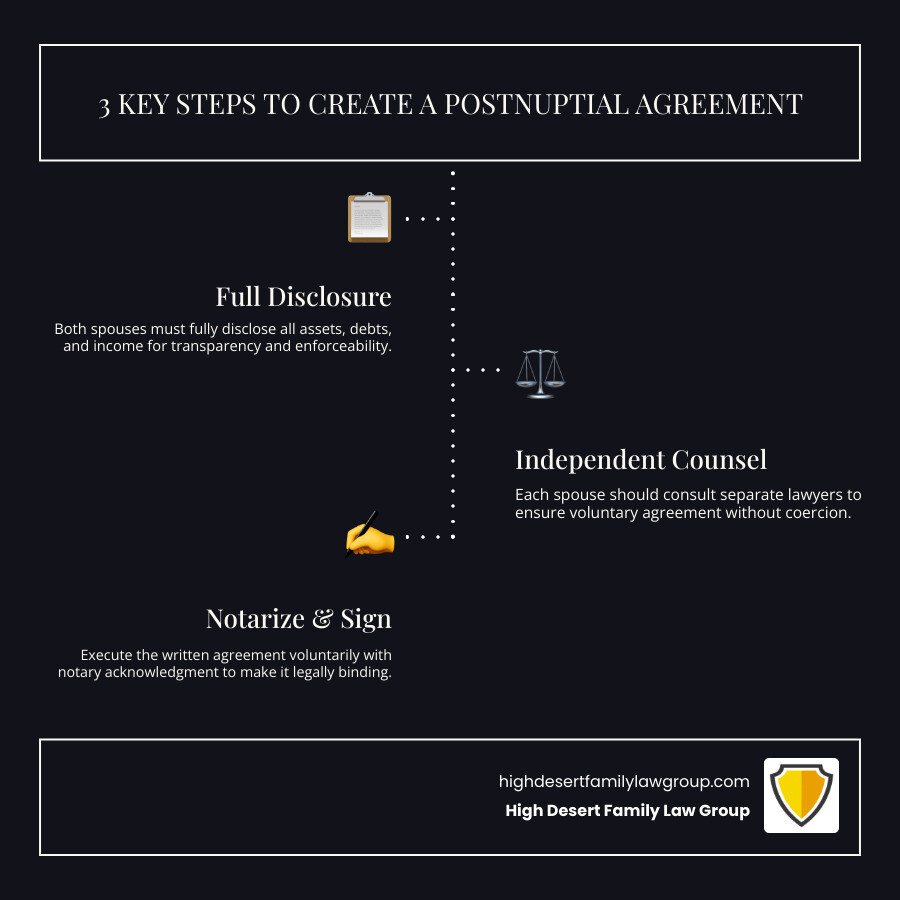
- In Writing: Oral agreements regarding property in marriage are virtually never enforceable. It must be a formal, written document.
- Voluntary Execution: Both spouses must sign the document of their own free will. If one spouse says, “Sign this or I’m taking the kids and leaving tonight,” that is duress, and the agreement will likely be voided.
- Full Financial Disclosure: You cannot hide the ball. Both parties must provide a full and fair disclosure of all assets, debts, and income. If you “forget” to mention a vacation home in Sedona, the whole agreement could be tossed.
- Notary Acknowledgment: While not always strictly required for the contract itself, having the document notarized is a best practice that makes it much harder to challenge the signatures later.
For a detailed look at whether your current or planned agreement holds water, check out Are Postnuptial Agreements Enforceable?.
Grounds for Challenging Post Nup Agreements
Even if you have a signed document, it can still be challenged in court. The most common grounds for a challenge include:
- Coercion/Duress: As mentioned, pressure to sign can invalidate the deal.
- Fraud: Hiding assets or lying about their value.
- Unconscionability: This is a legal term for “so one-sided it shocks the conscience.” If the agreement leaves one spouse with millions and the other on public assistance, a judge will likely intervene.
- Lack of Independent Counsel: This is the big one. If one lawyer drafts the agreement and both spouses sign it without the other spouse having their own lawyer look at it, it’s a red flag. Courts want to see that both parties understood what they were signing.
We are often asked, Can You Do a Postnuptial Agreement Without a Lawyer?. Technically, yes. But it is a very bad idea. Without independent legal advice, the odds of the agreement being overturned significantly increase. As Prenup vs. Postnup: Pros, Cons, and What You Need to Know suggests, judges hold postnups to a higher standard of fairness than prenups specifically because of the existing marriage relationship.
Frequently Asked Questions about Postnuptial Agreements
How much does a postnuptial agreement cost in 2026?
The cost of post nup agreements varies wildly based on complexity. If you and your spouse have one house and two 401(k)s, it will be much cheaper than if you own multiple businesses and international real estate.
Generally, you can expect to pay for the hourly rates of two separate attorneys (one for each spouse). While some services like the New York City Bar Legal Referral Service have historically offered $35 initial consultations to help people find lawyers, the actual drafting and negotiation usually range from a few thousand to several thousand dollars. You can find more specifics on our Postnup Cost page.
Can a postnup be used to save a marriage?
Absolutely. We often see couples who are on the brink of divorce because of “money fights.” By creating a postnup, they remove the “what if” from the equation. When the financial stakes are settled, the couple can focus on the emotional work of the marriage. It provides a sense of security and clarity that can actually prevent a split. We call this Postnuptial Agreement vs Divorce—choosing the contract to avoid the court.
Does Arizona law recognize postnuptial agreements?
Yes, Arizona recognizes them, but with caveats. Because Arizona is a community property state, the law starts with the assumption that everything is split 50/50. A postnup is essentially an agreement to opt-out of those default laws.
Arizona courts are particularly wary of agreements signed “in contemplation of divorce.” If you sign a postnup on Monday and file for divorce on Tuesday, the court might view it as a separation agreement rather than a postnuptial agreement, which involves different legal standards. We always ensure our clients meet the Postnuptial Agreement Arizona standards to ensure their interests are protected.
Conclusion
At High Desert Family Law Group, we believe that post nup agreements are not about planning for failure—they are about planning for reality. Whether you are in Scottsdale, Chandler, or anywhere in the Greater Phoenix area, our team provides aggressive, individualized representation to ensure your assets are protected and your future is secure.
You don’t have to navigate these complex waters alone. Our four-person team is dedicated to providing the clarity and protection you need, whether you’re just starting your marital journey or have been together for decades.
Secure your future with a Postnuptial Agreement today by reaching out to us for a consultation. It’s better late than never.