



A spousal maintenance order is a court directive requiring one spouse to pay financial support to the other after a divorce or legal separation in Arizona.
Here is a quick overview of how it works:
| Topic | Key Point |
|---|---|
| What it is | Court-ordered financial support from one spouse to the other |
| Who can get it | A spouse who lacks property, earning ability, or gave up career opportunities |
| How the amount is set | Arizona’s Spousal Maintenance Guidelines and an official calculator |
| How long it lasts | Typically 12 to 96 months; longer in some cases under the Rule of 65 |
| When it ends | Remarriage, death, or the date set in the order |
| Can it be changed? | Yes, if circumstances change substantially — unless the order is non-modifiable |
If you are going through a divorce in Arizona right now, the rules around spousal maintenance can feel overwhelming. The law changed significantly in 2022, and again in 2023 and 2025, shifting from broad judicial guesswork to a structured, formula-driven process. The goal under Arizona law is clear: support should only last as long as it takes the receiving spouse to become self-sufficient — not indefinitely, and not arbitrarily.
This guide walks you through everything — from eligibility and how the calculator works, to how orders are modified or terminated.
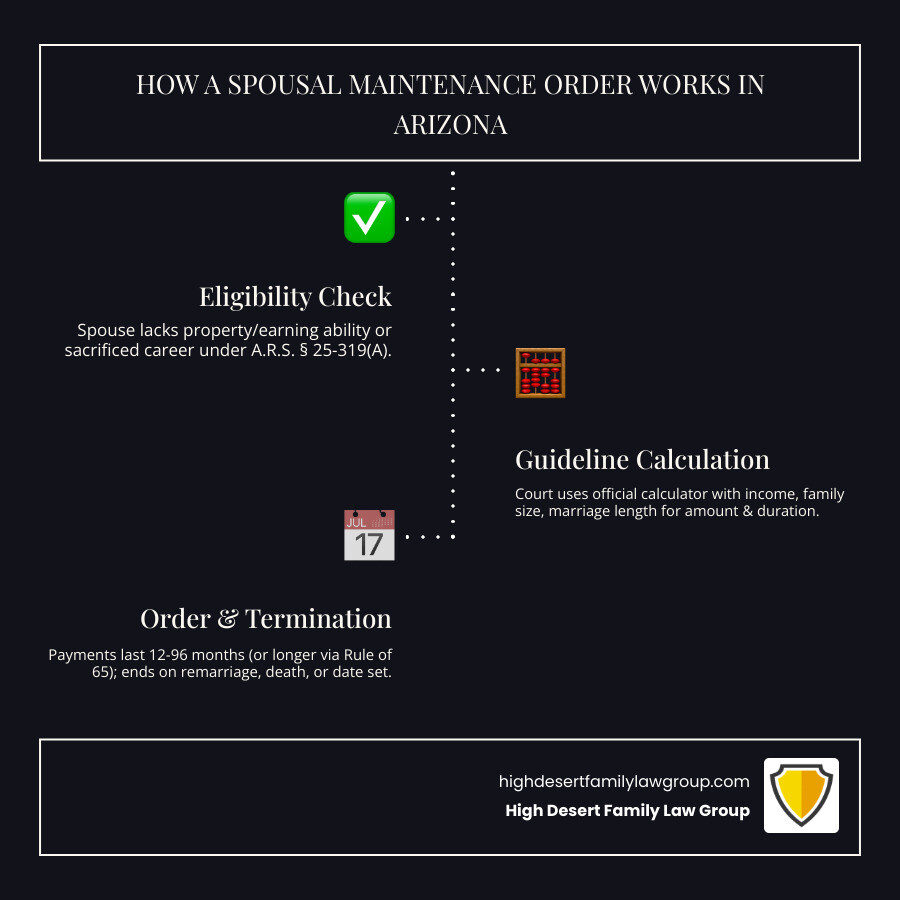
What a Spousal Maintenance Order Means in Arizona
In Arizona, spousal maintenance is governed primarily by A.R.S. § 25-319. It can apply in a dissolution of marriage or a legal separation. In plain English, it is money one spouse may be ordered to pay the other to help meet reasonable needs after the relationship legally changes.
Arizona is a no-fault divorce state, and that matters here. The court does not award or deny maintenance because one spouse was “the bad guy.” Marital misconduct is excluded from the analysis. So no, being annoying at Thanksgiving is not a legal factor.
What is spousal maintenance in Arizona?
Spousal maintenance is Arizona’s formal legal term for what many people still call alimony. It is financial support paid by one spouse to the other, with the purpose of helping the receiving spouse become self-supporting when possible.
Arizona law is gender-neutral. Either spouse can request support. The court looks at finances, earning ability, and statutory factors, not traditional stereotypes.
If you want a broader overview, see our page on Alimony In Arizona.
Eligibility vs entitlement to a spousal maintenance order
This is one of the most misunderstood parts of Arizona family law.
- Eligibility means a spouse meets at least one of the legal threshold grounds under A.R.S. § 25-319(A).
- Entitlement means the court and the guideline calculation support an actual award of maintenance in a certain amount.
A spouse can be eligible and still receive less than expected, or even no meaningful amount, depending on the calculator result, income data, and the facts of the case. Eligibility gets you in the door. Entitlement helps determine what happens once you are inside.
Arizona’s current guideline system also separates amount from duration in an important way. Courts may deviate from the amount in some cases, but duration is generally tied to the guideline ranges.
Who qualifies under A.R.S. § 25-319(A)?
A spouse may qualify for maintenance if any of the following applies:
- The spouse lacks sufficient property to provide for reasonable needs.
- The spouse lacks earning ability in the labor market to be self-sufficient.
- The spouse is the custodian of a child whose age or condition makes outside employment inappropriate.
- The spouse contributed to the educational opportunities, training, career, or earning ability of the other spouse.
- The marriage was long, and the spouse is of an age that may preclude becoming self-sufficient.
That does not mean the court automatically orders support. It means the spouse may legally qualify to ask for it.
For a deeper look at threshold qualification issues, visit our Alimony Qualifications page.
Statutory factors the court weighs after eligibility
Once eligibility is established, the court looks at the statutory factors in A.R.S. § 25-319(B), along with the Arizona Guidelines. These include:
- The standard of living during the marriage
- The duration of the marriage
- The age, employment history, earning ability, and physical and emotional condition of the spouse seeking support
- The paying spouse’s ability to meet both their own needs and the other spouse’s needs
- Comparative financial resources
- Contributions to the other spouse’s earning capacity
- Career or educational sacrifices made for the other spouse
- The extent to which one spouse reduced income for the benefit of the other
- The ability of both spouses to contribute to children’s future educational costs
- The financial resources of the spouse seeking maintenance
- The time needed for education or training
- Excessive or fraudulent spending or disposition of property
- Health insurance costs and certain criminal damages or judgments
You can review the statute directly here: 25-319 – Maintenance; guidelines; computation factors.
How Arizona Calculates a Spousal Maintenance Order
Arizona now uses formal guidelines and a calculator to create more predictable outcomes. That is a major shift from the old days, when results could depend more heavily on which courtroom you were in.

How the Arizona Spousal Maintenance Guidelines set the amount
The Arizona Supreme Court adopted spousal maintenance guidelines after the legislature amended the law effective September 24, 2022. The guidelines were first implemented in 2023 and later updated in 2025.
The purpose is to:
- Encourage self-sufficiency
- Improve consistency
- Increase predictability
- Help parties settle cases with more realistic expectations
The court uses the official worksheet and calculator to generate an amount range. That range is based on guideline inputs rather than pure discretion. For the current court resources, see the Spousal Maintenance Guidelines – Arizona Judicial Branch.
What the Spousal Maintenance Calculator considers
The calculator focuses on several key inputs:
- Each spouse’s actual income
- Any attributed income
- Family size
- Length of the marriage in months
- Mortgage principal payments
- Certain property-related income assumptions
- A low-income threshold that can result in a zero award
The guidelines are data-driven and use household spending concepts drawn from expenditure data. In some low-income cases, if combined annual income is at or below a very low threshold tied to state minimum wage, the calculator may produce no maintenance award.
How family size is determined
Family size is not just “how many people live in the house.”
For calculator purposes, family size generally includes:
- The two spouses
- Common children of the marriage
- In some cases, children from prior relationships if a legal duty of support exists and support is actually being paid
The support obligation must be real, not hypothetical. The maximum family size used in the expenditure tables is five.
This matters because family size affects the household expenditure assumptions built into the guideline model.
What counts as Actual Income and what is excluded
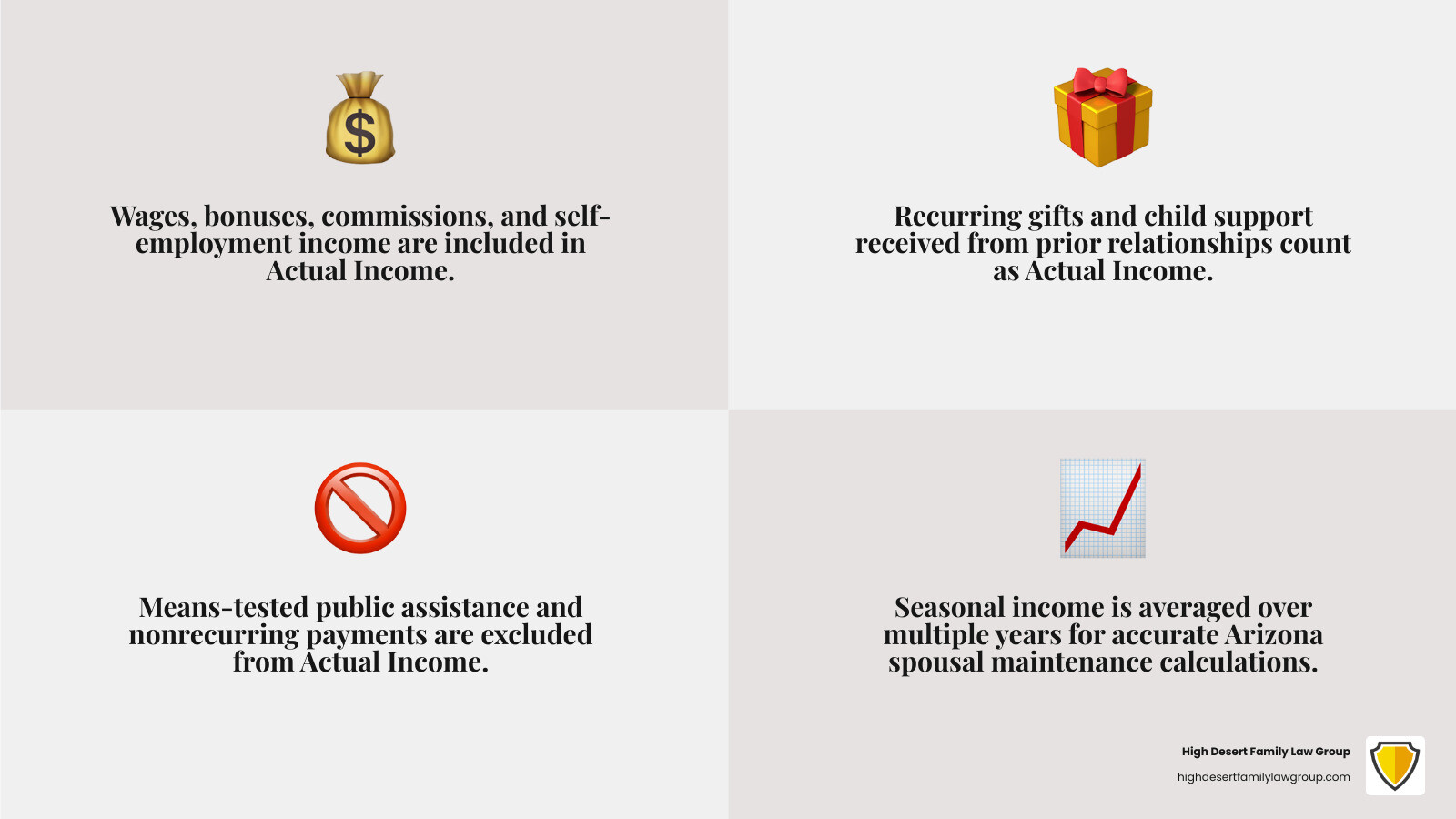
“Actual Income” is broader than just base salary. It usually includes income from all sources before deductions.
Commonly included income can include:
- Wages and salary
- Bonuses
- Commissions
- Tips
- Self-employment income
- Recurring gifts
- Child support received for a child from another relationship, in some circumstances
- Certain retirement distributions
- Trust or investment income
Common exclusions can include:
- Means-tested public assistance
- Some nonrecurring or unusual payments
- Income that would create unfair double counting in specific business valuation situations
A few practical notes:
- Seasonal or fluctuating income may be averaged over more than one year.
- Self-employment income requires careful review because personal expenses run through a business can distort the number.
- Retirement assets may count differently depending on age, access, and whether attribution rules apply.
When income is attributed to a spouse
A court may attribute income when a spouse is unemployed or underemployed without a legally sufficient reason. The idea is that the court can look at earning capacity, not just current pay stubs.
Factors can include:
- Education
- Work history
- Training
- Available jobs
- Health
- Childcare responsibilities
- Good-faith career choices
- Retirement status
Examples of when attribution may come up:
- A spouse voluntarily quits a decent-paying job during the divorce
- A spouse works far below their skill level without a persuasive reason
- A spouse has reached full retirement age and has accessible retirement income
Examples of when attribution may be limited or inappropriate:
- A spouse is caring for a child whose needs reasonably prevent outside work
- A spouse is making a good-faith educational or career transition
- Serious health problems prevent employment
- Incarceration may prevent wage attribution, though assets or other income may still matter
Key Rules That Affect Amount and Duration
Even with a calculator, several rules can significantly affect the final spousal maintenance order.

Standard duration ranges based on marriage length
Arizona measures marriage length in months, from the date of marriage to the date of service of the dissolution or legal separation petition.
Some key duration ranges from the guidelines include:
- 120 to 192 months of marriage: guideline duration range of 12 to 60 months
- 192 months or more of marriage: guideline duration range of 12 to 96 months
In many cases, that means a typical order lasts somewhere between 1 and 8 years. The court is not authorized to ignore the duration structure and invent a different range simply because it feels fair.
The Rule of 65 and when it applies
The Rule of 65 is one of the most talked-about exceptions in Arizona maintenance law.
It may apply when:
- The spouse seeking maintenance is at least age 42
- The marriage lasted at least 16 years
- The spouse’s age plus the length of the marriage equals at least 65
When those conditions are met, a longer duration may be available in long-term marriage cases. This rule recognizes a simple reality: rebuilding earning power at 25 is different from rebuilding it at 55.
Why mortgage principal matters in the formula
Mortgage principal has a weird but important role in the calculation.
The expenditure tables behind the guidelines do not treat mortgage principal as a normal monthly living expense because principal builds equity. In other words, it is not just money gone forever like a utility bill. It partly becomes ownership.
Because of that, mortgage principal is excluded from the base expenditure tables and then added back separately. Typically, the calculation uses an average monthly mortgage principal amount over the 12 months before filing.
This issue can materially affect the final number, especially in higher-value Scottsdale-area homes.
When the court can deviate from the guideline amount
The court may deviate from the calculated amount if applying the guideline amount would be inappropriate or unjust. But if the court does that, it must make written findings.
Possible reasons may include:
- Abnormal or excessive expenditures
- Fraudulent transfer or marital waste
- Unusual financial circumstances
- Facts not adequately captured by the calculator
Important limitation: Arizona law allows deviation from amount, but not from the guideline duration structure in the same flexible way. That is a big distinction.
Temporary spousal maintenance orders during the case
A spouse can ask for temporary maintenance while the divorce or legal separation is pending. These are often called temporary orders or pendente lite orders.
Temporary maintenance is designed to preserve stability during the case. It does not necessarily control the final order, but it can set the tone for negotiations.
In some filing situations, including certain default decree proceedings without a hearing, a completed spousal maintenance worksheet is required. That makes accuracy especially important even before the final decree is entered.
Changing, Ending, or Locking In a Spousal Maintenance Order
Not every order lasts unchanged until the end date. Some can be modified. Some terminate automatically. Some are locked down by agreement.
How to modify a spousal maintenance order
A modifiable maintenance order can usually be changed only if there has been a substantial and continuing change in circumstances.
Examples might include:
- Significant involuntary income loss
- Retirement
- Serious illness
- Disability
- A major change in the recipient’s financial condition
To seek modification, a party generally files a petition stating facts that show the required change. Updated financial disclosures are also typically required, including Affidavits of Financial Information.
Arizona courts usually retain continuing jurisdiction over modifiable maintenance orders during the term of the award unless the parties agreed otherwise.
If you are dealing with a modification issue, our Spousal Maintenance page is a good place to start.
When a spousal maintenance order ends
Many Arizona maintenance orders end when one of the following happens:
- The date set in the order arrives
- Either spouse dies
- The receiving spouse remarries
The decree can also include additional or more specific termination language. Because wording matters, we always recommend reading the exact order, not relying on memory or hallway advice from a cousin who “once took paralegal classes.”
What non-modifiable spousal maintenance agreements do
Parties can agree that spousal maintenance will be non-modifiable. If that agreement is properly incorporated into the decree, the court generally loses jurisdiction to change it later.
That means:
- The amount may be locked in
- The duration may be locked in
- Future changed circumstances may not matter
Why would someone agree to that?
- Certainty
- Settlement leverage
- Risk management
- Avoiding future litigation
The tradeoff is obvious: certainty can be comforting, but it can also be unforgiving.
The difference between the 2023 and 2025 Arizona Guidelines
The main timeline looks like this:
- Legislative amendments to A.R.S. § 25-319 became effective September 24, 2022
- The Arizona Supreme Court implemented major guideline orders in 2023
- Updated guidelines took effect again on September 1, 2025
The 2023 framework introduced the modern calculator-driven approach. The 2025 update refined the rules, forms, and current filing materials under Administrative Order 2025-101, replacing the earlier 2023 administrative order as the most current guidance.
For cases in May 2026, the 2025 guidelines are the current operational standard unless a court is dealing with an older case under earlier applicable rules.
Common Questions About a Spousal Maintenance Order
Can the court ignore misconduct when issuing a spousal maintenance order?
Yes. Arizona law specifically says maintenance is awarded without regard to marital misconduct. Affairs, cruel texts, laziness, and general romantic chaos are not part of the statutory maintenance analysis.
That does not mean bad conduct never matters anywhere in a divorce. It just means it is not the legal basis for awarding or denying spousal maintenance under A.R.S. § 25-319.
Does the court have to follow the calculator for duration?
Yes, generally. The duration ranges in the guidelines are binding in a way the amount range is not. Courts may deviate from the amount with proper written findings when application would be unjust or inappropriate, but the statute does not give the same free-form deviation authority for duration.
That makes duration disputes especially technical.
Is Arizona’s approach different from other states?
Very much so.
States use very different systems for spousal support. Some states treat support for married but not yet divorced couples differently from post-divorce maintenance. Other states, such as California, use a broader factor-based approach for long-term support decisions, as shown here: Long-term spousal support | California Courts | Self Help Guide.
Arizona’s current system is more structured. It combines statutory eligibility, a formal calculator, amount ranges, and duration rules aimed at self-sufficiency and statewide consistency.
If you want more Arizona-specific reading, you can also explore our related resources:
- Spousal Maintenance
- Alimony In Arizona
- Alimony Qualifications
- Tag/Criminal Conviction And Alimony
- Tag/Spousal Support Planning
Conclusion
A spousal maintenance order in Arizona is no longer a vague, purely discretionary concept. In May 2026, it is a structured legal analysis that starts with eligibility under A.R.S. § 25-319, moves through the Arizona Guidelines and calculator, and ends with an order covering amount, duration, modifiability, and termination.
The biggest takeaways are these:
- Eligibility is not the same as entitlement
- Amount and duration are calculated differently
- Family size, actual income, attributed income, and mortgage principal can all change the result
- The Rule of 65 can expand duration in the right long-term marriage case
- Some orders can be modified, while negotiated non-modifiable orders cannot
- Remarriage, death, and decree language often control termination
At High Desert Family Law Group, we help Scottsdale and Chandler clients look beyond the headline number and focus on the full financial picture. Whether you expect to pay maintenance, receive it, modify it, or negotiate it into a settlement, strategy matters.
For more information or to speak with our team, visit Spousal Maintenance.