


Process Server vs. Sheriff: Who Should Serve Your Arizona Papers?
In Arizona, you can have court papers served by a sheriff’s office or by a certified private process server. Both are legal. For most divorce and custody cases, a private process server is the faster and more flexible choice. The sheriff is a sound option when cost is the main concern, when a court fee deferral applies, or when the court or the type of case points that way. Either way, what counts is valid service and proof of it filed with the court.
This guide compares the two on speed, cost, reliability and rules. It also covers what to do when the other side is dodging service. It is written for people in Scottsdale and the rest of Maricopa County who are starting a divorce or custody case.
TL;DR
- Arizona allows service by a sheriff, deputy, constable or a private process server who is certified and registered with the clerk of the court.
- Sheriff service usually costs less but can be slower. Maricopa County’s sheriff’s office asks you to allow 2 to 3 weeks and requires a $200 deposit unless the court has deferred or waived fees.
- Private servers typically offer evenings, weekends and several attempts, which helps when the other spouse works odd hours or avoids the door.
- Whoever serves, the case cannot move forward until proof of service is filed correctly. A mistake here can cost you weeks.
Table of Contents
- Is a process server the same as a sheriff?
- Who is allowed to serve papers in Arizona
- Process server vs. sheriff: side-by-side
- Speed: why timing matters more than most people expect
- Cost: what the sheriff charges and what to expect from a private server
- When the sheriff is the better choice
- When a private process server is the better choice
- What happens when someone avoids service
- Is the sheriff “trying to serve me papers” a red flag?
- A note on orders to show cause
- How to hire and instruct a server
- Our perspective
- How we can help
- FAQ
- Sources
Is a process server the same as a sheriff?
No, but they do the same job. Service of process means someone who is not part of your case hands a copy of your filed papers to the other party. That is how the court knows the other side has been told about the case and has a chance to respond. A California court guide explains why proof of service matters: the judge cannot properly move forward until it is shown that notice was given. Arizona follows the same principle.
The difference is who they are and what else they do. A sheriff’s civil division is one duty among many for a law enforcement agency. A private process server does this work as a profession. The National Association of Professional Process Servers notes that because service is their only focus, private servers often do better on harder cases.
Neither one can give you legal advice. Their role is to deliver the documents and file proof of service. Questions about your case belong to your attorney, as a sheriff’s civil process guide also points out.
Who is allowed to serve papers in Arizona
Under Rule 4 of the Arizona Rules of Civil Procedure, service must be made by a sheriff, a deputy, a constable, or a private process server who is certified and registered with the clerk of the court. The same rules say the server must meet the registration requirements in Arizona Code of Judicial Administration § 7-204.
Two practical points follow:
- You cannot hand the papers to a friend, and you cannot serve them yourself. The server must be someone who is not a party to the case. A neighbor or relative is not the same as a certified server.
- You can check credentials. The Arizona Supreme Court publishes a Private Process Server Directory. It lists each server’s status, certified county, certification date, expiry date and any disciplinary action. Confirm that the person you hire is active and certified for the county where the papers will be served.
The same rules also let you ask the court for a special appointment of a person to serve process. That is a case-specific tool for unusual situations, not a shortcut. It does not make the person a certified, registered process server.
For the full mechanics of divorce papers specifically, including alternatives when a spouse cannot be found, see our guide on how to serve divorce papers in Arizona.
Process server vs. sheriff: side-by-side
| Factor | Sheriff | Certified private process server |
|---|---|---|
| Who qualifies | Sheriff, deputy or constable | Server certified and registered with the clerk of the court |
| Typical speed | Slower; Maricopa County asks for 2 to 3 weeks | Often a few days, depending on the case and the address |
| Hours | Often weekday business hours | Often evenings and weekends |
| Attempts | Usually limited by office workload | Often multiple attempts in a short window |
| Updates | Often limited until an attempt is complete | Often real-time updates and direct contact |
| Cost | Set by statute; deposits apply | Set by the server; usually higher |
| Best for | Cooperative spouse, tight budget, fee deferral | Time pressure, hard-to-find or evasive spouse, irregular work schedule |
The speed, hours and communication rows reflect what industry resources report in general. Your own results depend on the address, the county and the individual server.
Speed: why timing matters more than most people expect
Sheriff offices handle civil papers alongside their public safety duties. Some say plainly that they do not offer rush or same-day service and may take up to 30 days. One sheriff’s civil process sheet states this outright, although it is from another state. In Maricopa County, the sheriff’s own page asks you to allow 2 to 3 weeks.
Why does that matter in a family case? A few examples:
- A custody dispute with a pending school year or move. Waiting weeks to start the clock can matter.
- A request for temporary orders. The other parent has to be properly served before the court can act on most requests.
- Financial exposure. When you are worried about accounts or property being moved, delays work against you.
A private server who can attempt service at 6:30 a.m. or on a Saturday can close that gap. That is the main reason many attorneys default to private servers.
Cost: what the sheriff charges and what to expect from a private server
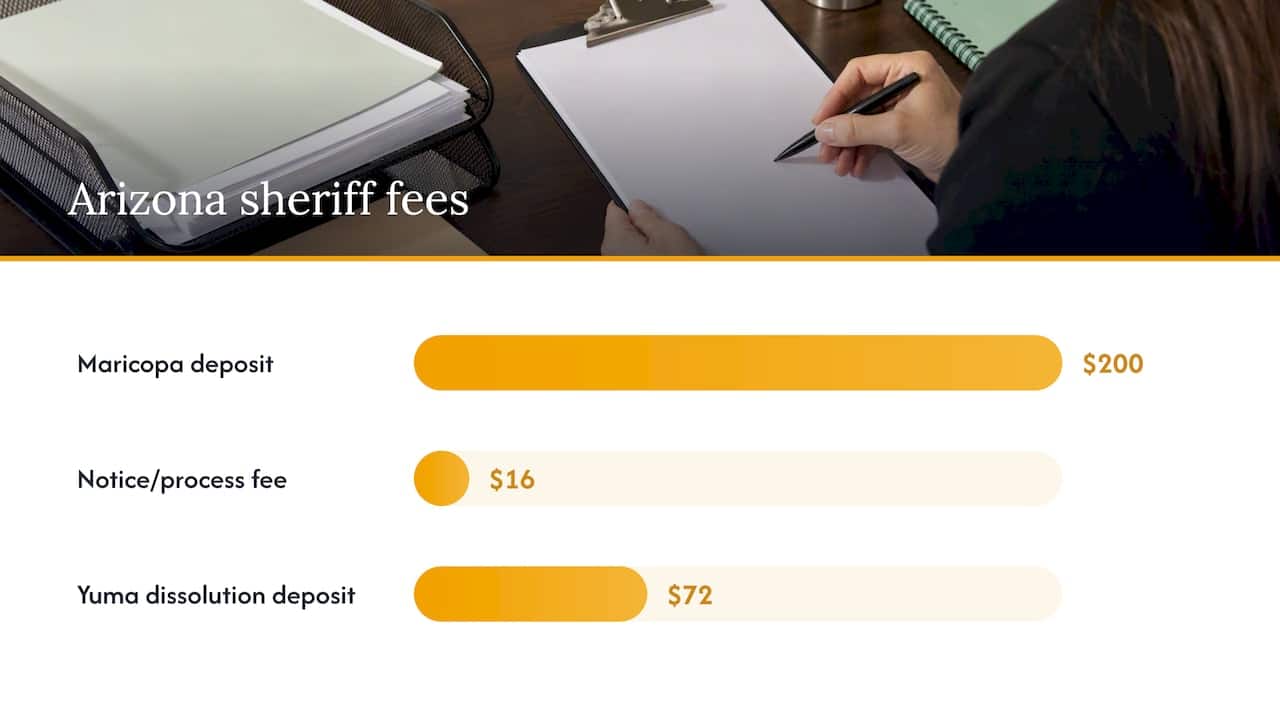
Sheriff fees in Arizona are set by statute, so they are predictable. Maricopa County’s sheriff’s civil process section lists a $200 deposit unless you have a deferral or waiver from the court, plus the original papers for each person to be served and a cover sheet with instructions. The statutory fee schedule on the same page lists $16 for serving a notice, process or order not otherwise provided for. Fees vary by county. As an example, Yuma County’s sheriff lists a $72.00 deposit for a dissolution petition under A.R.S. § 11-445, and no charge for serving orders of protection and injunctions against harassment.
Private servers set their own prices, and rush or difficult service usually costs more. Ask for a quote that spells out the base fee, the cost of additional attempts, and any charge for skip tracing or rush service. We do not quote private server prices here because they vary by provider and change often.
If you are weighing the overall cost of a divorce, service is a small line item. The larger numbers are filing fees and attorney time. Our guides to Arizona divorce costs and fee relief and the Maricopa County divorce filing fee break those down.
If money is the sticking point, remember that a court fee deferral or waiver can affect what the sheriff requires as a deposit. That is one situation where sheriff service often makes the most sense.
When the sheriff is the better choice
We do not treat sheriff service as second best. It fits when:
- Your spouse is cooperative and easy to find. If they work a regular schedule at a known address, the speed advantage shrinks.
- You qualify for a fee deferral or waiver. That can reduce or remove the upfront deposit.
- The case involves an order of protection. In some counties, such as Yuma, the sheriff charges no fee to serve these. Check with the sheriff’s office for your county. If safety is an issue, a sheriff’s deputy can also be the right person to deliver the order.
- There is a safety concern at the address. A uniformed deputy can be better placed to handle a tense situation. Talk to your attorney before choosing.
If you or your children are in danger, call 911. Do not wait on paperwork.
When a private process server is the better choice
Choose a certified private server when:
- The deadline is tight. Your attorney may need the respondent served before a hearing.
- Your spouse is avoiding service. Multiple attempts at different times of day are the best answer to evasion. The NAPPS guidance notes that evenings and weekends can raise the odds for someone avoiding the door or working irregular hours.
- You want to know what is happening. Private servers often update you directly and flag problems early.
- The address is uncertain. Some providers help locate a person. Ask before you hire.
What happens when someone avoids service
People often ask what happens if they do not answer the door for a process server. Not answering does not stop the case. Courts have other options when a person cannot be found or is clearly evading, and your attorney can ask the judge for permission to serve in another way. That request is made in the case, and it needs a record of the attempts already made. This is why a server who logs dates, times and addresses is worth paying for.
If you are the person being served, the practical advice is the reverse. Take the papers, read them, and note the date you received them. The clock for your response starts from service, and ignoring the papers can lead to a default. See an attorney promptly. Our guide on what happens after you serve your spouse divorce papers explains the next steps from both sides.
Is the sheriff “trying to serve me papers” a red flag?
Not by itself. A deputy delivering papers is not an arrest or a criminal matter. The papers may come from a divorce, custody case, small claims action or other civil matter. Read what you were given: the document title and the case number tell you what it is and which court issued it. Calling the police on a server who is doing the job lawfully will not make the case go away. If a server is trespassing or threatening you, that is different, and it is a matter for the police.
A note on orders to show cause
Some readers arrive here after being told about an “order to show cause.” In Arizona family court, this is a court order telling a person to appear and explain why the court should not grant the relief another party has asked for, or why they should not be held to an earlier order. The Arizona statute on orders to show cause covers service and return of such orders in contempt-type proceedings. These orders also need valid service, so the same choice applies: a sheriff or a certified private server. Because they often come with a hearing date, timing usually favors a fast option. If you have received one, or need to file one to enforce a decree, speak with a family law attorney before the hearing date. We help clients with enforcement of court orders.
How to hire and instruct a server
- Get your papers filed first. The server delivers the filed summons and petition, not drafts.
- Gather the details. Full name, a physical address, work address, a description or photo, work hours and vehicles help.
- Verify certification. Look the person up in the state directory.
- Prepare one set per person. The sheriff expects original paperwork for each person to be served, and a cover sheet with instructions.
- Set expectations. Ask for attempt logs and a rough timeline.
- Get the proof of service back and filed. Check the name, date, time and address for errors. A wrong date or missing detail can cause problems later.
For the filing side, see how to file for divorce in Arizona.
Our perspective
We see service as a step where small mistakes cost real time. A petition can be perfect and still sit idle because proof of service was wrong or never filed. Over more than 20 years of family law, we have learned that the right choice depends on the person being served, not on a rule of thumb.
When a spouse is cooperative, the cheaper option often does the job and keeps costs in line with your financial goals. When the other parent is hard to reach or time matters for children, we lean toward a certified private server, because delay in a custody matter can shape what comes next. We also tell clients to avoid improvising: no handing papers off to a friend, and no guessing about whether service counts.
We would rather talk through the choice at the start than fix service later. If you are unsure, bring the question to your consultation.
How we can help
If you are starting a divorce or custody case in Scottsdale or elsewhere in Arizona, we can guide the whole process, including service. Our team handles divorce, uncontested divorce, child custody and enforcement matters, and we plan around your finances and your children’s interests. Contact us through our website to talk through your situation.
FAQ
Can I serve the papers myself in Arizona?
No. Service must be made by a sheriff, deputy, constable or a certified and registered private process server, under Rule 4. You cannot serve your own spouse, and a friend or relative is not a substitute.
Is a sheriff more official than a private process server?
Not in the eyes of the court. A certified private server’s service is just as valid in Arizona when done correctly and proven with filed proof of service. What the court looks at is whether the rules were followed.
How long does sheriff service take in Maricopa County?
The sheriff’s office asks you to allow 2 to 3 weeks. Actual timing can vary with workload and how easy the person is to find. If time matters, ask your attorney whether a private server makes more sense.
What if the sheriff or server cannot find my spouse?
Your attorney can document the attempts and ask the court to allow another method of service. A record of when and where attempts were made helps. Do not stop the case; ask for help early.
Does the process server or sheriff give legal advice?
No. Both are limited to delivering the documents and filing proof of service. Direct your questions about deadlines, responses or hearings to an attorney.
Sources
- Arizona Rules of Civil Procedure, Rule 4
- Arizona Private Process Server Directory
- Maricopa County Sheriff’s Office: Civil Process
- Yuma County Sheriff’s Office: Civil Department
- NAPPS: Why Choose a Process Server Over a Sheriff
- Greenville County Sheriff’s Office: Civil Process
- California Courts: What Is Proof of Service?
- A.R.S. 12-862: Order to show cause