



Divorce Trial Preparation in Arizona: A Practical Guide

Preparing for a divorce trial in Arizona comes down to five jobs. Know which issues the judge must decide. Build a clean set of evidence. Line up witnesses. File the pretrial paperwork on time. Practice telling your story plainly. Trial is a hearing before a judge, not a jury, and the judge decides only what the parties could not settle. The better organized you are, the easier you make that decision for the court.
This guide walks through what to do, in roughly the order to do it, with the Arizona specifics that generic national articles skip.
TL;DR
- A divorce trial is for the issues you and your spouse could not resolve. The judge decides them, so your job is to prove your side with admissible evidence.
- Read every minute entry and trial notice from the court. They set your deadlines, and in Arizona they usually call for a pretrial statement filed shortly before trial.
- Gathering exhibits is not the same as getting them admitted. Documents must be marked, exchanged and then formally offered to the judge.
- Tell a clear, chronological story built on specific facts. Do not try to win sympathy.
- Before trial, check whether a settlement is still possible. Most cases do not end in a trial.
Table of Contents
- What a divorce trial actually is
- Step 1: Define the disputed issues
- Step 2: Learn your court’s rules and read every order
- Step 3: Get the Arizona pretrial paperwork right
- Step 4: Build your evidence the way a judge will use it
- Step 5: Decide who will testify
- Step 6: Prepare your testimony and your story
- What not to say in divorce court
- A preparation timeline
- Our perspective: preparation is also your best settlement tool
- How we can help
- FAQ
- Sources
What a divorce trial actually is
If you and your spouse cannot agree on every issue, the judge will decide at a trial. That could be property and debt, spousal maintenance, parenting time, or child support, the kinds of relief you ask the judge to grant.
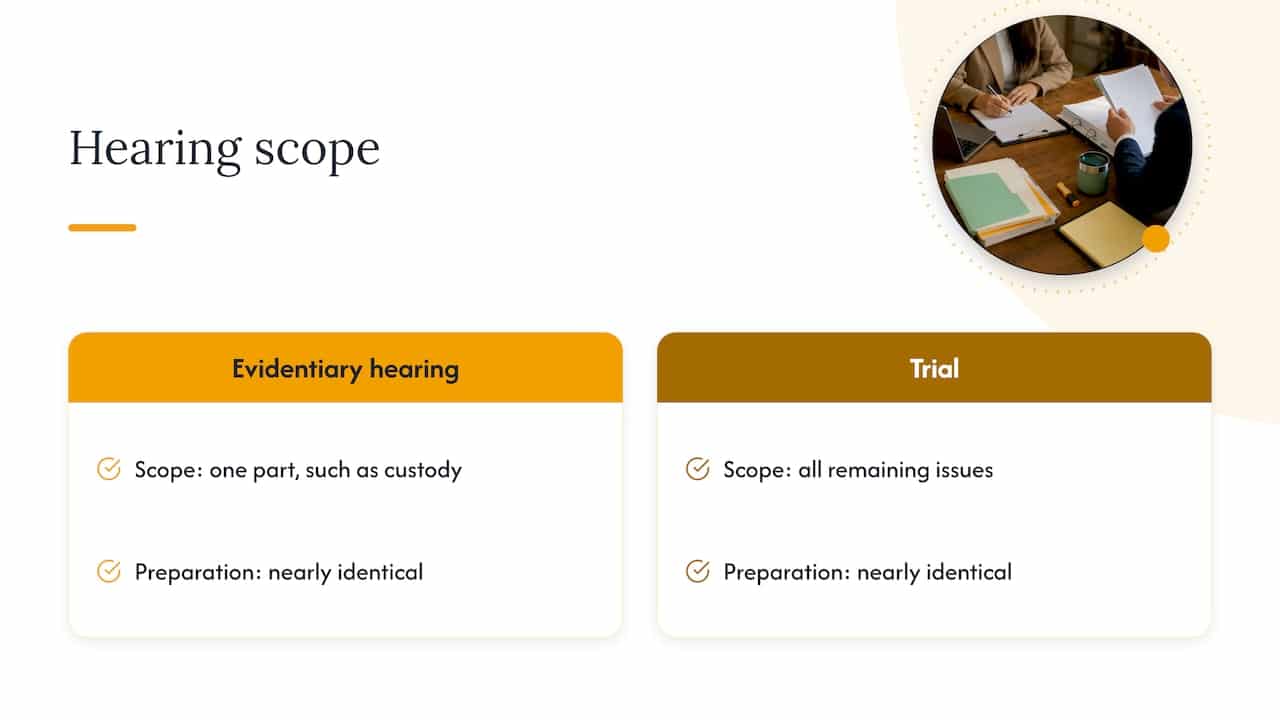
Two terms get mixed up. One self-help center explains that an evidentiary hearing resolves one part of the case, such as custody, while a trial is the final hearing on all remaining issues. The preparation is nearly identical for both. The difference is how many issues you have to prove.
Trials are the exception. A 2021 study of family court cases found that the vast majority of parental separations and divorces are resolved without a trial, and that the cases which do go to trial carry higher financial and emotional costs for families. That is not a reason to skip preparation. It is a reason to prepare early, because strong preparation is also what makes a fair settlement possible.
Step 1: Define the disputed issues
Before you collect a single document, write down what is actually in dispute. Split your case into two lists:
- Agreed issues. Anything you and your spouse already settled, ideally in writing.
- Contested issues. Each one the judge must decide: who lives in the house, how a business is valued, whether spousal maintenance is warranted, the parenting schedule, and so on.
For each contested issue, write one sentence describing what you are asking for and one sentence on why. If you cannot say it in a sentence, you are not ready to say it to a judge.
Then ask which issues are worth trying. Trial is expensive, slow and unpredictable. Our checklist on choosing between settlement and trial in Arizona helps you weigh that honestly.
Step 2: Learn your court’s rules and read every order
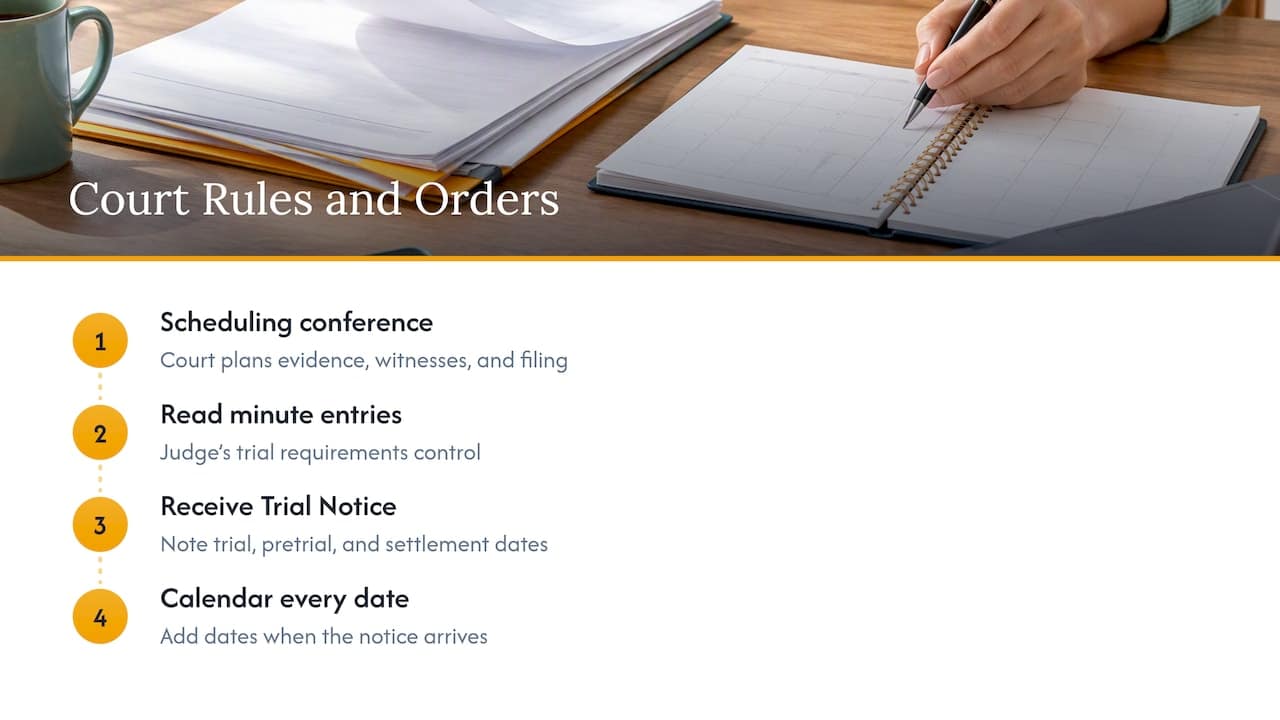
Arizona family courts run on a schedule set by the court, not by you. The Arizona Rules of Family Law Procedure require the court to hold a scheduling conference to plan the trial. That plan covers how evidence is admitted, how witnesses are presented and when a pretrial statement is filed.
Many people miss the most basic instruction. A county self-help packet tells parents to read the judge’s minute entries carefully, because they spell out the requirements for the trial. Those may include a pretrial statement, an exhibit list and a witness list. Judges differ. What your judge ordered controls over any article, including this one.
Pima County’s court packet adds that once the case is ready, the judge issues a Trial Notice with the trial date or final pretrial conference date, the due date for your pretrial statement, and the settlement conference date. Put every one of those dates on a calendar the day it arrives.
Step 3: Get the Arizona pretrial paperwork right
This is where self-represented parties and even prepared clients stumble. Two documents matter most.
Notice of Issues and the pretrial statement
Unless the court orders otherwise, a Notice of Issues is due 20 days before trial and a pretrial statement 5 days before trial. Check your own trial notice, because the judge can set different dates. A Notice of Issues is generally not required before a hearing for temporary orders or another interim hearing.
The pretrial statement is essentially an outline of what will happen at trial, and you can use it during the hearing to keep your presentation on track. It summarizes the facts, the issues and your positions, and it lists your witnesses and exhibits.
Joint or separate
The parties may file a joint pretrial statement or separate ones, as the Cochise County packet explains. Pima County notes that the usual expectation is a joint statement, which means you and the other side must actually confer before the deadline. If that is not possible, the form lets a party explain why a separate statement is being filed.
The practical advice: do not wait until the last week to contact the other side or their attorney. Send your outline early, in writing, and keep a record that you did. If your spouse stalls, that record explains to the judge why you filed separately.
Financial paperwork
The Arizona form also asks for an Affidavit of Financial Information, and the Cochise packet flags it as required in all cases. It also asks each party to confirm that discovery and disclosure are complete and that exhibits and expert reports have been exchanged. Gaps in disclosure are a common reason a judge refuses to consider a document.
Step 4: Build your evidence the way a judge will use it
Good evidence is relevant to a contested issue, genuine, and properly admitted. Work through it issue by issue.
What to gather
| Issue | Typical evidence |
|---|---|
| Property and debt | Bank, retirement and brokerage statements, loan documents, tax returns, titles, appraisals |
| Spousal maintenance | Income records, pay stubs, a budget of monthly expenses, proof of health or work limitations |
| Parenting time and decision-making | Calendars, school and medical records, messages about the children, records of who handles daily care |
| Child support | Income documentation, childcare and insurance costs |
Marking an exhibit is not admitting it
This catches many people. Putting documents in a binder is gathering. The court’s process has more steps: your exhibits are marked with an exhibit number by the clerk, usually about five days before trial, and then you must formally offer them to the judge during trial. Marking alone does not make an exhibit evidence the judge will consider. Confirm the exact timing and procedure with your judge’s orders and your county’s clerk.
Print your texts and emails
Do not plan to hold up your phone. One state court guide says that you should have physical copies for yourself, the judge and the opposing party, and be ready for a witness to authenticate where a message came from. That guide comes from Oregon, so confirm how your Arizona judge handles electronic evidence, but printed, labeled copies are a safe habit anywhere.
Keep the set small
A judge reading 400 pages will remember none of them. For each contested issue, pick the five to ten documents that prove the point and put them in order. Add a one-page index. Highlight only what you will refer to in testimony.
Step 5: Decide who will testify
You are your own first witness. Beyond that, ask of each possible witness: do they have firsthand knowledge of a contested issue, and will they be credible and calm under cross-examination?
Good witnesses tend to be neutral people who saw something specific: a teacher who handled pickups, a coach, a bookkeeper, a financial professional who valued an asset. Weak witnesses are relatives who will say you are a wonderful person. Judges rarely decide a case on character praise.
Tell each witness the date, time and location well ahead. Confirm the week before. If a witness will not come voluntarily, ask early about the court’s subpoena process, since last-minute subpoenas often fail.
Step 6: Prepare your testimony and your story
Your testimony is where preparation shows. Your attorney will conduct a direct examination, asking questions that let you explain your side. Then the other side cross-examines you.
Tell a story that fits the facts
A Michigan Bar Journal article by a trial attorney argues that judges, like all of us, categorize cases quickly using mental frameworks, and that effective preparation means telling a story that fits those frameworks rather than trying to generate sympathy. It also notes that portraying yourself as a victim can backfire. We agree with that from experience: a judge responds to a clear, believable account of what happened, who did what, and what arrangement works going forward.
Practice this way:
- Tell your story in chronological order, once, in under five minutes.
- Replace general statements with dates, amounts and specific incidents. “He was never involved” becomes “He attended two of the last twelve school conferences.”
- Tie every point to what you are asking the judge to order.
- Practice with someone who will interrupt you with hard questions.
On the stand
- Answer only the question asked, then stop.
- If you do not know or do not remember, say so.
- Do not guess at numbers. Say “approximately” and refer to the document.
- Stay respectful about the other parent, even when the question is designed to provoke you.
- Pause before answering cross-examination questions. It slows the pace and gives your attorney time to object.
There is a practical communication tool here too. Practitioners recommend active listening, restating what the other person said to confirm you understood it, to lower reactivity. It is useful in settlement conferences and in the hallway before court, where cases are often settled.
What not to say in divorce court
The answer is simpler than it sounds. Avoid exaggeration, absolutes (“always”, “never”), insults toward your spouse, speculation about what your spouse is thinking, and anything you cannot support. Do not argue with the judge, and do not talk over the other side. Judges forgive nervousness. They do not forgive lost credibility.
A preparation timeline
Your court dates control the real schedule, but this order works well.
| When | What to do |
|---|---|
| As soon as trial is likely | List contested issues, complete financial disclosure, request missing records |
| When the trial notice arrives | Calendar all deadlines, read the judge’s minute entries, begin the pretrial outline |
| About a month out | Draft the Notice of Issues if required, finalize witness list, organize exhibits |
| Two to three weeks out | Send your pretrial statement outline to the other side, confirm witnesses |
| About a week out | Exchange and mark exhibits, finalize copies for the judge and other side |
| Days before | Practice testimony, file the pretrial statement, prepare an opening outline |
| Day of trial | Arrive early, bring copies, dress for court, turn off your phone |
Our perspective: preparation is also your best settlement tool
After more than 20 years in family law, we have found that the clients who do best at trial are the ones who prepared as if trial were certain and stayed open to a good settlement until the end. Those two things do not conflict. When the other side sees organized exhibits, a clear financial picture and a client who tells a steady story, they negotiate more realistically.
We also build every plan around what a client actually wants, whether that is a financial outcome, a parenting schedule that works for the children, or simply a fast and calm finish. Sometimes the right answer is a trial. Often it is a settlement reached because the trial plan was strong. Either way, we think you should walk into the courtroom understanding every document and every question you may face, with no surprises.
One caution we give every client: a trial is not a place to vent. Judges are deciding the future of your finances and your children’s routines, and they respond to evidence and reasonableness.
— Brett
How we can help
If a trial date is set, or you think one is coming, our team can review your case, tell you which issues are worth trying, and prepare the pretrial statement, exhibits and testimony with you. You can read about our divorce and contested divorce services or start with a divorce strategy session. If custody is the main fight, see our child custody page. If you would rather settle, we also handle divorce mediation and collaborative divorce.
FAQ
How do you win a divorce trial?
There is no formula, but the pattern is consistent: identify the issues, prove each one with admissible evidence, present credible witnesses and tell a clear, fact-based story. Meet every deadline, since missed filings can limit what the judge hears. Winning also usually means getting a workable result, not defeating your spouse.
What percentage of divorces go to trial?
A small share. A 2021 study of family courts in Quebec found the vast majority of separations and divorces end without a trial. Figures vary by place and year, and we do not have an Arizona-wide number to cite, so ask an Arizona attorney how cases like yours tend to resolve in your court.
What is the difference between an evidentiary hearing and a trial in a divorce?
An evidentiary hearing is where the judge decides one part of the case, such as custody, after hearing testimony and reviewing evidence. A trial is the final hearing that decides all remaining issues. The Family Law Self-Help Center draws the same line.
When is the pretrial statement due in Arizona?
Unless the court orders otherwise, five days before trial, with a Notice of Issues 20 days before. Your judge’s trial notice sets the dates that actually apply, so follow it. The parties can file jointly or separately.
Sources
- Arizona Family Court Pretrial Statement and Instructions Packet (Cochise County)
- Trial preparation packet (Superior Court of Arizona in Pima County)
- Divorce with Children (Navajo County, Arizona)
- Divorce and Custody Trials in Oregon (Oregon Judicial Department)
- Prepare for your divorce trial (California Courts Self Help Guide)
- Family Law Self-Help Center: The Trial
- Winning Divorce Trials: New strategies for overcoming bias at trial (Michigan Bar Journal)
- Family dispute resolution: Characteristics of cases resolved by trial (2021)