



Arizona Parents: 7 Legal Decision Making Factors, Evidence Checklist

Under Arizona law, legal decision-making is the authority to make non-emergency major decisions for a child, including schooling, medical care, and religious upbringing. A court awards this authority as either sole or joint legal decision-making, based on the child’s best interests under A.R.S. §25-403. If you’re trying to establish or change an order, your next move is either the self-help forms at your county courthouse or a consultation with an Arizona family law attorney.
TL;DR:
- Joint decision-making requires both parents to agree on major issues like education and healthcare, while sole decision-making grants one parent final authority.
- Evidence supporting the child’s relationship, adjustment, health, and cooperation is crucial in court for establishing or modifying custody and decision-making orders.
- Parenting time is always guaranteed unless it endangers the child’s safety, and it is managed separately from legal decision-making authority.
- Cases involving domestic violence or special needs require strong documentation of incidents or care history, which heavily influences court decisions.
- Moving out of state or within 100 miles triggers additional legal steps, with courts scrutinizing the reasons and impact on decision-making and parenting time.
Table of Contents
- Joint Legal Decision-Making Arizona vs Sole: What Each Actually Means
- The A.R.S. §25-403 Best-Interests Factors and How to Prove Them
- Parenting Time vs Legal Decision-Making: They’re Not the Same Order
- How to Establish or Modify a Custody Order in Arizona
- Domestic Violence and Safety: How Abuse Allegations Change the Case
- Preparing Your Case: Documents, Witnesses, and What Judges Ask
- The Court’s Role When Parents Can’t Agree
- How Judges Actually Weigh the Decision-Making Factors
- Moving Out of State: How Relocation Changes Legal Decision-Making
- When Courts Bring In a Guardian ad Litem or CASA
- Legal Decision-Making for Children With Special Needs
- What Thousands of Arizona Custody Cases Have Taught Us
- Get Help With Your Legal Decision-Making Case in Scottsdale
- Sources
Joint Legal Decision-Making Arizona vs Sole: What Each Actually Means
Joint legal decision-making means both parents share the authority to decide on schooling, therapy, doctors, and religious training, and neither parent’s vote automatically outweighs the other’s. Sole legal decision-making means one parent has final say when the two of you can’t agree, though Arizona courts still expect that parent to consult the other on major issues in most arrangements.
Here’s how that plays out in real situations:
- Education: Under joint arrangements, both parents must agree on enrolling a child in a new school or approving an IEP. Under sole authority, one parent decides after disagreement.
- Medical consent: Joint decision-makers typically need to align on elective procedures or long-term medication plans; a sole decision-maker can consent alone.
- Religious training: Courts rarely dictate which faith a child is raised in, but decision-making authority determines who has final say when parents disagree on religious school enrollment or ceremonies.
When joint parents hit a wall, the usual path is mediation or a parenting coordinator before anyone files a motion. What sole authority does not do is let that parent unilaterally rewrite the parenting time schedule. Changing when a child sees each parent requires a separate enforcement or modification action, not just a decision-making order.
The A.R.S. §25-403 Best-Interests Factors and How to Prove Them
Arizona judges don’t decide legal decision-making on gut feeling. A.R.S. §25-403 lists specific factors the court must weigh, and in contested cases, the judge has to make findings on the record for each one that applies. That record matters later. If you ever need to modify custody in Arizona or appeal a ruling, those specific findings are the paper trail everyone points back to.
The core factors, with the kind of evidence that actually moves them:
- The child’s relationship with each parent. School pickup logs, medical appointment attendance, and photos or messages showing day-to-day involvement.
- The child’s adjustment to home, school, and community. Report cards, teacher statements, and counselor notes.
- Mental and physical health of everyone involved. Therapist records or medical documentation, not secondhand claims.
- Which parent is more likely to allow a meaningful relationship with the other parent. Text or email threads showing cooperation or interference.
- Whether either parent has intentionally misled the court about the case.
- Domestic violence or abuse history, which can override other factors entirely.
- Coercive control in the parental relationship.
Pro Tip: Judges respond to recent, specific, and corroborated evidence tied directly to a factor above, not a list of old grievances. A single documented incident from last month usually carries more weight than a pattern you describe from three years ago.
Parenting Time vs Legal Decision-Making: They’re Not the Same Order
Legal decision-making and parenting time get decided separately, even though they show up in the same court case. Decision-making is about authority over big choices; parenting time is the actual schedule of where the child sleeps and who handles daily routines like homework and meals. A.R.S. §25-403.01 also guarantees that a parent without decision-making authority is still entitled to reasonable parenting time, unless the court finds that time would endanger the child.
This split produces arrangements that surprise a lot of parents:
- Joint legal decision-making with an unequal parenting time split, common when one parent travels for work.
- Sole legal decision-making paired with nearly equal parenting time, often when one parent has concerns about decision-making but remains a safe, involved caregiver.
- Supervised parenting time ordered alongside either type of decision-making, usually tied to safety concerns.
Common schedules range from alternating weeks to a 2-2-3 rotation for younger kids. Courts lean toward whatever keeps disruption low for the child’s age and school calendar.
How to Establish or Modify a Custody Order in Arizona
Filing starts at the clerk’s office in your county, and Maricopa County’s Law Library Resource Center publishes the actual petitions, instructional videos, and checklists parents use to start a case without hiring counsel first. You can resolve a case through a consent judgment both parents sign, a default decree if the other parent doesn’t respond, or a full contested hearing when you can’t agree.
The typical sequence looks like this:
- File the petition for legal decision-making, parenting time, or modification.
- Serve the other parent formally.
- Wait for their response (20 days in-state, 30 days if served out of state).
- Attend mediation or a pretrial conference, often court-ordered before trial.
- Go to hearing if mediation fails; the judge issues findings and an order.
- File for enforcement separately if the other parent ignores the order later.
- Uncontested cases often resolve within a few months.
- Contested cases can take several months to over a year, depending on the county’s docket.
- Emergency or expedited relief is available when a child faces immediate danger, and that petition moves on a much faster track than a standard modification.
Domestic Violence and Safety: How Abuse Allegations Change the Case
Significant domestic violence can bar joint legal decision-making outright. Arizona law requires the court to weigh abuse findings heavily, and when the record supports them, the judge must document those findings specifically rather than fold them into a general ruling. That documentation shapes what happens next: supervised parenting time, a protective order, or denial of joint authority to the parent with the abuse history.
If you’re the parent raising these concerns, evidence quality decides the outcome:
- Police reports and incident numbers, even from calls that didn’t lead to an arrest.
- Medical records documenting injuries, with dates.
- Screenshots of threatening messages, saved before they can be deleted.
- Contact with victim services or an advocate who can speak to safety planning.
Courts weigh documented incidents far more heavily than a description of a pattern with no paper behind it. If you’re in immediate danger, safety planning and a protective order petition come before anything related to the custody case itself.
Preparing Your Case: Documents, Witnesses, and What Judges Ask
Walking into a hearing unprepared is the single most common mistake parents make. Judges expect evidence mapped to the statutory factors, not a narrative about who’s the better parent in general terms.
Bring these, organized by date:
- School records and report cards showing the child’s adjustment.
- Medical and therapy records, redacted for privacy where required.
- A parenting calendar or log showing actual time spent with the child.
- Texts or emails documenting communication attempts and responses.
- A draft parenting plan showing what schedule you’re requesting.
Teachers can corroborate school adjustment; therapists can speak to emotional health; a shared babysitter or relative can confirm day-to-day caregiving patterns.
Pro Tip: Answer the judge’s question directly, then stop talking. Rambling into unrelated complaints about the other parent reads as unfocused, and it buries the specific fact the court actually needed.
The Court’s Role When Parents Can’t Agree
A family court judge in a legal decision-making dispute isn’t there to referee every disagreement between parents. The court’s job is narrower: apply the A.R.S. §25-403 factors to the specific facts in front of it and issue an order that reflects the child’s best interests, not either parent’s preference.
Before a case reaches a judge, most Arizona counties require some form of mediation or a settlement conference. That step resolves a substantial share of disputes without a contested hearing, because a neutral third party often gets parents to agree on structure even when they can’t agree on details. When mediation fails, the case moves to a hearing where each side presents evidence and the judge issues a ruling with specific findings on the record.
That record does double duty. It tells the losing party why the ruling went the way it did, and it becomes the baseline for any future modification. A judge revisiting the case in two years doesn’t start from scratch. They compare current circumstances against the findings already on file, which is exactly why vague testimony hurts you now and later.
Judges also retain authority to appoint neutral evaluators, order supervised exchanges, or refer high-conflict cases to a parenting coordinator who helps manage disputes between hearings. The court’s role expands or contracts based on how much the parents can manage on their own. Cooperative parents get a lighter touch; high-conflict cases get more court involvement, more oversight, and more paperwork.
How Judges Actually Weigh the Decision-Making Factors
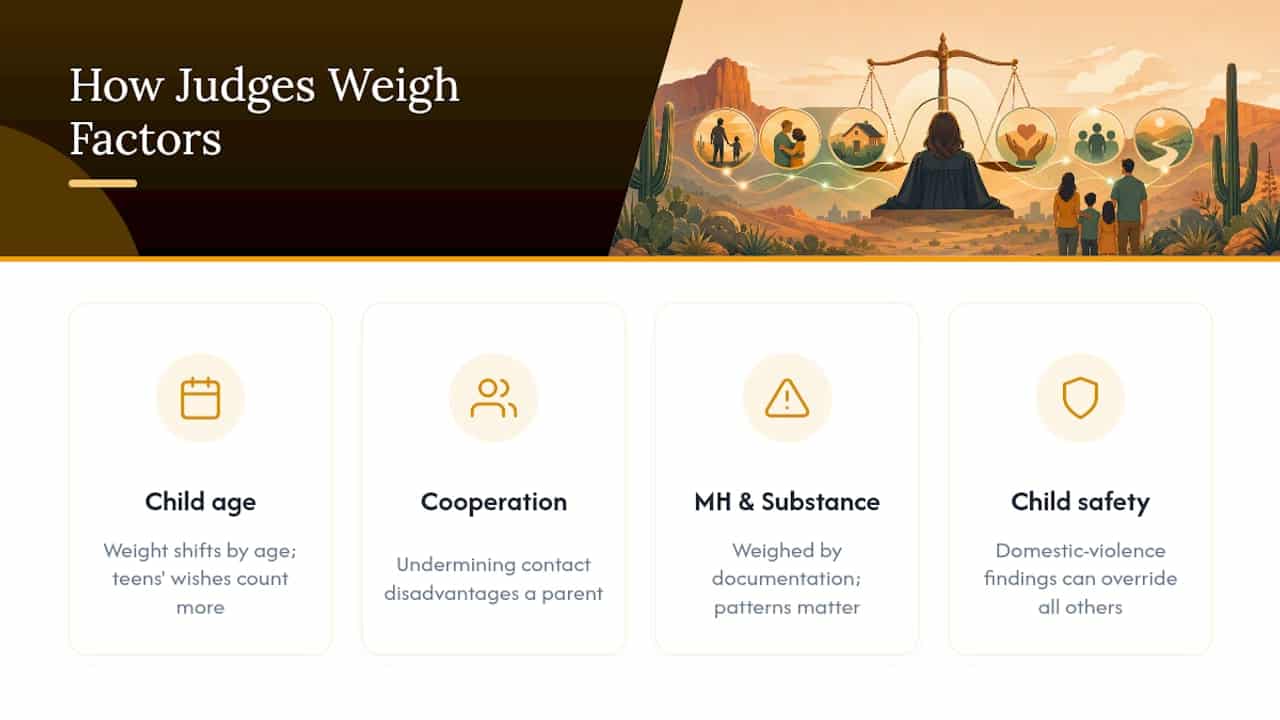
No single factor from A.R.S. §25-403 automatically decides a case. Judges weigh them together, and which factors carry the most weight shifts depending on the child’s age, the family’s history, and what’s actually contested.
For a toddler, adjustment to school and community carries less weight than it does for a teenager already embedded in a specific district with friends and activities. For older kids, courts increasingly consider the child’s own wishes, though a preference alone rarely overrides safety concerns or a documented pattern of poor judgment.
Cooperation between parents matters more than most people expect. A parent who has actively undermined the other’s relationship with the child, through scheduling interference or negative talk in front of the kid, faces a real disadvantage even if every other factor looks neutral. Judges read that behavior as a signal of what joint decision-making would look like in practice, and they don’t want to hand authority to someone likely to weaponize it.
Mental health and substance use factors get weighed against documentation, not accusation. A single incident rarely tips a ruling unless it’s severe; a pattern with dates, records, and corroboration does. And when domestic violence findings are on the table, they can outweigh every other factor combined, because Arizona law treats child safety as the threshold question before the court even reaches the rest of the list.
Moving Out of State: How Relocation Changes Legal Decision-Making
A parental move triggers its own legal process separate from the original decision-making order. If you share legal decision-making and want to relocate more than 100 miles within Arizona, or move out of state entirely, Arizona requires written notice to the other parent at least 45 days before the move. The other parent can object and ask the court to intervene.
Relocation cases get evaluated under a version of the same best-interests framework, but with an added twist: the court has to weigh how the move affects the existing decision-making and parenting time structure. A joint decision-maker moving across the country doesn’t automatically lose authority, but the practical logistics of shared decisions, coordinating school choices from two states away, for instance, often push courts toward reallocating some authority to the parent who stays local.
Courts also scrutinize why the move is happening. A job relocation with a clear economic benefit reads differently than a move that looks designed to distance the child from the other parent. If relocation is contested, expect the same evidence standards from the best-interests factors: employment offers, school comparisons, cost-of-living documentation, and a concrete plan for maintaining the other parent’s relationship with the child despite distance.
If you’re the parent staying behind, don’t wait until the move happens to act. Filing a petition to address relocation before the 45-day window closes preserves your ability to contest it, rather than reacting after the child has already started a new school in another state.
When Courts Bring In a Guardian ad Litem or CASA
In cases involving serious allegations, special needs, or a child too young to express a clear preference, Arizona courts sometimes appoint a Guardian ad Litem (GAL) or a Court Appointed Special Advocate (CASA) to represent the child’s interests independently of both parents.
A GAL is typically an attorney who investigates the family situation, interviews the child, teachers, and caregivers, and submits recommendations to the court. A CASA volunteer performs a similar investigative role but usually in cases involving the dependency or welfare system rather than a straightforward decision-making dispute between parents.
Their involvement changes the dynamic of a case substantially. Instead of two parents presenting competing narratives, the judge now has a third, ostensibly neutral, voice weighing in on what the evidence actually shows. That recommendation carries real weight, since it comes from someone with no stake in the outcome. Parents preparing for a case with a GAL involved should expect a home visit, direct interviews, and requests for the same kind of documentation described earlier: school records, medical notes, and communication logs.
Not every case gets one. Appointment is discretionary, and courts reserve it for disputes where the child’s voice or welfare needs independent representation beyond what either parent’s attorney can provide.
Legal Decision-Making for Children With Special Needs

A child with a disability or significant medical condition changes what “best interests” looks like in practice, and it changes what evidence matters most. Medical decision-making authority carries more weight when a child has ongoing treatment needs, specialized therapies, or an Individualized Education Program (IEP) that requires consistent parental engagement with the school.
Courts pay close attention to which parent has historically managed medical appointments, therapy schedules, and IEP meetings, because that history often predicts who can realistically continue managing complex care going forward. A parent who has attended every IEP meeting and coordinated every specialist appointment has a documented track record that speaks louder than intentions.
Joint decision-making can work for families with a special needs child, but it requires more explicit coordination language in the order itself, sometimes specifying who handles school-related decisions versus medical decisions if the parents’ strengths differ. Sole decision-making gets requested more often in these cases, not because joint arrangements fail by default, but because the stakes of a missed decision or delayed consent can be higher for a child with complex medical needs.
If your child receives disability services, bring documentation of every provider, every IEP or 504 plan, and a clear account of which parent has handled that coordination. That record does more to establish a workable custody arrangement than general statements about which parent loves the child more.
What Thousands of Arizona Custody Cases Have Taught Us
Cases rarely fail because the law was unclear. They fail because a parent shows up with a narrative instead of a record. High Desert Family Law Group has handled thousands of custody and legal decision-making matters across Scottsdale and the surrounding area over more than 20 years, and the pattern holds regardless of the specifics: judges rule on documented facts mapped to the statutory factors, not on who sounds more frustrated.
Cooperative cases move fastest when both parents agree to mediation early and draft a parenting plan before a hearing gets scheduled. Contested cases demand a tighter evidence strategy from day one. Safety-first cases, where abuse or violence is alleged, require immediate documentation and protective filings before anything else. Matching your first move to your case type saves months.
Get Help With Your Legal Decision-Making Case in Scottsdale
If you’re staring down a first filing, a contested hearing, or a modification because the other parent moved or stopped following the order, you don’t have to map the statutory factors to your evidence alone — consider how to choose a backup guardian for your minor children to protect their future. High Desert Family Law Group handles legal decision-making petitions, custody modifications, mediation, emergency orders, and safety planning for families across Scottsdale.

The firm’s team prepares filings, organizes evidence against the specific A.R.S. §25-403 factors a judge will actually weigh, represents clients at hearings, and drafts individualized parenting plans that hold up under enforcement later. Whether your situation is cooperative and headed toward divorce mediation or contested and headed for trial, the approach gets built around your specific facts, not a generic template.
Start with a consultation to review your case and figure out the right first filing. Visit High Desert Family Law Group’s family law services page to see the full range of representation available and schedule a consultation.
This article is general information, not a substitute for advice from a qualified lawyer. Consult a qualified legal professional about your own circumstances before acting on anything here.
Sources
- 25-403. Legal decision-making; best interests of child — Arizona Legislature
- Legal Decision-Making — Maricopa Superior Court LLRC