



What is bigamy crime is a straightforward question with serious legal consequences: bigamy is the act of marrying a second person while still legally married to a first spouse. That second marriage is void from the start — and in every U.S. state, it is also a criminal offense.
Here is a quick summary:
| Question | Answer |
|---|---|
| What is bigamy? | Marrying someone while already legally married to another living person |
| Is it a crime? | Yes, illegal in all 50 U.S. states |
| Is the second marriage valid? | No — it is void and can be annulled |
| How serious is it? | Ranges from misdemeanor to felony depending on the state |
| Does separation count as divorce? | No — only a final court order dissolves a marriage |
| Can it affect immigration status? | Yes — it can trigger deportation proceedings |
This applies even if:
- Your spouse agreed to the second marriage
- You were separated (but not legally divorced)
- The first marriage took place in another state or country
- A religious leader declared the first marriage dissolved
Bigamy is not just a family law problem. It can mean jail time, heavy fines, and long-term consequences for your immigration status and professional licenses.
What Is Bigamy Crime and How Do Courts Define It?
When we talk about what is bigamy crime, we are looking at a specific violation of the monogamy laws that underpin our legal system. In the eyes of the court, a person can only have one legal spouse at a time. If you enter into a second marriage while the first one is still legally active, you have committed bigamy.
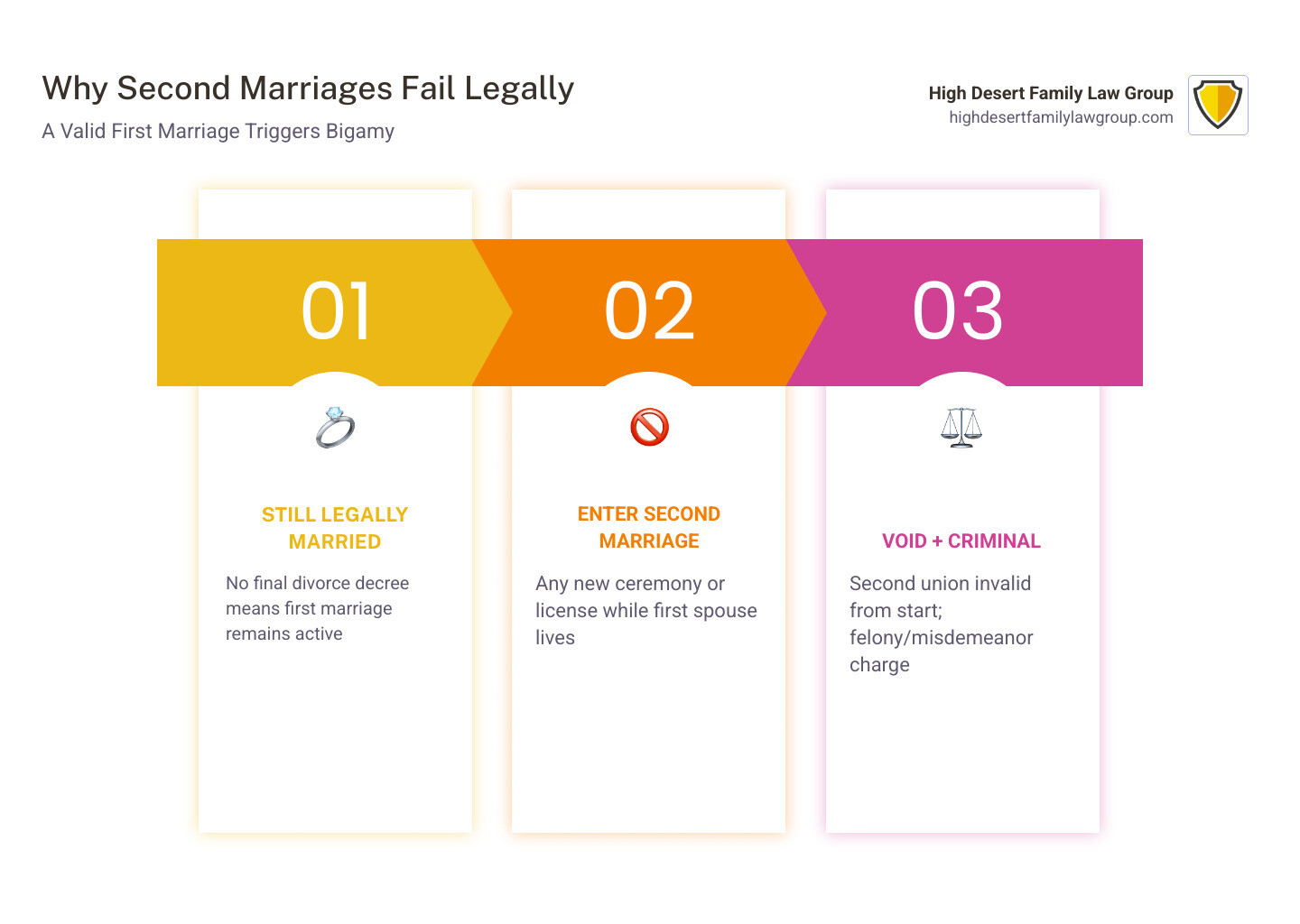
The definition is fairly rigid. It doesn’t matter if you have been living apart from your first spouse for years or if you have already filed for divorce. Until a judge signs that final decree, you are still “legally married.” This means any subsequent marriage ceremony or “purporting to marry” is a criminal act. Furthermore, the second union is considered “void ab initio,” which is a fancy Latin way of saying it was never valid from the moment it began. Even if your first spouse gives you their “blessing” to remarry, the law does not recognize their consent as a valid reason to bypass the legal dissolution process.
What is bigamy crime under U.S. law?
Under U.S. law, bigamy is a crime in all 50 states. The core of the offense is the formal act of entering a marriage contract while a prior undissolved marriage exists. While the specific statutes vary by state, the federal government also takes an interest in bigamy, particularly through the Edmunds Act, which historically targeted polygamous lifestyles. In modern practice, bigamy is a state-level criminal offense that renders the second marriage legally non-existent.
What is bigamy crime in California under Penal Code 281?
In California, the law is very specific. Under Penal Code 281 PC, bigamy occurs when a person with a living spouse (or a registered domestic partner) marries or enters into a new domestic partnership with someone else.
The prosecution carries the burden of proving that the first marriage was valid and that it had not been legally ended by death, annulment, or a final judgment of dissolution. California law is unique in that it explicitly includes registered domestic partnerships in its bigamy statutes, reflecting the state’s modern approach to legal unions.
Bigamy vs. polygamy vs. adultery
People often confuse these three terms, but they represent very different legal concepts.
- Bigamy: The legal act of entering a second marriage while the first is still valid. It is a crime of “status.”
- Polygamy: Usually refers to a social or religious practice of having multiple spouses simultaneously. While bigamy is the legal term for the act, polygamy is the broader cultural term.
- Adultery: Having a sexual relationship with someone other than your spouse. While adultery can be grounds for divorce in some states, it is rarely prosecuted as a crime in modern times, whereas bigamy is a serious criminal offense.
| Feature | Bigamy | Polygamy | Adultery |
|---|---|---|---|
| Definition | Marrying a second person legally | Practicing multiple marriages | Extramarital sexual relations |
| Legal Status | Criminal offense | Criminal offense | Civil/Rarely criminal |
| Marriage Involved | Yes (two or more) | Yes (multiple) | No (usually just one) |
For a deeper dive into these distinctions, you can read our guide on What Is The Difference Between Bigamy And Polygamy.
When Is Bigamy a Crime in California and Other States?
While bigamy is illegal everywhere in the U.S., how it is punished depends entirely on where the second “marriage” took place. Most states classify it as a felony, but some treat it as a misdemeanor.
Is bigamy illegal in California?
Yes. In California, bigamy is what we call a “wobbler.” This means the prosecutor has the discretion to charge it as either a misdemeanor or a felony. If charged as a misdemeanor, you could face up to one year in county jail. If the circumstances are more severe—for example, if you committed bigamy to defraud someone out of an inheritance—it can be filed as a felony, carrying a sentence of up to three years in state prison.
How other states treat bigamy
State laws vary significantly:
- New York: Bigamy is a Class E felony.
- Texas: It is generally a third-degree felony, but the Texas Penal Code can elevate it to a first-degree felony if the “spouse” is a minor.
- Utah: Recently updated its laws so that basic bigamy is an infraction, but it becomes a serious felony if it involves fraud or co-occurring crimes like child abuse.
- Hawaii: Treats it as a petty misdemeanor with a maximum of 30 days in jail.
- Colorado: Recently reclassified bigamy from a felony to a Class 2 misdemeanor.
Do out-of-state or foreign marriages count?
Absolutely. If you were married in Mexico, Canada, or even just another state like New York, that marriage is generally recognized as valid in California and Arizona. You cannot escape a bigamy charge by claiming the first marriage “doesn’t count” because it happened elsewhere. As long as the first marriage was legal where it was performed, it remains a barrier to any new marriage in the U.S. according to the Bigamy Law and Legal Definition standards.
What Prosecutors Must Prove to Convict Someone of Bigamy
To get a conviction for what is bigamy crime, the state can’t just point to a rumor. They must prove specific “elements” of the crime beyond a reasonable doubt.
The key elements of a bigamy charge
The prosecutor must establish:
- You were previously married (or in a registered domestic partnership).
- That first union was legally valid.
- The first spouse was still alive when you entered the second union.
- You willfully entered into a second marriage or domestic partnership.
How is bigamy proven in court without a marriage certificate?

Many people think that if they lost their original marriage certificate, they are safe. That is a dangerous misconception. Prosecutors can prove a marriage exists through:
- Witness Testimony: Friends or family who attended the wedding.
- Public Records: Tax returns filed as “married,” insurance forms, or mortgage applications.
- Cohabitation Evidence: Proof that you lived together and held yourselves out to the community as a married couple.
- Admissions: Statements you made to others about being married.
Common real-world scenarios that lead to charges
We often see bigamy charges arise from these common patterns:
- The “Unfinished” Divorce: You thought the lawyer finished the paperwork, but the judge never signed the final decree.
- Religious Dissolution: A priest or rabbi “annulled” the marriage, but you never went to civil court.
- The Vanishing Spouse: Your spouse left years ago, and you assumed they were dead or the marriage was “expired” (marriages do not expire!).
- Immigration Fraud: Marrying a second person specifically to help them get a green card while still married to someone else.
Penalties, Exceptions, and Defenses in Bigamy Cases
The penalties for bigamy can be life-altering, but the law does provide certain “outs” or exceptions if you can prove you acted in good faith.
California penalties for bigamy: misdemeanor vs. felony
In California, the penalties are split based on the “wobbler” status:
- Misdemeanor: Up to 1 year in county jail and a fine of up to $1,000.
- Felony: 16 months, 2 years, or 3 years in state prison and a fine of up to $10,000.
Beyond jail time, a felony conviction can lead to the loss of voting rights, the right to own a firearm, and the loss of professional licenses (like teaching, nursing, or law).
Legal exceptions that may prevent a conviction
Under California Penal Code 282, you are NOT guilty of bigamy if:
- Five-Year Absence: Your first spouse has been absent for five years straight, and you did not know they were alive during that time.
- Reasonable Belief: you had a “reasonable and good faith belief” that you were legally free to remarry (for example, you received a fake divorce decree).
- Prior Marriage Dissolved: The first marriage was already legally annulled or dissolved by a court.
Best defenses to bigamy charges
If you are facing charges, we look at several defense strategies:
- Invalid First Marriage: If your first marriage was never legal (e.g., it was incestuous or you were underage without consent), you can’t be guilty of bigamy.
- Mistake of Fact: You truly believed the divorce was final because of a clerical error or misinformation from a legal professional.
- Lack of Knowledge: You had no idea your first spouse was still alive after a long period of separation.
To understand more about these legal hurdles, check out our article on What Are Bigamist Laws.
Related Crimes, Immigration Risks, and Family Law Consequences
Bigamy rarely travels alone. It often brings other legal headaches along for the ride.
Related California offenses tied to bigamy
- Marrying the Spouse of Another (PC 284): If you marry someone knowing they are already married, you can be charged with a crime and fined up to $5,000.
- Incest (PC 285): If the bigamous marriage is also between close relatives, additional felony charges apply.
Does bigamy have immigration consequences?
This is a critical area. Bigamy is considered a “crime of moral turpitude.” For non-citizens, a bigamy conviction can lead to:
- Deportation (especially if the crime happened within 5 years of entering the U.S.).
- Being labeled “inadmissible,” meaning you cannot re-enter the country or adjust your status to get a Green Card.
- Denial of naturalization (citizenship).
What happens to the second marriage and family law rights?
The second marriage is a legal “nullity.” This means:
- No Spousal Support: You generally cannot ask for alimony from a “spouse” you weren’t legally married to.
- Property Division: Traditional community property laws may not apply, though “putative spouse” laws sometimes protect the person who honestly believed the marriage was real.
- Children: Fortunately, children born of bigamous marriages are still considered legitimate in the eyes of the law, and child support remains mandatory.
If you suspect your partner might already be married, read our guide on what to do if you Discovered My Partner Is A Bigamist.
Frequently Asked Questions About What Is Bigamy Crime
Can you be charged with bigamy if you are separated but not divorced?
Yes. Legal separation is not the same as divorce. You are still legally married until a “Final Judgment of Dissolution” is entered by the court. Remarrying during a separation is bigamy.
Can both people in the second marriage face criminal liability?
Yes. The person already married is charged with bigamy (PC 281). The “new” spouse can be charged under PC 284 if they knew the other person was already married.
What should you do if you are facing a bigamy investigation or charge?
Stop talking to investigators and start gathering documents. You need your original marriage license, any divorce filings, and any communication that supports your belief that you were single. Most importantly, consult an attorney who understands both criminal and family law.
Conclusion: What to Do Next If a Marriage May Be Bigamous
Understanding what is bigamy crime is the first step toward protecting yourself. Whether you accidentally remarried too soon or you’ve discovered your spouse has a secret family, the legal path forward is complex.
At High Desert Family Law Group, we provide aggressive, individualized representation for clients in Scottsdale and throughout Arizona. We know that these cases are often rooted in simple mistakes or deep betrayals, and we are here to help you navigate the annulment process, property disputes, and potential criminal exposure.
If you need a clear strategy, visit our category/bigamy section for more resources, or contact us today to review your case. Don’t let a mistake of the past ruin your future—get more info about family law services and start your defense today.