



Bigamy in divorce cases creates a legal mess that goes far beyond just ending a marriage. It can void your marriage entirely, expose a spouse to criminal charges, and completely change how property, support, and custody are handled.
Here is what you need to know right away:
| Issue | What Happens With Bigamy |
|---|---|
| Marriage validity | The second marriage is void — treated as if it never existed |
| Divorce vs. annulment | You typically cannot divorce a bigamous marriage; you need an annulment |
| Criminal risk | The bigamous spouse can face felony or misdemeanor charges |
| Property rights | Community property laws may not apply; protections depend on your good faith |
| Spousal support | Usually unavailable unless you qualify as a putative spouse |
| Children | Kids retain full legal rights regardless of the marriage’s validity |
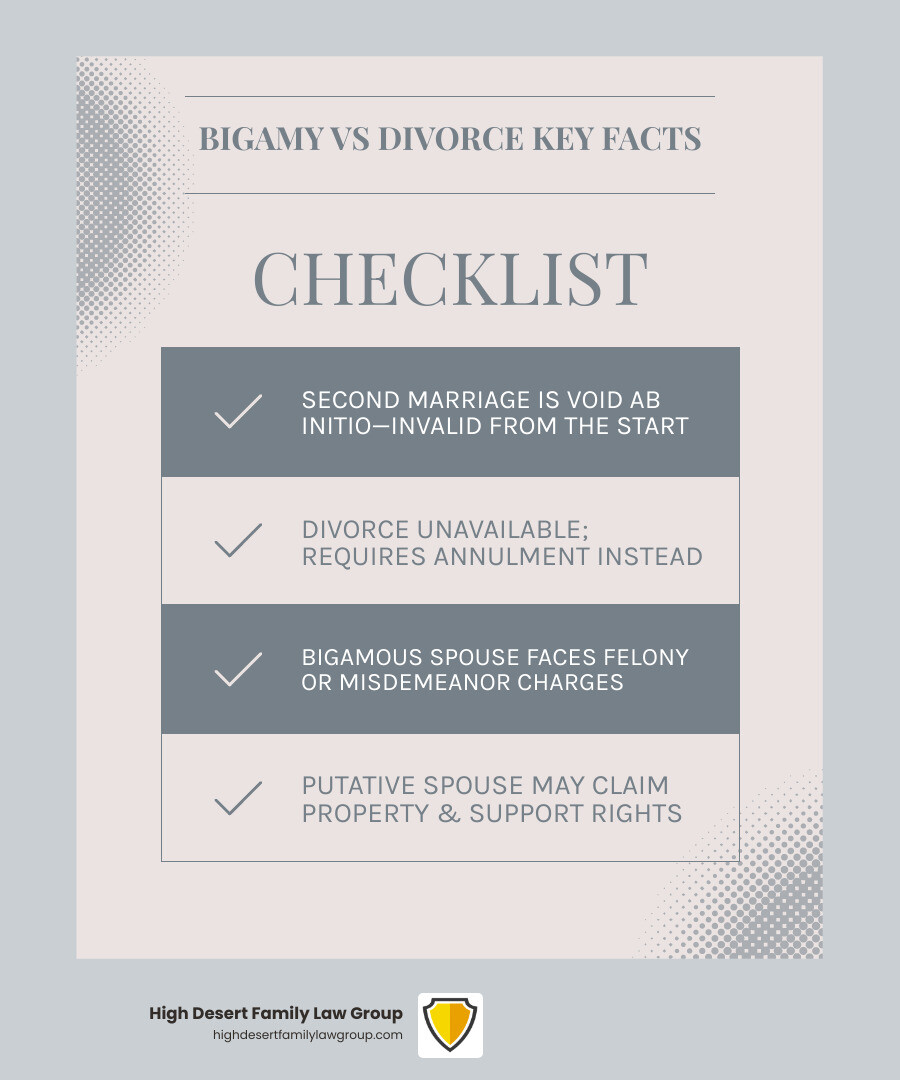
The law is straightforward on one point: you cannot legally marry someone while a prior marriage is still active. If that happens — whether by accident or intent — the second marriage is void from the start. No divorce can fix it. Only an annulment can formally clear the record.
This situation comes up more often than people expect. A prior divorce that was never finalized. A foreign marriage that was never properly dissolved. A spouse who simply moved to a new state and started over without telling anyone. The result is the same: two marriages, one serious legal problem.
The Legal Reality of Bigamy in Divorce Cases
When we talk about bigamy in divorce cases, we are usually dealing with a “void ab initio” situation. In plain English, that means the marriage was “invalid from the beginning.” Under Arizona law, if you are already married to Person A, your marriage to Person B isn’t just “broken”—it technically never existed in the eyes of the state.
This often happens due to an unfinalized divorce. We see cases in Scottsdale where a spouse thought their previous attorney had filed the final decree years ago, only to find out the judge never signed it because of a clerical error or a missed filing fee. Even if you’ve lived with your “second” spouse for a decade, if that first marriage wasn’t legally dissolved, you are technically a bigamist.
Verification of marital status is the first step in any high-stakes divorce. If we discover a prior marriage was never ended, we shift gears from a standard dissolution to an annulment. You can learn more about the specifics of these laws in our guide on What Are Bigamist Laws or read our advice on what to do if you Discovered My Partner Is A Bigamist/.
The Difference Between Void and Voidable Marriages
Not all “bad” marriages are treated the same way. A bigamous marriage is void, meaning it is illegal by its very nature. It doesn’t matter if both parties wanted to be married; the state simply won’t allow it.
On the other hand, a voidable marriage is one that is technically valid but can be canceled for specific reasons, like fraud or duress. For example, if your spouse lied about their ability to have children, that might make the marriage voidable. But bigamy is a different beast—it is an absolute legal barrier. It’s also important to distinguish this from polygamy. While bigamy is the act of entering a second marriage, polygamy usually refers to the religious or cultural practice of having multiple spouses. You can explore these nuances further at What Is The Difference Between Bigamy And Polygamy or browse our category/polygamy/ section.
Proving Bigamy in Divorce Cases
Proving bigamy requires a paper trail. We look for:
- Certified marriage licenses from both the first and second ceremonies.
- A lack of a divorce decree or annulment papers dated between those two ceremonies.
- Proof that the first spouse was still alive at the time of the second marriage.
Sometimes, people try to hide their tracks by marrying in different states or even different countries. However, with modern digital registries, it’s becoming much harder to hide a “secret” family in another jurisdiction. For those dealing with international complications, understanding Legal Remedies for Multiple Marriages and Possible Bigamy can provide insight into how these cases cross borders.
Criminal Penalties and Legal Consequences

In Arizona, bigamy isn’t just a “whoopsie” in family court; it is a crime. Under ARS 13-3606, a person is guilty of bigamy if they have a spouse living and marry any other person.
In the Grand Canyon State, bigamy is typically classified as a Class 5 felony. While it is rarely prosecuted if the mistake was truly accidental, the threat of criminal charges is a powerful lever in divorce negotiations. A conviction can result in:
- Up to 2.5 years in prison for a first offense.
- Hefty fines reaching into the thousands.
- A permanent criminal record that can affect professional licenses and employment.
For a deeper dive into the definitions, check out the entry for Bigamy – State 48 Law Firm or read about Day 67: Bigamy: The Unusual Crime and Its Penalty in Arizona.
Defenses Against Bigamy Charges
The law does provide an “out” for those who acted without criminal intent. Common defenses include:
- Lack of Intent: You genuinely believed your previous marriage was over.
- Good Faith Belief: You were told by a lawyer or official that your divorce was final.
- Presumed Death: Your first spouse has been missing for a statutory period (usually five years in Arizona) and you had no reason to believe they were still alive.
If you find yourself facing these accusations, strategies for Setting Aside Fraudulent Divorce and Bigamy Charges in Philippines (or elsewhere) often focus on the timeline of discovery and the documentation of “good faith.”
The Role of Laches and Delay
Can you challenge a bigamous marriage 20 years after the fact? This is where the doctrine of laches comes in. Laches is a legal “use it or lose it” rule. If you knew about the bigamy but waited decades to bring it up—perhaps waiting until a spouse died to claim their estate—the court might bar you from seeking an annulment.
Courts generally dislike it when people use bigamy as a tactical weapon only when it becomes financially convenient. As seen in the Bessie Jean Peete v. Maryland Elizabeth Peete case analysis, a long delay can sometimes protect even a technically void marriage from being overturned if the challenger’s motives are purely financial.
Financial Implications of Bigamy in Divorce Cases
This is where the “mess” in our title really happens. If a marriage is void, how do you split the house, the 401(k), and the debt? Arizona is a community property state, but community property laws only apply to legal marriages.
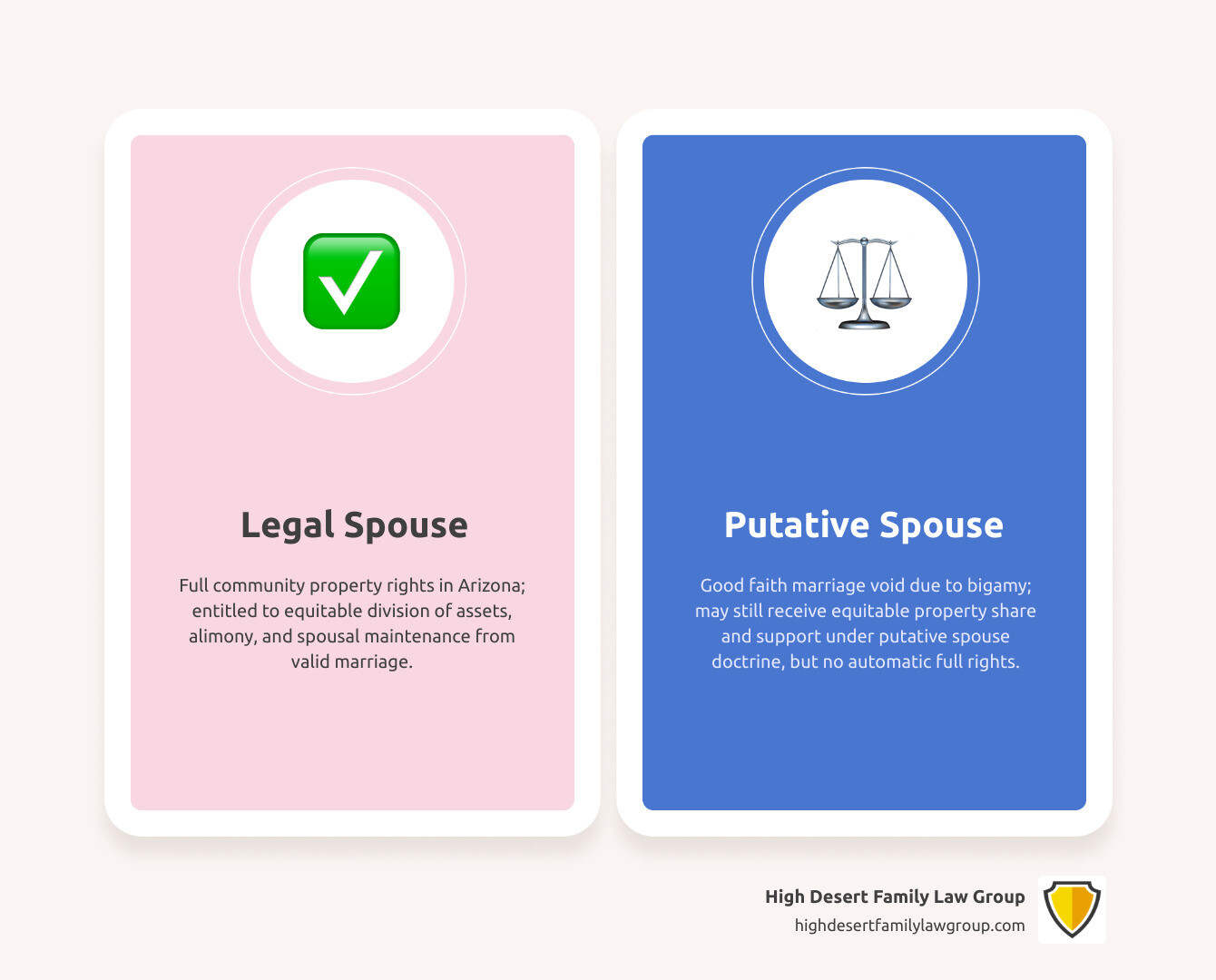
If the marriage is void, the bigamous spouse might technically forfeit their rights to assets acquired during the “union.” However, Arizona courts are courts of equity, meaning they want to be fair. They won’t necessarily let one person walk away with everything just because of a filing error. In the case of Medina v. Medina (2006 NMCA 42), the court noted that bigamy alone doesn’t automatically cause a total forfeiture of property rights unless the circumstances “shock the conscience.” You can find more discussions on this in our category/bigamy/ blog.
The Putative Spouse Doctrine and Alimony
What if you were the “innocent” spouse? You thought you were legally married, you filed joint taxes, and you supported your partner for years, only to find out they never divorced their high school sweetheart in New Jersey.
Arizona recognizes the Putative Spouse Doctrine. If you entered the marriage in “good faith” (meaning you truly believed it was legal), the court can treat you as a legal spouse for the purpose of property division and spousal maintenance (alimony). This prevents a bigamist from using their own crime as a way to avoid paying support. For a look at how this works in other community property states, see Bigamy in California: How It Affects Divorce, Annulments & Your Family Law Rights.
Impact on Retirement and Death Benefits
Bigamy can be a nightmare for retirement planning. If a husband dies and has two “wives,” the Social Security Administration and pension administrators have a massive headache. Generally:
- The first (legal) wife usually has the primary claim to survivor benefits.
- The second (bigamous) wife may get nothing unless she can prove putative spouse status.
- Federal law often trumps state law here, making these cases incredibly complex.
Problems like these are common when DISSOLVING A PLURAL MARRIAGE IN CONNECTICUT or other states that have strict public policy against multiple marriages.
Child Custody and Support in Bigamous Unions
One of the most common fears is that bigamy makes children “illegitimate.” In May 2026, let us be very clear: The legal status of the parents’ marriage does not affect the rights of the children.
In Arizona, children born of a bigamous marriage have the same rights to support and inheritance as children born of a valid marriage. However, bigamy can complicate paternity establishment. In a legal marriage, the husband is presumed to be the father. If the marriage is void, that presumption might be challenged, requiring a formal paternity test or a Voluntary Acknowledgement of Paternity (VAP).
When determining custody, the court uses the “Best Interests of the Child” standard. A parent’s bigamy might be used to question their character or honesty, but it won’t automatically result in a loss of custody unless it directly harms the child.
State-Specific Variations and Waiting Periods
While we focus on Scottsdale and the Greater Phoenix area, it’s helpful to see how Arizona compares to other states:
- Arizona: We have a mandatory 60-day cooling-off period after filing for divorce. If you marry on day 59, you’ve committed bigamy.
- California: Under Family Code 2201, bigamous marriages are strictly void, but they have robust “putative spouse” protections for asset division.
- Texas: Similar to Arizona, Texas allows a second marriage to become “valid” automatically if the first marriage ends and the couple continues to live together (this is called “removal of the impediment”).
- Illinois: They use the term “Declaration of Invalidity” instead of annulment.
- Maryland: They have strict rules about who has “standing” to challenge a marriage; sometimes only the spouses can do it, not third parties.
- New Mexico: As seen in the Medina case, they are very careful about not letting bigamy lead to unfair asset forfeiture.
Frequently Asked Questions about Bigamy in Divorce Cases
Can I get remarried while my divorce is still in process?
No. Absolutely not. Do not pass go, do not collect $200. Until the judge signs the Final Decree of Dissolution, you are still legally married. Even if you have a “signed agreement” or have been separated for five years, remarrying before that final signature is bigamy.
Does bigamy apply to common-law marriages or domestic partnerships?
It can. If you lived in a state that recognizes common-law marriage (like Colorado or Texas) and met their requirements for a legal marriage, you are “married” in the eyes of Arizona too. You must divorce that common-law spouse before marrying someone else. This also applies to same-sex unions and domestic partnerships that have been legally registered.
What happens if I unknowingly married a bigamist?
You should seek an annulment immediately. This protects your future ability to marry legally and allows you to ask the court for “putative spouse” status to protect your financial interests. We recommend gathering all your financial records and any evidence that you acted in good faith (like the marriage license you signed together).
Conclusion
Dealing with bigamy in divorce cases is like trying to untangle a knot that was tied with legal wire. It requires a steady hand and a deep understanding of Arizona’s specific statutes. At High Desert Family Law Group, we provide the aggressive, individualized representation you need to navigate these “two-marriage messes.”
Whether you are the innocent spouse who discovered a shocking secret, or someone who made a mistake with a prior divorce filing, our four-person team is here to protect your assets, your reputation, and your future. We serve clients throughout Scottsdale, Chandler, and the Greater Phoenix area with a strategy tailored to your unique situation.
Don’t let a void marriage ruin your financial life. Contact our Scottsdale family law attorneys today for a consultation. We’ll help you find the “reset” button and move forward with confidence.