



Sole Custody Arizona: What Parents Need to Know

In Arizona, “sole custody” is officially called sole legal decision-making, and it means one parent holds the legal authority to make major decisions about a child’s health, education, and religious upbringing. If you believe your situation warrants it, your immediate next step is either to file a petition for legal decision-making with your county Superior Court or to schedule a consultation with an Arizona family-law attorney before you do anything else.
A few things to understand right away:
- Sole legal decision-making and parenting time are separate legal concepts. Getting sole decision-making authority does not automatically cut the other parent’s time with the child.
- Arizona courts start from the premise that both parents should be involved in a child’s life. Sole decision-making is awarded when the evidence shows joint decision-making would harm the child’s welfare.
- The governing statute is A.R.S. §25-403, which lists the specific best-interest factors every Arizona judge must weigh.
Table of Contents
- What does “sole custody” actually mean under Arizona law?
- How do Arizona courts decide who gets legal decision-making?
- When do Arizona judges actually award sole legal decision-making?
- How to file for sole legal decision-making in Arizona
- What evidence strengthens your petition?
- Special situations: unmarried parents, relocation, and out-of-state orders
- How to modify or enforce an existing order
- How an Arizona family-law attorney can help you
- Key Takeaways
- What most parents get wrong about sole legal decision-making
- Working with Highdesertfamilylawgroup in Scottsdale
- Primary sources, forms, and further reading
What does “sole custody” actually mean under Arizona law?
Arizona stopped using the word “custody” in its family statutes in 2013. The statutory terms are now legal decision-making (who decides) and parenting time (who the child is physically with and when). That distinction matters practically, not just semantically.
Sole legal decision-making gives one parent the exclusive right and responsibility to decide on major issues: which school the child attends, which doctor treats them, and what religious community, if any, they participate in. The other parent does not need to be consulted on those decisions, though they are still entitled to access school and medical records under Arizona law.
Parenting time is entirely separate. A parent can have sole legal decision-making while the other parent still has regular, substantial parenting time. Courts will restrict or eliminate parenting time only when contact would endanger the child physically or emotionally, not simply because one parent has sole decision-making authority. As the AZLawHelp custody guide puts it, the other parent retains parenting time rights unless the court makes a specific finding of danger.
| Term | What it covers | What it does NOT do |
|---|---|---|
| Sole legal decision-making | Major decisions: health, education, religion | Does not eliminate the other parent’s parenting time |
| Joint legal decision-making | Both parents share major decisions; requires written parenting plan | Does not guarantee equal parenting time |
| Parenting time | Physical schedule — when each parent has the child | Does not determine who makes major decisions |
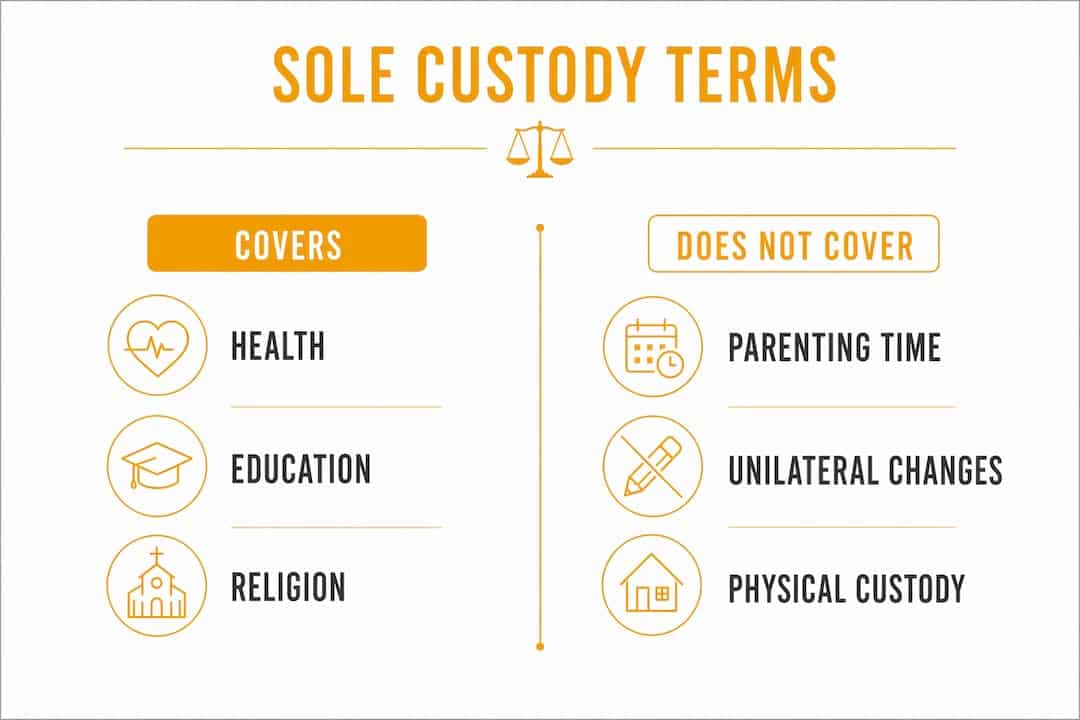
One practical limit worth knowing: sole decision-making does not give you the right to unilaterally change the parenting time schedule or enroll the child in private school and then demand the other parent pay tuition. Financial obligations tied to new decisions generally require a separate court order.
How do Arizona courts decide who gets legal decision-making?
Every Arizona custody decision turns on the best interests of the child, and A.R.S. §25-403 lists the factors a judge must consider. In contested cases, the court must make specific written findings on the record for each factor. That requirement is not a formality — it is what appellate courts review when orders are challenged.
The statutory factors include:
- The past, present, and potential future relationship between each parent and the child
- The child’s interaction and interrelationship with parents, siblings, and others who affect the child’s best interest
- The child’s adjustment to home, school, and community
- The mental and physical health of all individuals involved
- Which parent is more likely to allow the child frequent, meaningful, and continuing contact with the other parent
- Whether one parent has provided false information to the court to gain an advantage
- Whether domestic violence or child abuse has occurred (this factor carries significant weight)
- The nature and extent of coercion or duress used by a parent to obtain an agreement regarding legal decision-making or parenting time
- Whether a parent has complied with Chapter 3, Article 5 (parenting education requirements)
- Whether either parent was convicted of an act of false reporting of child abuse or neglect
The child’s own wishes may be considered when the court finds the child is of suitable age and maturity, though Arizona law does not set a specific age at which a child’s preference becomes controlling.
There is no presumption favoring sole or joint decision-making. Joint legal decision-making is more common than sole decision-making in Arizona, and judges generally prefer detailed parenting plans that keep both parents meaningfully involved when it is safe to do so. A parent seeking sole decision-making needs to show, through evidence, that joint decision-making would not serve the child’s welfare.

When do Arizona judges actually award sole legal decision-making?
Courts award sole legal decision-making when the evidence shows that shared authority would put the child at risk or that one parent is genuinely unable to participate in joint decision-making. The most common factual patterns include:
- Domestic violence or abuse. Under A.R.S. §25-403.03, Arizona law creates a rebuttable presumption against awarding legal decision-making to a parent who has committed domestic violence. The burden shifts to that parent to prove the requested arrangement will not endanger the child. A protective order, police reports, and documented injuries are the typical evidence base.
- Substance abuse that endangers the child. Chronic, untreated addiction documented by failed drug tests, DUI arrests, or CPS involvement gives courts strong grounds for sole decision-making and restricted parenting time.
- Long-term parental absence or incapacity. A parent who has been incarcerated, institutionalized, or simply absent for an extended period often cannot demonstrate the kind of ongoing relationship that supports joint decision-making.
- Parental neglect. Documented failure to provide food, medical care, or supervision, especially when CPS has investigated and substantiated neglect, weighs heavily in favor of the present, engaged parent.
- Inability or refusal to co-parent. When parents have a documented history of being unable to communicate or make joint decisions without court intervention, and that pattern harms the child, a judge may conclude sole decision-making is the only workable arrangement.
A few concrete examples of how facts map to outcomes: a parent with a documented history of domestic violence and an active protective order against them will likely face restricted parenting time in addition to losing decision-making authority. A parent with a single, older substance-abuse incident who has completed treatment and maintained sobriety stands in a very different position than one with ongoing, untreated addiction.
For scenarios involving mothers seeking full decision-making authority, the factual grounds and the analysis are the same as for any parent. Arizona courts do not favor either parent based on gender.
How to file for sole legal decision-making in Arizona
The filing process has several distinct stages. Skipping or mishandling any one of them can delay your case or damage your petition.
- Confirm jurisdiction. Generally, the child must have lived in Arizona for at least six months before you file, or Arizona must be the child’s primary place of residence. If the child is under six months old, they must have lived in Arizona since birth.
- Assemble your forms. The core packet for establishing legal decision-making, parenting time, and child support (when paternity is already established) is the DRCV1 packet from Maricopa Superior Court. It includes the petition, parenting plan, and child support worksheets. Other Arizona counties have equivalent packets through their Superior Court clerks.
- File at the Superior Court. File your completed forms with the clerk of the Superior Court in the county where the child lives. Pay the filing fee or submit a fee waiver application if you qualify.
- Serve the other parent. The other parent must be formally served. AZCourtHelp outlines the accepted service methods and the response deadlines: 20 days for in-state service, 30 days for out-of-state service.
- Request temporary orders if needed. If the child’s safety is at immediate risk, you can request emergency or ex parte temporary orders at the time of filing. Temporary orders govern the situation while the case is pending and do not predetermine the final outcome, but they matter practically.
- Attend mediation. Most Arizona courts require parents to attempt mediation before a contested hearing. A written parenting plan is required when parents reach agreement; if they cannot, the court holds an evidentiary hearing.
- Attend the hearing. In contested cases, both parents present evidence and testimony. The judge applies the A.R.S. §25-403 factors and issues a final order.
Key cost components to budget for:
- Court filing fees (vary by county; fee waivers are available for qualifying parties)
- Mediation fees (private mediators typically charge hourly; court-connected programs may be lower cost — see mediation cost guidance)
- Attorney retainer and hourly fees (see below for ranges)
- Expert witness fees if a custody evaluator or mental health professional is involved
Realistic timelines: An uncontested case where both parents agree can resolve in as little as 60–90 days. A fully contested case in Maricopa County typically takes six months to over a year from filing to final order, depending on court scheduling and the complexity of the evidence.
Pro Tip: Incomplete forms or improper service are among the most common reasons petitions stall. Review the filing guidance carefully before you submit, and consider having an attorney review your paperwork even if you plan to represent yourself.
What evidence strengthens your petition?
The quality of your evidence packet often determines the outcome more than the underlying facts alone. Courts respond to organized, authenticated documentation, not general allegations.
- Police reports and arrest records related to domestic violence, substance abuse, or child endangerment
- Protective orders currently in effect or previously issued
- Medical records documenting injuries to the child or the parent
- CPS investigation reports and any substantiated findings
- Substance-abuse test results (hair follicle, urinalysis) and related court records
- School records including attendance, teacher notes, and records of who participates in school conferences
- Communications (texts, emails, voicemails) that document parenting behavior, threats, or missed parenting time
- Sworn declarations from teachers, doctors, neighbors, or family members with direct knowledge
- A parenting-time log recording dates, times, and any missed or disrupted visits
When you present this material, organize it chronologically and create a clear timeline the judge can follow. Courts see hundreds of custody cases; a well-organized packet signals credibility. For sensitive materials like medical records or communications involving third parties, ask your attorney about redaction, sealed exhibits, or requesting in-camera review.
Pro Tip: Never submit screenshots of text messages as your only evidence. Print the full conversation thread, note the phone number and contact name, and be prepared to authenticate the messages through your own testimony or a phone carrier record. Courts are skeptical of cherry-picked screenshots without context.

Special situations: unmarried parents, relocation, and out-of-state orders
Unmarried parents
If you were never married to the other parent, paternity must be legally established before a court can enter a final legal decision-making order. Arizona requires separate petitions to establish legal decision-making, parenting time, and child support. Paternity can be established through a voluntary affidavit (often signed at the hospital), a court order, or a DNA test ordered by the court. Understanding your parental rights in Arizona before you file is worth the time.
Out-of-state custody orders (UCCJEA)
If another state issued a custody order, Arizona will generally enforce it under the Uniform Child Custody Jurisdiction and Enforcement Act (UCCJEA). To have an out-of-state order recognized and enforced in Arizona, register a certified copy with the Superior Court in the county where the child now lives. Arizona courts can modify an out-of-state order only when Arizona has become the child’s home state and the original state no longer has jurisdiction. Maricopa Superior Court’s family court resources provide the specific registration steps.
Relocation
A parent with sole legal decision-making who wants to relocate with the child must provide written notice to the other parent, typically at least 45 days before the planned move for in-state relocations and 60 days for out-of-state moves. The other parent can object, triggering a court hearing. Judges weigh the reason for the move, the impact on the child’s relationship with the non-relocating parent, and whether the parenting plan can be modified to preserve that relationship.
How to modify or enforce an existing order
Modifying a sole legal decision-making order
Arizona courts will not revisit a custody order simply because one parent is unhappy with the outcome. To modify an existing order, you must show a substantial and continuing change in circumstances since the last order was entered, and then demonstrate that modification serves the child’s best interests. Common triggers include a parent’s relocation, a significant change in the child’s needs, documented new abuse or substance abuse, or a parent’s extended incapacity.
The steps to request modification:
- File a Petition to Modify Legal Decision-Making and Parenting Time with the Superior Court
- Serve the other parent and allow the response period
- Attend mediation (usually required before a contested hearing)
- Present evidence of the changed circumstances and best-interest factors at the hearing
Courts are cautious about frequent modification attempts. Filing too soon after a final order, without genuinely new circumstances, can damage your credibility and result in sanctions. For a detailed look at what moves judges to change a custody arrangement, the grounds for modification are worth reviewing before you file.
Enforcing an existing order
When the other parent violates a legal decision-making or parenting time order, your options include:
- Motion for contempt or order to show cause: File with the court documenting the specific violations. The court can impose fines, make-up parenting time, supervised exchanges, or modify the arrangement.
- Make-up parenting time: Arizona courts can order compensatory time when a parent has wrongfully withheld parenting time.
- Modification as a remedy: Repeated, documented violations can themselves constitute a substantial change in circumstances supporting modification.
Document every violation with dates, times, and any communications. A log kept in real time is far more persuasive than a summary written from memory months later.
How an Arizona family-law attorney can help you
An experienced attorney does more than file paperwork. At each stage of a sole legal decision-making case, counsel provides:
- Case assessment: Evaluating whether your facts support a petition for sole decision-making or whether a strong joint-decision-making arrangement with protective terms is more realistic
- Evidence gathering: Identifying what records to subpoena, which witnesses to prepare, and how to authenticate digital communications
- Drafting: Petitions, parenting plans, and proposed orders that address the A.R.S. §25-403 factors directly
- Mediation representation: Negotiating protective terms and parenting-plan language that holds up in court
- Hearing representation: Presenting evidence, cross-examining the other parent, and making legal arguments on the record
- Enforcement and modification work: Filing contempt motions and modification petitions when circumstances change
When should you hire counsel rather than proceed on your own? High-conflict cases, any situation involving domestic violence, contested paternity, complex financial issues tied to custody, and relocation disputes all carry enough legal complexity that self-representation significantly increases your risk of a bad outcome.
What to bring to an initial consultation:
- Any existing court orders (divorce decree, paternity order, prior custody orders)
- School and medical records you already have access to
- A written summary of the key incidents or concerns driving your petition
- Any police reports, protective orders, or CPS correspondence
- A list of questions about the process, timeline, and likely costs
Attorney fees for contested custody cases in Arizona vary based on case complexity, the number of hearings, and whether expert witnesses are needed. A retainer is typically required upfront, with fees billed against it at an hourly rate. For a realistic picture of what legal representation costs in Arizona family-law matters, the attorney fee guidance at Highdesertfamilylawgroup is a useful starting point.
Key Takeaways
Sole legal decision-making in Arizona requires proving, through documented evidence, that the child’s best interests are served by one parent holding exclusive authority over major decisions about health, education, and religion.
| Point | Details |
|---|---|
| Terminology matters | Arizona uses “sole legal decision-making,” not “sole custody” — the distinction affects what you file and how courts analyze your case. |
| Decision-making and parenting time are separate | Winning sole decision-making authority does not automatically restrict the other parent’s parenting time. |
| Best-interest factors are statutory | A.R.S. §25-403 lists the specific factors every judge must weigh; contested cases require written findings on each factor. |
| Domestic violence triggers a presumption | Under A.R.S. §25-403.03, a parent who committed domestic violence must prove the requested arrangement is safe — the burden shifts to them. |
| Highdesertfamilylawgroup serves Scottsdale parents | With 20+ years of Arizona family-law experience, the firm handles sole legal decision-making cases from petition through final order and modification. |
What most parents get wrong about sole legal decision-making
The single biggest misconception is that sole legal decision-making is a prize to be won. Parents sometimes pursue it as a way to limit the other parent’s involvement or as leverage in a broader dispute, and courts see through that immediately. Judges are not interested in which parent “won” — they are focused, sometimes relentlessly, on what arrangement actually serves the child’s day-to-day welfare.
The second misconception is that sole decision-making means the other parent disappears from the child’s life. It does not. In most cases, the non-decision-making parent retains meaningful parenting time, access to school and medical records, and the right to be notified of emergencies. The decision-making authority is narrower than most parents expect: it covers major decisions, not every routine choice made during parenting time.
What actually moves courts is child-centered, documented evidence presented without exaggeration. A parent who comes in with a clear, chronological evidence packet, a realistic proposed parenting plan, and a demonstrated willingness to put the child’s needs first tends to fare better than one who arrives with sweeping allegations and no documentation. That is not idealism — it is what experienced Arizona family-law practitioners observe in contested hearings.
If your situation genuinely involves domestic violence, substance abuse, or a parent who is truly absent or incapacitated, the law provides real tools. Use them, document everything, and work with counsel who knows how to present that evidence effectively.
Working with Highdesertfamilylawgroup in Scottsdale
Pursuing sole legal decision-making is one of the most consequential legal steps a parent can take, and the outcome depends heavily on how the case is built from the start. Highdesertfamilylawgroup works with parents in Scottsdale and throughout the greater Phoenix area on exactly these cases: contested and uncontested legal decision-making petitions, emergency protective orders, paternity actions, parenting plan negotiations, and modification proceedings.

The firm’s attorneys will review your facts, tell you honestly what your evidence supports, and map out a strategy before you file anything. That initial assessment alone can prevent costly procedural mistakes. To understand what legal representation typically costs in Arizona family-law matters, start with the firm’s attorney fee overview.
What to bring to your first appointment:
- Existing court orders and any paternity documentation
- School records, medical records, and any CPS correspondence
- Police reports, protective orders, or documentation of incidents
- A communication log (texts, emails) relevant to the dispute
- Any proposed or prior parenting plans
Schedule a consultation directly through Highdesertfamilylawgroup to speak with an attorney about your specific situation. The sooner you get a clear picture of your legal position, the better prepared you will be.
This article provides general legal information about Arizona family law and is not a substitute for advice from a licensed Arizona attorney about your specific situation. Confirm current statutes and court procedures with the Arizona Legislature’s website or a qualified family-law attorney.
Primary sources, forms, and further reading
The table below identifies the key statutory and court resources you will need.
| Resource | What it covers | Where to find it |
|---|---|---|
| A.R.S. §25-403 | Best-interest factors; court’s duty to make findings | azleg.gov |
| A.R.S. §25-403.03 | Domestic violence presumption in custody cases | azleg.gov |
| Maricopa DRCV1 packet | Forms to establish legal decision-making, parenting time, child support | superiorcourt.maricopa.gov |
| AZCourtHelp filing guide | Step-by-step filing instructions, service rules, fee waivers | azcourthelp.org |
| University of Arizona parenting plan guide | Parenting plan structure and best practices | law.arizona.edu |
| AZLawHelp custody guide | Plain-language overview of the custody process | azlawhelp.org |
A few notes on how to use these:
- For forms: go directly to your county’s Superior Court clerk or the Maricopa DRCV1 packet linked above. Do not use forms from unofficial websites; outdated forms are rejected.
- For statute text: the Arizona Legislature’s site (azleg.gov) is the authoritative source. FindLaw and similar sites republish the statutes but may lag behind amendments.
- For self-help guidance: AZCourtHelp and AZLawHelp are the state’s primary self-help resources and are updated regularly.
- For representation: contact Highdesertfamilylawgroup for a consultation on your specific case.