



72 Hour 7 Step Plan to Fight False Custody Claims in Arizona

Yes, a false allegation of abuse or domestic violence can trigger an emergency custody order, supervised visitation, or a DCS investigation within days. Arizona law does not leave you defenseless: statutes like A.R.S. § 25-415 require courts to sanction a parent who knowingly files a false claim about a child’s safety. Your first move is not to argue your case in a text message or to the caseworker. Comply with every order on paper, then call an Arizona family-law attorney the same day.
TL;DR:
- A judge can issue emergency custody orders without notice based on allegations of abuse, often leading to supervised visitation, no contact orders, or move-out requirements within days.
- Family law sanctions for knowingly false claims include attorney fee shifts, and criminal charges as a class 1 misdemeanor, with potential civil damages under proposed legislation.
- Parents must comply exactly with temporary orders, gather and preserve digital and third-party evidence quickly, and respond within deadlines to avoid defaults or unchallenged allegations.
- DCS findings are recorded in a public registry and can impact future custody cases, even if unsubstantiated, so parents should request case files and seek legal guidance before participating.
- Building a prompt, organized defense within the first 72 hours to 60 days improves chances of countering false allegations and avoiding custody penalties.
Table of Contents
- What happens immediately after a false custody allegation in Arizona
- How DCS investigates and what “substantiated” really means
- Your defense checklist: the first 72 hours through day 60
- When a claim crosses from unsubstantiated to legally false
- How High Desert Family Law Group handles false-allegation cases
- What I’d tell you to do first if I were your lawyer
- Get help defending against false allegations in Scottsdale
- Sources
- FAQ
What happens immediately after a false custody allegation in Arizona
A judge who receives an emergency petition alleging abuse or domestic violence can act before you ever get a chance to respond. Arizona’s rules allow temporary orders without notice when a party shows a real risk of harm, and the standard for that motion is lower than the standard for a final custody ruling. That is by design. It protects children first and sorts out the truth later.
What a judge can order on an emergency basis:
- Supervised visitation only, sometimes through a third-party monitor
- No contact between you and the child pending a hearing
- Temporary removal of decision-making authority or parenting time
- A requirement that you move out of the shared home
Once a judge signs a temporary order without notice, Arizona court rules require a prompt evidentiary hearing, often within about 10 days, so the other parent doesn’t sit on an unchallenged order indefinitely. Under the Arizona Rules of Family Law Procedure governing temporary orders, you typically have a limited window, often 20 to 30 days depending on the filing, to submit a verified response. Miss that deadline and you risk a default that locks in the other parent’s version of events. Read the emergency custody process in Arizona before you do anything else, and follow every order exactly as written even if you believe it’s unjust. Violating a temporary order, even one you consider unfair, hands the other side ammunition they didn’t earn.
How DCS investigates and what “substantiated” really means
The Arizona Department of Child Safety runs on a separate track from family court, and it doesn’t decide custody. Its only job is assessing whether a child is safe right now. A caseworker will typically interview the child, both parents, and sometimes teachers or medical providers before closing the case as either substantiated or unsubstantiated.
A few things matter here that most parents don’t know until they’re living through it:
- A substantiated finding gets recorded in the DCS Central Registry, which can follow you into background checks for jobs, licensing, or future custody disputes.
- You can request your case file using Form CSO-1036A, and you generally have the right to notice, a copy of the findings, and an administrative hearing to challenge a substantiated result within statutory timeframes, often 14 to 20 days.
- Even a report closed as unsubstantiated can still color the family court judge’s impression, because the timing and existence of the investigation becomes part of the record judges see.
Talk to counsel before signing any release form or sitting for an informal DCS interview without a lawyer present. Parents routinely waive protections they didn’t know they had, according to guidance from the DCS parents’ rights page, simply because no one told them they could ask for time to consult an attorney first.
Your defense checklist: the first 72 hours through day 60
Speed and organization win these cases more often than eloquence does. Here’s the order that actually works.
- Comply with every order, then call a lawyer. Do this the same day you’re served. Delay costs you leverage and sometimes costs you deadlines.
- Preserve everything electronically. Screenshot text threads, save voicemails, back up social media posts, and never delete a message even if it looks bad out of context. A deleted message looks worse than an embarrassing one.
- Build a timeline. Write down dates, times, and locations for every relevant event while your memory is fresh. Courts trust contemporaneous records far more than reconstructed ones.
- Gather corroborating evidence. School attendance logs, pediatrician or ER records, coworker or neighbor witness statements, and shared calendar entries all carry weight because they come from third parties with no stake in the outcome.
- File a timely, verified response. Missing this deadline can mean the court treats the allegations as unopposed.
- Request a resolution management conference or evidentiary hearing. Pushing for an early hearing date forces fact-finding before a one-sided narrative hardens into the court’s working assumption.
- Track your DCS deadlines separately from your court deadlines. They run on different clocks, and missing one can undercut your position in the other.
Pro Tip: Ask your attorney about targeted early discovery, things like text message metadata, school records, and third-party affidavits. Getting hard facts on the record fast is often more persuasive than any amount of testimony later.
What not to do matters just as much as what to do. Never contact the other parent to “work it out” outside of counsel. Never coach or question the child about the allegations; a judge who suspects coaching will punish you for it regardless of who started the fight. And document every single interaction with a DCS caseworker in writing, even a phone call summary sent to yourself by email, because your memory of a stressful conversation six months from now will not hold up as well as a dated note.
When a claim crosses from unsubstantiated to legally false
Arizona courts draw a sharp line between a parent who raised a good-faith but unproven concern and one who knowingly fabricated a claim. The first is protected. The second gets sanctioned.
Under A.R.S. § 25-415, a judge who finds that a party knowingly presented a false claim about abuse or a child’s best interests must order that party to pay the other side’s reasonable attorney fees and costs. That word “shall” matters. It’s not discretionary once the court makes the finding.
There’s a criminal exposure layer too. Knowingly filing a false report of child abuse or neglect can be prosecuted as a class 1 misdemeanor under A.R.S. § 13-2907.02, separate from anything happening in the family court case.
- Mandatory fee-shifting under ARS §25-415 when fabrication is proven
- Potential class 1 misdemeanor charges under ARS §13-2907.02
- Possible civil liability under proposed legislation like SB1018, which would let a falsely accused parent sue for damages, emotional distress, and legal fees
Legal commentary on Arizona custody disputes consistently notes that once a judge concludes an allegation was knowingly fabricated, it becomes a credibility problem for the accuser that tends to follow them through the rest of the case, according to analysis from LegalClarity. A parent who lied about abuse to gain leverage often ends up with reduced parenting time or a shift in legal decision-making authority, the opposite of what they were trying to achieve.
How High Desert Family Law Group handles false-allegation cases
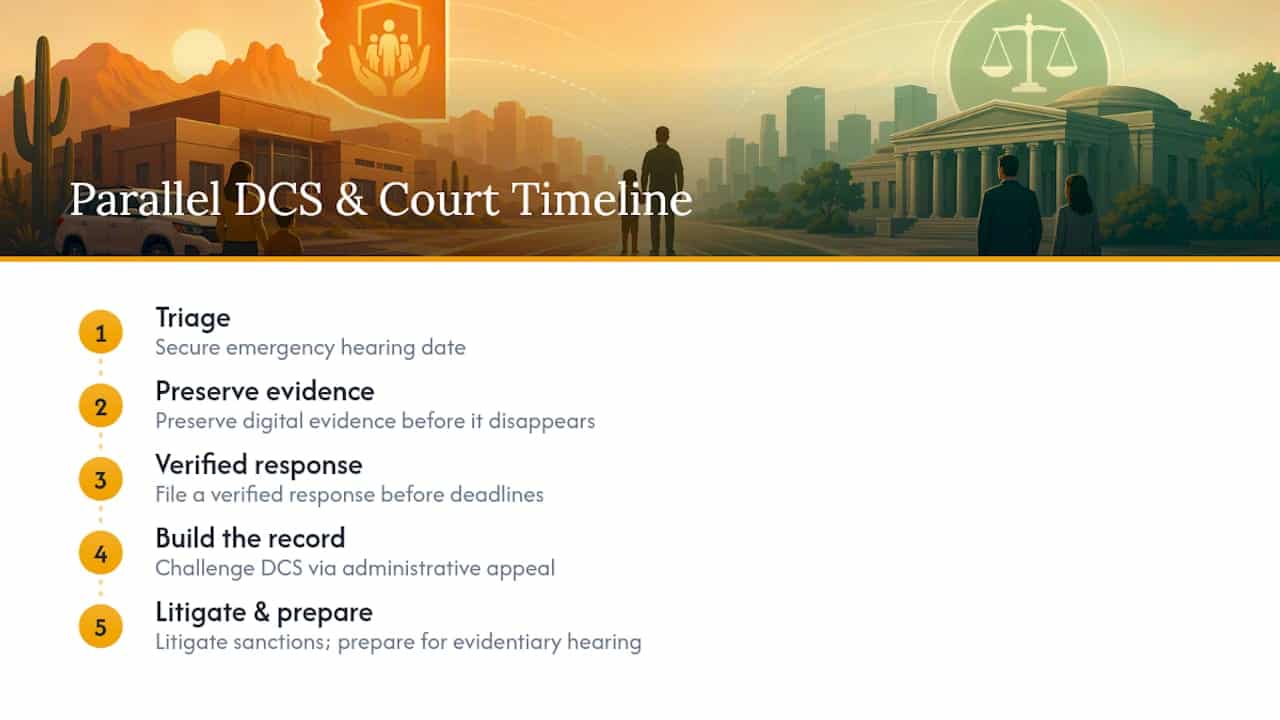
A family law group with extensive experience has handled numerous custody disputes, including cases where one parent weaponizes abuse allegations to gain an edge. The firm’s approach starts with triage: securing an emergency hearing date, preserving digital evidence before it disappears, and filing a verified response before deadlines lapse.
From there, the work moves into building the record: challenging DCS findings through administrative appeal, litigating sanctions motions under A.R.S. § 25-415, and preparing for evidentiary hearings where credibility, not volume of accusations, decides outcomes. Clients facing these disputes need someone moving on both the DCS timeline and the court timeline simultaneously, not sequentially.
What I’d tell you to do first if I were your lawyer
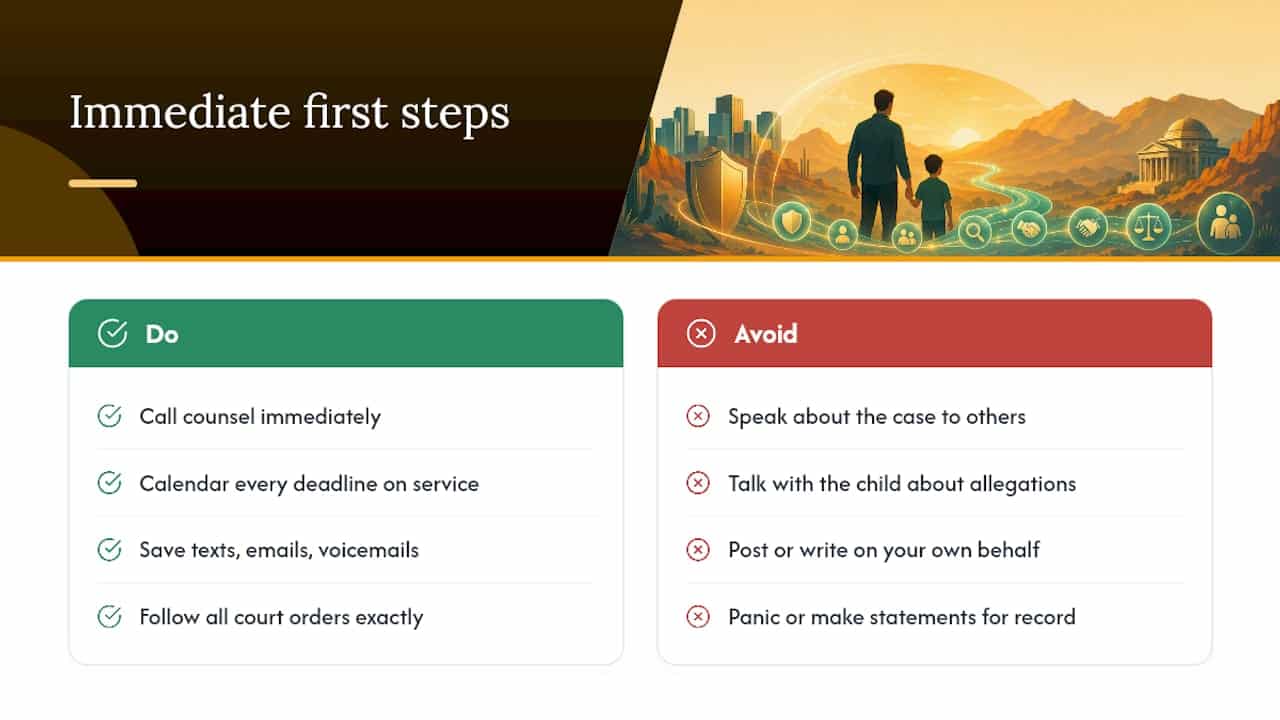
Call counsel today, not after the next hearing date creeps up on you. Calendar every deadline the moment you’re served, both the court’s and DCS’s, because they don’t run on the same clock and missing either one costs you. Save every text, email, and voicemail before anything gets deleted or lost. Follow every order exactly, even the ones that sting.
Stay quiet around the child and the other parent. Let your attorney be the only voice speaking on your behalf in writing. Panic makes people say things that read badly in a transcript six months later; discipline is what actually protects you.
Get help defending against false allegations in Scottsdale
This family law group specializes in assisting parents blindsided by emergency orders or DCS reports and facing urgent deadlines. Experienced attorneys move on both the court and DCS tracks simultaneously, filing verified responses, pushing for evidentiary hearings, requesting administrative appeals, and pursuing sanctions motions under ARS §25-415 when a claim was knowingly fabricated.

When you call, expect a direct conversation about your specific deadlines first, not a sales pitch. The team will walk through your temporary order, your DCS timeline if one exists, and what evidence needs to be locked down this week. If a criminal report was also filed alongside the family case, resources like The Bail Network’s guide on domestic violence bail amounts can help you understand that separate process while your family-law attorney handles custody. Start by reviewing the firm’s child custody services page and requesting a consultation before your next filing deadline arrives.
This article is general information, not a substitute for advice from a qualified lawyer. Consult a qualified legal professional about your own circumstances before acting on anything here.
Sources
- 25-415 – Sanctions for litigation misconduct
- Investigations and OCWI — Department of Child Safety
- Timelines under Statute and Rule — Family law temporary orders (AZ Courts)
- False child abuse allegations in an Arizona custody case — LegalClarity
FAQ
What happens if a child makes false accusations?
Courts don’t automatically assume a child fabricated a claim; DCS and the court both look for signs of coaching by an adult, inconsistency in the child’s account, and corroborating evidence. If investigators or a judge conclude an adult prompted the false statement, that adult faces the same exposure under A.R.S. § 25-415 as if they’d made the claim directly.
How do I fight false allegations in an Arizona custody case?
Comply with any existing orders, hire an Arizona family-law attorney immediately, and start preserving texts, emails, and other contemporaneous records the day you learn of the claim. File your verified response before the deadline and push for an early evidentiary hearing rather than letting the allegation sit unchallenged. Review this evidence checklist for Arizona custody cases for what documentation carries the most weight.
Can a parent lose custody for making false accusations in Arizona?
Yes. When a judge finds a parent knowingly fabricated an abuse or neglect claim, the court can reduce that parent’s parenting time, shift legal decision-making authority to the other parent, and order mandatory attorney fee payments under A.R.S. § 25-415. More detail on how this plays out is available on the firm’s page about losing custody for false accusations.
What should I do if my ex makes false allegations in a custody case?
Follow every existing court order exactly, avoid contacting your ex directly about the allegation, and call an attorney the same day you’re served with any petition or notified of a DCS report. Start documenting your side of events immediately, since courts weigh contemporaneous records far more heavily than statements made after the fact.
Is filing a false abuse report a crime in Arizona?
Yes, knowingly filing a false report of child abuse or neglect can be prosecuted as a class 1 misdemeanor under A.R.S. § 13-2907.02, separate from any sanctions imposed in the family court case itself.