



How to Enforce a Divorce Decree in Arizona

To enforce a divorce decree in Arizona, file the enforcement petition that matches your issue. Unpaid child support or spousal maintenance runs through ARS §25-508 civil remedies, filed with an affidavit of default. Property disputes in Maricopa County use the DREP1 packet: the Petition to Enforce (drep11f) and the Order Enforcing Decree (drep82f). Denied parenting time or custody violations often call for a Motion to Enforce or, when the violation is willful, a Petition for a Rule to Show Cause (contempt).
Before you file anything:
- Pull your signed, filed decree and highlight the exact paragraph being violated.
- Build a paper trail — a payment ledger, texts, titles, or a parenting-time calendar, depending on the issue.
- If the decree was issued in another state, register it in Arizona first. Local self-help packets are built for in-state orders only.
Pro Tip: Arizona’s family courts see these petitions constantly. The single most common reason one gets bounced back is filing the wrong packet for the wrong problem, so confirm your category before you touch a form.
Key Takeaways
Arizona enforces divorce decrees through three distinct legal tracks, support, property, and custody, and using the wrong one delays relief and wastes filing fees.
| Point | Details |
|---|---|
| Match the remedy to the violation | Support uses ARS §25-508 civil remedies; property uses Maricopa’s DREP1 packet; custody often needs a Motion to Enforce or contempt. |
| Notarize and attach the decree | Property petitions like drep11f require notarized signatures and copies of the relevant decree pages. |
| Register out-of-state decrees first | Local packets apply only to Arizona orders, so foreign decrees need registration before enforcement. |
| Document before you file | Payment ledgers, titles, and dated communication logs make or break a hearing, regardless of violation type. |
| Know when to modify instead | Changed income, relocation, or impossible performance call for a modification, not enforcement. |
| Get counsel for complex cases | Highdesertfamilylawgroup handles contempt hearings, foreign order registration, and asset-heavy enforcement disputes. |
This article is general information, not a substitute for advice from a qualified lawyer. Consult a qualified legal professional about your own circumstances before acting on anything here.
Table of Contents
- How Do I Enforce a Divorce Decree in Arizona?
- How to File an Enforcement Petition in Arizona
- What Happens at a Contempt Hearing in Arizona?
- What if My Divorce Decree Was Issued Outside Arizona?
- Should I Modify Instead of Enforce?
- When to Hire a Lawyer for Enforcement in Arizona
- How Do I Prove Non-Compliance in Court?
- What If the Other Party Still Ignores the Order After I File?
- How Are Child Custody Violations Enforced Differently?
- What the Research Actually Tells Arizona Filers
- Get Help Enforcing Your Arizona Divorce Decree
- Sources
How Do I Enforce a Divorce Decree in Arizona?
The honest answer depends on what’s actually being violated, and mixing these up wastes filing fees and court time.
Support enforcement fits missed child support or spousal maintenance payments, growing arrears, or a former spouse who stopped paying entirely. This route relies on civil remedies under ARS §25-508: liens, wage garnishment, bank levies, or attachment.
Property enforcement fits a spouse who won’t sign a deed, refuses to transfer a vehicle title, or keeps property the decree awarded to you. Maricopa County built the DREP1 packet specifically for this and it’s not a debt-collection tool, so don’t use it to chase money owed under a decree.
Custody and parenting-time enforcement fits denied visitation, a parent who won’t return the kids on schedule, or one who ignores the parenting plan outright.
Within custody and property cases, you also have to pick your weapon:
- Motion to Enforce works for low-conflict situations, like a decree that’s ambiguous or a one-time missed exchange that needs court clarification.
- Petition for Rule to Show Cause (contempt) fits repeated, willful violations where the other party clearly knew the order and chose to ignore it.
- Neither one applies if circumstances have genuinely changed since the decree, such as a job loss or a move. That’s a signal you need a modification, not enforcement.
How to File an Enforcement Petition in Arizona
Filing mechanics differ slightly by remedy type, but the backbone is the same everywhere in the state.
For property enforcement in Maricopa County:
- Complete the drep11f Petition to Enforce, matching the case caption exactly to your decree.
- Attach a copy of the relevant decree pages and any supporting documentation (title, deed, bill of sale).
- Sign the petition in front of a notary. Unnotarized petitions get rejected at the counter.
- Prepare the drep82f Order Enforcing Decree for the judge to sign after the hearing.
- File with the Clerk of Superior Court and pay the filing fee, or request a fee deferral if you qualify.
For support enforcement, file an affidavit of default along with a certified copy of the support order, per ARS §25-508. The clerk uses this to initiate wage garnishment, a lien, or attachment without a separate finding of contempt in many cases.
Filing logistics that trip people up:
- Most county packets, including Pima County’s non-support enforcement packet, require you to organize documents into separate sets: one for the court, one for the other party, one for your records.
- Service on the other party typically needs a set number of days’ notice before a hearing. Check your county’s current packet for the exact window.
- Filing fees vary by county and case type, and courts routinely offer a deferral or waiver for those who qualify financially.
Evidence checklist for your hearing: a payment ledger or bank statements showing missed support, title documents and photos for property, and texts, emails, or a shared calendar showing denied parenting time. Bring proof you tried to resolve the issue directly first. Judges notice when you skipped that step.
Pro Tip: Read the DREP11 instructions line by line before you fill anything out. Courts built these forms to match exactly what the judge needs to see, and following the caption and attachment rules to the letter is what keeps your filing from getting kicked back for a technicality.
What Happens at a Contempt Hearing in Arizona?
A judge won’t hold someone in contempt just because they missed a deadline. The standard is willfulness: the court needs to see the person knew the order, had the ability to comply, and chose not to.
If the judge finds willful noncompliance, the remedies get real fast:
- Monetary fines payable to the court or the other party.
- Coercive incarceration, meaning jail until the person complies (this shows up almost exclusively in support and parenting-time cases, rarely in pure property disputes).
- Orders to pay back support or make up missed parenting time.
- Attorney’s fees awarded against the noncompliant party.
Collection remedies like liens, garnishment, and attachment under ARS §25-508 run on a separate civil track from contempt. You can pursue a lien on someone’s property to collect unpaid support without ever asking the court to hold them in contempt. Contempt carries more punch for ongoing defiance around kids or support; straight collection tools work better when you just want the money. For a fuller breakdown of how contempt actually plays out in Arizona family court, see our guide on contempt of court in Arizona family law.
What if My Divorce Decree Was Issued Outside Arizona?
Arizona’s do-it-yourself enforcement packets are built for Arizona orders. If your decree came from another state, you generally need to register it here before any local packet applies. Skipping this step is one of the most common reasons self-represented filers get turned away at the clerk’s counter.
A few timing and jurisdiction issues worth flagging before you file:
- Registration typically requires a certified copy of the out-of-state decree and additional authentication paperwork, which can slow things down if you’re not prepared for it.
- Collection remedies like liens and garnishment often depend on how long the underlying judgment stays enforceable, so don’t assume an old decree still carries full force without checking.
- Counties don’t all use identical packets. Maricopa County runs DREP1 for property enforcement, while Pima County uses its own Request to Enforce packet (Packet #26) for non-support orders. Confirm you’re using your county’s current version before filing, since a Maricopa form filed in Pima County (or vice versa) can cause delays.
Check your county Superior Court’s family court forms page for the most current version of any packet before you file.
Should I Modify Instead of Enforce?
Enforcement asks the court to make someone follow the decree as written. Modification asks the court to change what the decree says going forward. Confusing the two burns filing fees and delays real relief.
Modification is the right move when:
- Your ex lost their job or their income changed substantially since the decree was entered.
- The custodial parent wants to relocate, or already moved without following notice requirements.
- Property ordered to be transferred was already sold or no longer exists.
- Complying with the original order has become genuinely impossible, not just inconvenient.
If any of that sounds like your situation, filing an enforcement petition probably won’t get you far. Our post-decree modification guide walks through the forms and standards for changing support, custody, or property terms after the fact.
When to Hire a Lawyer for Enforcement in Arizona
High Desert Family Law Group has handled thousands of Arizona family law matters, including contempt actions, out-of-state order registration, and complex property enforcement. An attorney earns their fee fastest in three scenarios:
- Registering a decree from another state, where missed paperwork causes real delays.
- Property enforcement involving businesses, retirement accounts, or real estate with title complications.
- Aggressive collection strategies against a spouse actively hiding assets or income.
Self-represented litigants can absolutely win straightforward enforcement petitions. Where cases get expensive is when the other side lawyers up or the assets get complicated, and that’s exactly when experienced counsel pays for itself.
If your case fits one of those categories, our overview of types of family lawyers explains which kind of representation matches which kind of enforcement problem.
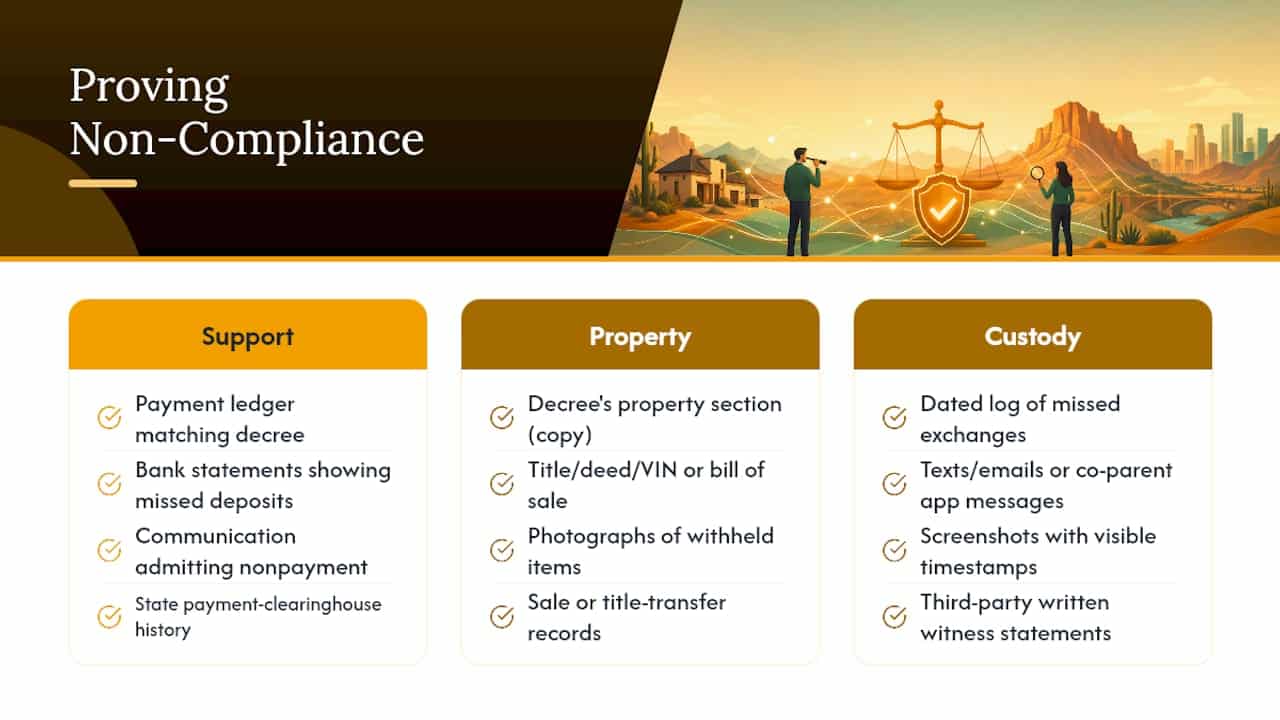
How Do I Prove Non-Compliance in Court?
Judges rule on documentation, not frustration. What counts as proof depends heavily on which part of the decree got violated.
For support violations, build a payment ledger that lines up exactly with the decree’s schedule. Bank statements showing missed deposits, along with any communication where the other party acknowledges they didn’t pay, carry real weight. If support runs through the state’s payment clearinghouse, request the official payment history. That printout alone can settle a dispute over whether payments arrived on time.
For property violations, gather the decree’s property section alongside title documents, deeds, VIN numbers, or bills of sale showing the item was awarded to you. Photographs help when someone refuses to hand over physical items like furniture or vehicles. If the other party sold or transferred property that was supposed to come to you, pull whatever sale records or title transfer paperwork you can find.
For custody and parenting-time violations, a dated log matters more than memory. Note every missed exchange, late pickup, or denied visit, and back it up with texts, emails, or app-based co-parenting messages. Screenshots with visible timestamps hold up better than a printed conversation with no dates attached. If a third party witnessed the denial, a school employee or a mutual friend, get a written statement while the details are fresh.
Across all three categories, judges respond well to proof you tried resolving the issue outside court first. A dated email asking the other party to comply, even if ignored, shows good faith and strengthens your position at the hearing.
What If the Other Party Still Ignores the Order After I File?
Filing the enforcement petition doesn’t guarantee instant compliance. If the other party ignores the order even after a judge rules, your next moves depend on what kind of order it was.
For support and property judgments, you can pursue additional civil collection tools without going back through the entire enforcement process. That includes wage garnishment, bank levies, or placing a lien on real property under ARS §25-508. These remedies exist specifically for cases where a first order didn’t produce payment.
For custody and parenting-time defiance, continued noncompliance after a court order is when a contempt filing becomes the stronger tool. Document every additional violation with the same rigor as before: dates, times, and communications. A pattern of repeated defiance after a court already ruled makes a much stronger contempt case than a single incident.
In persistent cases, ask the court to add specific consequences to the enforcement order itself, like automatic fines for each future violation or a requirement that future exchanges happen through a neutral third party. Courts can and do escalate remedies when a party shows they’ll ignore anything short of real consequences. If garnishment or a lien didn’t work the first time, a second filing citing continued noncompliance carries more weight than starting from scratch.
How Are Child Custody Violations Enforced Differently?
Custody and parenting-time cases move faster and hit harder than property or support disputes, because courts treat a child’s wellbeing and schedule stability as urgent.
A single missed exchange usually calls for a Motion to Enforce, asking the judge to clarify the schedule or order a make-up visit. But a pattern of denied access, a parent who’s disappeared with the child, or a co-parent who’s clearly alienating the child from you calls for something stronger.
Emergency relief options exist specifically for custody cases in a way they generally don’t for property or routine support disputes. If a child is in immediate danger, or a parent has taken the child in violation of the order and won’t disclose their location, you can request an emergency hearing rather than waiting for the standard calendar. Courts can issue temporary orders addressing immediate safety or return of the child while the underlying enforcement or contempt petition proceeds.

Contempt findings in custody cases can also carry consequences you won’t see in a property dispute, including modified parenting time, supervised visitation for the violating parent, or in the most serious repeat cases, a shift in primary custody itself. That’s a meaningfully higher stake than a fine for a missed property transfer, and it’s part of why courts scrutinize the evidence closely before ruling. Bring your documentation, and bring it organized by date.
What the Research Actually Tells Arizona Filers
The conventional advice you’ll find online treats “enforce your divorce decree” as one generic process. It isn’t. Arizona splits enforcement into distinct tracks with their own statutes, packets, and evidence standards, and the biggest single mistake self-represented filers make isn’t paperwork error. It’s picking the wrong track entirely.
What gets underrated is how often enforcement isn’t even the right tool. A parent whose ex lost their job doesn’t need a contempt hearing. They need a modification. Filing enforcement papers against someone who genuinely can’t comply wastes a filing fee and often backfires, because judges notice when the underlying facts have shifted and the enforcement petition doesn’t fit them.
What should come first, before any form gets filled out, is a five-minute gut check: did the other party violate a clear, unambiguous order they had the ability to follow? If yes, enforcement is your path. If circumstances changed since the decree was signed, look at modification instead of forcing a mismatched filing through the system.
— Brett
Get Help Enforcing Your Arizona Divorce Decree
Highdesertfamilylawgroup is the option for Scottsdale-area families who’d rather not learn court-packet procedure from scratch while their ex ignores a support payment or blocks a scheduled visit. Instead of guessing which form fits your situation or risking a rejected filing over a missed notarization, our team handles the petition, the evidence packet, and the hearing itself.

We’ve built our practice around exactly this kind of case: contempt hearings, out-of-state order registration, and property enforcement that involves more than a simple title transfer. If your enforcement case involves complicated assets, a parent who’s already ignored one court order, or a decree issued in a different state, that complexity is where experienced representation pays for itself fastest. Our types of family lawyers page breaks down which attorney fits which enforcement scenario. Reach out for a consultation, and we’ll tell you plainly whether your case needs a lawyer or whether a self-filed petition will get the job done.