



Recover Half: Marital Waste in Arizona and How Courts Credit It

Yes, Arizona courts can offset marital waste. Under A.R.S. § 25-318©, a judge dividing community property may credit a spouse for money the other spouse wasted on excessive, abnormal, or fraudulent spending. In practice, that usually means a dollar-for-dollar credit equal to half the wasted amount, or a money judgment if there is not enough left in the estate to cover it.
TL;DR:
- Courts can offset marital waste only if the spending was excessive, abnormal, or fraudulent, with the burden shifting to justify or prove the expense.
- Evidence such as bank statements, receipts, and transfer histories is crucial to establish documented patterns of waste, especially for larger estates.
- The usual remedy is a credit for half the wasted amount against the community estate, potentially accompanied by a money judgment or lien if assets are insufficient.
- Timing is critical, as automatic injunctions prevent further dissipation once a petition is filed, making early evidence collection vital.
- Defenses include prior consent, consistent spending patterns, legitimate purpose, and lack of concealment; silence or vague records typically weaken your position.
Table of Contents
- What Counts as Marital Waste Under Arizona Law?
- How Do Arizona Courts Evaluate a Waste Claim?
- What Are Common Examples of Waste, and What Proves Them?
- What Remedies Do Courts Award for Marital Waste?
- When Should You Act to Preserve the Estate?
- What Should You Do If You’re Accused, or Accusing?
- Does Marital Waste Affect Child Custody or Support?
- How Do Courts Tell Waste From a Legitimate Bad Decision?
- What Defenses Work Against a Marital Waste Claim?
- What Do Arizona Courts Actually Say About Waste Claims?
- The Part Nobody Tells You About Waste Claims
- Talk to a Family Law Attorney About Protecting Your Assets
- Where to Verify the Law on Marital Waste
- Sources
What Counts as Marital Waste Under Arizona Law?
Arizona’s waste statute doesn’t hand you a checklist. It uses broader language: “excessive or abnormal expenditures,” destruction, concealment, or fraudulent disposition of community property under A.R.S. § 25-318©. Judges apply that language by comparing spending against what the household actually looked like before things fell apart. A spouse who always dropped $3,000 a month on hobbies isn’t wasting funds by doing it again in month eleven of a rocky marriage. A spouse who suddenly starts pulling $2,000 a month from a joint account with no explanation is a different story.
The core question courts ask: did this spending serve the marriage or community, or did it serve one spouse’s private interest at the community’s expense?
Common examples that typically qualify:
- Cash or gifts spent on an affair partner
- Gambling losses that spike well beyond any established pattern
- Money funneled to a secret account or a friend “holding” funds
- Deliberate destruction or a lowball sale of a shared asset
- Substance abuse spending that drains joint accounts
What usually doesn’t qualify: ordinary bills, groceries, kids’ expenses, or even a bad investment made in good faith. Courts distinguish waste from garden-variety financial mismanagement, and that distinction matters a lot for anyone building or defending a claim.
How Do Arizona Courts Evaluate a Waste Claim?
Arizona uses a burden-shifting framework, and understanding it changes how you build your case. The accusing spouse first has to make what’s called a prima facie showing: enough documented anomalies (unexplained withdrawals, transfers, missing assets) to raise a legitimate question. You don’t need to trace every dollar. You need enough of a pattern that a judge looks at the other spouse and says, “explain this.”
Once that threshold is met, the burden shifts. The spending spouse has to justify the expenditures as legitimate, or the court treats the money as wasted community property.
Quick fact: There’s no fixed statutory lookback period for how far back a court will examine spending. Practitioners commonly focus on the two to five years before the marriage started breaking down, since that window tends to hold the most relevant financial anomalies.
Three statutes anchor this framework:
- A.R.S. § 25-318 governs disposition of property and lets courts consider waste in the division
- A.R.S. § 25-211 establishes the presumption that property acquired during marriage is community property, which is why one spouse can’t unilaterally burn through joint funds without consequence
- A.R.S. § 25-315 imposes an automatic injunction once a petition is filed, restricting what either spouse can do with community assets
What Are Common Examples of Waste, and What Proves Them?
Waste claims live and die on paper trails. Judges don’t rule on suspicion; they rule on documented patterns. The most common categories are:
- Affair-related spending — hotel charges, jewelry, travel, or cash withdrawals timed to an affair. Infidelity itself doesn’t change property division in Arizona, but the money spent supporting it absolutely can.
- Gambling losses that spike sharply compared to historical patterns.
- Substance abuse spending that drains accounts with no corresponding household benefit.
- Hidden transfers to a separate account, a family member, or a shell arrangement.
- Destruction or underpriced sales of vehicles, collectibles, or business assets right before filing.
The evidence that actually moves a judge: bank and credit card statements, ATM withdrawal logs, hotel and merchant receipts, Venmo or PayPal transfer histories, and sometimes social media or location data that ties a withdrawal to a specific trip or person.
For larger estates, a forensic accountant is often worth the cost. They typically bill in the low hundreds per hour, and their job is tracing commingled funds and reconstructing timelines that a spouse without accounting training simply can’t build alone.
Pro Tip: Start a spreadsheet timeline the day you suspect waste. List date, amount, account, and your best guess at purpose. Courts respond to organized patterns, not scattered receipts handed over in a folder three days before trial.
What Remedies Do Courts Award for Marital Waste?
When a court finds waste, the fix usually starts with a straightforward calculation: add the wasted amount back into the total community estate, then credit the innocent spouse with roughly half of it. That typically plays out as an unequal division of remaining assets rather than a separate payment.
Quick fact: Practitioner guidance confirms courts routinely credit the innocent spouse with half the wasted amount, entering a money judgment against the wasting spouse if the remaining estate can’t absorb the offset.
Additional consequences can include:
- A money judgment enforceable like any other civil judgment
- A lien against real property or other assets to secure payment
- Attorney’s fee awards under A.R.S. § 25-324 if the wasting spouse’s conduct increased litigation costs
- Downstream effects on spousal maintenance calculations, since a judge weighs each spouse’s financial resources after the offset
When Should You Act to Preserve the Estate?
Timing decides most waste cases before they ever reach trial, and it is helpful to understand the divorce property sale process: stress-free NZ guide for pointers on managing asset sales efficiently. The moment a petition is filed, an automatic preliminary injunction under A.R.S. § 25-315 bars either spouse from selling, hiding, or destroying community property without consent or court approval. Violating it can itself become evidence of waste.
If you suspect dissipation is happening now:
- Download and save copies of every joint account statement you can access
- Screenshot balances before they can be manipulated further
- Ask your attorney about an emergency motion or temporary restraining order if funds are actively disappearing
- Request a contempt hearing if the other spouse violates the injunction after filing
Evidence gets harder to reconstruct every week that passes. Waiting to “see how things go” is the single most common mistake accusing spouses make.
What Should You Do If You’re Accused, or Accusing?
Your next move depends on which side of the claim you’re on.
- If you’re accused: Gather receipts and records showing a legitimate purpose for each questioned expense, note if your spouse consented or knew about the spending, and preserve texts or emails that provide context.
- If you’re accusing: Build a chronological transaction timeline, subpoena records if a bank won’t release them voluntarily, and get a realistic estimate of likely recovery before paying for forensic accounting.
- Weigh mediation against litigation: If the wasted amount is modest, a full-blown forensic investigation can cost more than it recovers. Larger, harder-to-explain patterns usually justify litigation and expert involvement.
Both sides benefit from talking to counsel early, since a few smart moves in month one can save months of costly discovery later.
Does Marital Waste Affect Child Custody or Support?
Marital waste and custody run on separate tracks in Arizona, and conflating them is one of the more common mistakes divorcing spouses make. A judge deciding legal decision-making and parenting time looks at the child’s best interests: stability, each parent’s involvement, and any history of abuse or neglect. Wasting community funds on gambling or an affair doesn’t, by itself, make someone a worse parent in the court’s eyes.
Where waste can matter is indirectly. If the wasteful spending involved substance abuse or reckless behavior that put a child at risk, that pattern becomes relevant to custody on its own terms, separate from the financial waste claim. A parent who gambled away savings while leaving young kids unsupervised faces a custody problem tied to the neglect, not the money.
Child support calculations can feel the effects more directly. Arizona’s child support guidelines run off each parent’s gross income, not their asset division outcome. But if a waste finding results in a money judgment or unequal division that shifts a parent’s overall financial picture, that can influence a later modification request, particularly if one parent’s earning capacity or available assets changed as a result of the court’s remedy. It’s worth noting that a waste finding doesn’t automatically increase or decrease a support obligation. The connection is indirect and case-specific, not automatic.
How Do Courts Tell Waste From a Legitimate Bad Decision?
Intent is the hinge the entire waste analysis swings on. Arizona judges aren’t in the business of punishing bad investments or judgment calls that seemed reasonable at the time. A spouse who sank savings into a business that failed made a legitimate, if unlucky, financial decision. A spouse who secretly funneled money to a girlfriend while claiming the withdrawals were “business expenses” made something else entirely.
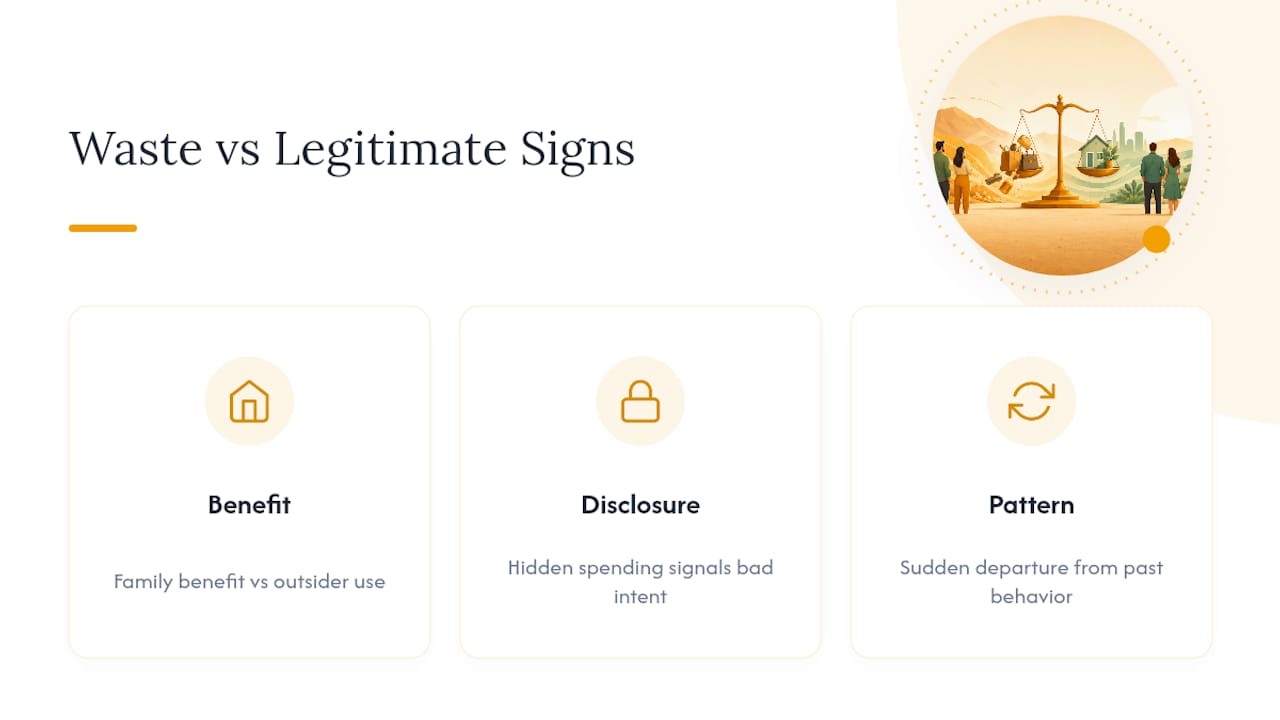
Courts look for a few markers to separate the two. First, did the spending benefit the community or only the individual? Money spent on a family vacation benefits the marriage, even if the timing was poor. Money spent on a hotel room with someone outside the marriage doesn’t. Second, was the spending disclosed or hidden? Concealment is one of the strongest signals of bad intent, since a legitimate expense usually doesn’t need to be hidden from a spouse with equal ownership rights. Third, does the spending pattern match historical behavior, or did it appear suddenly and inexplicably once the marriage started to unravel?
A useful way to think about it: waste requires a private, non-marital purpose paired with a departure from established norms. Remove either element and you’re usually looking at ordinary financial risk, not waste. That’s why documentation matters so much on both sides. The accusing spouse needs to show the departure from the pattern; the accused spouse needs evidence that the purpose was legitimate, even if it turned out badly.
What Defenses Work Against a Marital Waste Claim?
If you’re the one accused, Arizona law gives you real room to push back, and several defenses come up repeatedly in these disputes.
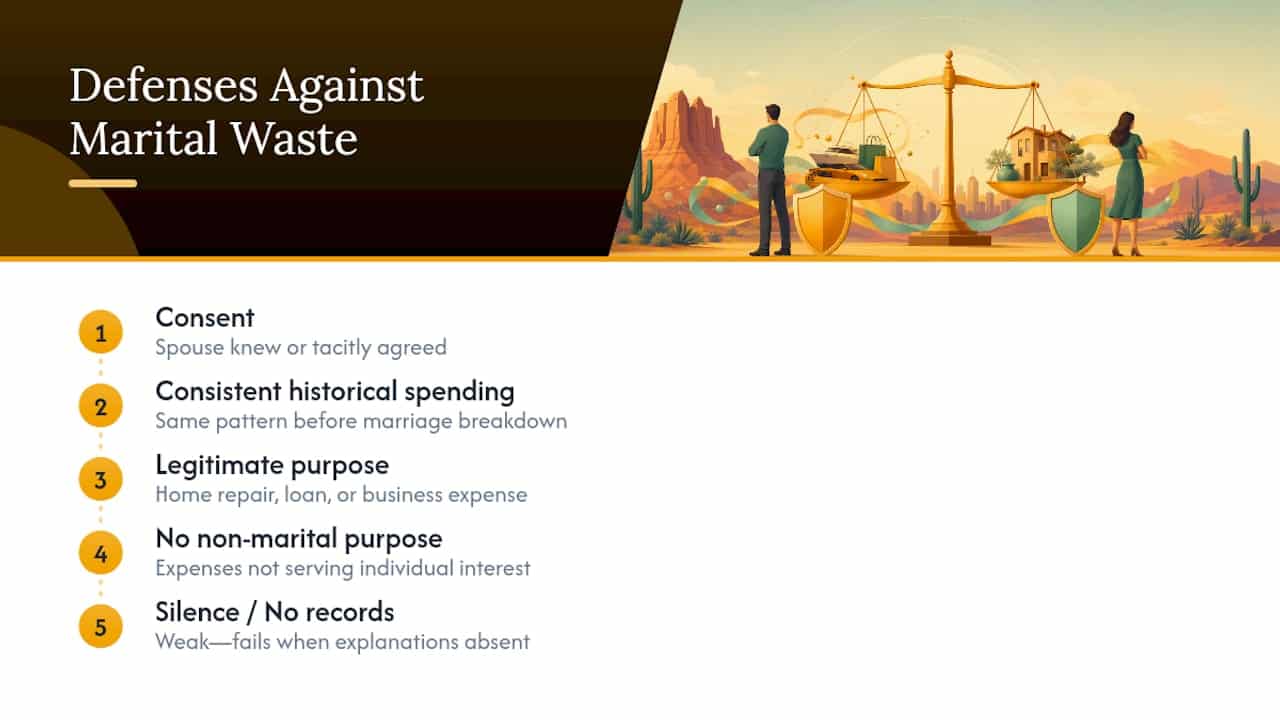
Consent is often the strongest one. If your spouse knew about and agreed to the spending, even implicitly by never objecting over years of the same pattern, that undercuts the claim that it was secretive or wrongful. Courts weigh whether the behavior was truly hidden or just something the accusing spouse now regrets tolerating.
Consistency with historical spending is another solid defense. If you can show bank records demonstrating the same spending pattern existed well before the marriage started to break down, you undercut the argument that the expenditure was “abnormal.”
Legitimate business or household purpose covers a lot of ground. An expense that looks suspicious in isolation, a large cash withdrawal, an unusual transfer, often has a mundane explanation: a home repair paid in cash, a loan to a family member both spouses agreed on, or a business expense that simply lacked a paper trail at the time.
Lack of a non-marital purpose matters too. Waste requires spending that served an individual interest at the community’s expense. A failed investment, a risky but honest business decision, or an expensive but disclosed purchase generally doesn’t meet that bar, even if it turned out to be a poor choice.
The weakest defense is usually silence. Spouses who can’t produce records or explanations once a prima facie showing is made tend to lose that argument by default, since the burden has already shifted to them.
What Do Arizona Courts Actually Say About Waste Claims?
Arizona’s waste doctrine has developed less through a single landmark ruling and more through a consistent line of appellate decisions applying A.R.S. § 25-318 to specific fact patterns: hidden accounts, gambling losses, and business asset transfers among them. The consistent thread running through these cases is that appellate courts give trial judges wide discretion once a prima facie showing has been made. Reviewing courts rarely second-guess a trial judge’s factual findings about whether spending was excessive or abnormal, so long as the judge applied the right legal framework and the record supports the conclusion.
That discretion cuts both ways for readers. It means a strong, well-documented case in front of a sympathetic judge has real staying power on appeal. It also means a weak factual record, vague accusations without bank statements, guesses about where money went, rarely survives review even if the accusing spouse feels certain waste occurred. The consistent lesson from how Arizona’s appellate courts have treated these disputes: the trial court record is almost everything. Build it well the first time, because appellate courts are not inclined to rebuild it for you.
The Part Nobody Tells You About Waste Claims
Most articles on marital waste treat it like a math problem: prove the spending, get the credit, move on. That undersells how much these cases actually turn on narrative and timing rather than pure numbers. A $15,000 waste claim backed by six months of methodical bank statements often lands harder with a judge than a $50,000 claim built on a scattered pile of screenshots gathered the week before trial.
The other thing people underestimate: waste claims are frequently used as leverage in settlement negotiations even when the underlying case is shaky. A spouse facing a credible, well-documented allegation often settles for more favorable terms elsewhere just to avoid a forensic accountant digging through years of statements. That’s not a loophole. It’s simply how litigation risk works, and it’s a reason accusing spouses shouldn’t assume they need airtight proof before raising the issue with counsel.
Where I’d push back on conventional wisdom: too many people wait for a “smoking gun” transaction before acting, when the real leverage comes from pattern evidence assembled early and organized clearly. If you’re already suspicious, you likely have enough to start building a timeline today.
— Brett
Talk to a Family Law Attorney About Protecting Your Assets
Marital waste claims are won or lost on documentation, and building that record without legal guidance is where most people lose ground they didn’t have to. High Desert Family Law Group has spent more than 20 years handling Arizona divorce and property disputes, including cases where forensic tracing and emergency motions made the difference between a fair split and a spouse walking away with community funds nobody could recover.

Whether you’re building a waste claim or defending against one, the right legal team helps you know which records actually matter, when a forensic accountant is worth the cost, and when an emergency motion is the faster path to protecting what’s left of the estate. Bring your bank statements, a rough spending timeline, and any records of unusual transfers to your first consultation. Our team can help you sort out what’s a genuine claim and what’s a distraction before you spend money proving it. Learn more about the types of family lawyers who handle these disputes and schedule a consultation to talk through your specific situation.
Where to Verify the Law on Marital Waste
- A.R.S. § 25-318: property disposition and waste-related remedies
- A.R.S. § 25-211: community property presumption
- A.R.S. § 25-315: automatic preliminary injunction on filing
- Marital Waste in Arizona: Laws, Proof, and Consequences: practitioner overview of proof standards
- Background on community property classification in Arizona divorces
This article is general information, not a substitute for advice from a qualified lawyer. Consult a qualified legal professional about your own circumstances before acting on anything here.
Sources
- 25-318 – Disposition of property; retroactivity; notice to creditors; assignment of debts; contempt of court
- 25-211 – Property acquired during marriage as community property; exceptions; effect of service of a petition
- Compensation for Waste of Community Assets in AZ – LegalClarity