



Avoid Litigation Reset: Scottsdale Collaborative Divorce (Rule 67.1)

Collaborative divorce is a voluntary, out-of-court process available in Arizona under Rule 67.1, and it works well when both spouses genuinely want to settle without a judge deciding their future. You need at least 90 days of Arizona residency to file, both spouses must agree to participate, and the process is a poor fit where coercion, abuse, or hidden assets are likely. For the right couple, it’s often faster and less adversarial than litigation.
TL;DR:
- Collaborative divorce costs in Arizona typically range from $7,000 to $40,000 and lasts around four to nine months, depending on case complexity.
- The process requires at least 90 days of Arizona residency, mutual agreement to participate, and honest financial disclosure from both spouses.
- It is unsuitable for couples dealing with coercion, domestic violence, or suspicion of asset concealment, as safety and transparency are critical.
- A disqualification clause discourages litigation by requiring attorneys to withdraw if either spouse files for court cases, incentivizing cooperation.
- Preparing organized financial records and clarifying parenting and support priorities before the first meeting can significantly reduce costs and delays.
Table of Contents
- What Collaborative Divorce Means Under Arizona Law
- How Does the Collaborative Divorce Process Work Step by Step?
- Is Collaborative Divorce Right for You?
- What Does Collaborative Divorce Cost in Arizona, and How Long Does It Take?
- What Should You Prepare Before Your First Collaborative Session?
- How Do You Choose a Collaboratively Trained Attorney in Scottsdale?
- What Happens After You Reach an Agreement?
- Publisher Perspective: How High Desert Family Law Group Applies Collaborative Practice
- Ready to Talk to a Collaborative Divorce Attorney in Scottsdale?
- Primary Sources and Legal References
- Sources
What Collaborative Divorce Means Under Arizona Law
Rule 67.1 of the Arizona Rules of Family Law Procedure governs collaborative law proceedings statewide, including in Scottsdale’s Maricopa County courts. The process starts when both spouses sign a participation agreement committing to negotiate in good faith, disclose finances honestly, and stay out of court entirely while the collaborative process is underway.
A typical collaborative team looks different from a courtroom fight. You each retain your own collaboratively trained attorney, and the team often includes a financial neutral to handle asset and retirement questions, plus a divorce coach or child specialist when parenting issues are contested.
That structure sets collaborative divorce apart from its two main alternatives:
- Mediation uses one neutral mediator and usually no attorneys in the room, while collaborative divorce gives each spouse independent legal counsel throughout.
- Litigation puts a judge in control of outcomes; collaborative divorce keeps every decision in the spouses’ hands.
- Both mediation and collaborative practice avoid a public trial, but only collaborative law builds in a dedicated professional team.
How Does the Collaborative Divorce Process Work Step by Step?
The process moves through a predictable sequence, though the pace depends on how complex your finances and parenting situation are.
- Sign the participation agreement. This document includes the disqualification clause: if either spouse files for litigation, both attorneys must withdraw from the case entirely.
- Hold initial private meetings. Each spouse meets individually with their attorney to set goals and identify concerns before any joint session.
- Assemble the neutral team. A financial neutral and, if needed, a child specialist or coach join the process at this stage.
- Attend four-way meetings. You, your spouse, and both attorneys meet repeatedly to work through property division, support, and parenting terms.
- Complete financial disclosure. Expect to hand over tax returns, pay stubs, retirement statements, and debt records early and completely.
- Draft and finalize the settlement. Once terms are set, attorneys prepare the agreement for court filing.
Pro Tip: Treat the disqualification clause as your biggest incentive to stay cooperative. Losing your collaborative attorney mid-process means starting over with new litigation counsel, which erases most of the time and money you already saved.
Is Collaborative Divorce Right for You?
Collaborative divorce fits couples who can still talk to each other, even if the conversations are hard. It suits spouses who want privacy, plan to co-parent afterward, and are willing to negotiate rather than dig in.
It’s the wrong choice in several situations:
- Either spouse has a history of coercive control or domestic violence.
- One spouse is likely concealing income, assets, or debt.
- Communication has broken down so completely that four-way meetings aren’t safe or productive.
Collaborative protocols require attorneys to screen for coercion and violence before the process begins, and to confirm informed consent from both spouses. A responsible attorney will ask direct questions about safety and control dynamics during your first consultation, not after the participation agreement is signed.
What Does Collaborative Divorce Cost in Arizona, and How Long Does It Take?
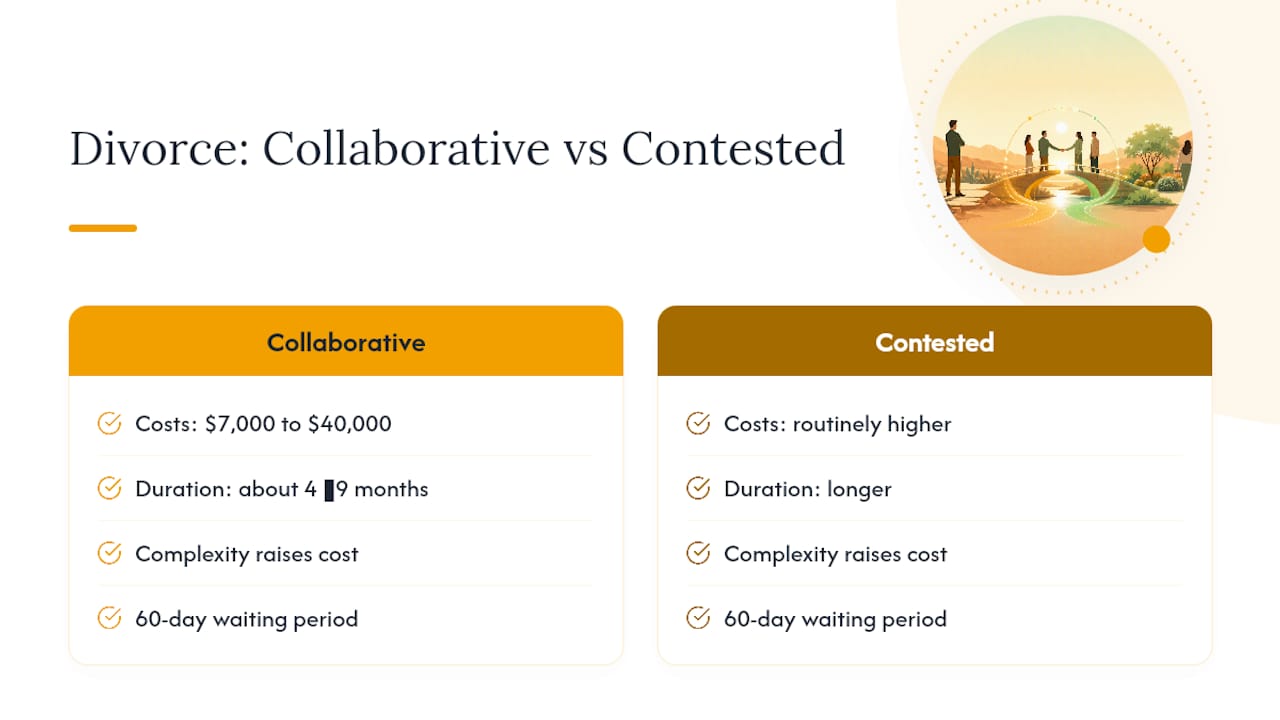
Collaborative divorce in Arizona typically runs $7,000 to $40,000 and takes about four to nine months, compared with contested litigation, which routinely costs more and drags on longer.
That range swings widely based on complexity. A business valuation, multiple financial neutrals, contested disclosure disputes, or difficult parenting-plan negotiations all push costs toward the higher end. Simpler cases with modest assets and cooperative spouses tend to land near the bottom.
One fixed cost applies no matter how smooth your case runs: Arizona’s 60-day waiting period between filing and final decree, which no amount of cooperation shortens. If you’re comparing this against other paths, our breakdown of divorce costs and attorney fees in Arizona lays out how litigation expenses typically stack up.
What Should You Prepare Before Your First Collaborative Session?
Walking into your first meeting organized saves real time and money, since neutrals and attorneys bill for the hours spent chasing down paperwork.
- Two to three years of tax returns.
- Recent pay stubs and any additional income documentation.
- Bank, brokerage, and retirement account statements.
- Mortgage statements and a list of outstanding debts.
- Business financial records, if either spouse owns a company.
Beyond paperwork, think through your priorities on parenting time, how you’d like retirement accounts split, and what spousal support goals matter most to you.
Pro Tip: Organize documents by category in labeled folders, digital or physical, before your first meeting. Financial neutrals move faster with clean records, and that efficiency shows up directly in your final bill.
How Do You Choose a Collaboratively Trained Attorney in Scottsdale?
Not every family law attorney has collaborative training, so ask directly about it during your consultation. A few questions separate attorneys who genuinely practice collaborative law from those who simply say they do:
- How many collaborative cases have you handled under Rule 67.1, and what were the outcomes?
- Which financial neutrals or child specialists do you typically work with?
- What is your fee structure, and how do you estimate total cost for a case like mine?
- How do you screen for coercion or domestic violence before recommending collaboration?
A clear informed-consent conversation should cover the disqualification clause in plain language, realistic cost expectations, and what happens if the process breaks down. The written participation agreement itself should spell out disclosure obligations, neutral roles, and the withdrawal provision in detail, not vague summaries.
What Happens After You Reach an Agreement?
Once both spouses sign the settlement, your attorneys file a consent decree with the court. Arizona’s 60-day waiting period under Ariz. Rev. Stat. § 25-329 still applies from the date of filing, regardless of how quickly you reached terms.
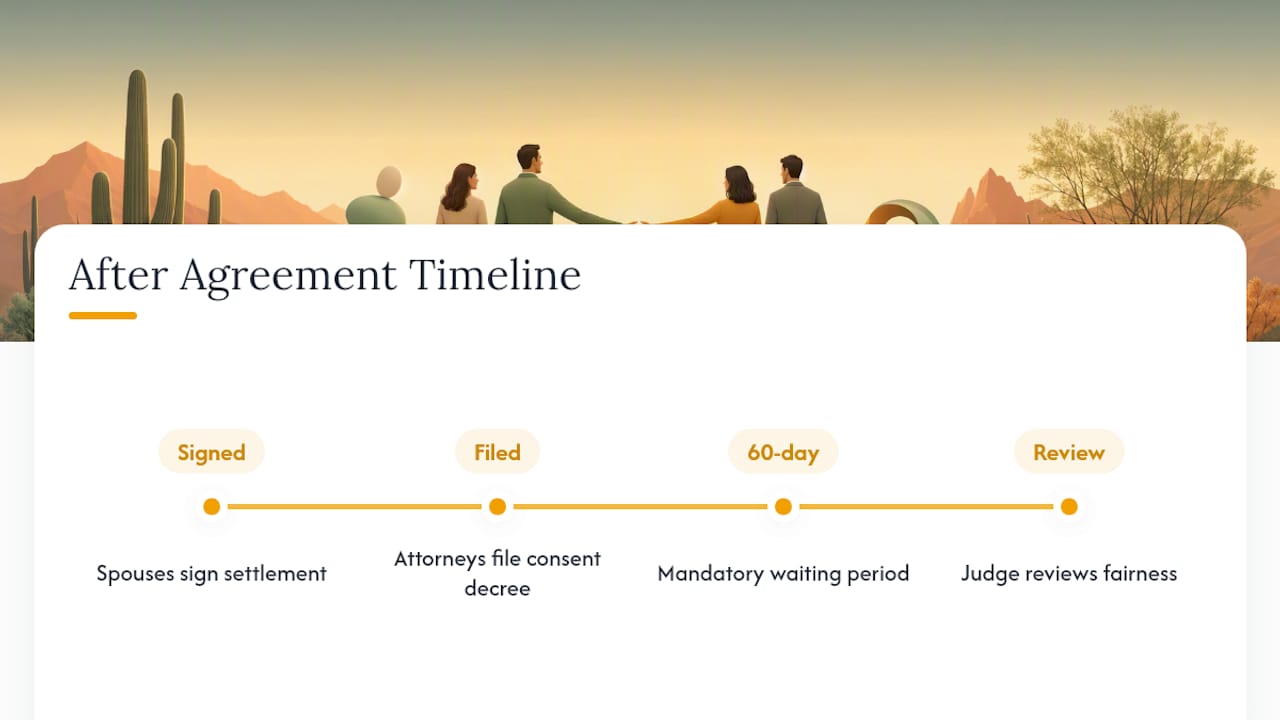
A judge reviews uncontested agreements for fairness and completeness rather than re-litigating terms, so a clean, well-documented settlement usually moves through review quickly.
If collaboration collapses before you reach agreement, both attorneys must withdraw under the participation agreement’s disqualification clause. You’ll need to hire new litigation counsel, which resets much of the progress you made.
Publisher Perspective: How High Desert Family Law Group Applies Collaborative Practice
With over 20 years of combined experience and thousands of family law cases handled, Highdesertfamilylawgroup treats collaborative divorce as the preferred route whenever both spouses can commit to honest financial disclosure and civil negotiation. We recommend mediation instead when spouses want a single neutral rather than dual representation, and we steer clients toward litigation only when screening reveals coercion, concealment, or a genuine impasse.
Our approach coordinates financial neutrals early, gives clients a realistic fee estimate before the participation agreement is signed, and builds parenting plans around what actually works for the family, not a generic template. Collaborative law rewards preparation, and that’s where a firm with real Rule 67.1 experience earns its value.
Ready to Talk to a Collaborative Divorce Attorney in Scottsdale?
Some local family law firms handle collaborative and uncontested divorces and can provide attorneys experienced with working alongside financial neutrals and child specialists familiar with the area’s resources. Instead of researching Rule 67.1 requirements and vetting neutrals yourself while managing an emotionally difficult transition, you may benefit from a team with established connections and the ability to provide an initial cost estimate.

Bring your last two to three years of tax returns, a list of major assets and debts, and your priorities for parenting time to your initial consultation. We’ll walk through whether collaborative divorce, mediation, or another path fits your situation, and outline what the process would look like for your case. Visit our family law services overview to schedule a consultation and get a clear picture of your options.
Primary Sources and Legal References
For further reading, consult Rule 67.1 of the Arizona Rules of Family Law Procedure, the Maricopa County Superior Court family law self-help resources, and the Arizona Courts self-service family law forms for filing requirements and checklists.
This article is general information, not a substitute for advice from a qualified lawyer. Consult a qualified legal professional about your own circumstances before acting on anything here.
Sources
- Maricopa Superior Court family law resources
- Collaborative divorce in Arizona: guide to process, costs, timeline
- Collaborative protocols and screening guidance (DC-Metro protocols)