



7 Questions to Help You Choose a Scottsdale Divorce Lawyer

Choosing a divorce lawyer in Scottsdale comes down to four things: verified family-law experience in Arizona courts, transparent fees you can compare on paper, communication you can actually live with for months, and an approach that matches how contentious your case is likely to get. Schedule consultations with two or three firms before you sign anything. Bring your financial documents, a written list of custody or property concerns, and a set of direct questions to each meeting.
TL;DR:
- The most important factors are verified family-law experience in Arizona courts, transparent fees, effective communication, and an approach tailored to your case’s conflict level.
- Specialization in family law and recent case experience in Maricopa County are crucial for accurate advice and better outcomes.
- Clear, written fee estimates and understanding who handles your case are essential to avoid unexpected costs and miscommunication.
- Contested cases with custody disputes, hidden assets, or property valuations tend to be more expensive and lengthy, often exceeding a year if highly contentious.
- Choosing an attorney with local, focused experience can significantly impact case outcomes and prevent costly mismatches between case complexity and lawyer expertise.
Table of Contents
- What should you look for when you choose a divorce lawyer in Scottsdale?
- How much does a divorce attorney cost in Arizona?
- How long does a divorce take in Scottsdale?
- Mediation, collaborative divorce, or litigation: which one fits your case?
- What questions should you ask at a divorce consultation?
- Why local, specialized experience changes the outcome
- Ready to talk to a Scottsdale divorce attorney?
- Where to go next for cost and fee details
What should you look for when you choose a divorce lawyer in Scottsdale?
Start with specialization, not general reputation. A lawyer who handles a little bit of everything, personal injury on Monday, a divorce on Tuesday, rarely tracks the changes in Arizona’s community property and custody statutes the way a dedicated family law attorney does. Ask directly how many divorce or custody cases the attorney has handled in Maricopa County courts in the past year, and how many went to trial versus settlement.
Communication style matters more than most people expect going in. You’ll likely email or call this person during some of the worst weeks of your life, so pay attention to how a firm responds during the consultation itself. Did the attorney return your call within a day? Did a paralegal or associate handle most of the conversation instead? Neither is automatically a problem, but you want to know now whether you’ll be talking to the lead attorney or mostly to support staff once you’re a paying client.
Approach is where a lot of people get mismatched with the wrong firm. Some attorneys default to an aggressive, litigation-first posture regardless of the facts. Others push mediation even when one spouse is hiding assets or there’s a real safety concern. Neither extreme fits every case, so ask the attorney point blank how they’d handle your specific situation, and listen for whether the answer sounds tailored to you or recycled from the last client.
Finally, demand fee transparency before you commit to anything.
- Confirm whether the attorney specializes primarily in family law, and for how long
- Ask for recent case outcomes similar to yours, in general terms
- Clarify who on the team will handle your day-to-day communication
- Get the firm’s stated approach to mediation versus litigation in writing
- Request a written fee estimate, not just a verbal range
Pro Tip: Ask each firm the same five questions in the same order. Comparing near-identical answers side by side makes weak responses much easier to spot than judging each consultation in isolation.
How much does a divorce attorney cost in Arizona?
Most Scottsdale family law attorneys bill one of three ways: an hourly rate against a retainer, a flat fee for defined services, or, less commonly, a hybrid of both. A retainer is an upfront deposit the attorney draws down against as work happens, and it’s rarely the total cost of your case. The firm’s own breakdown of what a retainer fee covers walks through which tasks typically get billed against it and which don’t.
Flat fees show up more often for uncontested or simple dissolution cases where the scope is predictable from the start. Hourly billing dominates anything contested, because nobody can promise in advance how many hours a custody fight will actually take.
A few things reliably push costs higher:
- Contested child custody, especially with competing parenting evaluations
- Forensic accounting when one spouse suspects hidden income or assets
- Expert witnesses for valuing a business, real estate, or retirement accounts
- Repeated continuances or a slow-moving opposing party
When a firm hands you a fee estimate, ask what’s included and what triggers additional charges. A family law retainer guide is useful here for benchmarking whether a quoted retainer falls in a reasonable range for your case type, and most firms will discuss payment plans if you ask directly rather than assuming the number on the page is fixed.
How long does a divorce take in Scottsdale?
An uncontested divorce, where both spouses agree on everything, can sometimes be completed in a few months once Arizona’s mandatory waiting period runs its course. Mediated divorces often take several months, depending on how many sessions it takes to resolve property and custody terms. Litigated, contested cases can stretch beyond a year when custody evaluations, discovery disputes, or a crowded court calendar get involved.
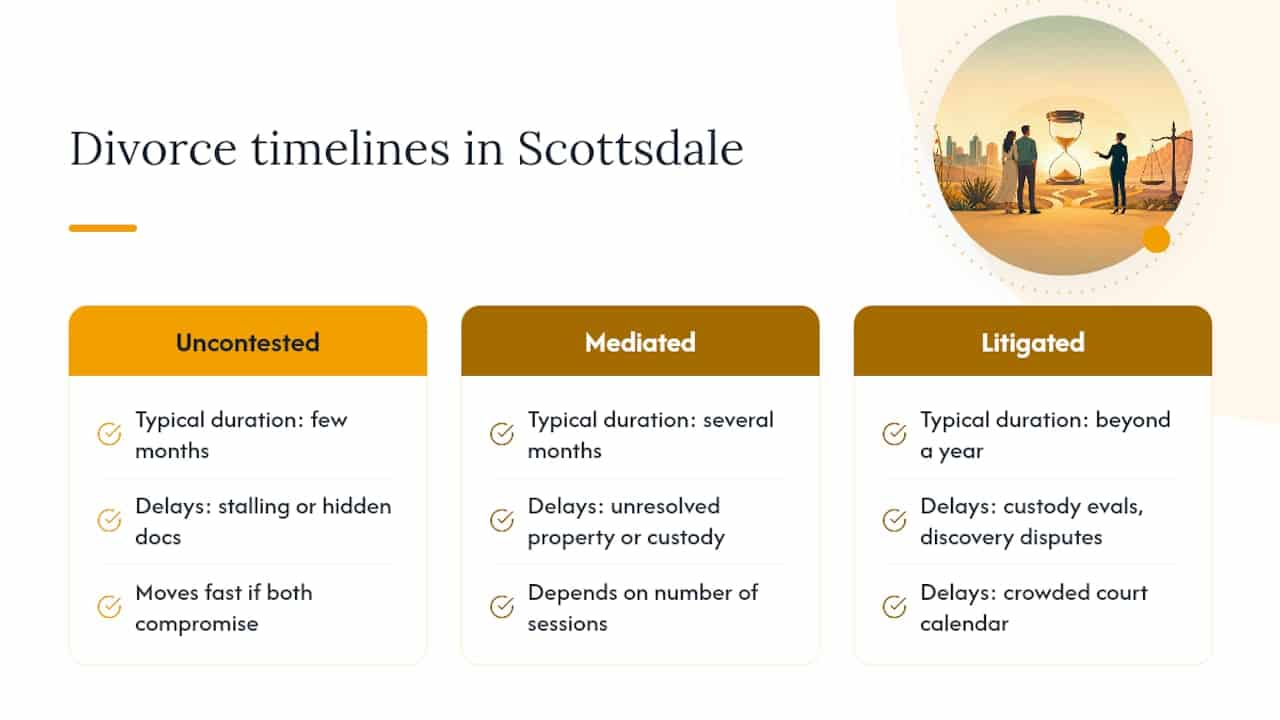
The biggest variable isn’t the court, it’s the two spouses. Cases move fast when both sides show up to negotiations ready to compromise, and they crawl when one party stalls, hides documents, or refuses reasonable settlement terms. A good attorney gives you milestone check-ins rather than vague reassurance: expect updates after filing, after the response period, after any mediation session, and before any hearing date. If your lawyer can’t tell you roughly where your case sits in that sequence, that’s worth asking about directly at your next meeting.
Mediation, collaborative divorce, or litigation: which one fits your case?
The service model you need should drive which attorney you hire, not the other way around.
- Mediation puts both spouses in the same room with a neutral third party to negotiate terms directly. It’s faster and cheaper, and it works best when both sides are willing to compromise and there’s no history of abuse or asset concealment. The advantages of divorce mediation hold up best in exactly these lower-conflict cases.
- Collaborative divorce keeps each spouse represented by their own attorney but commits both sides, in writing, to negotiate rather than litigate. It suits couples who want privacy and control but need more individual advocacy than mediation offers.
- Uncontested divorce applies when spouses already agree on every major term. It’s the fastest and least expensive path when it genuinely fits.
- Litigation becomes necessary when there’s a safety concern, hidden assets, or a spouse unwilling to negotiate in good faith.
Ask any attorney directly how many cases they’ve closed using the model you think you need. A litigator by temperament may talk you into court even when mediation would serve you better.
What questions should you ask at a divorce consultation?
Bring these questions to every consultation and take notes on the answers so you can compare firms afterward:
- How many years have you practiced family law specifically, and in Maricopa County?
- What’s your realistic estimate for how long a case like mine takes?
- Can you give me a written fee estimate, including what triggers extra charges?
- Will you personally handle my case, or will it go mostly to an associate?
- What’s your approach if my spouse refuses to negotiate?
- How do you typically communicate progress, email, calls, a client portal?
- Have you handled cases with a similar asset or custody complexity to mine?
Watch for a few red flags: vague, non-committal answers about cost; pressure to sign a retainer agreement on the spot; or an attorney who guarantees a specific outcome, which no ethical lawyer will do. Bring your financial statements, a list of shared property and debts, and any existing custody arrangement to save time at the first meeting.
Pro Tip: If an attorney can’t give you even a rough written fee range by the end of the first consultation, treat that as a signal to keep looking rather than a detail to sort out later.
Why local, specialized experience changes the outcome
Family law in Arizona rewards specialization in a way general practice doesn’t reward well. A firm that has handled thousands of cases in Scottsdale courts over two decades has seen how specific judges rule on custody disputes, how local mediators operate, and which negotiation tactics actually move opposing counsel. High Desert Family Law Group built its practice around that kind of concentrated focus, covering collaborative divorce, uncontested cases, mediation, and custody arrangements rather than treating family law as one item on a broader menu.
What gets underestimated in most advice on this topic is how much a mismatched approach costs people, not in fees, but in outcome. A cooperative couple pushed toward a litigator’s default posture ends up paying for a fight nobody needed. A person facing a genuinely difficult spouse gets hurt by an attorney who’s uncomfortable in a courtroom. Matching the attorney’s actual working style to your case’s real conflict level matters more than any firm’s years in practice or client count.
Ready to talk to a Scottsdale divorce attorney?
The firm described here handles contested and uncontested divorce, mediation, collaborative divorce, and child custody arrangements provided by a team experienced in Arizona family law. That local focus means you’re not explaining your situation to someone unfamiliar with Maricopa County courts or getting handed off to a generalist mid-case.

If you’re ready to move forward, the next step is simple: schedule a consultation and bring your financial documents, a list of custody or property concerns, and your questions from above. Start by reviewing the firm’s family law practice areas to see which service matches your situation, then request your consultation directly.
Where to go next for cost and fee details
For deeper reading, check the firm’s retainer fee breakdown, its mediation advantages page, and a partner resource on inclusive, client-centered law office practices worth reviewing before your first consult.
This article is general information, not a substitute for advice from a qualified lawyer. Consult a qualified legal professional about your own circumstances before acting on anything here.