



3 Moves to Protect Your Arizona Business in Divorce: Rule 49 Steps

In Arizona, your business is presumed community property once you marry, and that presumption can hand your spouse a real financial claim on it. The three moves that matter most right now: stop any transfer or sale of business assets, gather three years of financial records, and call a business divorce attorney and a valuation expert before you say anything else. Arizona’s community property statute, A.R.S. §25-211, and the mandatory Rule 49 disclosure rules both start running the moment a petition is filed.
TL;DR:
- Starting or growing a business during marriage presumes community property, making it easier for a spouse to claim half unless clear documentation or exclusion evidence exists.
- Commingling personal and business accounts for years can turn a separate business into community property, so separate accounts and documented contributions are essential defenses.
- Early valuation using Rule 49 disclosures and hiring forensic accountants significantly reduces costs and delays, especially if you secure a credible initial number before your spouse’s attorney does.
- Most cases settle through buyouts, with installment payments being common; ensuring a secured lien on assets is critical to avoid future payout risks.
- For minority owners, restrictive partnership agreements and valuation discounts influence how much of the business is awarded, requiring early coordination with partners and robust appraisals.
Table of Contents
- Divorce Laws for Business Owners in Arizona: The Community Property Rule
- Business Valuation in Arizona Divorce: Methods and the Rule 49 Checklist
- Dividing a Business in Divorce: Buyout, Sale, or Co-Ownership
- Protecting Business Assets in Divorce: What to Do Before and After Filing
- Divorce Timeline and Costs for Arizona Business Owners
- Tax Implications of Dividing a Business in Divorce
- How Business Debt Affects Property Division in Divorce
- Strategies for Minority Business Owners Facing Divorce
- What Happens to Business Contracts and Employee Agreements in Divorce
- What Business Owners Get Wrong About Divorce in Arizona
- Work With an Arizona Business Divorce Attorney Who Handles the Numbers, Not Just the Filing
- Sources
- FAQ
Divorce Laws for Business Owners in Arizona: The Community Property Rule
Arizona is one of nine community property states, and A.R.S. §25-211 presumes that anything acquired during the marriage, including a business you built from scratch, belongs equally to both spouses. That presumption applies whether you started the LLC on your kitchen table or bought a franchise with a business loan. It does not matter whose name is on the operating agreement.
The presumption can be overcome, but only with evidence. A business you owned before the wedding, or one funded entirely with inheritance or gift money, has a real shot at staying separate property. The problem is what happens after the “I do.” Growth during the marriage, reinvested profits, and any labor either spouse put into the business tend to pull that separate asset back toward the community side of the ledger.
Three things push a business toward community classification:
- Marital funds used for payroll, inventory, equipment, or expansion
- Either spouse’s unpaid or underpaid labor contributing to the company’s growth
- Commingled bank accounts, where business and personal money mix without a clear paper trail
Commingling is the fastest way to lose a separate-property argument. If you started the business before marriage but ran household expenses through the business checking account for a decade, a court has grounds to treat a chunk of that value as community. Clean books, separate accounts, and a documented capital contribution history are what actually hold up when a judge or forensic accountant starts asking questions.
Business Valuation in Arizona Divorce: Methods and the Rule 49 Checklist
Valuation is where most business divorces actually get decided, and it typically runs through one of three approaches: income based valuation using discounted cash flow, market comparables drawn from similar business sales, or an asset based approach that totals equipment, inventory, and receivables minus debt. Each method can produce a wildly different number for the same company, which is exactly why both sides usually bring in a forensic accountant or a certified business appraiser rather than trusting a guess.
A forensic accountant traces cash flow, flags personal expenses run through the business, and builds a defensible number that survives cross-examination. Skipping this step is the single most common way owners lose leverage.
Rule 49 requires you to produce, early and without being asked twice:
- Three years of business and personal tax returns
- Profit and loss statements and balance sheets
- Business bank statements and merchant account records
- Material contracts, leases, and vendor agreements
- Payroll records and any partnership or shareholder equity documents
Courts expect complete disclosure under Rule 49, and incomplete filings can trigger sanctions or an adverse inference against you. One overlooked detail: valuation disputes are the single biggest driver of both cost and delay in these cases, so getting ahead of the numbers early is worth more than almost any other move you can make.
Pro Tip: Order your valuation before your spouse’s attorney does. Whoever controls the first credible number usually controls the negotiation.
Dividing a Business in Divorce: Buyout, Sale, or Co-Ownership
Most business divorces resolve one of four ways, and each carries its own set of trade-offs for control, cash flow, and taxes.
- Buyout: one spouse keeps the business and pays the other their share, either as a lump sum or through a promissory note with a fixed interest rate and, ideally, a security interest or lien backing the payments.
- Third-party sale: rare, but courts may order it when neither spouse can afford a buyout or when the business cannot survive a split ownership structure.
- Co-ownership: both spouses stay on as owners after the divorce, which only works with airtight governance rules on decision-making, profit distribution, and exit triggers.
- Court-imposed remedy: in deadlock or asset-dissipation cases, judges can order liens, appoint a receiver, or force judicial dissolution.
Installment buyouts are the most common outcome because they let the operating spouse keep the business running instead of liquidating it to raise cash. The trade-off is risk: a five-year promissory note is only as good as the paper backing it, which is why buy-sell agreements with defined valuation terms matter so much when they exist ahead of time.
Pro Tip: Never agree to an unsecured note on a buyout. Attach a lien on business assets or personal collateral, or you’re trusting your ex-spouse’s future business decisions with your payout.
Protecting Business Assets in Divorce: What to Do Before and After Filing
Prevention beats litigation every time, and most of it comes down to paperwork you should already have.
- Put a prenuptial or postnuptial agreement in place that names a specific valuation method and transfer mechanism for the business, removing the guesswork later.
- Draft or update a buy-sell agreement between partners that defines what happens to an owner’s stake in a divorce, death, or disability.
- Keep business and personal accounts fully separate, and document every capital contribution and salary with the same rigor you’d use for a lender.
- Run formal payroll for any spouse who works in the business, with real pay stubs, not informal cash draws.
- The moment a petition is filed, comply with the automatic injunction on transferring or encumbering assets outside normal operations. Courts treat quiet transfers, sudden write offs, or asset shuffling as dissipation, and it can shift the entire division in the other spouse’s favor.
Agreeing on a valuation method in advance through a buy-sell or prenup cuts both dispute time and expert fees dramatically once a divorce actually starts.
Pro Tip: If you’re structuring an installment buyout, negotiate a security interest and an acceleration clause now. It costs you nothing today and protects your entire payout if your ex-spouse defaults later.
Divorce Timeline and Costs for Arizona Business Owners
Rule 49 disclosure deadlines start the clock early, and missing them creates real consequences, from sanctions to a judge simply accepting your spouse’s numbers by default. Beyond that first filing window, timing depends almost entirely on whether you and your spouse can agree.
- Negotiated or mediated resolutions: roughly 3 to 6 months
- Contested litigation with dueling valuation experts: 9 to 18 months or longer
The gap between those two numbers comes down to one thing: amicable cases settle faster because both sides accept a single valuation, while contested cases burn months on competing appraisers and discovery fights. Cost follows the same pattern. Forensic accounting fees, appraiser retainers, depositions, and expert testimony are what run up a bill in a contested business divorce, not attorney hours alone.
The single most effective lever for controlling cost is agreeing on a valuation approach early, ideally through mediation rather than a courtroom fight where each side hires its own expert to contradict the other’s.
Tax Implications of Dividing a Business in Divorce
Dividing a business interest is not a tax neutral event just because it happens inside a divorce. The structure you choose determines what the IRS sees, and getting it wrong can cost you far more than the legal fees.
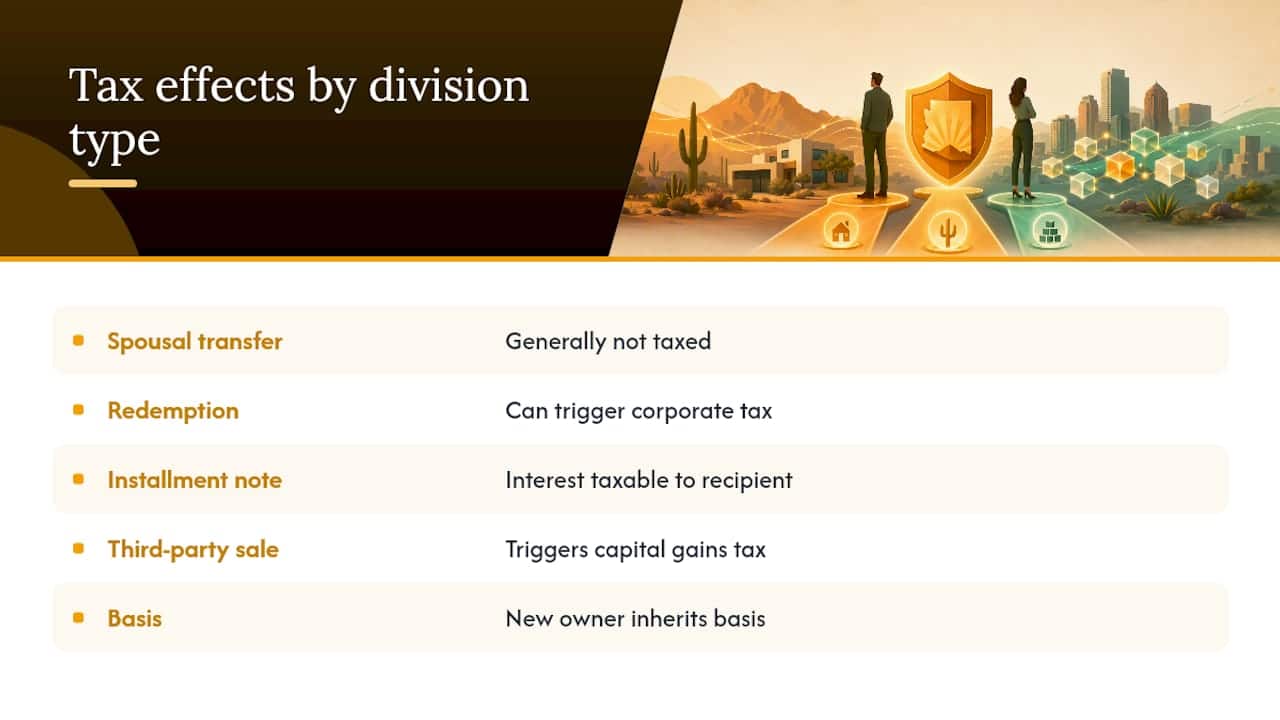
A straightforward transfer of a business interest between divorcing spouses, incident to the divorce, is generally not taxed at the time of transfer under federal tax rules. But that is only the starting point. If the buyout is structured as a redemption where the business itself buys out the departing spouse’s shares, rather than the remaining spouse buying them personally, the tax treatment shifts and can trigger different consequences for both parties.
Installment buyouts carry their own wrinkle: interest paid on a promissory note is generally taxable income to the spouse receiving it and may be deductible to the spouse paying it, depending on how the note is structured. Selling the business outright to a third party instead of dividing it between spouses can trigger capital gains tax on the full appreciation since the business was acquired, a bill that gets split according to however the settlement allocates it.
Basis matters too. Whoever ends up owning the business after divorce inherits its existing tax basis, which affects future depreciation and any eventual sale. IRS guidance on property valuation is a useful starting point, but a business divorce almost always needs a tax professional working alongside your attorney to model out the actual consequences of each division scenario before you sign anything. Get the structure wrong, and a buyout that looked fair on paper can leave one spouse with a much bigger tax bill than the other.
How Business Debt Affects Property Division in Divorce
Debt divides the same way assets do in Arizona: community debt gets split, separate debt generally does not. A business loan taken out during the marriage to fund equipment, inventory, or expansion is presumptively community debt, even if only one spouse signed the note. That means both spouses can be on the hook for it regardless of who actually runs the business day to day.
This creates a real complication in valuation. A business showing $500,000 in gross assets but carrying $300,000 in liabilities is worth its net figure, not its gross one, and both spouses’ attorneys will fight over which debts count as legitimate business obligations versus which look like last minute liabilities created to shrink the number on paper.
Personal guarantees are the trap most owners miss. If you personally guaranteed a business line of credit or an SBA loan, that guarantee doesn’t disappear when the divorce decree is signed. Whoever keeps the business needs to either refinance the debt solely in their own name or negotiate an indemnification clause protecting the other spouse from future liability on a guarantee they can no longer control. Skipping this step means your ex-spouse could still get a collections call five years after the divorce is final if the business defaults.
Lines of credit, vendor financing, and equipment leases all need to be inventoried with the same rigor as assets. A buyout that ignores the debt side of the balance sheet isn’t a real number. It’s half of one.
Strategies for Minority Business Owners Facing Divorce
Owning a 15% stake in a family business or a small percentage of a professional partnership creates a different set of problems than owning the whole thing outright. Minority owners typically have far less control over valuation, timing, and whether a buyout even happens on reasonable terms, because the other partners or majority owner are running the process.
Operating agreements and partnership agreements often already restrict how a minority interest can be transferred, sold, or valued in the event of a divorce, and those restrictions can work in your favor or against you depending on how they’re written. Review the agreement immediately. Many include a right of first refusal for other partners, buy-sell terms with a preset valuation formula, or outright prohibitions on transferring shares to a spouse, all of which affect what the divorce court can actually order.
A minority discount is the other factor that catches owners off guard. Because a minority stake carries less control and less marketability than a majority interest, appraisers typically apply a discount to its value, sometimes substantial, when calculating what it’s actually worth on the open market. Your spouse’s attorney may push back on this discount; your attorney and appraiser need to be ready to defend it with real market comparables.
If you’re a minority owner, coordinate early with your business partners about how the divorce might affect the entity as a whole. A poorly handled valuation dispute can pull the whole partnership into litigation, not just your marriage.
What Happens to Business Contracts and Employee Agreements in Divorce
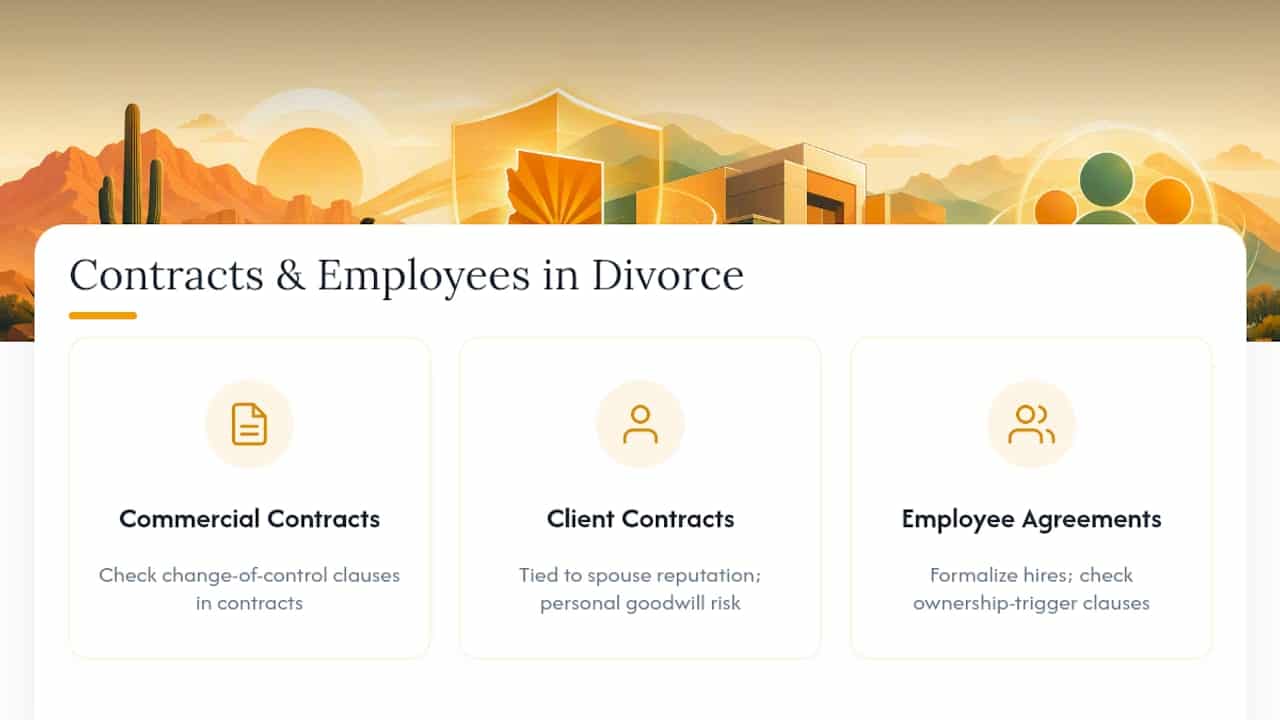
A divorce doesn’t touch your contracts with vendors, clients, or lenders directly, but it can trigger clauses inside them that you didn’t know existed. Some commercial leases, loan agreements, and vendor contracts contain change of control provisions that get activated if ownership shifts, even partially, as part of a divorce settlement. Read every material contract before you agree to a buyout structure that changes who owns what percentage of the company.
Client contracts tied to a specific spouse’s personal reputation or relationships, common in professional service businesses like law firms, medical practices, or consulting shops, raise a separate issue entirely. If the divorcing spouse who built those client relationships leaves the business, the company’s value to the remaining owner may be far lower than a formula based valuation suggests. This is exactly why forensic accountants dig into client concentration and personal goodwill versus enterprise goodwill during valuation.
Employee agreements matter too, particularly for any employee who happens to be a spouse’s family member or was hired under informal terms. A divorce is a natural moment for the operating spouse to formalize employment agreements, non-compete provisions, and confidentiality terms that may have been handled loosely before. It’s also worth checking whether any key employee agreements include provisions that get triggered by a change in majority ownership, since a divorce buyout can technically qualify as one even when the business keeps running exactly as before.
What Business Owners Get Wrong About Divorce in Arizona
The mistake I see most often isn’t a bad legal strategy. It’s timing. Owners wait until they’re already served with a petition before pulling together financial records or calling an appraiser, and by then they’ve lost weeks they didn’t need to lose. The spouses who protect the most value are the ones who treat the first thirty days like a deadline, not a grace period.
Commingled accounts are the second recurring problem, and it’s almost always avoidable. An owner who ran fifteen years of separate-property argument through a joint checking account has handed the other side’s attorney a roadmap. The fix isn’t complicated. It’s just tedious, and tedious is exactly what gets skipped when business owners are busy running a company instead of preparing for a legal fight.
What actually works tends to be unglamorous: secured installment buyouts with real collateral, negotiated offsets against other marital assets instead of touching business equity at all, and getting a credible valuation locked in before either side has a reason to argue about the number. None of that requires a courtroom. It requires getting organized before you need to.
Work With an Arizona Business Divorce Attorney Who Handles the Numbers, Not Just the Filing
The firm gives Scottsdale business owners specialized attorneys who coordinate directly with forensic accountants and business appraisers from day one, instead of waiting for a valuation fight to blow up mid case. That coordination is what keeps a buyout negotiation moving instead of stalling over competing numbers from two different experts.

The firm handles business asset division, structures secured installment buyouts with real collateral and enforceable terms, and represents owners in mediation as an alternative to courtroom litigation. If you own a company, a professional practice, or a minority stake in one and you’re facing divorce, the numbers matter more than almost anything else in the case. Review the types of family law representation available and consider scheduling a consultation to get a valuation strategy in place before the other side sets the terms.
Sources
Start with the statute itself, A.R.S. §25-211, which governs how community property is defined in Arizona. Maricopa County Superior Court publishes the family court forms and Rule 49 disclosure requirements you’ll need to comply with early filing deadlines. For tax questions around valuing and transferring business interests, the IRS Publication 561 valuation guidance is a useful reference point before you talk to a tax professional.
This article is general information, not a substitute for advice from a qualified lawyer. Consult a qualified legal professional about your own circumstances before acting on anything here.
- Arizona Revised Statutes §25-211 — Property acquired during marriage as community property; exceptions
- How is a business divided in an Arizona divorce? – LegalClarity
- Maricopa County Superior Court family court forms and disclosure requirements
- Business Divorce Lawyer In Arizona | Desert Valley Law, PLLC
FAQ
Is My Spouse Entitled to Half My Business in an Arizona Divorce?
If the business was started or grew significantly during the marriage, Arizona’s community property presumption under A.R.S. §25-211 generally gives your spouse a claim to half its community value, though a portion may still qualify as separate property depending on when and how it was funded.
Can My Spouse Touch My LLC in a Divorce?
Yes, an LLC formed or grown during the marriage is typically treated as community property regardless of whose name is on the formation documents, which means its value can be divided even if your spouse never worked in the business.
Would I Lose My LLC in a Divorce?
Losing outright ownership is uncommon; most cases resolve through a buyout where you keep operating the business and pay your spouse their share of its value, often through a secured installment note.
What Is Rule 69 in Arizona Family Law?
Binding settlement agreements reached during a family law case, including business divorce settlements, are generally enforceable once both spouses agree to specific terms on the record, even before the final decree.
How Long Does a Business Divorce Take in Arizona?
Negotiated or mediated business divorces typically resolve in 3 to 6 months, while contested cases involving dueling valuation experts often stretch to 9 to 18 months or longer.