



Avoid Return to Court: Arizona Holiday Parenting Clauses That Hold Up

Under Arizona law, a court-approved parenting plan must include a practical schedule for holidays and school vacations, not just regular weekly time. Parents should choose a clear format such as even/odd years or split-day blocks, spell out exchange logistics and travel rules, and put any recurring schedule changes in writing rather than relying on verbal agreements.
TL;DR:
- Holiday schedules must be specific and include exact dates, times, and exchange locations to be enforceable in court.
- Common formats include even/odd year rotations, fixed holiday assignments, and split-day blocks, with certain holidays like Mother’s or Father’s Day always assigned to the respective parent.
- Vacation and travel provisions require written notice, detailed itineraries, and often prior court approval for out-of-state or international trips.
- Formal addenda are recommended to document any holiday swaps or schedule changes to prevent enforcement issues later.
- Practical language—such as exact dates, explicit exchange procedures, and clear dispute resolution steps—ensures the judge will approve and uphold the plan.
Table of Contents
- What Arizona law and court guidance require for holiday schedules
- Common, court-friendly sample holiday schedule formats parents use in Arizona
- How to draft holiday provisions so they are specific and court-approvable
- Vacation, travel, and out-of-state travel rules
- Changing, enforcing, or modifying holiday provisions
- Special situations: teens, special needs, and long distance
- How an Arizona family law attorney can help
- Getting help building an Arizona parenting plan that holds up
- Sources
- FAQ
What Arizona law and court guidance require for holiday schedules
Arizona’s parenting plan statute, A.R.S. §25-403.02, requires every parenting plan to set out a practical schedule of parenting time, and that schedule must specifically address holidays and school vacations, not only the day-to-day routine. A judge cannot approve a plan that skips this piece. Before signing off, the court looks for evidence that the plan reflects the child’s best interests and gives both parents workable, specific time.
Judges reviewing a plan for approval generally expect it to cover:
- A clear statement of legal decision-making authority for medical, educational, and religious decisions.
- A practical day-to-day parenting-time schedule, plus a separate schedule for holidays and school vacations.
- Exchange procedures, including times, locations, and who provides transportation.
- A process for periodic review as the child grows older.
- A dispute resolution method, such as mediation, before either parent files a court motion.
The holiday schedule typically overrides the regular weekly schedule when the two conflict. If a plan says Dad has every other weekend but Christmas falls on his off weekend in an even year assigned to Mom, the holiday provision controls that day. Courts favor plans that say so explicitly, because vague plans generate the phone calls and last-minute disputes that bring parents back to court. Specificity is the entire point of the statute: a schedule that just says “reasonable holiday time” gives a judge nothing to enforce.
Common, court-friendly sample holiday schedule formats parents use in Arizona
Most Arizona parenting plans use one of a handful of proven formats, and county courts are familiar with all of them.
- Even/odd year rotation: Parent A gets Thanksgiving in even years and Christmas in odd years; Parent B gets the reverse. This is the most common format because it is simple to track and easy to enforce.
- Alternating year rotation with fixed anchors: Some holidays alternate every year (Thanksgiving, winter break) while others stay fixed to one parent every year (a parent’s birthday, a specific cultural or family holiday).
- Split-day blocks: For holidays that span more than one calendar day, such as winter break, the day is divided by time, for example Christmas Eve at 6:00 PM through Christmas Day at noon with one parent, and the remainder with the other.
A few holidays get their own default rules regardless of the rotation method:
- Mother’s Day and Father’s Day are typically spent with the corresponding parent every year, regardless of the regular rotation.
- A child’s birthday is often split by time block or alternated, and many plans require both parents to allow reasonable contact if the birthday falls on the other parent’s time.
- Three-day weekends tied to a Monday holiday (Memorial Day, Labor Day) usually extend whichever parent’s regular weekend it is, unless the plan assigns them separately.
Maricopa County’s own parenting plan template, DRCVG11f, includes checkbox fields for exactly this kind of even/odd assignment and states directly that holiday time takes priority over the standard schedule. A short sample clause might read: “In even-numbered years, Mother has Thanksgiving from Wednesday at 6:00 PM until Sunday at 6:00 PM; Father has the same period in odd-numbered years.” That level of detail, not “Thanksgiving break,” is what a judge wants to see.
How to draft holiday provisions so they are specific and court-approvable
Vague language is the single biggest reason holiday clauses fail once real life tests them. Replace loose phrases with fixed dates, times, or unambiguous rules a stranger could apply without asking either parent.
- Write “the fourth Thursday in November” or an exact calendar date rather than “Thanksgiving break,” since school calendars shift year to year.
- Avoid catch-all terms like “major holidays” or “school breaks” without defining which days those cover.
- Assign transportation responsibility by name (who drives, who picks up) and name the exact exchange address, not just “the usual place.”
- List a working phone number or messaging method for exchange-day contact, separate from general co-parenting communication.
A workable priority clause might read: “The holiday schedule in this section supersedes the regular parenting-time schedule for the specific days and times listed.” A workable exchange clause might read: “Exchanges shall occur at [named location] at 6:00 PM unless otherwise agreed in writing at least 48 hours in advance.”
If either parent wants to trade a holiday for personal reasons, the plan should require written notice, commonly 7 to 14 days for a routine swap, spelled out in the document itself.
Pro Tip: Put the notice period and the swap procedure in the parenting plan itself rather than assuming “we’ll just work it out,” since that assumption is what usually ends up in front of a judge.
Vacation, travel, and out-of-state travel rules
Summer and extended vacation time is usually governed by a separate section from the holiday schedule, and Arizona’s own court guidance addresses it directly. The Arizona Courts’ Planning for Parenting Time guide recommends written notice for vacation dates, commonly a 30-day initial notice period along with a 3-day requirement for a detailed itinerary before departure.
A typical structure gives each parent two separate one-week vacation periods during the summer, spaced roughly four weeks apart so neither parent loses more than a week of regular time at once. This spacing also helps avoid the two parents claiming overlapping vacation weeks.
- State the initial notice deadline for choosing vacation weeks and the deadline for handing over a full itinerary.
- For out-of-state or international travel, many plans require written consent from the other parent or, absent agreement, a court order.
- Travel notices should include the destination address, dates of travel, the airline or carrier and flight numbers, and an emergency contact number.
- If a parent regularly denies reasonable travel requests without cause, that pattern can become relevant in a later modification request.
County parenting-plan forms, including the Coconino County template, typically bundle vacation rules with holiday and exchange provisions in one section, which makes the whole document easier for a judge to read at a glance.
Changing, enforcing, or modifying holiday provisions
Informal swaps happen in nearly every co-parenting relationship, but a pattern of unwritten changes creates real enforcement risk if the relationship turns adversarial. A text message thread is better than nothing, but a signed addendum carries far more weight in court.
- Draft a short addendum stating the exact dates and times being changed, both parents’ printed names, and a line stating that it amends the existing parenting plan.
- Both parents sign and date it, and each keeps a copy; some parents also file it with the court to attach to the official record.
- Save the addendum alongside the original plan so the full holiday history is easy to reconstruct later.
Modification and enforcement are not the same process. A modification request applies when circumstances have materially changed, such as a parent relocating or a child’s needs shifting significantly. Enforcement applies when one parent is already violating the current order, such as refusing a scheduled exchange. Filing the wrong one wastes time and money.
If enforcement becomes necessary, courts look for concrete documentation: text messages confirming an agreed swap, calendar records showing the original schedule, and, where relevant, a witness statement about a missed exchange.
Pro Tip: Keep every swap request and confirmation in one dedicated folder or app thread so you are not searching for scattered texts months later when it matters.
Special situations: teens, special needs, and long distance
A teenager’s preference about holiday time carries weight with a judge but is never the deciding factor on its own, and courts weigh it alongside the child’s age and maturity. Younger children generally benefit from shorter, more frequent exchanges rather than long stretches away from either parent.
- Long-distance arrangements often include cost-sharing for travel and a neutral exchange hub, such as an airport, written directly into the plan.
- Special-needs children may require the plan to name specific medical information sharing rules and, in some cases, supervised exchanges.
- High-conflict families often do best with a neutral drop-off location or a third party handling the exchange to reduce direct contact between parents.
How an Arizona family law attorney can help
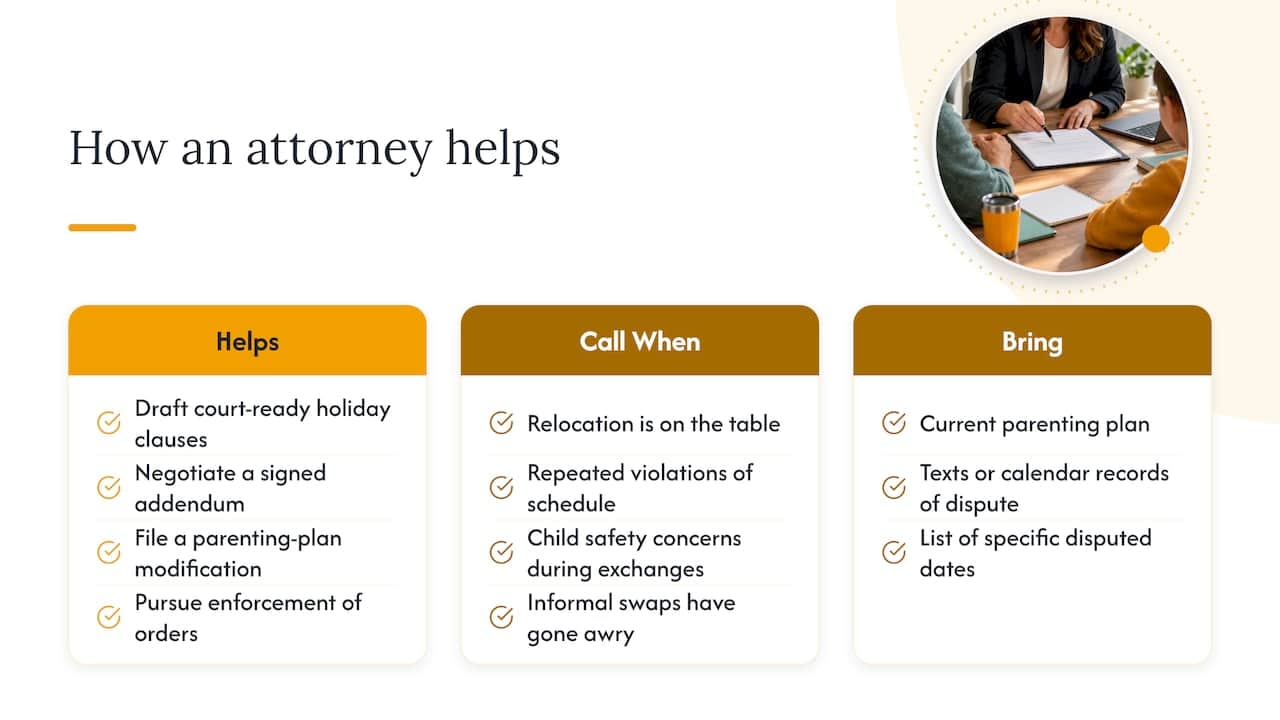
Drafting a holiday schedule that actually holds up under stress, an angry ex, a canceled flight, a teenager who wants to skip Thanksgiving, takes more than a template. An attorney can turn a vague holiday clause into court-ready language, negotiate a signed addendum when informal swaps have gotten out of hand, file a modification when circumstances change, or pursue enforcement when an existing order is being ignored.
A family law group in Scottsdale works with parents on exactly these situations, drawing on extensive family law experience and a team approach built around each family’s specific goals for their children and their schedule.
Call a family law attorney when a relocation is on the table, when violations of the current schedule keep repeating, or when a child’s safety is a genuine concern during exchanges. Bring the current parenting plan, any texts or calendar records showing the dispute, and a list of the specific dates in question.
Getting help building an Arizona parenting plan that holds up
A generic template downloaded online rarely accounts for your specific custody situation, your child’s school calendar, or the exchange conflicts that tend to surface once a holiday schedule meets real life. Some family law groups build parenting plans and holiday provisions around each family’s actual circumstances, drawing on experience to draft language that local courts recognize and approve.

Whether you need a first holiday schedule drafted from scratch, a signed addendum to formalize changes you and your co-parent already agreed to, or help enforcing an order that isn’t being followed, our child custody team can walk through your specific dates and draft language a judge will approve. Reach out to schedule a consultation and get your holiday schedule in writing before the next school break arrives.
This article is general information, not a substitute for advice from a qualified lawyer. Consult a qualified legal professional about your own circumstances before acting on anything here.
Sources
- 25-403.02 – Parenting plans
- Planning for Parenting Time: Arizona’s Guide to Parents Living Apart
- DRCVG11f – Joint legal decision-making parenting plan template (Maricopa County)
- Coconino County parenting plan template / consent decree (holiday and vacation provisions)
FAQ
What does a holiday custody schedule look like?
A holiday custody schedule typically assigns specific holidays to each parent using an even/odd year rotation, alternating years, or split-day time blocks for multi-day breaks like winter vacation. Arizona parenting plans must include this schedule under A.R.S. §25-403.02, and it generally takes priority over the regular weekly schedule for the specific days it covers.
At what age can kids decide what parent to live with in Arizona?
Arizona law does not set a fixed age at which a child can choose which parent to live with. A judge may consider a mature child’s wishes as one factor among several when deciding custody or parenting time, but the child’s preference alone does not control the outcome.
Can a mother lose custody for not having a home?
Housing stability can be one factor a court weighs when evaluating a child’s best interests, but it is not automatically disqualifying on its own. Courts look at the full picture, including the child’s overall safety, stability, and relationship with each parent, before making a decision.
Do I have the right to know where my child is during visitation?
Arizona parenting plans commonly require some level of information sharing during the other parent’s time, particularly for travel or overnight stays away from the usual address, but the specific rules depend on what your parenting plan actually states. If your current plan does not address this clearly, it is worth adding specific language the next time the plan is updated or addended.