



Refinancing After Divorce in Arizona: A Decree Won’t Clear the Loan

Yes, in Arizona you can usually refinance after divorce to remove a spouse from the mortgage or to fund an equity buyout, but a divorce decree alone does not remove lender liability. The lender has to act, through a refinance or an assumption, before anyone is released from the loan. If you cannot qualify on your own, the realistic fallbacks are loan assumption, selling the home, or a negotiated interim arrangement spelled out in your decree.
TL;DR:
- Government backed loan programs often set credit score minimums between 580 and 620, while lenders generally cap debt to income ratios at 43% to 50%.
- Lenders count support income only after six consecutive months of documented payments and proof that payments will continue for at least three years.
- Assumption may preserve a lower rate and cut costs, but loan rules apply, the remaining spouse must qualify, and the lender must release the departing borrower.
- For buyouts, subtract the mortgage payoff and estimated 6% to 8% selling costs from an appraised value, then divide the remaining equity under settlement terms.
- Set a 60 to 90 day refinance deadline in the decree and specify a forced sale if the remaining spouse misses it.
Table of Contents
- What refinancing, assumption, and selling accomplish after divorce
- Why a court order does not automatically remove you from a mortgage
- How lenders underwrite a refinance and count support payments as income
- How to calculate and fund an equity buyout
- Rate-and-term, cash-out, or assuming the loan: which fits your situation
- A step-by-step checklist and timeline for Arizona homeowners
- When the lender delays or your ex-spouse won’t cooperate
- How High Desert Family Law Group supports clients through refinance and property transfers
- What I’d tell a friend going through this
- Get help structuring your refinance terms before your decree is final
- FAQ
- Sources
What refinancing, assumption, and selling accomplish after divorce
A divorce decree tells you who keeps the house and who owes what. It does not touch the mortgage contract you both signed with your lender. That gap is why so many Arizona homeowners end up confused about what actually needs to happen after the paperwork is final.
Refinancing replaces your existing mortgage with a new loan in one spouse’s name only. The new loan pays off the old one, the departing spouse’s name comes off the note and the title, and the remaining spouse becomes solely responsible for payments going forward. This is the most common route because it cleanly separates both parties financially, according to PNC Insights, and it works whether you are keeping the home or using the new loan to cash out equity for a buyout.
Loan assumption is a less expensive alternative when your lender and loan investor allow it. Instead of originating a brand new mortgage, the remaining spouse takes over the existing loan, often keeping the same interest rate and avoiding new origination costs. According to Fannie Mae, assumption depends on the specific investor’s rules and still requires the assuming spouse to qualify, and a formal release of liability should be requested from the servicer once the assumption is approved.
Selling the home is the fallback when neither refinance nor assumption is realistic, whether because of credit issues, insufficient income, or a home that is underwater; some sellers consider alternatives like a quick sale during divorce in Florida to avoid lengthy processes.
Which path fits depends on three things:
- Credit and income: can the remaining spouse qualify alone for a new loan or an assumption?
- Equity position: is there enough value in the home to make a buyout worthwhile, or is a sale cleaner?
- Timeline pressure: does your decree set a deadline that favors a faster option like assumption over a slower refinance process?
Why a court order does not automatically remove you from a mortgage
This is the part that catches people off guard. Your divorce decree is a court order between you and your former spouse. Your mortgage is a contract between you, your spouse, and a lender who was never a party to the divorce case. A judge can decide who keeps the house and who is responsible for the debt between the two of you, but that decision has no binding effect on the mortgage company.
The Consumer Financial Protection Bureau confirms this directly: a creditor can still contact and collect from anyone whose name remains on a loan after divorce, regardless of what the decree says about who is supposed to pay. If your name stays on the mortgage, you stay fully liable to the lender even after a court assigns the debt to your ex-spouse.
Arizona law governs how the court divides property and debts, but it does not reach into your loan contract. A.R.S. §25-318 requires an equitable division of marital property and lets a judge assign debts between spouses and even impose liens or require a debt distribution plan to secure payment. Those tools bind the spouses to each other, not the lender. For a fuller picture of how Arizona treats marital property and debt in a divorce, our guide to Arizona community property laws walks through how courts approach equitable division.
A quitclaim deed often adds to the confusion. Signing one transfers title, meaning ownership on paper, but it does not touch the mortgage. We regularly see clients assume that once their ex-spouse signs a quitclaim deed, they are off the hook financially. They are not. Only a lender-issued release of liability or a full payoff removes someone from mortgage responsibility.
The practical consequences of staying on a loan you no longer control are real:
- Credit exposure: late payments by your ex-spouse show up on your credit report too, since you remain a borrower.
- Collection risk: the lender can pursue either name on the note if payments stop, regardless of the decree.
- Future borrowing limits: the mortgage counts against your debt-to-income ratio for any loan you try to get, even if you no longer live in the house.
Because of this, decrees should spell out a concrete refinance deadline and a remedy, such as a forced sale, if that deadline is missed. Our post-decree debt checklist covers the paperwork and statutory language that helps protect your credit once the case closes.
How lenders underwrite a refinance and count support payments as income
Qualifying for a refinance after divorce works the same way it would for any other mortgage application, with one added wrinkle: you are applying as a single-income household, often for the first time in years.
Lenders look at three main factors. Your credit score needs to meet the loan program’s minimum, typically in the 580 to 620 range for government-backed loans and higher for conventional financing, though exact thresholds vary by lender and loan type. Your debt-to-income ratio, meaning your total monthly debt payments divided by your gross monthly income, generally needs to stay under 43% to 50% depending on the program. And you need enough assets or reserves to cover closing costs and, in some cases, several months of payments.
If you receive alimony or child support, it can help you qualify, but only under specific conditions. According to Fannie Mae’s Selling Guide, lenders may count alimony or child support as qualifying income only when you can document that you have received it consistently for at least the most recent six months, and you can show it is expected to continue for at least three years from the date of the loan application. Miss either requirement and the lender will exclude that income entirely, which can sink an otherwise solid application.
To document support income properly, gather:
- Bank statements showing six consecutive months of deposits matching the support amount.
- A copy of the divorce decree or court order establishing the support obligation and its duration.
- Canceled checks or a payment history from a state disbursement unit if support is paid through one.
Pro Tip: Start collecting six months of bank statements showing support deposits as soon as your decree is final, since lenders will not count the income without that paper trail, even if the order has been in place for years.
A few practical moves strengthen a refinance application after divorce. Pay down revolving credit balances before applying, since utilization has an outsized effect on your score. If your support income does not yet meet the six-month documentation window, consider waiting until it does rather than applying prematurely and getting denied. And if you are close on qualifying income or credit but not quite there, adding a co-borrower, such as a family member, can sometimes bridge the gap, though this means sharing liability on the new loan with them.
How to calculate and fund an equity buyout
When one spouse keeps the house, the other is usually owed a share of the equity. Getting that number right, and agreeing on how to pay it, is often the most contentious part of dividing the marital home.
Start with the math. Equity is the home’s current market value minus what is owed on the mortgage and minus typical selling costs, even if you are not actually selling, because those costs approximate what the house would net if it went to market. A professional appraisal, rather than an online estimate, gives both spouses a number they can trust and reduces the chance of a dispute later.
- Get an appraisal. An independent, licensed appraiser establishes fair market value that both spouses can rely on.
- Subtract the mortgage payoff. Call your servicer for the exact payoff amount, which includes accrued interest, not just the remaining principal balance.
- Subtract estimated selling costs. Even in a buyout, many Arizona couples apply a notional 6% to 8% deduction to approximate what a sale would have cost, then split what remains.
- Apply the agreed split. Your decree or settlement agreement determines whether the split is 50/50 or some other division based on contributions or other assets.
- Decide how the buyout is funded. The spouse keeping the house needs a way to pay the other their share.
A worked example makes this concrete. The result is $165,000 in equity. Split evenly, each spouse’s share is $82,500.
The spouse keeping the house typically funds that $82,500 buyout one of three ways: cash on hand, a cash-out refinance that rolls the buyout amount into a new, larger mortgage, or a home equity line of credit if they already qualify for one separately. A cash-out refinance is the most common choice because it accomplishes two things in one transaction: it removes the departing spouse from the original note and it generates the cash needed for the payout. The tradeoff is a larger loan balance and the closing costs that come with any refinance.
It is worth separating title from mortgage liability here too. Signing over title through a quitclaim deed settles ownership, but the mortgage liability discussed earlier does not disappear until the refinance or assumption closes and the original loan is paid off or formally released.
Rate-and-term, cash-out, or assuming the loan: which fits your situation
Once you know whether you need extra cash for a buyout or simply need to remove a name from the note, the refinance product you choose follows naturally.
A rate-and-term refinance replaces your existing mortgage with a new one at current rates, without pulling out extra cash. This is the right tool when there is no buyout involved, for example when one spouse already bought out the other’s equity through other assets, or when the house has little equity to split and the only goal is removing a name from the loan.
A cash-out refinance does the same thing but borrows more than the current payoff, with the difference going to the borrower, typically to fund the equity buyout owed to the departing spouse.
Assumption is worth exploring before committing to a refinance, since it can preserve a lower existing interest rate and reduce closing costs. According to Fannie Mae, not every loan is assumable, and when it is, the assuming spouse still has to qualify under the lender’s underwriting standards and formally request release of the departing spouse’s liability.
Key differences to weigh:
- Cost: assumption generally costs less than a full refinance since there is no new loan origination.
- Rate: assumption can preserve a below-market rate from years ago; refinancing resets you to current rates.
- Cash needs: only a cash-out refinance generates funds for an equity buyout; assumption and rate-and-term refinances do not.
- Timeline: assumption can sometimes close faster than a full refinance, though this varies by servicer.
A step-by-step checklist and timeline for Arizona homeowners
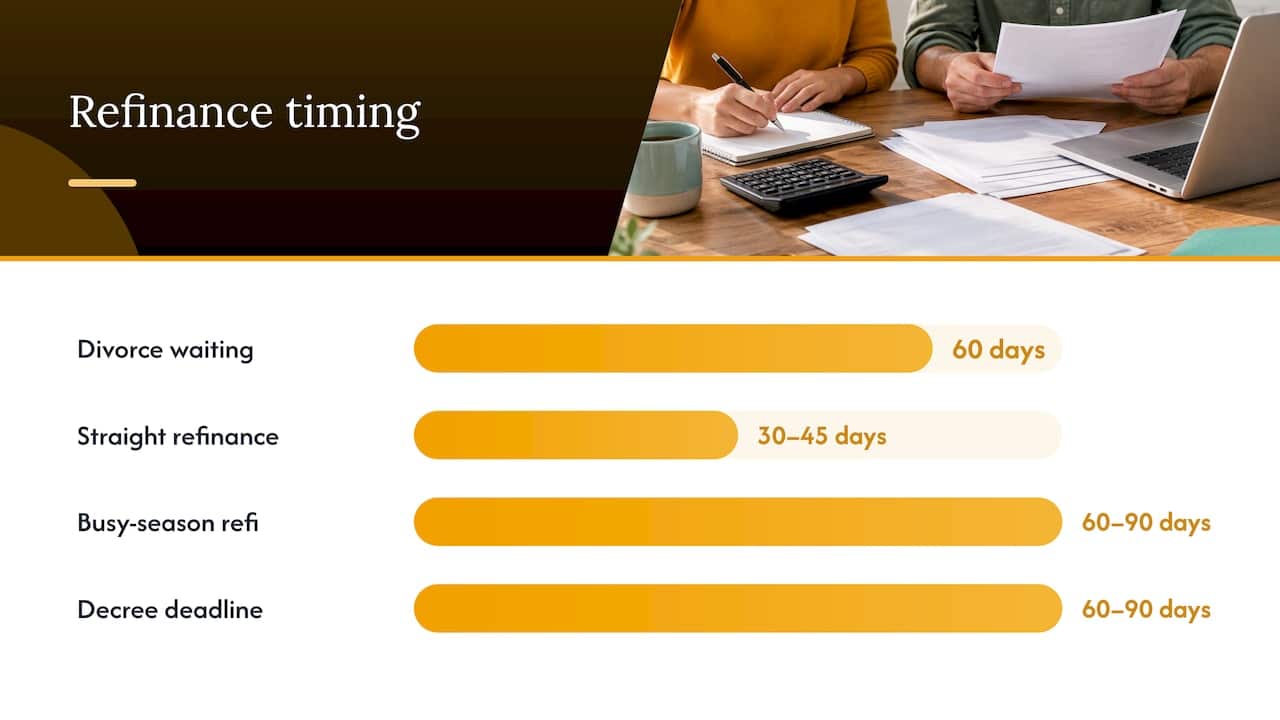
Arizona divorces move on their own statutory clock, and that clock affects when refinancing can realistically happen. Under A.R.S. §25-329, there is a 60-day waiting period after a spouse is served before a divorce can be finalized. That gap often means couples start planning the refinance well before the decree is actually entered, so there is no delay once it is final.
Before you contact a lender, gather:
- Your most recent mortgage statement showing the current balance and servicer contact information.
- A copy of the recorded deed and title report for the property.
- Both spouses’ credit reports, since lenders will pull these regardless of who is applying.
- The final divorce decree or settlement agreement, specifically the pages addressing the house and any buyout terms.
- Two years of tax returns and recent pay stubs, plus six months of support payment records if applicable.
Once you apply, expect the process to run 30 to 45 days for a straightforward refinance, though appraisal scheduling and underwriting backlogs can push that to 60 to 90 days in busier lending seasons. PNC Insights recommends working with a lender who has handled divorce-related refinances before, since they can flag documentation issues early rather than discovering them mid-underwriting.
Pro Tip: Ask your lender upfront whether they have a specific divorce refinance process, since some servicers have dedicated teams for post-divorce loan changes that move faster than general refinance queues.
The decree itself should do more than say “the house goes to spouse A.” Strong decree language names a specific refinance deadline, often 60 to 90 days from the decree date, and states what happens if that deadline is missed, usually a forced listing and sale. This kind of enforceable language gives you real leverage if your co-borrower drags their feet, and it gives the court something concrete to enforce if the matter comes back for post-decree motions. For the procedural side of starting your case and how timing requirements fit together, see our overview on how to file for divorce in Arizona.
When the lender delays or your ex-spouse won’t cooperate
Two separate problems can derail a refinance after divorce: a difficult servicer, or an uncooperative co-borrower. Both have specific remedies.
On the servicer side, CFPB research published in December 2024 found that mortgage servicers commonly pressure successor homeowners to refinance even when other options, like assumption, might be available, and that processing delays and repeated requests for duplicate documentation are widespread complaints. Servicer delays and pressure tactics documented by the CFPB can extend what should be a straightforward process significantly, which matters directly for anyone trying to meet a court-ordered refinance deadline.
If you hit this kind of resistance:
- Put every request to the servicer in writing and keep copies, including the date and the name of whoever you spoke with.
- Ask to escalate past the front-line representative to a supervisor or the loss mitigation department, since basic customer service lines often lack authority to approve assumptions.
- If the servicer continues to stall unreasonably, file a complaint with the CFPB, which creates a formal record and often prompts a faster response.
If the holdup is your ex-spouse refusing to sign documents or cooperate with the lender, your decree’s enforcement provisions become critical. An attorney can file a motion asking the court to compel signature or document exchange, or in some cases to hold the uncooperative spouse in contempt. This process takes time, which is exactly why building a clear deadline and remedy into the original decree matters so much.
In the short term, if payments are at risk while these issues get sorted out, a loan modification or temporary forbearance arranged directly with the servicer can prevent missed payments from damaging either spouse’s credit while the refinance or assumption works its way through.
How High Desert Family Law Group supports clients through refinance and property transfers
The legal side of a home transfer often matters as much as the financing side, and the two need to work together. Decree language typically sets a specific, enforceable refinance deadline and spells out what happens if it is missed, whether that means a forced sale or another remedy the court can act on quickly.
When buyout terms are contested, our team negotiates the actual numbers, the appraisal process, and the funding method before the decree is finalized, so neither spouse is left guessing afterward. If a former spouse refuses to sign a refinance or assumption document once the case is closed, enforcement motions can be filed asking the court to compel cooperation or impose consequences for noncompliance.
Clients coming in for a consultation on this issue often bring their current mortgage statement, any existing settlement proposals, a recent credit report, and an appraisal if one has already been done. That lets us assess realistically whether a refinance, assumption, or sale fits the financial picture before drafting decree language around it.
Coordination directly with lenders and appraisers may be needed, particularly when a servicer is slow to respond or when appraisal disputes threaten to delay the case. Divorce and mortgage timelines rarely move at the same pace on their own, and keeping them aligned is often what prevents a refinance deadline from becoming a post-decree dispute months later. Our debt division checklist outlines the documentation we typically ask clients to assemble early in the process.
What I’d tell a friend going through this
If I had to boil this down to one recommendation, it’s this: pursue a refinance first whenever the numbers work, and only consider selling if the remaining spouse genuinely cannot qualify or the home is underwater. Refinancing keeps more options open and avoids the disruption and cost of a sale, but it only works if you are honest with yourself about credit and income before you build your whole settlement around it.
The mistake I see most often isn’t a bad financial decision, it’s a vague one. Couples agree the house will be refinanced “soon” without a deadline or a backup plan, and six months later nobody has acted and resentment has set in. Get a firm deadline and a clear remedy written into your decree before you sign anything, and loop in an attorney early if you anticipate your co-borrower being difficult about it later.
Three things to do this week: pull your credit report, gather your last two mortgage statements, and schedule a consultation to talk through whether a refinance deadline belongs in your decree.
— Brett
Get help structuring your refinance terms before your decree is final
A decree that sets a real refinance deadline, with a clear remedy if it is missed, saves you months of frustration compared to one that just says the house “will be refinanced.” That upfront clarity is where legal guidance pays off most, since the terms you negotiate now determine how smoothly the mortgage transition actually goes later.

Our services most relevant to this process include:
- Divorce representation, where we build refinance deadlines and remedies directly into your settlement.
- Divorce mediation, useful when both spouses want to negotiate buyout terms and financing timelines without litigation.
- Uncontested divorce, a faster path when you already agree on the buyout amount and just need enforceable terms on paper.
Bring your mortgage statement, a copy of your proposed settlement, a recent credit report, and an appraisal if you have one. From there, we can help you figure out what belongs in your decree and what to ask your lender before you sign anything. Visit our divorce services page to schedule a consultation and get your refinance terms right from the start.
This article is general information, not a substitute for advice from a qualified lawyer. Consult a qualified legal professional about your own circumstances before acting on anything here.
FAQ
How long do you have to refinance a house after divorce?
There is no statewide deadline in Arizona law itself; the timeline comes from what your decree specifies. Most attorneys recommend building in a 60 to 90 day window from the decree date, which aligns with typical underwriting and closing timeframes for a standard refinance.
How to avoid financial ruin in divorce?
The biggest protections are getting your name off joint debts quickly and understanding that a decree alone does not release you from a mortgage or other loans, since the CFPB confirms creditors can still pursue anyone named on the original loan. Build enforceable deadlines into your settlement for refinancing or selling shared property so you are not left waiting indefinitely.
What are some common mistakes people make during divorce?
One frequent error is assuming a quitclaim deed removes mortgage liability, when it only transfers title and leaves the original loan obligation in place. Another is agreeing to vague refinance language in the decree with no deadline or remedy, which leaves the spouse waiting on the house with little leverage if their ex-spouse delays.
What happens if a spouse cannot refinance after divorce?
A well-drafted decree anticipates the possibility of refinancing falling through by naming a fallback, typically a forced sale, if refinancing falls through within the agreed timeframe.
Sources
- Fannie Mae Selling Guide — Other sources of income
- Changing or transferring ownership of a home | Fannie Mae
- Can a debt collector contact me about a debt after a divorce? | CFPB
- Refinancing your mortgage after a divorce | PNC Insights
- Arizona Revised Statutes — Division of property; debts; liens (A.R.S. §25-318)