



Arizona Parent Education Program: Who Must Take It and When

If you are divorcing, separating or establishing paternity in Arizona and you share a minor child with the other parent, the court will require you to complete a parent education class. Each parent takes it separately, the cost is capped at $50 per person in most jurisdictions, and the certificate must reach the court within 45 days. The details vary by county, and picking the wrong provider is the most common mistake we see.
This guide covers who has to attend, what the class teaches, how to choose a provider your court will accept, and what happens if you let the deadline slide.
TL;DR
- A.R.S. § 25-352 requires parents in divorce, legal separation, annulment and paternity cases involving a minor child to complete an approved program.
- Plan to finish within 45 days of filing or being served. The fee is capped at $50 per person in most Arizona jurisdictions, with waivers or deferrals if you already have one for your case.
- Confirm your county’s approved provider list before you pay. Some courts will not accept certificates from outside providers.
- Skipping the class can cost you: judges may withhold final orders or deny later requests, and contempt is possible.
Table of Contents
- What the Arizona parent education program is (and is not)
- Who has to take the class
- The 45-day deadline and what happens if you miss it
- What it costs
- Online or in person: how to choose a provider your court accepts
- What the class covers
- How the class connects to your parenting plan
- Special situations
- Our perspective: treat the class as the first exhibit of good faith
- How we can help
- FAQ
- Sources
What the Arizona parent education program is (and is not)
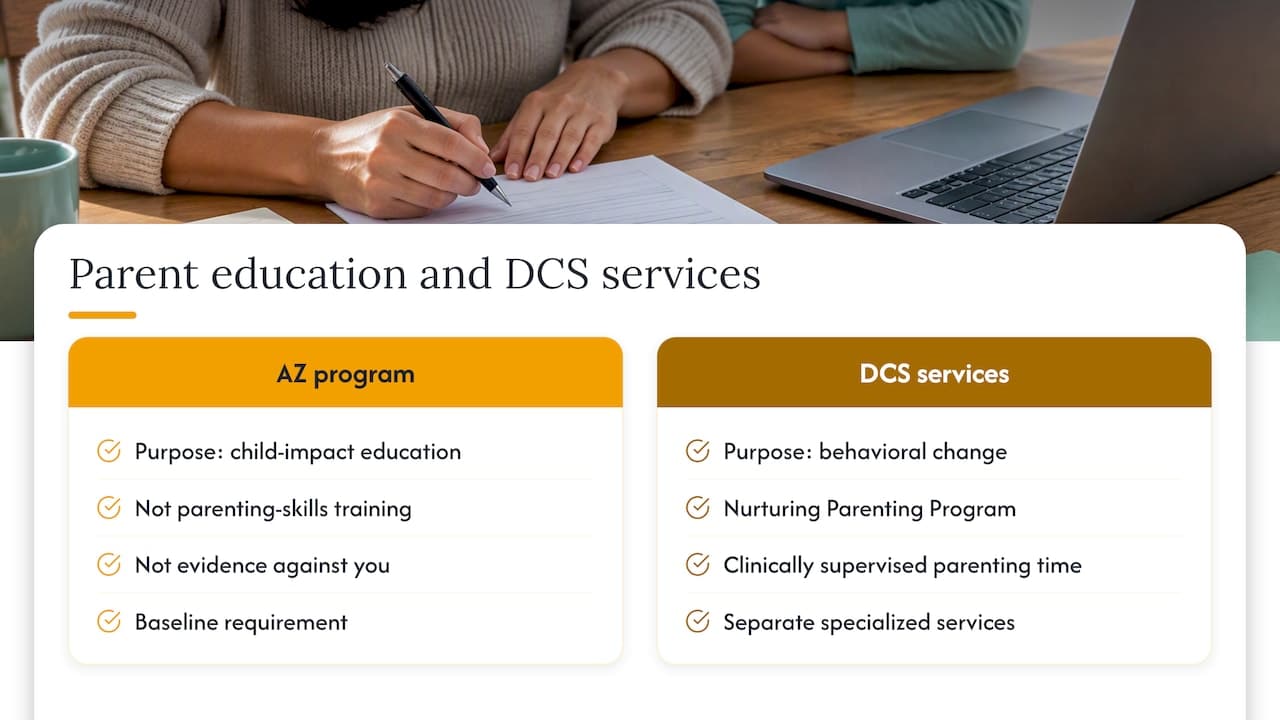
Arizona courts call it the Parent Education Program, and some counties call it the Parent Information Program (PIP). They are the same requirement. According to the Arizona Judicial Branch, the focus is not parenting skills training. It is education on how divorce, family restructuring and litigation affect children’s emotional and psychological well-being, so parents can limit the damage the process does to them.
That distinction matters. You will not be graded on your parenting, and the class will not be used as evidence against you. It is a baseline requirement that gets both parents looking at the case through the child’s eyes before positions harden.
It is also different from the specialized services the Department of Child Safety uses for behavioral change, such as the Nurturing Parenting Program or clinically supervised parenting time. The DCS service array bench card describes those separately. A standard divorce or custody case does not involve them, and completing one does not replace the other.
Who has to take the class
Under A.R.S. § 25-352, the requirement applies in actions for dissolution of marriage, legal separation or annulment that involve a minor, unemancipated child common to both parties. It also reaches paternity cases where the court is asked to decide legal decision-making (custody), parenting time or child support. Pima County’s conciliation court notes that some post-decree actions involving a shared minor child are covered too.
That means:
- Married parents filing for divorce or legal separation, contested or uncontested.
- Unmarried parents asking the court to set custody, parenting time or support.
- Parents returning to court after a decree on certain post-decree actions involving the child.
Both the person who files and the person who is served must complete it. An uncontested or agreed case does not exempt you. If you and your spouse agree on everything, you still each owe the court a certificate when children are involved.
The 45-day deadline and what happens if you miss it
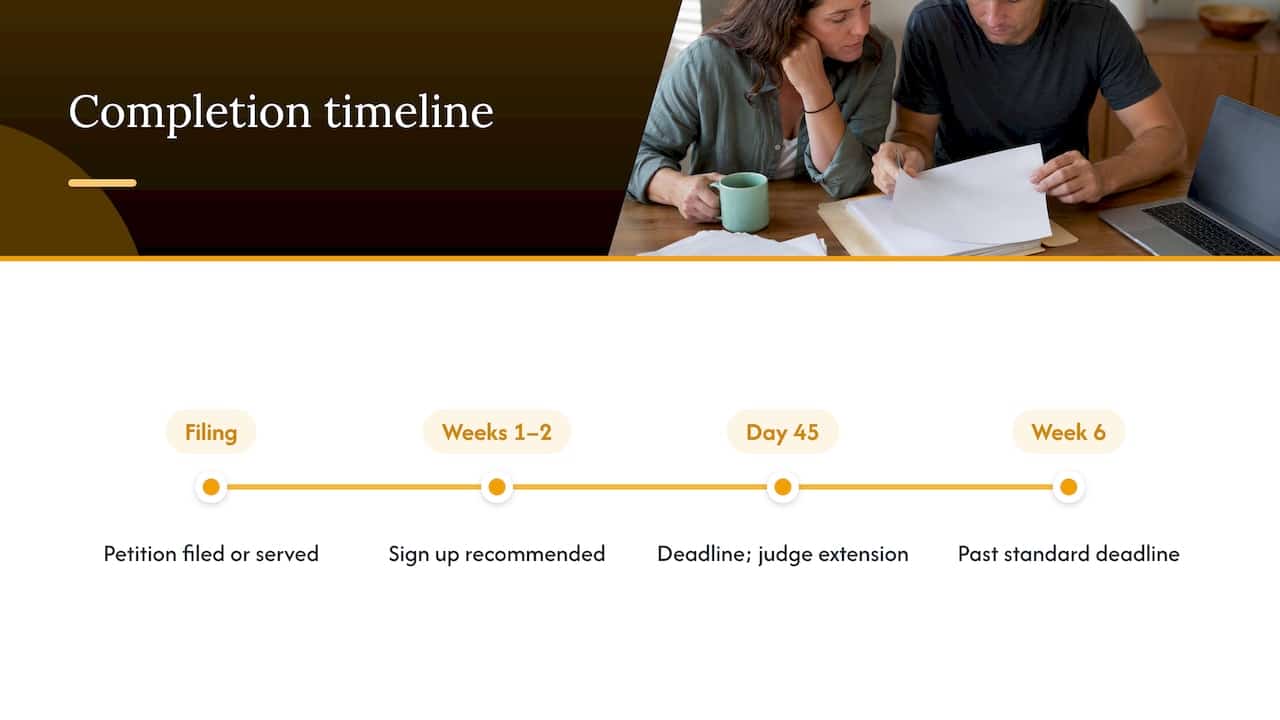
The standard court order requires completion within 45 days of filing or being served with the petition. The statute lets the judge set the time and extend the deadline, but do not count on an extension.
Missing the date will not automatically freeze your divorce. The practical risk shows up later. Judges may decline to sign final orders, or refuse future requests such as modifying legal decision-making, parenting time or child support, until the certificate is on file. A party who ignores the order can also be held in contempt. The Maricopa County order form states plainly that it is an official court order.
The fix is cheap and quick. Sign up within the first week or two after filing or service, not in week six.
What it costs
As of October 2026, the fee for the court-mandated class is capped at $50.00 per person across most Arizona jurisdictions. Providers can charge less, and some price below the cap, but you should not pay more than $50 for the court-approved class in a jurisdiction that applies the cap.
If you received a fee waiver or deferral for your family law case, you are generally eligible for a matching waiver or deferral of the class fee. Bring the paperwork to the provider. Without documentation, they cannot adjust the price.
A cheap class is only cheap if the court accepts it. A $25 certificate that your judge rejects costs you $25 plus a second class.
Online or in person: how to choose a provider your court accepts
Approved providers in larger counties such as Maricopa offer both online and in-person formats, in English and Spanish. Whichever you choose, use this checklist:
- Find your court’s approved list first. Start with the court’s own page for your county, not a search ad. Searching “court approved parenting class Arizona” returns many sellers who say they are accepted statewide. Do not rely on the seller’s own claim.
- Check for county-specific rules. Pima County, for example, will not accept certificates from outside providers without prior written authorization from the assigned judicial officer. Other counties, including Pinal, publish their own parent education class page.
- Bring what the provider asks for. Expect to need valid photo identification and your case number.
- Confirm the e-filing. The provider should e-file your certificate of completion directly with the court. Ask whether they do this, and whether it is automatic or something you must request.
- Keep your own copy. Save the certificate and confirmation email until your final order is entered.
Why parents attend separately
Arizona sends parents to separate classes, even when both choose the same provider. It is a safety measure that protects anyone who has experienced harassment or abuse. Many parents only discover it when they try to register, so book your own session and do not plan to attend together or on the same call.
What the class covers
Sessions differ by provider, but the court’s stated purpose sets the topic list. Expect material on:
- How children of different ages react to separation and conflict.
- The harm caused by exposing kids to disputes between parents.
- Why predictable, safe relationships with both parents matter.
- How to talk with children about changes in the family.
- How the court process works and how it affects the family.
As one example of how providers describe the length, the Arizona Judicial Branch has described the program as running between two and six hours depending on the provider. Check your provider’s page for the exact length before you block time.
How the class connects to your parenting plan
The class is the opening step toward a document that will govern your family for years. Under A.R.S. § 25-403.02, when parents cannot agree on legal decision-making or parenting time, each must submit a proposed parenting plan. Arizona courts favor plans that maximize both parents’ time and involvement, and the statute prohibits gender-based bias in evaluating them.
The class helps you put that in practice. Parents who finish it early tend to come to mediation with a clearer picture of what a child-centered schedule looks like. If you are starting to build one, these pages on our site go further:
- Arizona parenting plan: what every parent must know
- Parenting time in Arizona: schedules, laws and filing steps
- Joint custody in Arizona: shared decisions do not mean 50/50 time
- Arizona holiday parenting clauses that hold up
Special situations
High-conflict cases. If the other parent is combative, the class will not change that. What it does is put the court’s expectations on record. Our guide to court tools for high-conflict parenting in Arizona covers what to do when conflict escalates.
Safety concerns. If there are allegations of abuse or substance misuse, the class is not the safeguard. Courts may order supervised parenting time instead; see supervised visitation in Arizona. If you need protection from the other parent, speak with an attorney about an order of protection as soon as possible.
Moving away. If one parent plans to relocate, the class requirement still applies, but the larger issue is the schedule. See long-distance parenting plans in Arizona.
Fathers and mothers. The statute is gender neutral and so is the class. If you worry that the court will see you through a stereotype, finishing the requirement on time is the simplest way to show you take the process seriously. Our guide for mothers is here.
Our perspective: treat the class as the first exhibit of good faith
We see parents treat the class as a box to tick, and we understand why. They are stressed, the case is expensive, and one more requirement feels like punishment. Our view is different. The certificate is the first thing in the file that shows a judge you do what the court asks, on time, without being chased.
In more than 20 years of family law work, the pattern we have seen is that small compliance problems turn into big credibility problems. A missing certificate gives the other side something to raise at a hearing, and it can delay a final decree you were otherwise ready to sign. Our clients are told to enroll in the first week, confirm the provider files with the court, and keep their own copy.
We also tell parents to read the course with their own children in mind, not the other parent’s behavior. The class describes what kids need. Your parenting plan, whether reached through mediation, a collaborative process or a hearing, is where you turn that into a schedule. We build plans around your children’s interests and your financial goals, and we keep you informed at each step.
— Brett
How we can help
The class is one step in a larger case. If you are weighing how to proceed, we represent clients in collaborative divorce, uncontested divorce and divorce mediation, as well as contested cases and child custody matters in Scottsdale. If you need to know where your deadline stands, or whether your county accepts a particular provider, we can walk you through it at the start of your case. Start with our divorce page or contact the firm.
FAQ
Can I take the Arizona parent education class online?
Often yes. Larger counties such as Maricopa list approved providers that offer online and in-person sessions. Smaller counties may limit which providers they accept, so check your county’s court page before paying.
Do both parents have to take it?
Yes. Each parent completes the program separately, even if you choose the same provider. The separation is a safety measure, so book your own session.
What if I cannot afford the fee?
If the court granted you a fee waiver or deferral in your family law case, you are generally eligible for a matching waiver or deferral of the class fee. Present your documentation to the provider. Otherwise the fee is capped at $50 in most jurisdictions.
What happens if I do not finish in 45 days?
Your case will not necessarily stop, but the judge may refuse to sign final orders or grant later modification requests until your certificate is filed. You can also face contempt. If you are close to the deadline, enroll now and ask the court for more time if needed.
Does an out-of-county certificate count?
Not always. Pima County, for example, requires prior written authorization from the assigned judicial officer before accepting outside providers. Confirm with the court that has your case.
Sources
- A.R.S. § 25-352, Applicability of program; compliance
- A.R.S. § 25-403.02, Parenting plans
- Maricopa County Superior Court, Order and Notice to Attend Parent Information Program Class (DR12fz)
- Arizona Judicial Branch, Parent Education Program
- Pima County Superior Court, Parent Education
- Pinal County Superior Court, Parent Education Class
- Arizona courts, DCS Service Array Bench Card