



Arizona Long-Distance Parenting Plans: What to Include

If you live more than roughly 100 or 150 miles from your child’s other parent, depending on the specific legal context, Arizona’s long-distance parenting rules almost certainly apply to you. That means your parenting plan needs concentrated in-person blocks (think summer and holidays) paired with a specific virtual-contact schedule, not the standard week-on-week-off arrangement built for parents who live ten minutes apart.
Under A.R.S. §25-403.02, every Arizona parenting plan must spell out five things:
- Who makes legal decisions about the child’s health, education, and religion
- A parenting-time schedule covering the school year and vacations
- How and where exchanges will happen
- Communication expectations between parent and child
- A dispute-resolution process before anyone files a motion
Before you meet with an attorney or mediator, pull together a school calendar, a rough budget for travel costs, and a written proposal for virtual visits. That single packet saves most parents an entire consultation’s worth of back-and-forth.
Key Takeaways
A workable Arizona long-distance parenting plan requires precise statutory language, concentrated in-person blocks, and detailed virtual-contact and travel-cost terms to hold up in court.
| Point | Details |
|---|---|
| Confirm the distance threshold | Check whether your county uses 100 or 150 miles, since it changes how the schedule gets built. |
| Include all five statutory elements | Decision-making, schedule, exchanges, communication, and dispute resolution must all appear in writing. |
| Give 45 days’ notice for relocation | Moving more than 100 miles without notice risks contempt or an unfavorable modification. |
| Write precise virtual-contact terms | Specify days, times, and duration rather than “reasonable contact” to prevent disputes. |
| Get professional help drafting the plan | Highdesertfamilylawgroup drafts parenting plans and relocation notices from its Scottsdale office. |
Primary Statutes and County Guides to Cite
Review A.R.S. §25-403.02 and §25-408 for statutory requirements, Yavapai County’s parenting-time guidelines for local thresholds, and AFCC’s planning guide for age-specific scheduling recommendations.
This article is general information, not a substitute for advice from a qualified lawyer. Consult a qualified legal professional about your own circumstances before acting on anything here.
Table of Contents
- Key Considerations for a Long-Distance Parenting Plan Arizona Families Can Use
- Sample Long-Distance Parenting Time Schedules by Age
- What Does Arizona Law Actually Require for Long-Distance Custody?
- How Highdesertfamilylawgroup Helps With Long-Distance Parenting Plans
- What This Guide Gets Right That Others Miss
- Get Help Drafting Your Long-Distance Parenting Plan
- Sources
Key Considerations for a Long-Distance Parenting Plan Arizona Families Can Use
The schedule is only half the job. What actually prevents disputes down the road is how precisely you define the logistics around it.
Travel arrangements come first. Someone has to book the flight, drive the miles, or coordinate the handoff, and your plan should say who. Many Arizona plans include language tying travel time directly into the parenting-time period itself, something like “travel time up to a certain number of hours will be counted as part of the visiting parent’s parenting time,” which prevents arguments about whether a delayed flight eats into the other parent’s time.

Costs need the same specificity. Courts often split extraordinary travel expenses between parents, sometimes weighted by income, and this needs to be written into the plan rather than assumed. Vague language here is one of the most common sources of post-divorce conflict.
Here’s a practical sequence for building out the operational details:
- Name the exchange location (a specific school, airport terminal, or supervised neutral site).
- Set a buffer window (30 to 60 minutes) so late flights don’t trigger a violation.
- List a technology fallback (a backup video app) for the days the primary one glitches.
- Define virtual-contact frequency and duration, not just “reasonable contact.”
- Note any age-specific adjustments, especially for infants and toddlers who need shorter, more frequent blocks.
Age matters more than most parents expect. Infants and toddlers generally do better with shorter separations and frequent video check-ins, while school-age kids can typically handle multi-week summer blocks. Teenagers often want more say in the schedule and may travel with less supervision. If you have kids at different ages, most Arizona courts prefer syncing everyone’s schedule to the oldest child’s calendar unless there’s a good reason not to.
Pro Tip: Write your virtual-visit language with actual detail. “Video calls every Tuesday and Sunday at 6:00 PM Arizona time for at least 20 minutes” holds up far better in a dispute than “regular video contact.”
Sample Long-Distance Parenting Time Schedules by Age
Every family’s situation is different, but these three templates give you a starting point to adapt rather than a blank page.
Template A, for toddlers: Shorter, more frequent visits. Short visits multiple times per year, with video check-ins several times per week. Build in a caregiver-readiness checklist covering medication, sleep routine, and comfort items so transitions go smoothly.
Template B, for school-age kids: A concentrated summer block lasting several weeks, a split winter break often alternating years, plus spring or fall break rotation. Add a birthday clause specifying whether the visiting parent gets a call, a visit, or an alternate celebration day.
Template C, for teens: A longer summer stretch, sometimes up to a full month, alternating major holidays, and provisions for the teen to travel with less direct supervision as they get older.
| Age Group | Typical Visit Length | Suggested Frequency | Virtual Contact |
|---|---|---|---|
| Infant/toddler | 3–5 days | 6 times/year | 3x weekly |
| School-age | 4 weeks (summer) | Summer + holidays | 2x weekly |
| Teen | a multi-week summer visit | Summer + alternating holidays | Weekly or as requested |
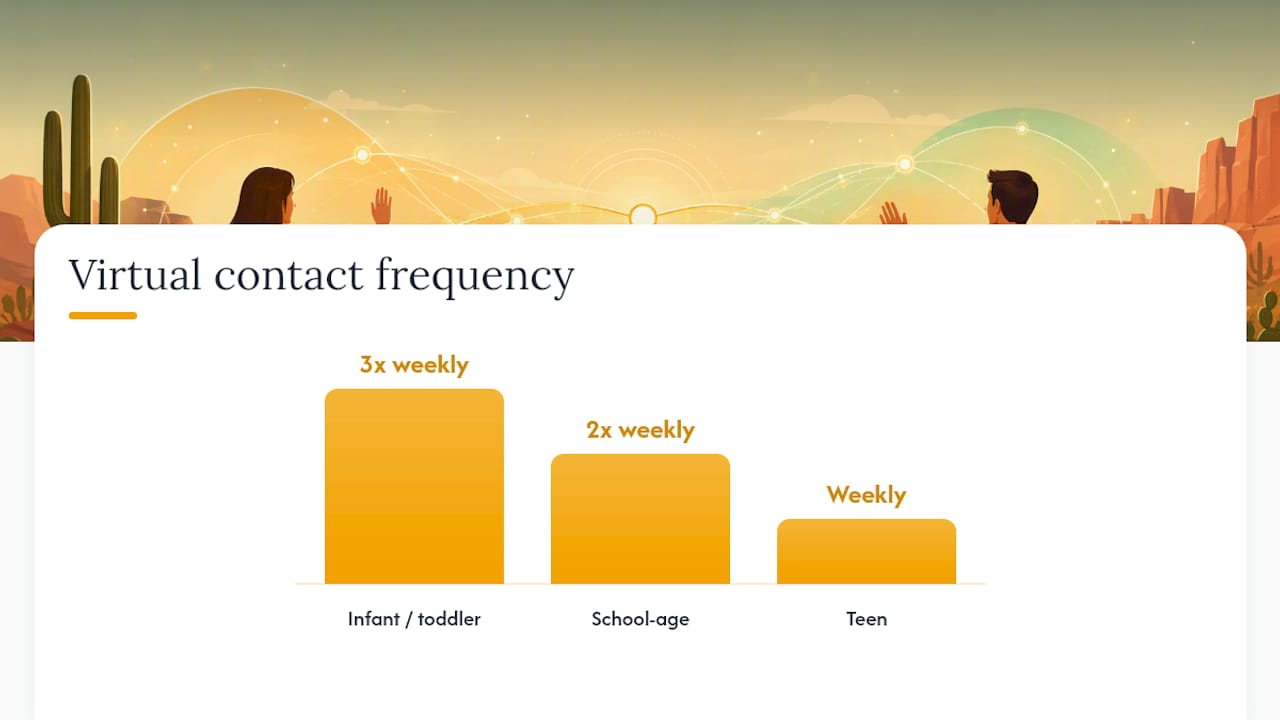
County guidance, including Yavapai County’s parenting-time guidelines, recommends a minimum of four parenting-time periods per year for long-distance arrangements. Don’t drop below that floor even if one parent pushes for less.
What Does Arizona Law Actually Require for Long-Distance Custody?
Arizona doesn’t have a separate statute labeled “long-distance parenting.” Instead, the standard parenting-plan requirements under A.R.S. §25-403.02 apply, and parents adapt the schedule and logistics to the distance involved. That means your plan still needs the same five statutory elements: legal decision-making, a schedule, exchange procedures, communication methods, and dispute resolution, but written with long-distance specifics baked in.
Relocation is where things get more formal. Under A.R.S. §25-408, a parent who wants to move a child more than 100 miles within Arizona, or out of state, must give at least advance written notice. The other parent then has 30 days to file an objection. Move first without giving notice, and you risk contempt findings or an unfavorable modification.
County practice adds another wrinkle. Yavapai County treats anything over 150 driving miles as long-distance for scheduling purposes, a different threshold than the 100-mile relocation-notice trigger in state statute. Confirm the local administrative order in your county before you draft anything.
- Verify your county’s specific distance threshold, not just the statewide relocation rule.
- Modification requests generally can’t be filed until one year after the original order, unless there’s a relocation or a safety concern.
- Document any missed exchanges, safety incidents, or changed circumstances contemporaneously. Courts weigh dated records far more heavily than after-the-fact recollections.
How Highdesertfamilylawgroup Helps With Long-Distance Parenting Plans
Highdesertfamilylawgroup has spent more than 20 years handling Arizona family law from its Scottsdale office, working through thousands of custody and divorce matters, including plenty that involved parents living states apart.
Our attorneys draft parenting plans and relocation notices, represent clients in mediation, work with parenting coordinators on ongoing scheduling disputes, and pursue enforcement when an existing order gets ignored. If your case is straightforward and both parents agree on the schedule, mediation or a parenting education class is often faster and cheaper than a court filing. If there’s disagreement over distance, costs, or decision-making authority, that’s when a consultation makes sense.
Bring these four things to your first meeting: a proposed schedule, a travel-cost estimate, the school calendar, and a written communication plan. If there’s any safety concern, say so up front.
Low-conflict, predictable exchanges reduce stress for kids more than the distance itself. Document the location, the time buffers, and a caregiver-readiness checklist, and most of the friction disappears before it starts.
Common questions about long-distance parenting in Arizona
Does a long-distance parenting plan need court approval?
Yes. Even an agreement both parents like needs to be filed and approved by an Arizona judge to be enforceable.
Can one parent refuse video calls specified in the plan?
Not without risking a contempt filing. If the plan states specific days and times for virtual contact, that’s an enforceable term.
Who pays for plane tickets in a long-distance custody arrangement?
It varies. Courts often split extraordinary travel costs, sometimes weighted by each parent’s income, but the plan should state the formula explicitly rather than leaving it open.
What happens if a parent moves without giving 45 days’ notice?
The other parent can object, and the court may order the child returned or modify custody in response to the unauthorized move.
How often should virtual visits happen for a long-distance schedule?
There’s no fixed legal minimum, but AFCC guidance and most Arizona plans specify at least two to three sessions weekly, more for younger children.
Can grandparents be included in a long-distance parenting plan?
Grandparent visitation is handled separately from parenting time between parents, though scheduling can sometimes be coordinated within the same plan.
Is 100 miles or 150 miles the real threshold for “long-distance” in Arizona?
Both numbers matter for different reasons. State relocation law uses 100 miles for notice requirements, while some counties, including Yavapai, use 150 miles for parenting-time scheduling purposes.
Do teenagers get input on the long-distance schedule?
Courts increasingly weigh a teen’s preferences, especially around ages 14 to 17, though the child’s wishes aren’t the sole deciding factor.
What if the other parent won’t cooperate on scheduling?
A parenting coordinator can help resolve day-to-day scheduling disputes without going back to court each time.
Can a long-distance plan be modified later?
Yes, generally after one year from the original order, or sooner if there’s a relocation or a safety issue.
Should siblings have separate schedules if they’re different ages?
Most Arizona courts prefer keeping siblings on the same schedule, synced to the oldest child, unless there’s a specific reason to separate them.
What documents should I bring to a consultation about a long-distance plan?
A proposed schedule, a school calendar, an estimate of travel costs, and any written communication with the other parent about the arrangement.
Does the plan need to name a specific exchange location?
It should. Naming an airport terminal, school, or supervised site in writing prevents disputes about where handoffs happen.
What if the other parent lives out of state entirely?
The same relocation-notice and long-distance scheduling principles apply, though enforcement across state lines can involve additional steps under interstate custody law.
Are co-parenting classes required before filing a plan?
Not always required, but programs through organizations like Child Crisis Arizona can help parents negotiate terms before they reach mediation.
How does back-to-school timing affect a long-distance schedule?
Plans should specify a firm return date before the school year starts, factoring in travel time so the child isn’t pulled from class. A back-to-school parenting plan can help align these dates in advance.
What This Guide Gets Right That Others Miss
Most articles on this topic treat “long-distance parenting” as one uniform problem with one uniform solution: give the visiting parent summer and alternate holidays, done. That advice isn’t wrong, but it skips the part that actually causes litigation, which is the fine print around exchanges, cost-splitting, and virtual contact.
The conventional wisdom underrates how much conflict comes from vague language, not distance itself. A plan that says “regular phone contact” invites disputes. A plan that says “video calls Tuesdays and Sundays at 6:00 PM for 20 minutes” doesn’t. Parents also tend to overlook county variation. Treating every Arizona county the same, when Yavapai’s 150-mile threshold differs from the 100-mile relocation trigger in state statute, is a mistake I see repeated constantly in generic guides.
If you take one thing from this article, prioritize the exchange and communication language before you argue over the calendar. The schedule matters, but precision is what actually gets enforced.
Get Help Drafting Your Long-Distance Parenting Plan
Highdesertfamilylawgroup is the practical alternative to drafting a long-distance parenting plan alone or relying on a generic template pulled from the internet. Where a downloaded form leaves gaps around travel costs, exchange locations, and virtual-visit specifics, our attorneys write that language based on 20-plus years of Scottsdale-based family law experience and thousands of Arizona custody cases.

Whether you need a plan drafted from scratch, a relocation notice reviewed before you file it, or representation because the other parent won’t agree to reasonable terms, our team handles the paperwork and the negotiation. Learn more about the types of family lawyers who handle these cases and what fits your situation, then schedule a consultation to bring your proposed schedule and documents in for review.
Sources
- 25-403.02 – Parenting plans
- Parenting Time Guidelines (Yavapai County Superior Court)
- Planning for Parenting Time: Guide for Parents Living Apart (AFCC)