



FSBO vs Realtor: What Divorcing Sellers in Scottsdale Need to Know

For most divorcing sellers in Scottsdale, a realtor is the safer financial and legal choice. According to the NAR’s 2025 Profile of Home Buyers and Sellers, FSBO transactions accounted for a small share of home sales, with median sale prices notably lower compared to agent-assisted sales, often offsetting any commission savings before you’ve even factored in Arizona’s community-property rules or court-approval requirements.
If you’re selling during a divorce, three things matter immediately:
- Consult a family law attorney first. A sale that violates a temporary court order can unravel your entire settlement.
- Get a comparative market analysis (CMA). Pricing errors cost divorcing sellers more than anyone, because both parties share the loss.
- Confirm whether you have a ready buyer. That’s the one scenario where for sale by owner vs realtor math can shift in FSBO’s favor.
Table of Contents
- How does FSBO compare to using a realtor?
- When can FSBO actually make sense during a divorce?
- What legal risks does Arizona law add to a divorce home sale?
- How does a realtor reduce risk in a divorce sale?
- How do you sell a Scottsdale home during a divorce, step by step?
- What should you ask your realtor and attorney before you list?
- What does selling during a divorce actually cost?
- Key Takeaways
- A local perspective on the real cost of going it alone
- How Highdesertfamilylawgroup supports divorce-related home sales in Scottsdale
- Useful sources
How does FSBO compare to using a realtor?
| Dimension | FSBO | Realtor-Assisted |
|---|---|---|
| Expected sale price | Median $360,000 | Median $425,000 |
| Upfront & closing costs | Flat-fee MLS listing fees along with buyer-agent commissions and marketing expenses | Listing and buyer-agent commissions in typical percentage ranges |
| Time & effort | High — you manage everything | Low — agent handles 40–80 hours of work |
| Legal/disclosure risk | High — liability shifts to you | Lower — agent guides compliance |
| Marketing reach | Limited without MLS access | Full MLS + agent network |
| Negotiation complexity | You vs. a professional buyer’s agent | Agent-to-agent negotiation |
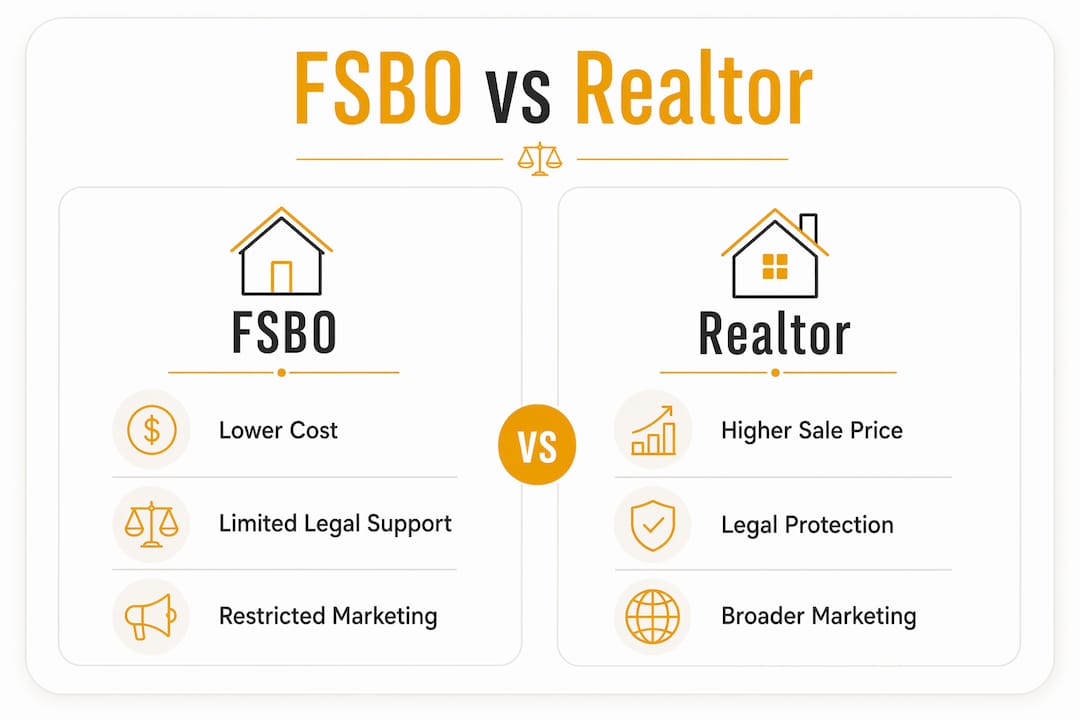
Realtor-assisted sales win on price, legal protection, and marketing reach. FSBO can win on cost only when you already have a buyer and the transaction is straightforward.
Pro Tip: A hybrid approach works for sellers who understand the market but want to cut costs. Pay a flat-fee MLS service ($100–$500) for listing exposure, offer a buyer-agent commission of 2–3% to attract represented buyers, and hire a real-estate attorney to review contracts. You reduce commission outlay without taking on full legal exposure.
When can FSBO actually make sense during a divorce?
The honest answer: rarely, but not never. FSBO is defensible in a narrow set of circumstances:
- You already have an identified buyer (a family member, neighbor, or colleague) who is ready to make an offer.
- The title is clean, the sale is uncontested, and both spouses agree on price and terms.
- One spouse is a licensed real estate professional or has direct transaction experience.
- You’re in a time-sensitive cash sale where speed matters more than maximizing price.
- The property is low-value and the settlement split is simple.
Even in these cases, hidden FSBO costs reduce the savings: flat-fee MLS listings, professional photography, buyer-agent commissions, and attorney review fees all add up. Buyer agents are also less likely to show your property unless you offer a cooperating commission of 2–3%, which cuts directly into what you thought you were saving.
Don’t attempt FSBO if the property is subject to a court order, if the settlement is contested, or if either spouse disputes the listing price or sale terms. The perceived benefit of control can become a serious liability when high-stakes negotiations and strict legal disclosures are involved. Surveys show a meaningful share of FSBO sellers eventually switch to an agent after pricing errors and paperwork problems — in a divorce, those mistakes affect both parties’ financial futures.
What legal risks does Arizona law add to a divorce home sale?
Divorce changes the stakes on every dimension of a home sale. Property division in Arizona is governed by community-property principles, meaning proceeds from the marital home are generally split equally unless a valid agreement or court order says otherwise. That makes pricing errors and undisclosed defects a shared problem, not just one spouse’s headache.
Arizona-specific risks every seller should know before listing:
- Disclosure obligations. Arizona requires sellers to complete a Residential Seller Disclosure Statement covering material defects, HOA status, and known legal issues. Omissions create post-closing liability for both spouses.
- Temporary orders. A divorce court may issue orders restricting the sale, transfer, or encumbrance of marital property. Listing without checking is a contempt risk.
- Court or opposing counsel notice. Depending on where you are in the Arizona divorce process, you may need to notify the court or opposing counsel before accepting an offer.
- Lien and payoff coordination. Both spouses’ names are typically on the mortgage. Payoff statements, lien releases, and title clearance require coordination before closing.
Pro Tip: Hire a real-estate attorney to review your purchase contract before you sign anything. Attorney review typically costs $500–$1,500 and can prevent contract mistakes that generate far larger liabilities after closing.
How does a realtor reduce risk in a divorce sale?
A good realtor does more than find a buyer. In a divorce context, each service maps directly to a financial or legal risk:
- CMA pricing. An accurate list price protects both spouses’ share of proceeds. Overpricing causes the home to sit; underpricing hands money to the buyer. Either outcome shrinks the settlement pool.
- MLS exposure. Broad listing reach generates competing offers, which is the single most reliable way to push final sale price above asking.
- Offer management. A realtor filters lowball offers, identifies contingency red flags, and presents options clearly to both parties and their attorneys.
- Inspection and repair negotiation. Repair credits and concessions are a common point of post-offer conflict. An experienced agent knows which requests are standard and which to push back on.
- Escrow and closing coordination. The realtor keeps the transaction on schedule, which matters when court deadlines or settlement timelines are involved.
According to Redfin’s analysis, a listing agent’s work typically spans 40–80 hours across the transaction. For high-value Scottsdale properties, that expertise in pricing and negotiation frequently secures a final price that more than offsets the commission.
Pro Tip: Before signing a listing agreement, ask your realtor and your attorney to agree in writing on a communication protocol: who reviews offers first, how quickly each party responds, and what triggers a court notification. Skipping this step is the most common source of delays in divorce-related closings.
How do you sell a Scottsdale home during a divorce, step by step?
Follow this checklist to reduce legal risk and protect both parties’ proceeds from the start.
- Retain a family law attorney before any listing decision. Confirm whether temporary orders restrict the sale.
- Consult on preparing for divorce options that affect property timing, including mediation or collaborative divorce paths.
- Get a CMA from at least one licensed Scottsdale agent to establish a defensible list price.
- Order a pre-listing inspection to identify defects before buyers do — surprises during escrow kill deals.
- Decide on listing strategy: full-service realtor, flat-fee MLS with attorney oversight, or FSBO (only if you meet the narrow criteria above).
- Obtain mortgage payoff statements and confirm both spouses’ names on title.
- Prepare Arizona disclosure documents with attorney review.
- Coordinate offer review with opposing counsel or the court as required by your case status.
- Open escrow with a title company experienced in divorce-related transactions.
- Close and distribute proceeds per the settlement agreement or court order.
Documents to have ready: mortgage payoff statement, HOA governing documents and financials, prior appraisals, settlement draft or decree language addressing the property, and any QDRO information if retirement accounts are part of the split.
Typical timeline: Marketing to close runs 30–90 days for a standard listed sale. Cash or iBuyer transactions can close in 7–30 days, which matters when court deadlines are tight.

What should you ask your realtor and attorney before you list?
Questions for your realtor
- How many divorce-related sales have you handled in Scottsdale in the past two years?
- Can you provide sample CMAs for comparable properties in our neighborhood?
- What buyer-agent commission will you recommend offering, and why?
- What is your marketing plan beyond MLS — photography, open houses, digital advertising?
- How do you handle offers when both spouses need to review and approve?
Questions for your family law attorney
- How will sale proceeds be treated in our settlement agreement?
- Does listing the property require court notice or approval at our current case stage?
- Which escrow or title companies do you recommend for divorce-related closings?
- Will you review the purchase contract before we sign?
- What happens if one spouse refuses to sign the listing agreement or accept an offer?
Red flags to watch for: A realtor who is unwilling to coordinate with your attorney, or who discourages offering a buyer-agent commission. An attorney who won’t review sale documents before closing. Either signals a gap that will cost you later.
What does selling during a divorce actually cost?
Commission savings may be swallowed by a lower sale price or hidden costs. The NAR 2025 data puts the median gap at $65,000 between FSBO and agent-assisted sales.
| Cost Item | FSBO Estimate | Realtor-Assisted Estimate |
|---|---|---|
| Listing commission | — | $10,000–$12,750 (2.3–3% of $425K) |
| Buyer-agent commission | $9,000–$10,800 (2.5–3% of $360K) | $10,000–$12,750 |
| Flat-fee MLS | $100–$500 | Included |
| Attorney review | $500–$1,500 | $500–$1,500 |
| Marketing/staging | $500–$1,500 | Included or negotiated |
| Inspection/repair credits | Varies | Varies |
The example above uses the NAR median prices: $360,000 for FSBO and $425,000 for agent-assisted. Even after paying full commissions, the realtor-assisted seller nets roughly $43,000 more. In a 50/50 community-property split, that’s $21,500 per spouse — real money that a commission-savings argument rarely accounts for.
Key Takeaways
For divorcing sellers in Scottsdale, a coordinated realtor-attorney strategy protects both parties’ financial interests far better than FSBO in most situations.
| Point | Details |
|---|---|
| Realtor wins on price | NAR 2025 data shows a $65,000 median gap between FSBO ($360K) and agent-assisted ($425K) sales. |
| FSBO works in one scenario | FSBO is defensible only when you already have an identified buyer and the sale is uncontested. |
| Arizona adds legal complexity | Community property, disclosure obligations, and possible court orders make attorney review essential before listing. |
| Coordinate realtor and attorney | Agree in writing on a communication protocol before listing to prevent delays and settlement disputes. |
| Highdesertfamilylawgroup | With 20+ years of Scottsdale family law experience, the firm helps divorcing clients coordinate real estate sales with settlement strategy. |
A local perspective on the real cost of going it alone
The conventional wisdom on FSBO is that it’s a commission-savings play. That framing misses the actual risk for divorcing sellers. The commission is not the biggest number in the equation — the sale price is. And in a divorce, the sale price determines what both parties walk away with, which shapes every other financial decision in the settlement.
What most articles don’t say plainly: a pricing error in a divorce sale isn’t just a financial mistake. It can reopen settled issues, generate post-closing disputes between former spouses, and in some cases require court intervention to resolve. The attorney fees from that kind of fallout routinely exceed whatever commission savings the FSBO route was supposed to produce.
The sellers who do best are the ones who treat the realtor and the attorney as a team, not as separate vendors. When those two professionals are aligned on timeline, offer review, and closing coordination, the transaction moves faster and cleaner. When they’re not, small miscommunications become expensive delays.
Scottsdale’s market is competitive enough that a well-priced, well-marketed listing almost always outperforms a FSBO on final price. The math is rarely close.
How Highdesertfamilylawgroup supports divorce-related home sales in Scottsdale
Selling a home during a divorce isn’t just a real estate transaction. It’s a legal event with settlement consequences, and the decisions made before listing often matter more than anything that happens during escrow.

Highdesertfamilylawgroup works with divorcing clients in Scottsdale to review real estate contracts, draft settlement language addressing property proceeds, coordinate with escrow and title companies, and provide mediation support when spouses disagree on listing strategy or offer acceptance. With over 20 years of Arizona family law experience and thousands of cases handled, the firm understands how a home sale fits into the broader financial picture of a divorce settlement.
If your home sale intersects with an active divorce, schedule a consultation before you list. Understanding your legal position first protects both your proceeds and your settlement. You can also review what a family lawyer does in a real estate context to know exactly what to expect from coordinated legal support.
Useful sources
- NAR 2025 Profile of Home Buyers and Sellers — Primary source for FSBO market share (5%) and median price data ($360,000 FSBO vs. $425,000 agent-assisted).
- Opendoor: Sell your house without a realtor — Practical breakdown of FSBO costs including flat-fee MLS, buyer-agent commission, and attorney review fees.
- Redfin: Is FSBO worth it? — Analysis of agent services and the time investment (40–80 hours) that typically justifies commission costs.
- ibuyer.com: How to sell your house without a realtor — Covers buyer-agent bias against FSBO listings and the cooperating commission strategy.
- ListWithClever: FSBO vs. Realtor statistics — Survey data on FSBO seller regrets, including pricing errors and paperwork problems.
This article provides general information about real estate and family law topics and is not legal advice. Consult a licensed Arizona attorney for guidance specific to your situation.