



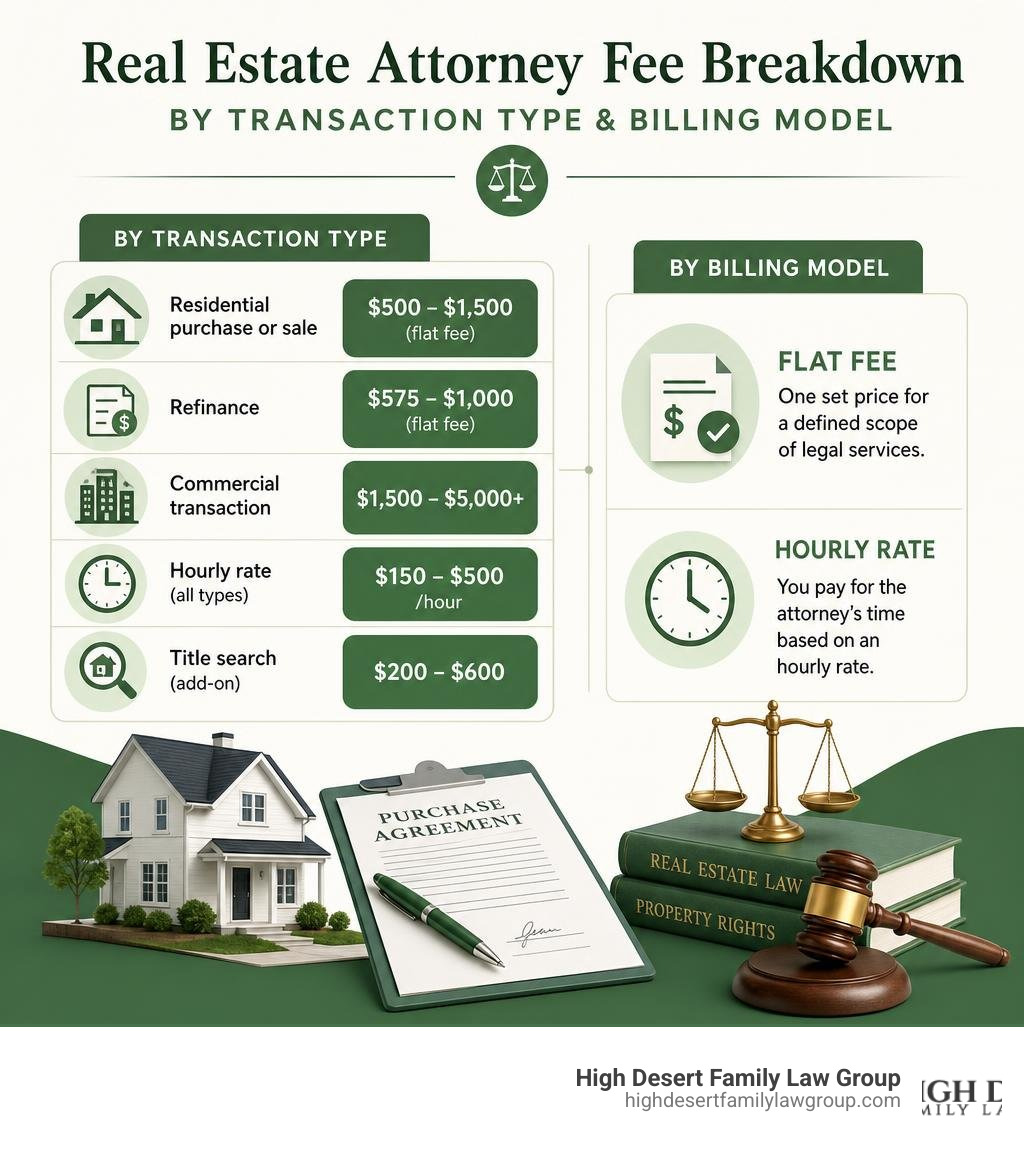
Understanding the real estate attorney fee before you sign anything can save you hundreds — sometimes thousands — of dollars. Here’s a quick breakdown:
| Transaction Type | Typical Attorney Fee |
|---|---|
| Residential purchase or sale | $500 – $1,500 (flat fee) |
| Refinance | $575 – $1,000 (flat fee) |
| Commercial transaction | $1,500 – $5,000+ |
| Hourly rate (all types) | $150 – $500/hour |
| Title search (add-on) | $200 – $600 |
Quick answer: Most people pay a flat fee of $500 to $1,500 for a standard residential closing. Complex or commercial deals can run much higher. Where you live also matters — attorneys in the Northeast typically charge $800 to $2,000, while the South and Midwest often run $500 to $1,000.
Real estate transactions are rarely simple. Whether you’re buying a home while navigating a divorce, protecting property you owned before marriage, or trying to understand who pays what at closing — the legal side can feel overwhelming fast.
And if your finances are already strained by a family law matter, an unexpected attorney bill on top of closing costs is the last thing you need.
This guide breaks down exactly what real estate attorney fees look like in 2026, what drives the cost up or down, and how to make smart decisions about legal representation — without overpaying.
Understanding the Average Real Estate Attorney Fee in 2026
When budgeting for a property transaction in Greater Scottsdale or Chandler, understanding how a real estate attorney fee is calculated is key to keeping your closing costs under control. In 2026, the cost of legal representation for property matters generally falls into two buckets: hourly billing or flat fees.
The average market benchmark rate for real estate legal work sits around $300 to $377 per hour, though actual hourly rates typically range from $150 to $500 per hour depending on the lawyer’s experience and the complexity of the matter. If you are dealing with a standard, highly predictable transaction, many attorneys will offer a flat fee instead. For a standard residential transaction, a flat fee usually ranges from $500 to $1,500.
Geographic location plays a massive role in what you will pay. In major coastal metros, hourly rates frequently jump to a band of $424 to $542 per hour, whereas mid-size cities and inland markets see average rates closer to $278 to $356 per hour. Here in Arizona, we fall somewhere in the middle, but because Arizona is a “title state” (meaning title companies, rather than attorneys, traditionally handle standard escrow and closings), hiring an attorney is an optional—but highly recommended—step to protect your interests, especially if you are navigating a complex life transition like divorce.
To explore how these baseline rates are established, you can read more about the general breakdown of a Real Estate Attorney Cost or review national averages via this Real Estate Lawyer Cost analysis.
How Real Estate Attorney Fees Vary by Transaction Type
Not all real estate transactions are created equal, and the legal fees associated with them reflect that reality. The more complex the paperwork, the higher the risk, and the more time an attorney must spend reviewing the details.
Residential Purchases and Home Sales
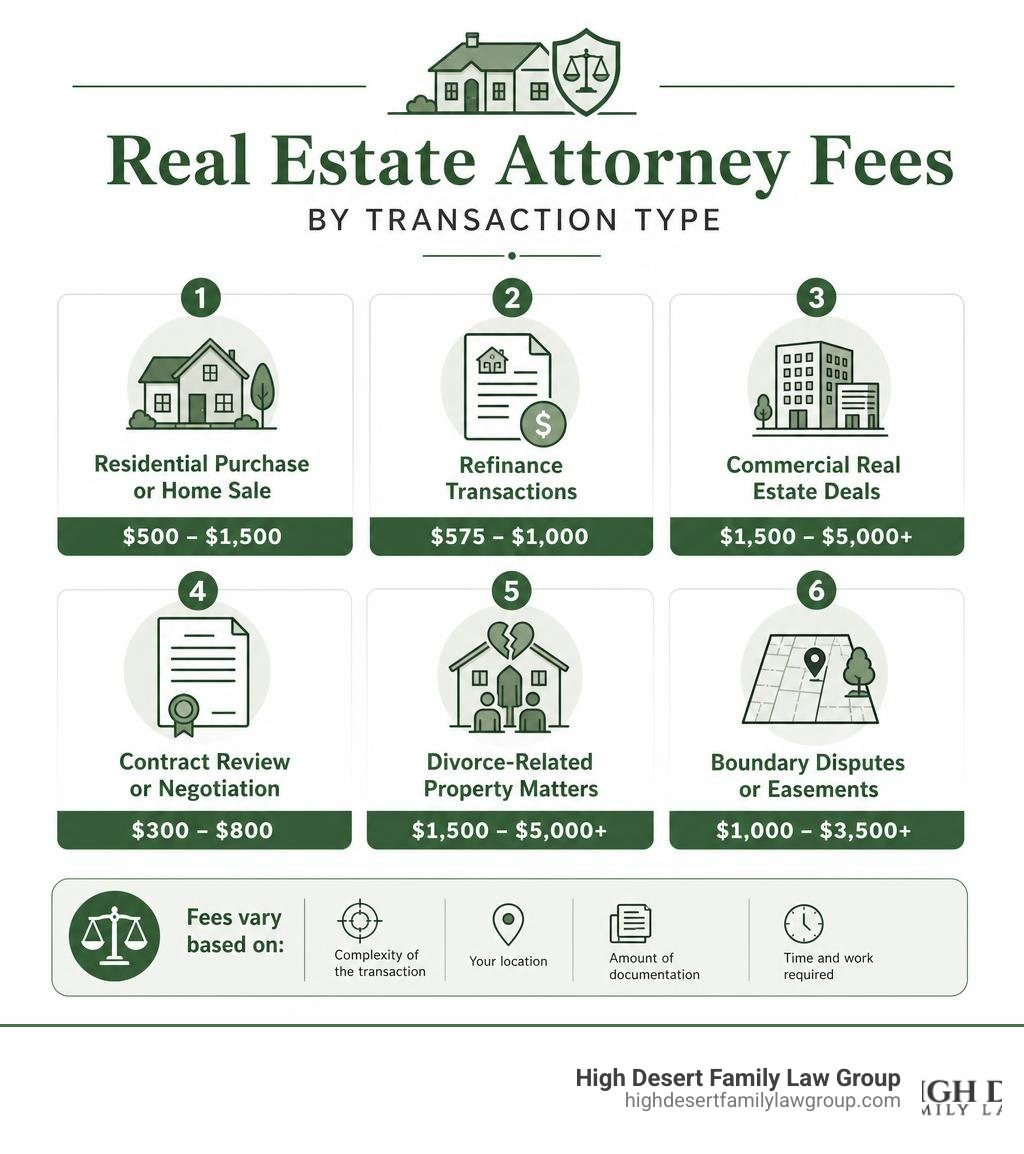
For a standard home purchase or sale, the legal work is highly repeatable. The attorney reviews the purchase contract, checks the title commitment, prepares the deed, and coordinates with the title company. Because the scope is predictable, most attorneys charge a flat fee of $500 to $1,500.
Refinance Transactions
A refinance is generally the most straightforward transaction type. The attorney’s main job is to review the new loan documents, verify title clearance, and ensure the old mortgage is properly released. Because of this streamlined scope, refinance attorney fees are often lower, typically ranging from $575 to $1,000.
Commercial Deals
Commercial real estate transactions are a completely different animal. These deals involve complex zoning laws, environmental assessments, commercial lease structures, tenant estoppels, and entity organizational documents. Because the financial stakes and legal risks are incredibly high, commercial transactions are rarely billed as flat fees. Instead, they are billed hourly or require a substantial retainer, often totaling $1,500 to $5,000 or more.
To help you visualize the cost differences, here is a comparison table:
| Transaction Type | Typical Fee Structure | Average Cost Range | Primary Legal Tasks |
|---|---|---|---|
| Residential Purchase/Sale | Flat Fee | $500 – $1,500 | Contract review, deed prep, closing coordination |
| Refinance | Flat Fee | $575 – $1,000 | Loan document review, title verification, release tracking |
| Commercial Purchase/Lease | Hourly / Retainer | $1,500 – $5,000+ | Zoning analysis, environmental review, lease negotiation |
| Property Dispute / Litigation | Hourly | $2,500 – $10,000+ | Discovery, motions, court appearances, mediation |
If you are facing a dispute or a unique property situation, you can learn more about how hourly billing accumulates by reading about the Real Estate Attorney Cost Per Hour or consulting this guide on Real Estate Lawyer Cost: Closing Counsel, Contract Review, and Property Dispute Fees.
Flat Fee vs. Hourly Rate: Which Billing Structure is Best?
Choosing the right billing structure can make a massive difference in your final bill. Attorneys generally use flat fees for transactional work and hourly rates for disputes or unpredictable situations.
+-----------------------------------------------------------------------+
| BILLING STRUCTURES |
+-----------------------------------------------------------------------+
|  FLAT FEES: Best for Predictable, Transactional Work |
|  - Standard residential closings |
|  - Simple contract or deed drafting |
|  - Document review packages |
| |
|  HOURLY RATES: Best for Unpredictable, Complex Matters |
|  - Boundary, easement, or title disputes |
|  - Partition actions (e.g., dividing property during a divorce) |
|  - Commercial negotiations with shifting terms |
+-----------------------------------------------------------------------+
Predictable Flat Fees
Flat fees provide excellent cost transparency. When you pay a flat fee for document review or contract drafting, you know exactly what the service will cost upfront. This model encourages open communication because you don’t have to worry about the clock ticking every time you send an email or ask a quick question. For example, simple deed preparation may cost as little as $175, while a comprehensive For Sale By Owner (FSBO) transaction package might start around $850.
Hourly Billing for Complex Disputes
For litigation, boundary disputes, or dividing a family home during a divorce, flat fees are rarely an option. Because the attorney cannot predict how the other party will respond or how long negotiations will take, they must bill hourly. In these cases, you will likely be asked to provide a replenishing retainer.
To dig deeper into how these fees have shifted over time, check out our resource on Real Estate Attorney Cost 2024 or read The Basics of Attorneys’ Fees and Fee Contracts for a broader look at legal billing standards.
Key Factors That Influence Your Real Estate Attorney Fee
The final price tag on your legal bill isn’t pulled out of thin air. Several distinct factors determine whether your fee stays at the lower end of the spectrum or climbs to the higher side.
- Property Value: High-value properties carry higher financial risk for the attorney, which can sometimes influence the fee, especially if the attorney is acting as a title agent.
- Transaction Complexity: A standard single-family home purchase is much simpler than purchasing a multi-parcel property, a home with unpermitted additions, or a property with historical preservation restrictions.
- Title Clearance: If the title search reveals unexpected judgments, old mechanics’ liens, or probate issues, the attorney must spend extra hours clearing the title before the transaction can proceed.
- Market Demand: Highly experienced real estate specialists in competitive markets like Scottsdale and Chandler naturally command higher rates than general practitioners in rural areas.
How Property Complexity Impacts Your Real Estate Attorney Fee
When a property has “baggage,” your legal fees will inevitably reflect the extra work required to untangle it. Title issues, such as an unresolved estate claim or an ancient tax lien, require meticulous research and negotiation to clear.
Similarly, easement disputes (such as a neighbor claiming a right-of-way across your driveway) or restrictive zoning laws can stop a sale in its tracks. If your attorney has to draft custom easement agreements or represent you before a local zoning board, expect the billing to transition from a flat closing fee to an hourly rate.
State Requirements and the Real Estate Attorney Fee at Closing
In some parts of the United States—particularly back East in states like New York, Massachusetts, or Connecticut—state law or local custom mandates that an attorney oversee the closing process. In these “attorney states,” the buyer and seller each hire legal counsel, and the attorney fees are a standard, expected line item on the closing disclosure.
In “title states” like Arizona, title and escrow companies handle the administrative closing tasks, meaning you are not legally required to hire an attorney to close on a home. However, title companies cannot give you legal advice. If you are signing complex contracts, buying a home outside of a traditional brokerage relationship, or dealing with a property division during a divorce, relying solely on a title company can be a costly mistake.
To see how different jurisdictions regulate these charges, you can review the guide on Attorneys’ Fees – The Florida Bar for a look at how other states approach fee reasonableness.
Additional Closing Costs and How to Control Legal Expenses
When buying or selling real estate, attorney fees are just one piece of the puzzle. To budget accurately, you must also account for other standard closing costs.

Beyond your attorney’s direct fee, you should expect to pay:
- Title Insurance: Typically costs $500 to $2,000 depending on the property’s purchase price. This protects you (and your lender) from future title claims.
- Recording Fees: Usually $25 to $250 to officially record your deed and mortgage with the county.
- Title Search & Opinion Fees: Often run $200 to $600 to perform a deep dive into public records.
How to Keep Your Legal Costs Down
While legal representation is a smart investment, you don’t want to overpay. Here are a few practical ways to keep your real estate attorney fees as low as possible:
- Organize Your Documents: Before your first meeting, gather your purchase contract, HOA guidelines, property surveys, and any correspondence. Presenting a clean, chronological packet saves your attorney from billing you for basic administrative sorting.
- Clarify the Scope Upfront: Ask your attorney exactly what is included in their flat fee. Does it cover contract revisions, or just the initial review? Will they attend the closing, or are they only drafting the deed?
- Consolidate Your Questions: Instead of calling or emailing your attorney every time a random question pops into your head, write them down and address them all in a single, focused conversation.
- Consider Limited-Scope Representation: If you don’t need full-service representation, ask if you can hire the attorney for a specific task, such as reviewing a single contract rider or drafting a disclaimer deed.
To understand how real estate legal rights and costs intersect, you can read our comprehensive overview of Real Estate Law.
Frequently Asked Questions about Real Estate Attorney Fees
What is typically included in a real estate attorney’s flat fee?
A standard residential flat fee usually covers the review of the purchase and sale agreement, review of the title commitment, preparation of the deed (such as a warranty deed or quitclaim deed), coordination with the title or escrow company, and answering basic legal questions leading up to the closing. It typically does not cover resolving major title defects, handling boundary disputes, or representing you in court if the deal falls through.
When is it worth hiring a real estate attorney if not legally required?
In Arizona, hiring an attorney is highly recommended for For Sale By Owner (FSBO) transactions, properties with complex easements or agricultural covenants, deals involving seller financing, or buying bank-owned/foreclosure properties. It is also incredibly important if you are going through a divorce and need to divide a marital home, or if you want to keep a pre-marital home as your sole and separate property using a disclaimer deed.
What should be included in a written fee agreement?
A clear, written fee agreement (often called an engagement letter) should clearly state the billing structure (flat fee or hourly rate), the exact scope of work covered, how out-of-pocket expenses (like recording fees or courier costs) will be billed, how often you will receive invoices, and how disputes over fees will be resolved.
Conclusion
Navigating a real estate transaction is a major financial milestone, but when property issues collide with family law matters, the stakes become even higher. Protecting your property rights and understanding your real estate attorney fee obligations shouldn’t be a source of constant stress.
At High Desert Family Law Group, we specialize in helping clients in Greater Scottsdale and Chandler, Arizona, navigate the complex intersection of family law and real property. Whether you are dealing with a divorce, negotiating spousal support, or trying to protect a pre-marital home from a community lien, our four-person team is here to provide aggressive, individualized representation.
We understand how stressful these transitions can be, and we are committed to helping you protect your assets and your future. If you are ready to discuss your situation and get clear, practical guidance, explore our resources on Real Estate Attorney Cost and contact us today to schedule a consultation.