



QDRO Arizona: What Divorcing Spouses Need to Know

If your spouse has a 401(k), pension, or other employer-sponsored retirement account, a Qualified Domestic Relations Order (QDRO) is the legal mechanism that actually moves your share of those funds to you. The divorce decree establishes your right to the money, but the QDRO is the only document that legally compels the plan administrator to pay you. Without it, the plan ignores the decree entirely.
Here is what to do right now:
- Identify the plan type. ERISA-covered plans (401(k), 403(b), most private pensions) require a QDRO. IRAs and some public-employee plans follow different rules.
- Contact the plan administrator. Ask for their model QDRO language and written procedures before anyone drafts a word.
- Hire an Arizona family law attorney. QDRO drafting is technical. A rejected order means refiling, more fees, and lost time.
- Submit a draft for pre-approval before filing with the court. This is the single step most people skip, and it is the one that prevents the most rejections.
Speed matters. If the participant dies, rolls funds, or elects a benefit form before your QDRO is qualified, you can permanently lose your share.
Table of Contents
- What a QDRO is, and what it is not
- When you must get a QDRO in an Arizona divorce
- How different plan types are handled
- How military retirement is treated in Arizona divorces
- How courts and administrators calculate the alternate payee’s share
- Step-by-step QDRO process and typical timeline in Arizona
- Who pays taxes and fees, and how to avoid surprises
- How to prepare for your QDRO conversation with an attorney or plan administrator
- Why hire an experienced Arizona family law attorney for your QDRO
- Key Takeaways
- What I see go wrong — and how to avoid it
- Highdesertfamilylawgroup handles the QDRO process for you
- Authoritative sources and plan administrator guidance
What a QDRO is, and what it is not
A Qualified Domestic Relations Order is a court order, separate from the divorce decree, that instructs an ERISA-covered retirement plan to recognize an “alternate payee” — typically a divorcing spouse — and pay that person a defined portion of the participant’s benefit.
Federal law requires every QDRO to contain four categories of information:
- The name and last known mailing address of the participant and each alternate payee
- The name of each plan to which the order applies
- The dollar amount or percentage to be paid to the alternate payee (or the method for calculating it)
- The number of payments or period to which the order applies
Missing any of these gives the plan administrator grounds to reject the order outright, even if a judge signed it.
The decree and the QDRO do different jobs. Say the decree states “Wife is awarded 50% of Husband’s 401(k) balance as of the petition service date.” That sentence creates the entitlement between spouses. The QDRO is the separate technical document that tells the plan exactly how to calculate, segregate, and distribute that 50%. One without the other leaves money stranded.
IRAs are different. They are not ERISA plans, so they do not require a QDRO. A properly worded decree or a transfer-by-decree instruction is typically sufficient for an IRA rollover. The IRS and plan custodian rules still apply, but the QDRO mechanism does not.
Pro Tip: Never assume the plan knows what the decree says. Plan administrators are legally bound only by a qualified order submitted directly to them, not by a decree they never received.
When you must get a QDRO in an Arizona divorce
Plans that typically require a QDRO:
- 401(k) and 403(b) accounts (private employers)
- Profit-sharing plans
- Most private-sector defined benefit (pension) plans
- Employee stock ownership plans (ESOPs)
Plans that usually do not require a QDRO:
- IRAs (traditional, Roth, SEP, SIMPLE) — use a transfer-by-decree or direct rollover
- Arizona State Retirement System (ASRS) — uses a Domestic Relations Order (DRO), not a QDRO
- Other Arizona public-employee plans — check each plan’s specific rules
Arizona is a community property state. The marital community generally runs from the date of marriage through the date the divorce petition is served on the other spouse. That service date is the standard valuation cutoff for defined contribution accounts like 401(k)s. Getting that date right in the QDRO matters because any growth or contributions after service are the participant’s separate property.
Pro Tip: Before your attorney drafts anything, request the plan’s Summary Plan Description (SPD) and any model QDRO template. Starting from the plan’s own template dramatically reduces rejection risk.
How different plan types are handled
Not all retirement accounts work the same way in a divorce, and the differences are significant enough to change both the drafting approach and the timeline.
Defined contribution vs. defined benefit
| Feature | Defined Contribution (401(k)/403(b)) | Defined Benefit (Pension) |
|---|---|---|
| What is divided | Account balance at valuation date | Monthly benefit or actuarial equivalent |
| Valuation method | Dollar amount or percentage of balance | Coverture formula; may need actuarial input |
| Division options | Separate account for alternate payee | Separate interest or shared payment |
| Survivor benefit | Typically not required by QDRO | Must be explicitly stated or it is lost |
| Complexity | Moderate | High |

For 401(k)-style accounts, the math is relatively straightforward: identify the community portion of the balance, state the percentage or dollar amount, and specify whether post-valuation gains and losses follow the alternate payee’s share.
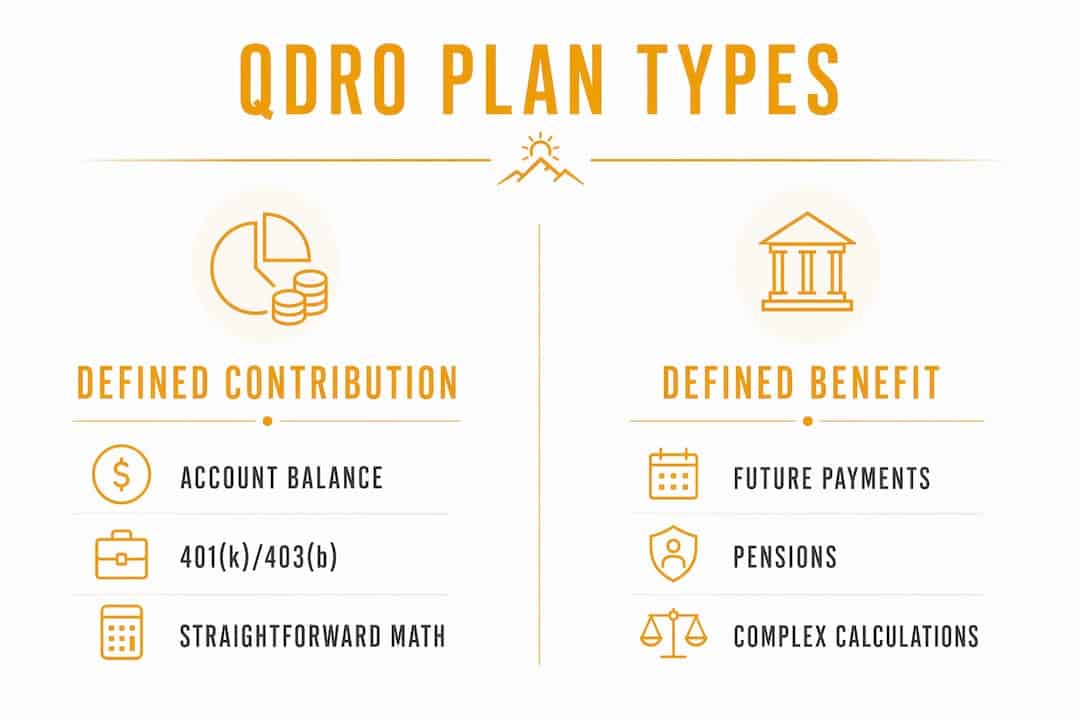
Pensions are harder. The benefit is a future monthly payment, not a current balance, so the QDRO must choose between a separate-interest approach (alternate payee gets their own independent benefit, payable when they reach retirement age) or a shared-payment approach (alternate payee receives a portion of each payment the participant receives, starting when the participant retires). The separate-interest method gives the alternate payee more control but requires actuarial translation.
IRAs
No QDRO needed. A properly worded decree or a qualified domestic relations transfer instruction is enough. The custodian will move the funds to a new IRA in the alternate payee’s name without triggering taxes, provided it is done as a direct transfer.
Arizona State Retirement System (ASRS)
ASRS has its own rules. ASRS will accept a full divorce decree if it contains all the information a DRO would include — marital dates, value on the date of service, and payment instructions. If the decree is missing any of those elements, ASRS requires a separate certified DRO. Contact ASRS directly before finalizing any language.
Survivor benefit language is not optional for pensions. If the QDRO does not explicitly preserve the alternate payee’s right to a survivor benefit, that right is gone the moment the participant dies. This is one of the most expensive omissions in QDRO drafting.
How military retirement is treated in Arizona divorces

Military retirement is governed by the Uniformed Services Former Spouses’ Protection Act (USFSPA), not ERISA. That means no QDRO. Instead, the court issues a division order, and the Defense Finance and Accounting Service (DFAS) handles payment.
The 10/10 rule is the threshold most former spouses need to clear for DFAS to pay them directly. It requires:
- At least 10 years of marriage
- Overlapping with at least 10 years of creditable military service
If those conditions are met, DFAS will send the former spouse’s share directly to them. If not, the court can still award a portion of the retirement, but the former spouse must collect from the service member directly — DFAS will not cut a separate check.
Disposable retired pay is the base for any division. It is the gross retired pay minus certain deductions (disability pay, survivor benefit plan premiums, etc.). Courts award a percentage of disposable retired pay, not gross pay, so the actual dollar amount can shift over time as deductions change.
Steps for a former military spouse:
- Obtain the service member’s DD-214 (Certificate of Release or Discharge from Active Duty)
- Document the marriage dates and the period of overlapping military service
- Contact DFAS for their specific division order requirements and forms
- Confirm whether the service member has elected or is eligible for the Survivor Benefit Plan (SBP) — and whether the court order addresses it
Pro Tip: Request DFAS’s current division order checklist early. Their requirements change periodically, and submitting an outdated form format is a common, avoidable delay.
How courts and administrators calculate the alternate payee’s share
Defined contribution accounts (401(k), 403(b))
The community portion is the account balance attributable to contributions and earnings during the marriage, measured to the petition service date. A typical award looks like this:
Example: The 401(k) had a balance of $120,000 on the date the petition was served. Of that, $80,000 was accumulated during the marriage. The decree awards the spouse 50% of the marital portion, so the QDRO directs the plan to transfer $40,000 to the alternate payee’s account.
The QDRO must state clearly whether the alternate payee’s share includes or excludes investment gains and losses between the valuation date and the actual distribution date. If it does not specify, market movement between those two dates can change what the alternate payee actually receives.
Loan balances add another layer. If the participant has an outstanding loan against the 401(k), the QDRO should state whether the loan reduces the alternate payee’s share or only the participant’s share.
Defined benefit pensions
The standard approach is the coverture formula:
Example: Participant worked 25 years total. The marriage overlapped with 15 of those years. The court awards the spouse 50% of the marital share.
Marital share = (15 ÷ 25) × 50% = 30% of the total pension benefit.
For pensions, an actuary is often needed to translate that percentage into a dollar-equivalent present value, especially when the parties want to offset the pension against other assets rather than divide it directly.
Pro Tip: For pensions, always confirm whether the plan uses a “final average salary” or “career average salary” formula — it affects how the coverture fraction translates into actual dollars at retirement.
Step-by-step QDRO process and typical timeline in Arizona
The six steps
- Identify the plan and request model language. Contact the plan administrator, confirm the plan’s formal legal name, and ask for their QDRO procedures, model order, and any processing fees.
- Draft the QDRO. Use the plan’s template as the starting point. An attorney should handle this — generic online templates frequently fail plan-specific formatting requirements.
- Submit the draft for plan pre-approval. Pre-approval catches errors before filing; a signed order that does not match the plan-approved draft risks rejection, new filings, and additional fees.
- File with the court and obtain the judge’s signature. Once the plan approves the draft, file it with the Arizona Superior Court and get the judge’s signature on the final order.
- Submit the certified order to the plan. Send a certified copy of the signed QDRO to the plan administrator. Most plans will segregate the alternate payee’s funds at this point while they complete their review.
- Plan qualification and distribution. The plan formally qualifies the order, notifies both parties, and processes the distribution or rollover.
Realistic timelines
- Plan pre-approval: 2–8 weeks, depending on the plan’s workload and how clean the draft is
- Court filing and signature: 2–6 weeks after the decree is entered (varies by county and judge availability)
- Plan qualification after submission: 18 months is the maximum review period under federal law; most plans act within 60–90 days
- Segregation of funds: Often happens during the review period; distribution follows qualification
Documents to gather
- Most recent account statement (showing balance and loan balances)
- Plan’s Summary Plan Description (SPD)
- Participant’s full name, address, and Social Security number
- Alternate payee’s full name, address, and Social Security number
- Marriage date and petition service date
- Divorce decree (once entered)
- For pensions: benefit election forms, any prior QDRO on the same account
Understanding how long Arizona divorces take helps set realistic expectations for when QDRO filing fits into the overall timeline.
Who pays taxes and fees, and how to avoid surprises
Tax rules for QDRO distributions
When an alternate payee receives a distribution directly from a qualified plan under a QDRO, the alternate payee — not the participant — owes income tax on that distribution. The 10% early withdrawal penalty is waived for QDRO distributions, which is one of the few tax advantages of this process.
The smarter move for most alternate payees is a direct rollover to their own IRA or eligible retirement plan. A rollover defers all taxes until the alternate payee takes distributions in retirement. Taking the cash now means paying ordinary income tax on the full amount in the year of distribution.
Fees
QDRO drafting fees typically range from about $500 to $1,500 for straightforward cases. Plan administrators often charge their own processing fees, commonly in the $300–$500 range. Complex cases — multiple plans, pension actuarial work, military retirement — cost more.
In Arizona divorce settlements, the parties can allocate these costs however they agree. Common approaches include splitting fees equally, assigning them to the party who holds the account, or rolling them into the overall settlement. Whatever the agreement, put the fee-allocation language in the decree itself so there is no dispute later.
Pro Tip: If you have a choice between taking a QDRO distribution as cash or rolling it into your own IRA, run the numbers with a tax professional first. The tax hit on a large lump-sum distribution can easily exceed the cost of a rollover.
How to prepare for your QDRO conversation with an attorney or plan administrator
Going into a consultation without the right documents wastes time and money. Here is what to bring and what to ask.
Documents to bring
- Most recent account statement for every retirement account at issue
- Plan’s Summary Plan Description (SPD) — request it from the plan administrator if you do not have it
- A copy of the divorce petition (showing the service date)
- The proposed or final divorce decree
- Beneficiary designation forms on file with the plan
- For military retirement: DD-214, marriage certificate, and any prior court orders affecting the retirement
- Both parties’ Social Security numbers and current addresses
Questions to ask the plan administrator
- Do you have a model QDRO or required format?
- What is your pre-approval process and typical turnaround time?
- What are your processing fees?
- What information do you need from the alternate payee to set up a separate account?
- Does the plan allow separate-interest division, or only shared-payment?
Questions to ask your attorney
- Have you drafted QDROs for this specific type of plan before?
- Will you submit the draft for plan pre-approval before we file with the court?
- How do you handle the valuation date for community property purposes?
- What happens if the plan rejects the order after the judge signs it?
Red flags to watch for
- Decree language that awards “a portion” of the retirement without specifying a percentage or dollar amount
- Missing the plan’s formal legal name (many large employers have multiple plans with similar names)
- No defined valuation date
- Failure to address survivor benefits for pensions
- Ambiguous loan-balance treatment
Reviewing common divorce mistakes before your consultation can help you spot these issues before they become expensive problems.
Why hire an experienced Arizona family law attorney for your QDRO
Generic online QDRO templates carry real risk. Plan administrators require model language and strict formatting; a template that works for one plan will be rejected by another. An attorney who has drafted QDROs for Arizona courts and specific plan administrators knows what each plan’s reviewers look for.
The stakes of getting it wrong are not just a rejected order. A poorly drafted QDRO can result in:
- Loss of survivor benefits that cannot be reinstated after the participant’s death
- Unexpected tax liability from a distribution that should have been a rollover
- Delays of months while the plan and court process corrections
- Loss of the alternate payee’s entire share if the participant retires, rolls funds, or dies before the order is qualified
What Highdesertfamilylawgroup provides for QDRO cases:
- QDRO drafting tailored to the specific plan’s requirements
- Coordination with plan administrators through the pre-approval process
- Referrals to actuarial professionals for pension valuation when needed
- Court filing and enforcement of the signed order
- Guidance on rollover options and post-qualification steps
Highdesertfamilylawgroup brings over 20 years of Arizona family law experience to retirement division cases, with a focus on protecting clients’ financial interests through every stage of the Arizona divorce process. The firm’s approach centers on clear communication about financial goals — which matters especially when retirement assets are the largest marital asset on the table.
To schedule a consultation, contact Highdesertfamilylawgroup directly through their website. Bring your account statements, the SPD, and any draft decree language that addresses retirement assets.
Key Takeaways
A QDRO is mandatory for ERISA-covered retirement plans in Arizona — the divorce decree alone does not compel the plan administrator to pay the alternate payee, and acting promptly after the decree is entered protects against permanent loss of benefits.
| Point | Details |
|---|---|
| QDRO is required for ERISA plans | A decree alone does not bind plan administrators; a separate QDRO must be submitted and qualified. |
| Pre-approval prevents rejection | Submit a draft to the plan administrator before filing with the court to catch errors early. |
| Valuation date affects your share | Arizona community property runs to the petition service date; specify this clearly in the QDRO. |
| Pensions and military plans need special handling | Use the coverture formula for pensions; military retirement follows USFSPA rules, not ERISA. |
| Highdesertfamilylawgroup | The firm handles QDRO drafting, plan administrator coordination, and court filing for Arizona divorces. |
What I see go wrong — and how to avoid it
Most QDRO problems I see in Arizona family law cases share a common thread: people treat the divorce decree as the finish line when it is really just the starting gun for the retirement division process.
The most expensive mistake is waiting. A client finalizes their decree, assumes the retirement account will sort itself out, and six months later discovers the participant has changed jobs, rolled the 401(k) to an IRA, or — in the worst cases — died. At that point, options narrow dramatically. The alternate payee’s share may be gone entirely.
The second most common problem is decree language that is too vague to qualify. Phrases like “wife shall receive her fair share of husband’s retirement” sound reasonable in a settlement negotiation but are legally meaningless to a plan administrator. The plan needs a percentage, a valuation date, and a clear statement of what happens to gains and losses after that date. Ambiguity does not get resolved in the alternate payee’s favor.
What actually works is straightforward: get the plan’s model order before drafting anything, submit the draft for pre-approval, and file the QDRO as soon as the decree is entered. That sequence, done correctly, protects survivor benefits, avoids tax surprises, and keeps the timeline from stretching into years. It is not complicated. It just requires knowing the steps and following them in order.
Highdesertfamilylawgroup handles the QDRO process for you
Retirement division is where Arizona divorces get technically complicated fast. Highdesertfamilylawgroup works directly with plan administrators so you do not have to navigate model orders, pre-approval timelines, and court filings on your own. The firm’s QDRO services cover the full process:
- QDRO drafting matched to your specific plan’s requirements
- Plan administrator communication and pre-approval coordination
- Pension actuarial referrals for defined benefit cases
- Court filing and enforcement of the qualified order
- Rollover guidance after qualification

Understanding what a family lawyer does in a retirement division case can help you decide whether you need full representation or targeted QDRO assistance. Either way, the first step is a consultation. Contact Highdesertfamilylawgroup at highdesertfamilylawgroup.com to schedule yours. Bring your account statements and any draft decree language — the firm can review both and tell you exactly where you stand.
Authoritative sources and plan administrator guidance
Use these primary resources to verify plan-specific rules and confirm current procedures before filing:
- Arizona State Retirement System (ASRS) — Divorce FAQs: ASRS-specific DRO requirements, what the decree must contain, and how to submit a certified DRO if needed.
- U.S. Department of Labor — QDRO FAQ: Federal rules governing QDROs, participant and alternate payee rights, and plan administrator obligations under ERISA.
- DOL — QDROs: The Division of Retirement Benefits Through Qualified Domestic Relations Orders: The DOL’s comprehensive publication on QDRO requirements, plan types, and the qualification process.
- IRS Publication 504 — Divorced or Separated Individuals: Tax treatment of QDRO distributions, rollover rules, and how QDROs interact with IRA transfers.
- LegalClarity — How to Get a QDRO in Arizona: Practical Arizona-specific guidance on the QDRO process, pre-approval steps, and common rejection causes.
- Highdesertfamilylawgroup — Contact and Consultation: Schedule a consultation with an Arizona family law attorney to review your specific plan and decree language.
First step: Contact your plan administrator and request their QDRO procedures and any model order before any drafting begins. Every plan has different requirements, and starting from the plan’s own template is the single most effective way to avoid rejection.
This article provides general information about QDROs in Arizona and is not legal advice. Retirement division rules vary by plan and individual circumstance. Consult a qualified Arizona family law attorney and your plan administrator to confirm the rules that apply to your specific situation.