



Finding the right postnup agreement lawyer could be one of the most important financial decisions you make as a married couple. Whether your circumstances have changed since your wedding day, a business has entered the picture, or you simply want clarity around your assets, a postnuptial agreement gives you and your spouse a legally binding plan — on your own terms.
Here’s what you need to know right away:
- A postnuptial agreement is a written contract signed after marriage that outlines how assets, debts, and spousal support will be handled if the marriage ends
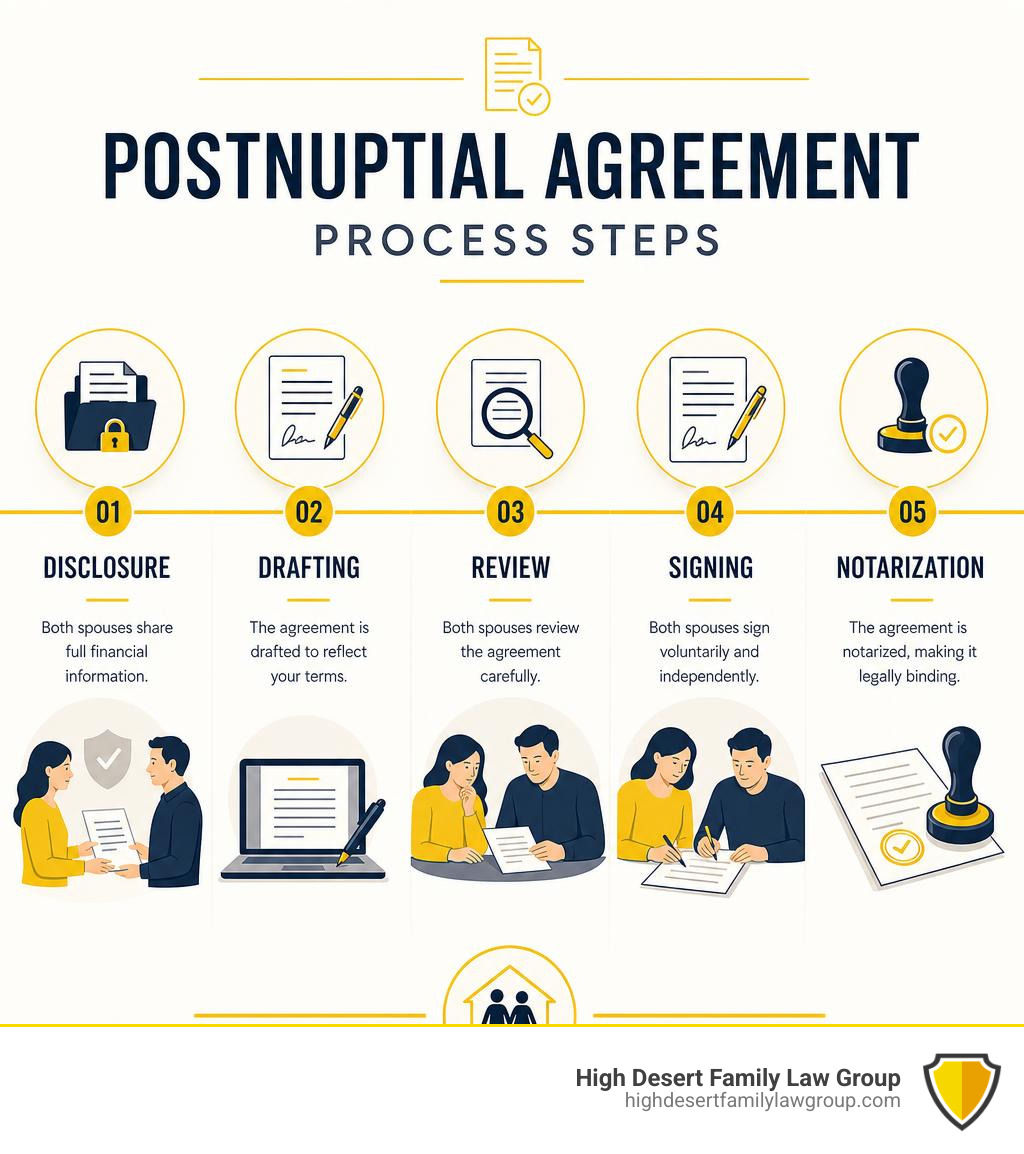
- It requires full financial disclosure, voluntary consent, and ideally independent legal counsel for each spouse
- It cannot address child custody or child support — courts decide those based on the child’s best interests
- Without one, your state’s default laws (community property in Arizona) will control how everything is divided
- Costs typically range from $1,500 to $10,000+ depending on complexity
- The process usually takes 2 weeks to 3 months from start to signed agreement
Without a postnuptial agreement, you’re leaving major financial decisions to a judge who doesn’t know your family, your business, or your priorities.
Understanding Postnuptial Agreements vs. Prenuptial Agreements
Many couples assume that if they didn’t sign a prenuptial agreement before walking down the aisle, the window of opportunity for financial planning has closed. Fortunately, that is not the case. A postnuptial agreement serves a very similar purpose to a prenup, but it is executed after the marriage is already legally established.

The primary difference between the two is timing, but that single difference completely changes how courts view and analyze the contracts. When you are engaged, you are considered two separate individuals entering into a contract. Once you say “I do,” you owe each other a fiduciary duty—a high legal standard of honesty and fair dealing. As a result, courts scrutinize postnuptial agreements much more strictly than prenups.
Both agreements allow you to define what counts as separate property and what counts as community (or marital) property. They can also outline spousal support (alimony) terms. However, neither agreement can legally bind a court regarding child custody or child support. Under Arizona law, those decisions must always be made based on the child’s best interests at the time of a split.
To understand which option fits your situation, check out our guide on prenup vs postnup and weigh the prenup pros and cons.
To make this simple, let’s break down the differences in a quick table:
| Feature | Prenuptial Agreement | Postnuptial Agreement |
|---|---|---|
| Timing | Signed before the wedding | Signed after the marriage has begun |
| Court Scrutiny | Standard contract scrutiny | Heightened scrutiny due to fiduciary duties |
| Property Division | Defines future asset division | Reclassifies current and future assets |
| Child Custody & Support | Cannot predetermine | Cannot predetermine |
| Common Trigger | Approaching wedding date | Business launch, inheritance, or financial shift |
If you are exploring your options in Chandler or Tempe, consulting with a qualified local family law attorney can help you understand how these distinct marital documents apply to your specific situation.
Why You Need a Specialized Postnup Agreement Lawyer
You wouldn’t ask a cardiologist to fix a broken leg, and you shouldn’t ask a general practice lawyer to draft a postnuptial agreement. Marital contracts require highly specialized family law expertise. Because of the fiduciary duties spouses owe each other during marriage, a poorly drafted postnup is essentially just an expensive piece of scratch paper that a judge will throw out during a divorce.
When you work with a specialized postnup agreement lawyer, you are protecting your future. A family law attorney knows how to structure the agreement so that it respects state-specific statutes while meeting your unique family goals. For a deeper dive into how these contracts work in our state, explore our detailed resource on postnuptial agreements in Arizona and browse our Category: Postnuptial Agreement library.
Working with local family law professionals ensures that your agreement aligns with local court expectations and Arizona case law.
How a Postnup Agreement Lawyer Protects Your Business and Separate Assets
One of the most common reasons couples seek a postnuptial agreement is to protect a business. If you started a business before marriage, you might assume it is automatically safe. However, if the business grew in value during your marriage, or if you used community funds (like your marital salary) to keep the business running, the community may have built up an equitable interest in that business.
Without a clear agreement, your spouse could be entitled to half the value of that business’s growth if you divorce. A postnup can:
- Designate the business and all its future appreciation as your sole and separate property.
- Prevent “commingling”—which happens when separate and marital assets are mixed together.
- Prevent “transmutation”—where separate property accidentally becomes community property (for example, by depositing an inheritance into a joint bank account).
By laying these rules out clearly, you protect your professional practice, your partners, and your employees from the chaos of a personal divorce.
What to Look for When Hiring a Postnup Agreement Lawyer
When you are ready to find a lawyer, don’t just click the first name that pops up on a search engine. You need an attorney who specializes in family law, understands asset valuation, and has a track record of drafting agreements that survive court challenges.
Look for these key qualities:
- Local Court Experience: Family law is highly localized. A lawyer who practices daily in Scottsdale and Chandler knows how local judges interpret agreements.
- Deep Financial Literacy: Your lawyer must understand complex assets, from stock options and retirement accounts to real estate and business valuations.
- A Collaborative but Firm Approach: A postnup shouldn’t feel like a declaration of war. You want an attorney who can negotiate terms warmly and professionally, keeping your marriage intact while protecting your interests.
For step-by-step guidance on your search, read our guide on How to Find a Postnuptial Agreement Lawyer Near You.
Legal Requirements and Enforceability Across Different States
Are postnuptial agreements actually enforceable? Yes-but only if they are drafted perfectly. Because courts look at postnups with a skeptical eye, there are strict legal requirements that must be met for the contract to hold up in court.

At a minimum, every valid postnuptial agreement must meet these four criteria:
- Written and Signed: Oral agreements are completely unenforceable.
- Voluntary Execution: Neither spouse can be forced, threatened, or pressured into signing.
- Full and Fair Financial Disclosure: Both spouses must provide a complete, honest list of all assets, debts, income, and liabilities. Hiding an asset is the fastest way to get your agreement thrown in the trash by a judge.
- Fair and Conscientious Terms: The agreement cannot be “unconscionable” (grossly unfair) at the time of signing or enforcement.
To understand the legal hurdles and how judges evaluate these contracts, read our article: Are Postnuptial Agreements Enforceable. For general statutory context on Arizona family law, you can also review the Arizona Legislature’s public version of Arizona Revised Statutes Title 25.
Community Property vs. Equitable Distribution States
The state you live in heavily influences how your assets are divided by default, which in turn dictates how your postnuptial agreement must be drafted.
- Community Property States: In states like Arizona, Texas, and California, all assets and debts acquired during the marriage are considered jointly owned. In a divorce, community property is split 50/50. A postnuptial agreement in these states is often used to “transmute” community property back into separate property.
- Equitable Distribution States: In the majority of states, assets are divided “equitably” (fairly but not necessarily equally). A postnup in these states helps define exactly what “fair” means to you, rather than leaving it up to a judge’s discretion.
State-Specific Rules: California, Texas, New York, Florida, Minnesota, and Illinois
If you own property in multiple states or have recently moved, it is helpful to see how other states handle these agreements:
- California: Governed strictly by California Family Code 72721. Because of the high fiduciary duty between spouses, California courts apply intense scrutiny. It is virtually impossible to waive spousal support without both parties having independent legal counsel.
- Texas: As a community property state, Texas allows couples to partition or exchange community property into separate property, but the agreement must be entirely voluntary and backed by clear disclosures.
- New York: Under New York law, postnuptial agreements must be signed and acknowledged with the same formalities required to record a deed. Technical defects in this acknowledgment can invalidate the entire agreement.
- Florida: Florida courts require postnuptial agreements to be signed by both parties in the presence of two witnesses and a notary.
- Minnesota: Minnesota has strict statutory requirements. Under Minnesota law, a postnuptial agreement is only valid if both spouses are represented by independent legal counsel at the time of signing.
- Illinois: Illinois courts generally respect postnuptial agreements regarding property division and maintenance, provided there is valid consideration and no duress.
To find out how Arizona’s specific rules apply to your marriage, you can Schedule a consultation for postnuptial agreements with our team.
Common Pitfalls, Costs, and Timelines of Postnuptial Agreements
Creating a postnuptial agreement is a process that requires careful planning. If you rush it, you risk falling into common legal traps that make the agreement useless.
Common Pitfalls to Avoid:
- Coercion or Duress: Presenting an agreement during a marital crisis and threatening divorce if it isn’t signed can be viewed as duress.
- Incomplete Disclosure: Forgetting to list a retirement account or undervalued business asset can invalidate the entire contract.
- No Independent Counsel: If only one lawyer drafts the agreement and both spouses sign it without independent review, a judge may rule that the unrepresented spouse did not understand what they were signing.
What Does a Postnup Cost?
The cost of a postnuptial agreement varies widely depending on the complexity of your financial life. Simple agreements with transparent assets may be handled on a flat-fee basis, while complex estates involving businesses, trusts, and out-of-state properties are typically billed hourly.
To help you plan financially, we have compiled comprehensive cost breakdowns. Learn more by reading about the Postnuptial Agreement Cost, reviewing general details on the Cost of Postnuptial Agreement, or checking out the basic Postnup Cost. You can also compare historical pricing trends in our guides on Postnuptial Agreement Costs 2023 and Postnuptial Agreement Costs 2025.
What is the Timeline?
A standard postnuptial agreement takes about 2 to 6 weeks to draft, negotiate, and execute. If there are complex business assets or disagreements over terms, it can take 2 to 3 months.
It is always better to take your time and do it right than to rush a document that won’t hold up when you need it. To understand how a postnup compares to other legal paths, read our comparison on Postnuptial Agreement vs Divorce.
Frequently Asked Questions About Postnuptial Agreements
Can you create a postnuptial agreement without a lawyer?
Technically, yes, you can download a template online and sign it. However, doing so is incredibly risky. Because courts apply heightened scrutiny to postnuptial agreements, a self-drafted contract is highly likely to be invalidated during a divorce.
Without professional guidance, you may fail to meet state disclosure laws or accidentally use language that a judge finds unconscionable. For more details on the risks of self-drafting, read Can You Do a Postnuptial Agreement Without a Lawyer and How to Get a Postnuptial Agreement Without a Lawyer.
Can a postnuptial agreement address child support or custody?
No. Under family law standards in Arizona and across the country, parents cannot contract away their children’s rights. Courts retain absolute jurisdiction over child custody and child support. Any clause in a postnup that attempts to limit child support or predetermine legal decision-making (custody) will be ignored by a judge.
How often should a postnuptial agreement be updated?
We recommend reviewing your postnuptial agreement every 3 to 5 years, or immediately following a major life event. Significant changes that warrant an update include:
- The birth or adoption of a child
- A substantial financial windfall (like a large inheritance or business sale)
- Moving to a new state with different property laws
- Starting a new business or acquiring significant real estate
Conclusion
A postnuptial agreement is not about planning for your marriage to fail; it is about taking control of your financial future together. By removing financial ambiguity, many couples find that a postnup actually reduces marital stress and strengthens their relationship.
At High Desert Family Law Group, we provide dedicated, individualized representation for clients throughout Scottsdale, Chandler, and the Greater Phoenix area. Our four-person team works collaboratively to craft custom agreements that protect your business, your separate assets, and your peace of mind.
If you are ready to protect what you have built, Schedule a consultation for postnuptial agreements with our experienced legal team today.