



A post nuptial contract is a written legal agreement made by two people after they are already married. It spells out how property, debts, and financial matters will be handled if the marriage ends in divorce or death.
Quick answer for couples researching post-nuptial contracts:
- What it is: A legally binding contract signed by spouses during marriage
- What it covers: Property division, spousal support, debt allocation, and inheritance rights
- What it cannot cover: Child custody or child support (courts decide these separately)
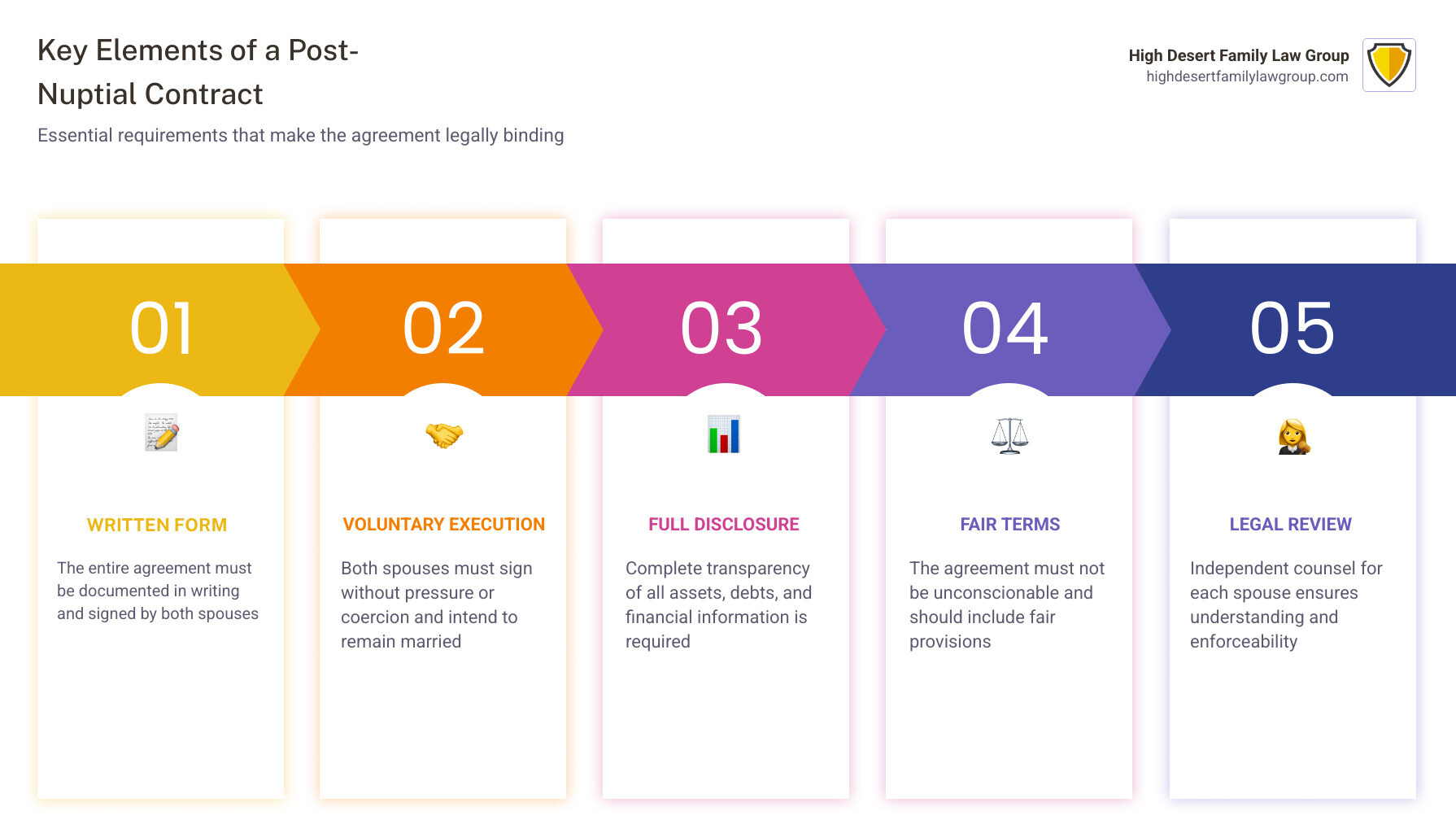
- Key requirements: Must be in writing, signed voluntarily by both spouses, with full financial disclosure, and fair terms
- When to sign: Any time during the marriage, as long as both spouses intend to remain married
These agreements were rarely recognized in U.S. courts before the 1970s. Back then, the law treated a husband and wife as a single legal entity — meaning a contract between spouses had no standing. That changed as divorce rates rose and no-fault divorce laws spread across the country. Today, post-nuptial contracts are valid and enforceable in all 50 states, though the specific requirements vary by state.
For many couples, a post-nuptial agreement is not a sign that the marriage is failing. It is a practical tool for financial clarity — especially when life changes like a new business, an inheritance, or a career shift create new questions about money and ownership.
Understanding the Post Nuptial Contract

At its core, a Postnuptial agreement is a proactive financial roadmap. While the term might sound clinical, it is essentially a way for a couple to say, “We love each other, and because we do, we want to make sure our financial expectations are clear so money never becomes a source of resentment.”
In the modern era of no-fault divorce, courts generally allow couples to override state default laws regarding marital assets through these contracts. Without a contract, Arizona’s community property laws dictate that almost everything acquired during the marriage belongs to both spouses equally. A post nuptial contract allows you to customize those rules to fit your specific life.
It is important to understand the difference between a Postnuptial Agreement vs Divorce. A divorce filing is the end of a legal partnership, whereas a post-nuptial agreement is a tool used within a marriage to strengthen its foundation by removing financial ambiguity.
How a Post Nuptial Contract Differs from a Prenup
The most obvious difference is timing: a prenuptial agreement is signed before the wedding, while a post nuptial contract is signed any time after the “I dos.” However, the legal distinction goes much deeper than just the date on the paper.
When you sign a prenup, you are two individuals entering a contract. Once you are married, you owe each other a “fiduciary duty.” This is a high legal standard that requires spouses to act in the highest good faith and fair dealing toward one another. Because of this existing legal obligation, courts often apply a much higher level of scrutiny to post-nuptial agreements than they do to prenups. You can learn more about these nuances in this guide on Prenup vs. Postnup: Pros, Cons, and What You Need to Know.
Key Elements of a Valid Post Nuptial Contract
For a post nuptial contract to hold up in an Arizona court, it must meet several strict criteria. It isn’t enough to just scribble some notes on a napkin and sign it.
- Written Form: Oral promises are essentially worthless in this arena. The agreement must be a formal written document.
- Voluntary Execution: Both spouses must sign the document of their own free will. If there is any hint of coercion, duress, or “sign this or I’m leaving,” a judge will likely toss the agreement out.
- Full Financial Disclosure: You cannot hide the “secret” Bitcoin stash or the offshore account. Both parties must provide a complete and honest picture of their assets and debts.
- Fairness: The agreement cannot be “unconscionable.” If the terms are so one-sided that they leave one spouse destitute while the other lives in luxury, the court will intervene.
When considering the Postnuptial Agreement Cost 2025, it is helpful to view it as an investment in your peace of mind. While costs vary based on the complexity of your assets, having a professionally drafted document is far cheaper than a contested divorce.
Why Couples Choose to Create Post-Nuptial Agreements

Life doesn’t stand still after the wedding. We often see couples in Scottsdale and Chandler who didn’t feel the need for a prenup but found that their circumstances changed significantly five or ten years into the marriage.
Common reasons for seeking Postnuptial Agreements include:
- Inheritance Protection: If one spouse receives a large inheritance, they may want to ensure it remains separate property even if it is used to benefit the family.
- Business Interests: If a spouse starts a business during the marriage, a post-nup can protect that business from being dismantled or divided in a potential divorce.
- Debt Allocation: If one spouse decides to go back to medical school or starts a high-risk venture, a contract can ensure the other spouse isn’t on the hook for those specific debts.
Using a Post Nuptial Contract for Reconciliation
Sometimes, a marriage hits a rocky patch. Whether due to infidelity or a breach of financial trust, some couples use a post nuptial contract as a tool for reconciliation. By pre-determining a fair settlement, the “wronged” spouse may feel secure enough to move forward and work on the relationship without the fear of being left with nothing if the reconciliation fails. It acts as a safety net that allows the couple to focus on emotional healing. You can find more on this in our Postnuptial Agreement category.
Protecting Stay-at-Home Parents and Blended Families
Modern families come in all shapes and sizes. For a spouse who leaves the workforce to raise children, a post-nup can provide a “catch-up” provision or guaranteed spousal support to acknowledge their non-monetary contribution to the household.
In blended families, these contracts are vital for ensuring that children from previous relationships are protected. A post-nup can clarify which assets are intended for the children’s inheritance versus which belong to the surviving spouse. This level of detail is a hallmark of What Is a Postnuptial Agreement? How It Works and What’s Included.
Legal Requirements and Enforceability Standards
Because spouses have a fiduciary relationship, the “vulnerability factor” is higher. Courts want to make sure no one was bullied into signing away their rights.
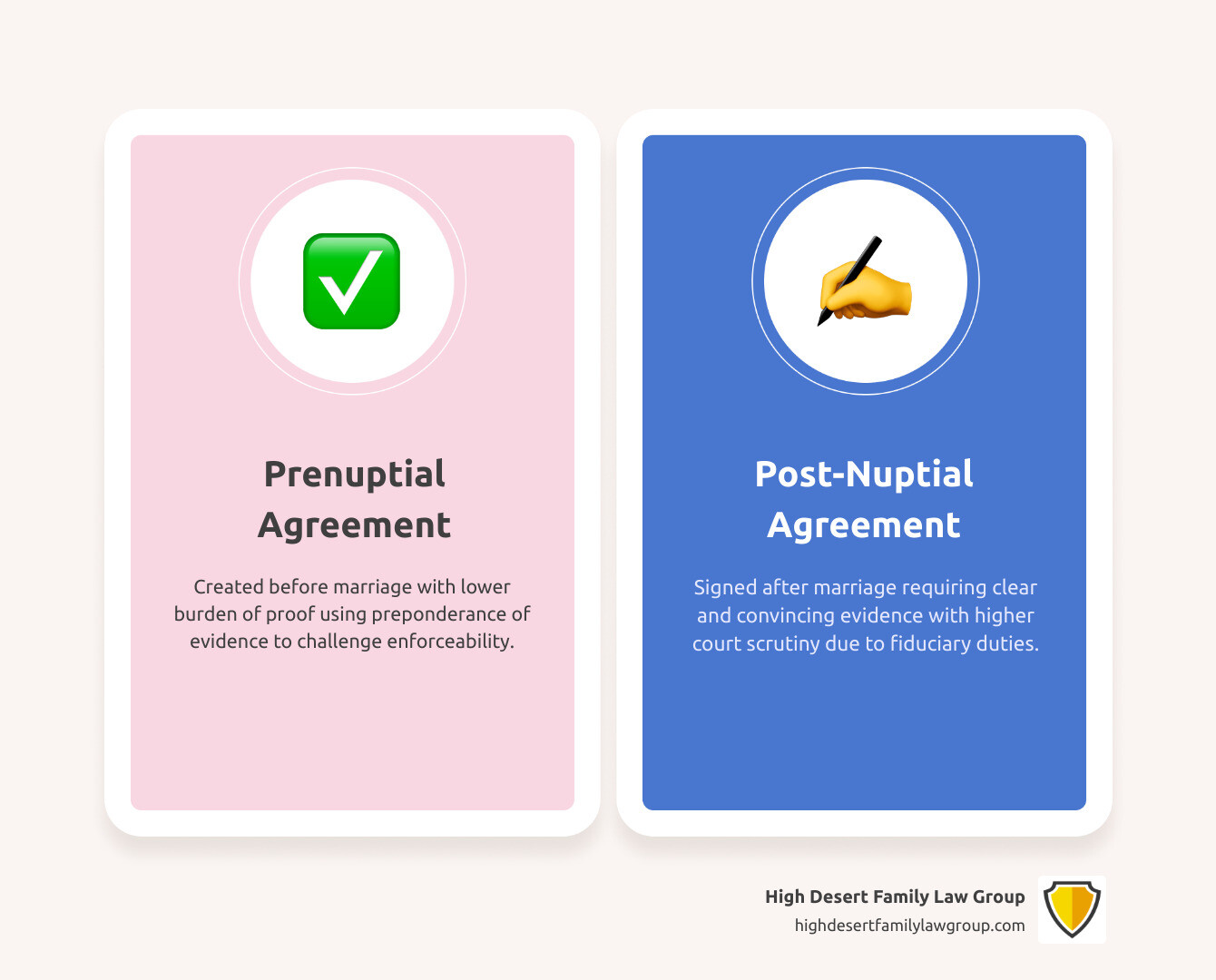
| Feature | Prenuptial Agreement | Post-Nuptial Agreement |
|---|---|---|
| Timing | Before Marriage | After Marriage |
| Burden of Proof | On the party challenging it | On the party seeking enforcement |
| Standard of Proof | Preponderance of evidence | Clear and convincing evidence |
| Consideration | The marriage itself | New “consideration” (often required) |
| Court Scrutiny | Moderate | Very High |
In Arizona, the party trying to enforce a post nuptial contract often bears the burden of proving it is fair. This is a significant shift from prenups, where the person trying to break the agreement usually has the harder job. Understanding the Postnup Cost involves recognizing that the legal work required to meet these higher standards is more intensive.
The Necessity of Independent Legal Counsel
We cannot stress this enough: Both spouses should have their own, independent attorney. If one lawyer drafts the agreement and the other spouse just signs it without having their own counsel review it, that agreement is on very shaky ground. Independent counsel ensures that bargaining power is balanced and that both parties fully understand what they are waiving. This is a key factor in the overall Postnuptial Agreement Cost.
Challenging or Modifying an Existing Agreement
A post nuptial contract isn’t necessarily set in stone forever, but changing it isn’t as simple as crossing out a line. To modify or revoke an agreement, both spouses must usually sign a new written document with the same formalities as the original.
Common grounds for challenging an agreement include:
- Fraud: One spouse lied about their assets.
- Coercion/Duress: One spouse was forced to sign.
- Unconscionability: The agreement was fundamentally unfair at the time it was signed.
- Changed Circumstances: In some cases, if the enforcement of the agreement would leave a spouse on public assistance due to unforeseen changes (like a disability), a court may refuse to enforce it.
State-Specific Variations in Nuptial Law
While we are discussing the general concept, the law that matters most is the law of the state where you live. For our clients in the Greater Scottsdale and Chandler areas, Arizona law is the gold standard.
Arizona is a community property state. This means the baseline is a 50/50 split of all assets and debts acquired during the marriage. Any Postnuptial Agreement Arizona is essentially an attempt to opt out of that 50/50 default.
Arizona Standards and Court Scrutiny
In Arizona, post-nuptial agreements are recognized, but they are viewed with “close scrutiny.” The courts want to ensure the agreement wasn’t entered into “in contemplation of divorce.” If a judge thinks you only signed the paper because you were already planning to file for divorce the next week, they may treat it as a separation agreement instead, which has different legal standards.
To be enforceable here, you generally need to show by “clear and convincing evidence” that the agreement was fair and equitable. This is a higher bar than the “preponderance of the evidence” standard used in many other civil matters. For a broader look at how these guides function, see the Postnuptial Agreement Guide – Lawble.
Notable Requirements in Other Jurisdictions
While our focus is Arizona, it’s interesting to see how other states handle these:
- Louisiana: Often requires court approval for a post-nup to be valid unless the couple opted out of community property before the marriage.
- New York: Requires the agreement to be executed with the same formality as a property deed.
- North Carolina: Generally allows property division but is very skeptical of alimony waivers in post-nups.
- Connecticut: Established in Bedrick v. Bedrick that agreements must be fair at execution and not unconscionable at the time of divorce.
Frequently Asked Questions about Postnuptial Agreements
Can a postnuptial agreement address child custody or support?
No. This is a common misconception. In Arizona (and virtually every other state), the court retains “ultimate jurisdiction” over children. Parents cannot contract away a child’s right to support, nor can they pre-determine custody. The court will always decide these issues based on the best interests of the child at the time of the split. Any clause in a post nuptial contract attempting to limit child support is typically void and unenforceable.
What issues cannot be included in a postnuptial agreement?
Aside from child-related issues, you generally cannot include:
- Routine Marital Duties: You can’t contractually require your spouse to do the dishes or maintain a certain weight.
- Illegal Acts: Any provision requiring a spouse to do something illegal is void.
- Encouraging Divorce: Provisions that seem to provide a “financial incentive” for divorce can sometimes be challenged on public policy grounds.
Is a postnuptial agreement valid if we didn’t disclose all assets?
Almost certainly not. Full and fair disclosure is the bedrock of a valid contract. If you hide a $500,000 retirement account and your spouse finds out during a later divorce, they can use that non-disclosure to have the entire agreement thrown out. This is why we emphasize honesty during the drafting process, regardless of the Postnuptial Agreement Cost 2023.
Conclusion
A post nuptial contract is a sophisticated tool for the modern couple. It isn’t about planning for failure; it’s about planning for reality. By addressing financial “what-ifs” today, you can protect your business, your inheritance, and your family’s future, allowing you to focus on what really matters: your relationship.
At High Desert Family Law Group, we provide aggressive, individualized representation for clients in Scottsdale, Chandler, and throughout Arizona. Our four-person team understands that every marriage is unique, and we take a tailored approach to ensure your agreement is robust enough to stand up to court scrutiny.
If you are considering a post-nuptial agreement or have questions about how one might work for your specific situation, we are here to help. For More info about postnuptial agreement services, reach out to us to schedule a consultation. Let us help you build a more secure future, together.